
Screening of Antimicrobial Peptides from Duck Farm Soil Metagenomic Sequences Based on Deep Learning and Molecular Dynamics Simulation



Article Information
Abstract
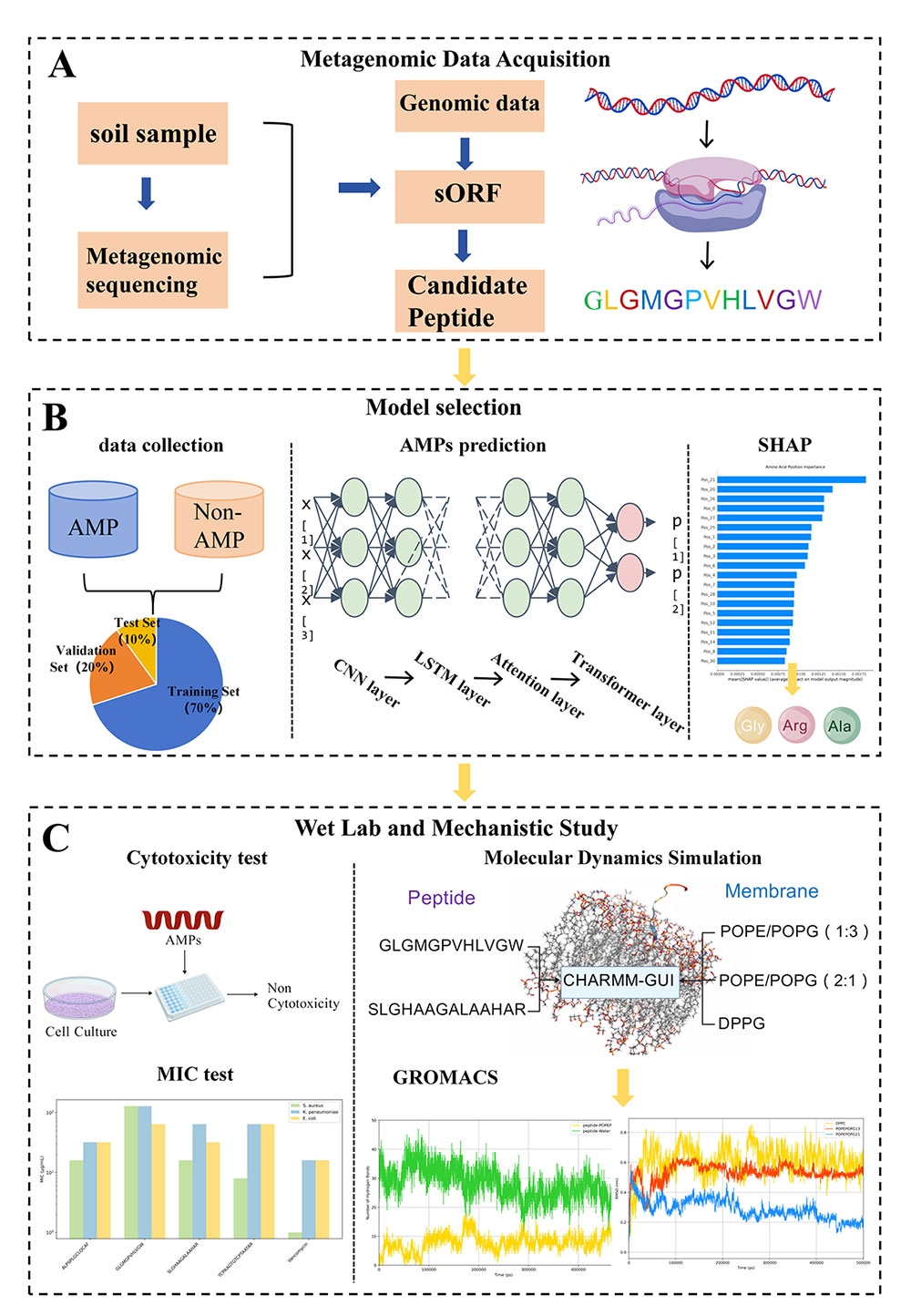
Antimicrobial peptides (AMPs) are promising candidates in the fight against antibiotic resistance. However, traditional screening methods are often complex and costly. Metagenome offers a powerful approach for discovering novel AMPs from environmental samples. In this study, the deep learning model AMP-CLIP was employed to screen for novel AMPs from metagenomes of livestock farm soil and feces, which are rich in microbial diversity. The model achieved a high prediction accuracy of 99%.To enhance model interpretability, SHAP analysis was performed, revealing that amino acids contributing most to antimicrobial activity predictions were predominantly positively charged residues, suggesting that the model captures biologically meaningful features. Based on model scores and additional screening using Hemopred and ToxinPred, four candidate peptides were selected.The chemically synthesized peptides exhibited inhibitory activity against Klebsiella pneumoniae, Escherichia coli, and Staphylococcus aureus. Among them, Peptide 5 (GLGMGPVHLVGW) and Peptide 3 (SLGHAAGALAAHAR) were further analyzed using molecular dynamics (MD) simulations. Peptide–membrane complex systems were constructed with POPE:POPG (1:3) representing Gram-positive bacteria, POPE:POPG (2:1) representing Gram-negative bacteria, and DPPC for mammalian cell membranes. MD simulations revealed that both peptides inserted deeper and bound more stably in bacterial membranes, while exhibiting weaker interactions with mammalian membranes, indicating selective antimicrobial potential targeting bacterial membranes. Given their activity against foodborne pathogens and selective membrane interaction, these peptides hold promise as natural antimicrobial agents for improving food safety and shelf life.
Graphical Abstract
Keywords
Data Availability Statement
Funding
Conflicts of Interest
AI Use Statement
Ethical Approval and Consent to Participate
References
- Cheng, Q., Zeng, P., Chi Chan, E. W., & Chen, S. (2022). Development of Peptide-based Metallo-$\beta$-lactamase Inhibitors as a New Strategy to Combat Antimicrobial Resistance: A Mini-review. Current Pharmaceutical Design, 28(44), 3538–3545.
[CrossRef] [Google Scholar] - Morris, C. F. (2019). The antimicrobial properties of the puroindolines, a review. World Journal of Microbiology and Biotechnology, 35(6), 86.
[CrossRef] [Google Scholar] - Bai, H., He, L. Y., Wu, D. L., Gao, F. Z., Zhang, M., Zou, H. Y., ... & Ying, G. G. (2022). Spread of airborne antibiotic resistance from animal farms to the environment: dispersal pattern and exposure risk. Environment international, 158, 106927.
[CrossRef] [Google Scholar] - Furlan, J. P. R., Lopes, R., Ramos, M. S., Rosa, R. D., Savazzi, E. A., & Stehling, E. G. (2024). The detection of KPC-2, NDM-1, and VIM-2 carbapenemases in international clones isolated from fresh vegetables highlights an emerging food safety issue. International Journal of Food Microbiology, 420, 110765.
[CrossRef] [Google Scholar] - Xu, C., Han, A., Tian, Y., Fu, M., Gao, X., & Liu, H. (2025). Based on computer simulation and experimental verification: mining and characterizing novel antimicrobial peptides from soil microbiome. Food Chemistry, 467, 142275.
[CrossRef] [Google Scholar] - Pashaei, F., Bevalian, P., Akbari, R., & Pooshang Bagheri, K. (2019). Single dose eradication of extensively drug resistant Acinetobacter spp. In a mouse model of burn infection by melittin antimicrobial peptide. Microbial Pathogenesis, 127, 60–69.
[CrossRef] [Google Scholar] - Memariani, H., Shahbazzadeh, D., Ranjbar, R., Behdani, M., Memariani, M., & Pooshang Bagheri, K. (2017). Design and characterization of short hybrid antimicrobial peptides from pEM‐2, mastoparan‐VT 1, and mastoparan‐B. Chemical Biology & Drug Design, 89(3), 327–338.
[CrossRef] [Google Scholar] - Lohner, K. (2009). New strategies for novel antibiotics: peptides targeting bacterial cell membranes. General Physiology and Biophysics, 28(2), 105–116.
[CrossRef] [Google Scholar] - Santos-Júnior, C. D., Pan, S., Zhao, X. M., & Coelho, L. P. (2020). Macrel: antimicrobial peptide screening in genomes and metagenomes. PeerJ, 8, e10555.
[CrossRef] [Google Scholar] - Akbar, S., Raza, A., & Zou, Q. (2024). Deepstacked-AVPs: predicting antiviral peptides using tri-segment evolutionary profile and word embedding based multi-perspective features with deep stacking model. BMC Bioinformatics, 25(1), 102.
[CrossRef] [Google Scholar] - Li, Z. R., Lin, H. H., Han, L. Y., Jiang, L., Chen, X., & Chen, Y. Z. (2006). PROFEAT: a web server for computing structural and physicochemical features of proteins and peptides from amino acid sequence. Nucleic acids research, 34(suppl\_2), W32-W37.
[CrossRef] [Google Scholar] - Waghu, F. H., Barai, R. S., Gurung, P., & Idicula-Thomas, S. (2016). CAMPR3: a database on sequences, structures and signatures of antimicrobial peptides. Nucleic Acids Research, 44(D1), D1094–D1097.
[CrossRef] [Google Scholar] - Li, C., Zou, Q., Jia, C., & Zheng, J. (2024). AMPpred-MFA: An Interpretable Antimicrobial Peptide Predictor with a Stacking Architecture, Multiple Features, and Multihead Attention. Journal of Chemical Information and Modeling, 64(7), 2393–2404.
[CrossRef] [Google Scholar] - Veltri, D., Kamath, U., & Shehu, A. (2018). Deep learning improves antimicrobial peptide recognition. Bioinformatics, 34(16), 2740–2747.
[CrossRef] [Google Scholar] - Lee, H., Lee, S., Lee, I., & Nam, H. (2023). AMP‐BERT: Prediction of antimicrobial peptide function based on a BERT model. Protein Science, 32(1), e4529.
[CrossRef] [Google Scholar] - Yang, S., Yang, Z., & Ni, X. (2023). AMPFinder: A computational model to identify antimicrobial peptides and their functions based on sequence-derived information. Analytical Biochemistry, 673, 115196.
[CrossRef] [Google Scholar] - Teufel, F., Refsgaard, J. C., Madsen, C. T., & Nielsen, H. (2023). DeepPeptide predicts cleaved peptides in proteins using conditional random fields. Bioinformatics, 39(10), btad616.
[CrossRef] [Google Scholar] - Wang, Y., Zhao, T., Wei, D., Strandberg, E., Ulrich, A. S., & Ulmschneider, J. P. (2014). How reliable are molecular dynamics simulations of membrane active antimicrobial peptides? Biochimica et Biophysica Acta (BBA) - Biomembranes, 1838(9), 2280–2288.
[CrossRef] [Google Scholar] - Nguyen, L. T., Haney, E. F., & Vogel, H. J. (2011). The expanding scope of antimicrobial peptide structures and their modes of action. Trends in Biotechnology, 29(9), 464–472.
[CrossRef] [Google Scholar] - Mahmoodzadeh, A., Zarrinnahad, H., Bagheri, K. P., Moradia, A., & Shahbazzadeh, D. (2015). First report on the isolation of melittin from Iranian honey bee venom and evaluation of its toxicity on gastric cancer AGS cells. Journal of the Chinese Medical Association, 78(10), 574–583.
[CrossRef] [Google Scholar] - Harris, F., Dennison, S. R., Singh, J., & Phoenix, D. A. (2013). On the selectivity and efficacy of defense peptides with respect to cancer cells. Medicinal Research Reviews, 33(1), 190–234.
[CrossRef] [Google Scholar] - Navgire, G. S., Goel, N., Sawhney, G., Sharma, M., Kaushik, P., Mohanta, Y. K., ... & Al-Harrasi, A. (2022). Analysis and Interpretation of metagenomics data: an approach. Biological Procedures Online, 24(1), 18.
[CrossRef] [Google Scholar] - Han, A., Liu, H., Dai, Y., Chen, W., & Zhao, C. (2024). Screening of umami peptides from fermented grains by machine learning, molecular docking and molecular dynamics simulation. Food Bioscience, 62, 105536.
[CrossRef] [Google Scholar] - Wang, P., Ge, R., Liu, L., Xiao, X., Li, Y., & Cai, Y. (2017). Multi-label learning for predicting the activities of antimicrobial peptides. Scientific reports, 7(1), 2202.
[CrossRef] [Google Scholar] - Wang, G., Li, X., & Wang, Z. (2016). APD3: the antimicrobial peptide database as a tool for research and education. Nucleic Acids Research, 44(D1), D1087–D1093.
[CrossRef] [Google Scholar] - Kang, X., Dong, F., Shi, C., Liu, S., Sun, J., Chen, J., ... & Zheng, H. (2019). DRAMP 2.0, an updated data repository of antimicrobial peptides. Scientific data, 6(1), 148.
[CrossRef] [Google Scholar] - Wang, B., Lin, P., Zhong, Y., Tan, X., Shen, Y., Huang, Y., ... & Wu, Y. (2025). Explainable deep learning and virtual evolution identifies antimicrobial peptides with activity against multidrug-resistant human pathogens. Nature microbiology, 10(2), 332-347.
[CrossRef] [Google Scholar] - Porto, W. F., Pires, A. S., & Franco, O. L. (2017). Computational tools for exploring sequence databases as a resource for antimicrobial peptides. Biotechnology Advances, 35(3), 337–349.
[CrossRef] [Google Scholar] - Lundberg, S. M., & Lee, S. I. (2017). A unified approach to interpreting model predictions. Advances in neural information processing systems, 30.
[Google Scholar] - Azodi, C. B., Tang, J., & Shiu, S. H. (2020). Opening the black box: interpretable machine learning for geneticists. Trends in genetics, 36(6), 442-455.
[CrossRef] [Google Scholar] - Merrifield, R. B. (1963). Solid Phase Peptide Synthesis. I. The Synthesis of a Tetrapeptide. Journal of the American Chemical Society, 85(14), 2149–2154.
[CrossRef] [Google Scholar] - Micsonai, A., Wien, F., Kernya, L., Lee, Y. H., Goto, Y., Réfrégiers, M., & Kardos, J. (2015). Accurate secondary structure prediction and fold recognition for circular dichroism spectroscopy. Proceedings of the National Academy of Sciences, 112(24), E3095-E3103.
[CrossRef] [Google Scholar] - Domon, B., & Aebersold, R. (2006). Mass Spectrometry and Protein Analysis. Science, 312(5771), 212–217.
[CrossRef] [Google Scholar] - Mohamed, M. F., Abdelkhalek, A., & Seleem, M. N. (2016). Evaluation of short synthetic antimicrobial peptides for treatment of drug-resistant and intracellular Staphylococcus aureus. Scientific Reports, 6(1), 29707.
[CrossRef] [Google Scholar] - Das, P., Sercu, T., Wadhawan, K., Padhi, I., Gehrmann, S., Cipcigan, F., ... & Mojsilovic, A. (2021). Accelerated antimicrobial discovery via deep generative models and molecular dynamics simulations. Nature Biomedical Engineering, 5(6), 613-623.
[CrossRef] [Google Scholar] - Murzyn, K., Róg, T., & Pasenkiewicz-Gierula, M. (2005). Phosphatidylethanolamine-phosphatidylglycerol bilayer as a model of the inner bacterial membrane. Biophysical journal, 88(2), 1091-1103.
[CrossRef] [Google Scholar] - Yusuf, M., Destiarani, W., Firdaus, A. R. R., & Rohman, F. (2022). Residual Interactions of LL-37 with POPC and POPE:POPG Bilayer Model Studied by All-Atom Molecular Dynamics Simulation. International Journal of Molecular Sciences, 23(21), 13413.
[CrossRef] [Google Scholar] - Travkova, O. G., Moehwald, H., & Brezesinski, G. (2017). The interaction of antimicrobial peptides with membranes. Advances in colloid and interface science, 247, 521-532.
[CrossRef] [Google Scholar] - Jo, S., Lim, J. B., Klauda, J. B., & Im, W. (2009). CHARMM-GUI Membrane Builder for Mixed Bilayers and Its Application to Yeast Membranes. Biophysical Journal, 97(1), 50–58.
[CrossRef] [Google Scholar] - Wu, E. L., Cheng, X., Jo, S., Rui, H., Song, K. C., Dávila-Contreras, E. M., & Im, W. (2014). CHARMM-GUI Membrane Builder toward realistic biological membrane simulations. Journal of Computational Chemistry, 35(27), 1997–2004.
[CrossRef] [Google Scholar] - Lee, J., Cheng, X., Swails, J. M., Yeom, M. S., Eastman, P. K., Lemkul, J. A., ... & Im, W. (2016). CHARMM-GUI Input Generator for NAMD, GROMACS, AMBER, OpenMM, and CHARMM/OpenMM Simulations Using the CHARMM36 Additive Force Field. Journal of Chemical Theory and Computation, 12(1), 405-413.
[CrossRef] [Google Scholar] - Venable, R. M., Sodt, A. J., Rogaski, B., Rui, H., Hatcher, E., MacKerell, A. D., ... & Klauda, J. B. (2014). CHARMM all-atom additive force field for sphingomyelin: elucidation of hydrogen bonding and of positive curvature. Biophysical journal, 107(1), 134-145.
[CrossRef] [Google Scholar] - Klauda, J. B., Venable, R. M., Freites, J. A., O’Connor, J. W., Tobias, D. J., Mondragon-Ramirez, C., ... & Pastor, R. W. (2010). Update of the CHARMM all-atom additive force field for lipids: validation on six lipid types. The journal of physical chemistry B, 114(23), 7830-7843.
[CrossRef] [Google Scholar] - Jorgensen, W. L., Chandrasekhar, J., Madura, J. D., Impey, R. W., & Klein, M. L. (1983). Comparison of simple potential functions for simulating liquid water. The Journal of chemical physics, 79(2), 926-935.
[CrossRef] [Google Scholar] - Jorgensen, W. L. (1982). Revised TIPS for simulations of liquid water and aqueous solutions. The Journal of chemical physics, 77(8), 4156-4163.
[CrossRef] [Google Scholar] - Aghazadeh, H., Ganjali Koli, M., Ranjbar, R., & Pooshang Bagheri, K. (2020). Interactions of GF-17 derived from LL-37 antimicrobial peptide with bacterial membranes: a molecular dynamics simulation study. Journal of Computer-Aided Molecular Design, 34(12), 1261-1273.
[CrossRef] [Google Scholar] - Parrinello, M., & Rahman, A. (1980). Crystal structure and pair potentials: A molecular-dynamics study. Physical review letters, 45(14), 1196.
[CrossRef] [Google Scholar] - Hess, B., Bekker, H., Berendsen, H. J., & Fraaije, J. G. (1997). LINCS: A linear constraint solver for molecular simulations. Journal of computational chemistry, 18(12), 1463-1472.
[CrossRef] [Google Scholar] - Hess, B., Kutzner, C., Van Der Spoel, D., & Lindahl, E. (2008). GROMACS 4: algorithms for highly efficient, load-balanced, and scalable molecular simulation. Journal of chemical theory and computation, 4(3), 435-447.
[CrossRef] [Google Scholar] - Chen, C. H., & Lu, T. K. (2020). Development and Challenges of Antimicrobial Peptides for Therapeutic Applications. Antibiotics, 9(1), 24.
[CrossRef] [Google Scholar] - Mei, H., Wang, J., Che, H., Wang, R., & Cai, Y. (2019). The clinical efficacy and safety of vancomycin loading dose: A systematic review and meta-analysis. Medicine, 98(43), e17639.
[CrossRef] [Google Scholar] - Wang, B., Zhang, J., Zhang, Y., & Wang, Y. (2018). The penetration of a charged peptide across a membrane under an external electric field: a coarse-grained molecular dynamics simulation. RSC Advances, 8(72), 41517–41525.
[CrossRef] [Google Scholar] - Stock, P., Monroe, J. I., Utzig, T., Smith, D. J., Shell, M. S., & Valtiner, M. (2017). Unraveling Hydrophobic Interactions at the Molecular Scale Using Force Spectroscopy and Molecular Dynamics Simulations. ACS Nano, 11(3), 2586–2597.
[CrossRef] [Google Scholar] - Kyte, J., & Doolittle, R. F. (1982). A simple method for displaying the hydropathic character of a protein. Journal of molecular biology, 157(1), 105-132.
[CrossRef] [Google Scholar] - Lee, M. T., Hung, W. C., Chen, F. Y., & Huang, H. W. (2008). Mechanism and kinetics of pore formation in membranes by water-soluble amphipathic peptides. Proceedings of the National Academy of Sciences, 105(13), 5087-5092.
[CrossRef] [Google Scholar] - Guerrero, M., Ayala, N., Rafael, D., Andrade, F., Marican, A., Vijayakumar, S., & Durán-Lara, E. F. (2025). Hydrogel-antimicrobial peptide association: A novel and promising strategy to combat resistant infections. Colloids and Surfaces B: Biointerfaces, 247, 114451.
[CrossRef] [Google Scholar]
Cited By (2)
-
Nikola V. Ćurčić, Aleksandar Grubor, Zoran D. Simonović, Bojan Č. Bojanić, Aleksandar S. Đorđević, Boris S. Jevtić. Legal and Economic Ecosystem Transformation Through AI: Innovation Challenges for Human-Centric Development.
Sustainability, 2026 , 18 (21).
[CrossRef] -
Haimeng Li, Han Gao, Jian Tian, Xin Wang, Rui Jiang, Ting Chen, Hui Chen, Yuqing Yang, Congmin Zhu. tsAMP: a strain-level antimicrobial peptide identification framework based on large language models and pathogen genomic variation.
Frontiers in Microbiology, 2026 , 17 .
[CrossRef]
Cite This Article
TY  - JOUR
AU  - Wang, Shu
PY  - 2026
DA  - 2026/03/26
TI  - Screening of Antimicrobial Peptides from Duck Farm Soil Metagenomic Sequences Based on Deep Learning and Molecular Dynamics Simulation
JO  - Agricultural Science and Food Processing
T2  - Agricultural Science and Food Processing
JF  - Agricultural Science and Food Processing
VL  - 3
IS  - 1
SP  - 25
EP  - 48
DO  - 10.62762/ASFP.2026.132931
UR  - https://www.icck.org/article/abs/asfp.2026.132931
KW  - antimicrobial peptides
KW  - metagenomics
KW  - explainable deep learning
KW  - molecular dynamics
KW  - membrane–peptide systems
AB  - Antimicrobial peptides (AMPs) are promising candidates in the fight against antibiotic resistance. However, traditional screening methods are often complex and costly. Metagenome offers a powerful approach for discovering novel AMPs from environmental samples. In this study, the deep learning model AMP-CLIP was employed to screen for novel AMPs from metagenomes of livestock farm soil and feces, which are rich in microbial diversity. The model achieved a high prediction accuracy of 99%.To enhance model interpretability, SHAP analysis was performed, revealing that amino acids contributing most to antimicrobial activity predictions were predominantly positively charged residues, suggesting that the model captures biologically meaningful features. Based on model scores and additional screening using Hemopred and ToxinPred, four candidate peptides were selected.The chemically synthesized peptides exhibited inhibitory activity against Klebsiella pneumoniae, Escherichia coli, and Staphylococcus aureus. Among them, Peptide 5 (GLGMGPVHLVGW) and Peptide 3 (SLGHAAGALAAHAR) were further analyzed using molecular dynamics (MD) simulations. Peptide–membrane complex systems were constructed with POPE:POPG (1:3) representing Gram-positive bacteria, POPE:POPG (2:1) representing Gram-negative bacteria, and DPPC for mammalian cell membranes. MD simulations revealed that both peptides inserted deeper and bound more stably in bacterial membranes, while exhibiting weaker interactions with mammalian membranes, indicating selective antimicrobial potential targeting bacterial membranes. Given their activity against foodborne pathogens and selective membrane interaction, these peptides hold promise as natural antimicrobial agents for improving food safety and shelf life.
SN  - 3066-1579
PB  - Institute of Central Computation and Knowledge
LA  - English
ER  -
@article{Wang2026Screening,
  author = {Shu Wang},
  title = {Screening of Antimicrobial Peptides from Duck Farm Soil Metagenomic Sequences Based on Deep Learning and Molecular Dynamics Simulation},
  journal = {Agricultural Science and Food Processing},
  year = {2026},
  volume = {3},
  number = {1},
  pages = {25-48},
  doi = {10.62762/ASFP.2026.132931},
  url = {https://www.icck.org/article/abs/asfp.2026.132931},
  abstract = {Antimicrobial peptides (AMPs) are promising candidates in the fight against antibiotic resistance. However, traditional screening methods are often complex and costly. Metagenome offers a powerful approach for discovering novel AMPs from environmental samples. In this study, the deep learning model AMP-CLIP was employed to screen for novel AMPs from metagenomes of livestock farm soil and feces, which are rich in microbial diversity. The model achieved a high prediction accuracy of 99\%.To enhance model interpretability, SHAP analysis was performed, revealing that amino acids contributing most to antimicrobial activity predictions were predominantly positively charged residues, suggesting that the model captures biologically meaningful features. Based on model scores and additional screening using Hemopred and ToxinPred, four candidate peptides were selected.The chemically synthesized peptides exhibited inhibitory activity against Klebsiella pneumoniae, Escherichia coli, and Staphylococcus aureus. Among them, Peptide 5 (GLGMGPVHLVGW) and Peptide 3 (SLGHAAGALAAHAR) were further analyzed using molecular dynamics (MD) simulations. Peptide–membrane complex systems were constructed with POPE:POPG (1:3) representing Gram-positive bacteria, POPE:POPG (2:1) representing Gram-negative bacteria, and DPPC for mammalian cell membranes. MD simulations revealed that both peptides inserted deeper and bound more stably in bacterial membranes, while exhibiting weaker interactions with mammalian membranes, indicating selective antimicrobial potential targeting bacterial membranes. Given their activity against foodborne pathogens and selective membrane interaction, these peptides hold promise as natural antimicrobial agents for improving food safety and shelf life.},
  keywords = {antimicrobial peptides, metagenomics, explainable deep learning, molecular dynamics, membrane–peptide systems},
  issn = {3066-1579},
  publisher = {Institute of Central Computation and Knowledge}
}
Publisher's Note
ICCK stays neutral with regard to jurisdictional claims in published maps and institutional affiliations.
Rights and Permissions
 Copyright © 2026 by the Author(s). Published by Institute of Central Computation and Knowledge. This article is an open access article distributed under the terms and conditions of the Creative Commons Attribution (CC BY) license (https://creativecommons.org/licenses/by/4.0/), which permits use, sharing, adaptation, distribution and reproduction in any medium or format, as long as you give appropriate credit to the original author(s) and the source, provide a link to the Creative Commons licence, and indicate if changes were made.


Portico
