
Response Surface Methodology Study of the Synergistic Effects of Soaking Pretreatment and Microwave Power on the Proximate Composition of Tiger nut (Cyperus esculentus L.)





Article Information
Abstract
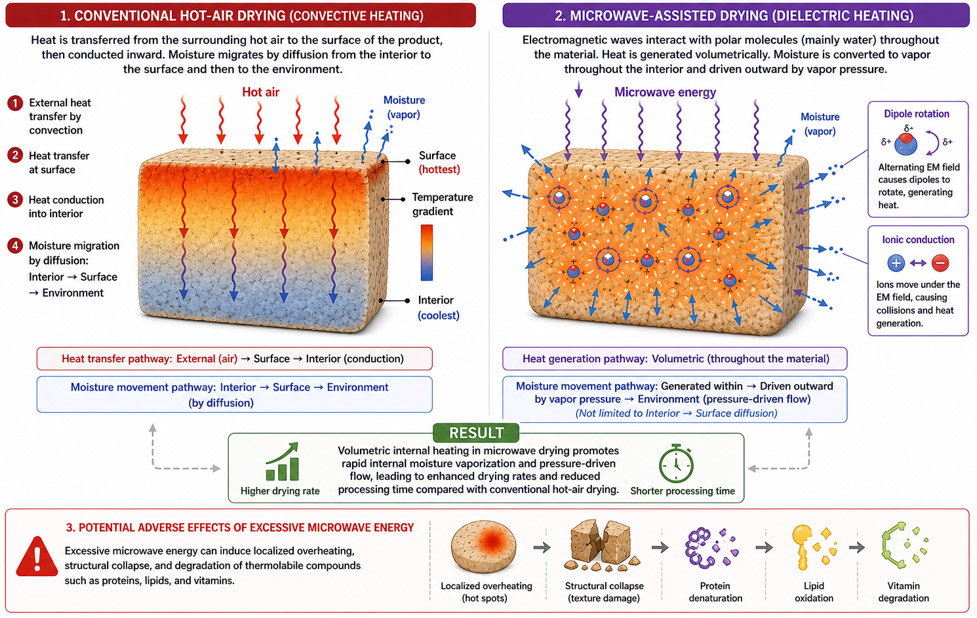
Despite its nutritional potential, Tiger nut remains under-utilized. This study examined the interactive effects of soaking time (24–72\,h) and microwave power (100–280\,W) on its proximate composition using response surface methodology. Commercial tubers (14.33% moisture) were rehydrated to 38.6–46.8% moisture via soaking and then microwave-dried at 2.45\,GHz. Proximate composition was determined by AOAC methods. Ash, fat and carbohydrate followed linear models (\(p<0.0001\)); fiber followed a two-factor interaction model (\(p<0.0001\)); protein showed quadratic behavior (\(p=0.0006\)). Multi-response optimization identified 48\,h soaking and 190\,W power as optimal (desirability=0.87). Five validation runs confirmed model predictions (no significant differences, \(p>0.05\); relative errors 0.56–2.62%), yielding: 4.18% ash, 5.62% fiber, 11.53% fat, 14.69% protein, 61.07% carbohydrate, and 2.91% moisture. Mechanistically, protein degradation exhibited non-thermal microwave effects (quadratic model), while fat followed thermal oxidation kinetics (linear model, \(r=-0.87\)). Dielectric loss factor (\(\varepsilon''\)) rose from 1.0–1.5 to 7–10 as moisture increased from 14.33% to 46.8%, and penetration depth (\(\approx\)15–20\,mm) exceeded tuber diameter (7.12\,mm), confirming volumetric heating. These findings demonstrate synergistic interactions between soaking and microwave drying, providing a validated framework for industrial Tiger nut processing balancing nutrient retention and shelf stability.
Graphical Abstract
Keywords
Data Availability Statement
Funding
Conflicts of Interest
AI Use Statement
Ethical Approval and Consent to Participate
References
- Kizzie-Hayford, N., Ampofo-Asiama, J., Zahn, S., Jaros, D., & Rohm, H. (2021). Enriching Tiger Nut Milk with Sodium Caseinate and Xanthan Gum Improves the Physical Stability and Consumer Acceptability. Journal of Food Technology Research, 8(2), 40-49.
[CrossRef] [Google Scholar] - Roselló-Soto, E., Poojary, M. M., Barba, F. J., Lorenzo, J. M., Mañes, J., & Moltó, J. C. (2018). Tiger nut and its by-products valorization: From extraction of oil and valuable compounds to development of new healthy products. Innovative Food Science & Emerging Technologies, 45, 306-312.
[CrossRef] [Google Scholar] - Sánchez‐Zapata, E., Fernández‐López, J., & Angel Pérez‐Alvarez, J. (2012). Tiger nut (Cyperus esculentus) commercialization: health aspects, composition, properties, and food applications. Comprehensive Reviews in Food Science and Food Safety, 11(4), 366-377.
[CrossRef] [Google Scholar] - Akabassi, G. C., Palanga, K. K., Padonou, E. A., Dagnon, Y. D., Tozo, K., & Assogbadjo, A. E. (2022). Biology, production constraints and uses of Cyperus exculentus L.(neglected and underutilized crop species), implication for valorization: a review. Genetic Resources and Crop Evolution, 69(5), 1979-1992.
[CrossRef] [Google Scholar] - Asare, P. A., Kpankpari, R., Adu, M. O., Afutu, E., & Adewumi, A. S. (2020). Phenotypic characterization of tiger nuts (Cyperus esculentus L.) from major growing areas in Ghana. The Scientific World Journal, 2020(1), 7232591.
[CrossRef] [Google Scholar] - Nwosu, L. C., Edo, G. I., & Özgör, E. (2022). The phytochemical, proximate, pharmacological, GC-MS analysis of Cyperus esculentus (Tiger nut): A fully validated approach in health, food and nutrition. Food Bioscience, 46, 101551.
[CrossRef] [Google Scholar] - Edo, G. I., Onoharigho, F. O., Jikah, A. N., Oloni, G. O., Samuel, P. O., Rapheal, O. A., ... & Akpoghelie, E. O. (2023). Cyperus esculentus (tiger nut): An insight into its bioactive compounds, biological activities, nutritional and health benefits. Food Chemistry Advances, 3, 100511.
[CrossRef] [Google Scholar] - Chukwuma, E. R., Obioma, N., & Christopher, O. I. (2010). The phytochemical composition and some biochemical effects of Nigerian tigernut (Cyperus esculentus L.) tuber. Pakistan Journal of Nutrition, 9(7), 709-715.
[CrossRef] [Google Scholar] - Edo, G. I., Samuel, P. O., Nwachukwu, S. C., Ikpekoro, V. O., Promise, O., Oghenegueke, O., ... & Ajakaye, R. S. (2024). A review on the biological and bioactive components of Cyperus esculentus L.: insight on food, health and nutrition. Journal of the Science of Food and Agriculture, 104(14), 8414-8429.
[CrossRef] [Google Scholar] - Yu, Y., Lu, X., Zhang, T., Zhao, C., Guan, S., Pu, Y., & Gao, F. (2022). Tiger nut (Cyperus esculentus L.): nutrition, processing, function and applications. Foods, 11(4), 601.
[CrossRef] [Google Scholar] - Adeyeye, S. A. O., Ashaolu, T. J., & Babu, A. S. (2022). Food drying: A review. Agricultural reviews, 1(8), 1-8.
[CrossRef] [Google Scholar] - Ibrahim, A., Cattaneo, T. M., Amer, A., & Helyes, L. (2023). Drying technology evolution and global concerns related to food security and sustainability. In Food processing and packaging technologies-recent advances. IntechOpen.
[CrossRef] [Google Scholar] - Asrate, D. A., & Ali, A. N. (2025). Review on the recent trends of food dryer technologies and optimization methods of drying parameters. Applied Food Research, 5(1), 100927.
[CrossRef] [Google Scholar] - Khan, M. I. H., Batuwatta-Gamage, C. P., Karim, M. A., & Gu, Y. (2022). Fundamental understanding of heat and mass transfer processes for physics-informed machine learning-based drying modelling. Energies, 15(24), 9347.
[CrossRef] [Google Scholar] - Jeevarathinam, G., Pandiarajan, T., Deepa, J., Aniesrani Delfiya, D. S., Krishnakumar, T., Preetha, P., ... & Rahul, R. (2026). Comparative Studies of Different Drying Methods on Turmeric Slices and Rhizomes: Effect on Drying Kinetics, Quality, Modelling, and Economic Feasibility. Journal of Food Process Engineering, 49(3), e70430.
[CrossRef] [Google Scholar] - Mansour, N. E., Villagran, E., Rodriguez, J., Akrami, M., Flores-Velazquez, J., Metwally, K. A., ... & Elshawadfy Elwakeel, A. (2025). Effect of Drying Conditions on Kinetics, Modeling, and Thermodynamic Behavior of Marjoram Leaves in an IoT-Controlled Vacuum Dryer. Sustainability, 17(13), 5980.
[CrossRef] [Google Scholar] - Rizvi, Q. U. E. H., Guiné, R. P., Ahmed, N., Sheikh, M. A., Sharma, P., Sheikh, I., ... & Kumar, K. (2024). Effects of soaking and germination treatments on the nutritional, anti-nutritional, and bioactive characteristics of adzuki beans (Vigna angularis L.) and lima beans (Phaseolus lunatus L.). Foods, 13(9), 1422.
[CrossRef] [Google Scholar] - Suo, K., Yang, Z., Wu, L., Zhang, Y., Feng, Y., Xu, B., ... & Chen, W. (2025). Enhancing drying characteristics and quality of fruits and vegetables using biochemical drying improvers: A comprehensive review. Comprehensive Reviews in Food Science and Food Safety, 24(1), e70094.
[CrossRef] [Google Scholar] - Ikrang, E. G., Okoko, J. U., & Akwa, M. M. (2020). Effects of temperature and steeping time on the proximate compositions and selected physical properties of soybean flour. Nigerian Journal of technological development, 17(1), 40-46.
[CrossRef] [Google Scholar] - Phuseerit, O., Seewaeng, P., Boonarsa, P., Seephua, N., & Siriamornpun, S. (2026). Effects of Processing on Antinutrients, Bioactives and Functional Properties of Bamboo Shoots (Bambusa beecheyana). Foods, 15(5), 854.
[CrossRef] [Google Scholar] - Anyene, C. C., Nwajinka, C. O., Okpala, C. D., Nwakuba, N. R., & Amaefule, D. O. (2026). Interactive effects of soaking duration and drying temperature on the drying kinetics and proximate composition of tiger nuts (Cyperus esculentus L.). European Food Research and Technology, 252(3), 98.
[CrossRef] [Google Scholar] - Calín-Sánchez, Á., Lipan, L., Cano-Lamadrid, M., Kharaghani, A., Masztalerz, K., Carbonell-Barrachina, Á. A., & Figiel, A. (2020). Comparison of traditional and novel drying techniques and its effect on quality of fruits, vegetables and aromatic herbs. Foods, 9(9), 1261.
[CrossRef] [Google Scholar] - Dehghannya, J., & Habibi-Ghods, M. (2025). Computer simulation of microwave-assisted drying: Coupled influence of microwave power and pulse ratio on product and process characteristics. Current Research in Food Science, 10, 101013.
[CrossRef] [Google Scholar] - Gong, S., Niu, Y., Yuwen, C., & Liu, B. (2025). Microwave drying of Tricholoma matsutake: Dielectric properties, mechanism, and process optimization. Foods, 14(17), 3054.
[CrossRef] [Google Scholar] - Lieu, L. P., & Lee, Y. (2026). Advances in Vacuum Microwave Drying for Berries: Processing, Quality, and Future Perspectives for Sustainable Fruit Drying. Journal of Food Science, 91(4), e71066.
[CrossRef] [Google Scholar] - Cui, T., Zhang, J., & Xu, H. (2025). Effect of Different Microwave Times on the Nutritional Properties of Glycosylated Soybean 7S. Foods, 14(21), 3694.
[CrossRef] [Google Scholar] - Deng, X., Huang, H., Huang, S., Yang, M., Wu, J., Ci, Z., ... & Zhang, D. (2022). Insight into the incredible effects of microwave heating: Driving changes in the structure, properties and functions of macromolecular nutrients in novel food. Frontiers in Nutrition, 9, 941527.
[CrossRef] [Google Scholar] - Anyene, C. C., Nwajinka, C. O., Nsofor, P. S., Okpala, C. D., & Ogbuagu, N. J. (2024). An Assessment of the Effects of Different Soaking Pretreatments and Microwave Drying Conditions on Selected Phytochemical Properties of Tiger-nut (Cyperus esculentus). UNIZIK Journal of Engineering and Applied Sciences, 3(1), 513-523. https://journals.unizik.edu.ng/ujeas/article/view/3540
[Google Scholar] - Cetin, N., Ozbey, B., Sacilik, K., & Cheein, F. A. (2026). Dielectric feature-driven dual prediction of moisture content and bulk density for rice quality assessment. Computers and Electronics in Agriculture, 241, 111276.
[CrossRef] [Google Scholar] - Zhu, Z., & Guo, W. (2017). Frequency, moisture content, and temperature dependent dielectric properties of potato starch related to drying with radio-frequency/microwave energy. Scientific reports, 7(1), 9311.
[CrossRef] [Google Scholar] - Myers, R. H., Montgomery, D. C., & Anderson-Cook, C. M. (2016). Response surface methodology: process and product optimization using designed experiments. John Wiley & Sons.
[Google Scholar] - Montgomery, D. C., Peck, E. A. & Vining, G. G. (2021). Introduction to linear regression analysis (6th ed.). John Wiley & Sons.
[Google Scholar] - Risman, P. (2009). Advanced topics in microwave heating uniformity. In Development of packaging and products for use in microwave ovens (pp. 66-107e). Woodhead Publishing.
[CrossRef] [Google Scholar] - Beh, C. Y., Cheng, E. M., Mohd Nasir, N. F., Abdul Majid, M. S., Khor, S. F., Mohd Jamir, M. R., ... & Lee, K. Y. (2022). Dielectric properties of hydrothermally modified potato, corn, and rice starch. Agriculture, 12(6), 783.
[CrossRef] [Google Scholar] - Vicente, A., Villanueva, M., Munoz, J. M., Caballero, P. A., & Ronda, F. (2025). The role of microwave absorption capacity and water mobility in the microwave treatment of grain vs. flour: Impact on the treated flour characteristics. Food Hydrocolloids, 159, 110680.
[CrossRef] [Google Scholar] - Chauhan, P. D., Gadani, D. H., & Rana, V. A. (2024). Effect of moisture content variation on dielectric properties of various plant leaves at microwave frequencies. Scientific Reports, 14(1), 13204.
[CrossRef] [Google Scholar] - Ali Hamed, S. M. (2018). Electromagnetics for engineering students (Part II). Bentham Science Publishers.
[CrossRef] [Google Scholar] - Hu, Q., He, Y., Wang, F., Wu, J., Ci, Z., Chen, L., ... & Zhang, D. (2021). Microwave technology: A novel approach to the transformation of natural metabolites. Chinese Medicine, 16(1), 87.
[CrossRef] [Google Scholar] - Latimer, G. W., Jr. (Ed.). (2016). Official methods of analysis of AOAC International (20th ed.). AOAC International.
[Google Scholar] - Barton, G. (1975). The mathematics of diffusion 2nd edn. Physics Bulletin, 26(11), 500-501.
[CrossRef] [Google Scholar] - Duque‐Dussán, E. (2026). Development and Validation of the D2MCD Family: Dual‐Term Diffusion Models for Coffee Drying. Journal of Food Process Engineering, 49(4), e70459.
[CrossRef] [Google Scholar] - Agusta, W., Maisaroh, Hermansyah, H. D., Anggraeni, D., Astuti, Harianto, ... & Manalu, L. P. (2022, December). Drying kinetics, modelling and total flavonoid content of Phyllanthus niruri L. under different drying temperature. In IOP Conference Series: Earth and Environmental Science (Vol. 1116, No. 1, p. 012033). IOP Publishing.
[CrossRef] [Google Scholar] - Djikeng, F. T., Djikeng, C. F. T., Womeni, H. M., Ndefo, D. K. K., Pougoué, A. A. N., Tambo, S. T., & Esatbeyoglu, T. (2022). Effect of different processing methods on the chemical composition, antioxidant activity and lipid quality of tiger nuts (Cyperus esculentus). Applied Food Research, 2(2), 100124.
[CrossRef] [Google Scholar] - Devi, M. P., Sahoo, M. R., Kuna, A., Deb, P., Dasgupta, M., & Prakash, N. (2018). Influence of Microwave Cooking on Proximate, Mineral and Radical Scavenging Activities of Tree Bean Seeds and Pods. Int. J. Curr. Microbiol. App. Sci, 7(8), 3909-3917.
[CrossRef] [Google Scholar] - Kaur, S., Singh, V., Panesar, P. S., & Chopra, H. K. (2025). Microwave-assisted extraction of dietary fiber from kinnow mandarin by-products: impact on yield and functional, structural, and thermal properties. Sustainable Food Technology, 3(6), 2122-2133.
[CrossRef] [Google Scholar] - Chen, X., Yang, J., Shen, M., Chen, Y., Yu, Q., & Xie, J. (2022). Structure, function and advance application of microwave-treated polysaccharide: A review. Trends in Food Science & Technology, 123, 198-209.
[CrossRef] [Google Scholar] - Min, Z., Hu, W., Xu, Y., Gong, X., Gao, Y., Zheng, T., ... & Kong, Y. (2025). Structural Changes and Functional Properties of Soluble Dietary Fiber From Buckwheat Bran by Different Processing Treatments. Journal of Food Science, 90(8), e70456.
[CrossRef] [Google Scholar] - Amadi, A. O., Jolaoso, O., Adigwe, C. W., & Opunabo, M. (2026). Effect of drying methods on the drying behaviour and nutrient composition of tiger nut (Cyperus esculentus). Research Journal of Food Science and Nutrition, 11(1), 7-14.
[CrossRef] [Google Scholar] - Putra, N. R., Agustini, S., Purwanto, W., Lestari, N., Nilawati, N., Hermawan, F., ... & Airlanngga, B. (2025). The impact of microwave technology on fruit drying processes in food industry: a bibliometric and comprehensive review (2018–2024). Food Science and Biotechnology, 34(14), 3175-3197.
[CrossRef] [Google Scholar] - Abbas Ali, M., Anowarul Islam, M., Othman, N. H., & Noor, A. M. (2017). Effect of heating on oxidation stability and fatty acid composition of microwave roasted groundnut seed oil. Journal of food science and technology, 54(13), 4335-4343.
[CrossRef] [Google Scholar] - Rashid, M. T., Liu, K., Han, S., & Jatoi, M. A. (2022). The effects of thermal treatment on lipid oxidation, protein changes, and storage stabilization of rice bran. Foods, 11(24), 4001.
[CrossRef] [Google Scholar] - Zhuang, Y., Dong, J., He, X., Wang, J., Li, C., Dong, L., ... & Wang, S. (2022). Impact of heating temperature and fatty acid type on the formation of lipid oxidation products during thermal processing. Frontiers in Nutrition, 9, 913297.
[CrossRef] [Google Scholar] - Knazicka, Z., Jurikova, T., Kovacikova, E., Fatrcova-Sramkova, K., Bella, V., Galik, B., ... & Mlcek, J. (2026). Biological Properties, Mineral Composition, and Health-Promoting Potential of Tiger Nut Tubers (Cyperus esculentus L.) as a Novel and Underutilized Food Source. Foods, 15(2), 191.
[CrossRef] [Google Scholar]
Cited By (1)
-
Kagnew Belayhun Admassie, Aynadis Molla Asemu, Birhanu Ayitegeb Ambaw. Performance and quality assessment of microwave-pre-treated solar drying of potato slices using an Arc'Teryx dryer.
Applied Food Research, 2026 , 6 (2).
[CrossRef]
Cite This Article
TY  - JOUR
AU  - Anyene, Chinedu C. C.
AU  - Nwajinka, Charles O.
AU  - Nwakuba, Nnaemeka R.
AU  - Okpala, Chukwunonso D.
PY  - 2026
DA  - 2026/05/10
TI  - Response Surface Methodology Study of the Synergistic Effects of Soaking Pretreatment and Microwave Power on the Proximate Composition of Tiger nut (Cyperus esculentus L.)
JO  - Agricultural Science and Food Processing
T2  - Agricultural Science and Food Processing
JF  - Agricultural Science and Food Processing
VL  - 3
IS  - 2
SP  - 73
EP  - 94
DO  - 10.62762/ASFP.2026.613613
UR  - https://www.icck.org/article/abs/asfp.2026.613613
KW  - tiger nut
KW  - microwave drying
KW  - soaking pre-treatment
KW  - proximate composition
AB  - Despite its nutritional potential, Tiger nut remains under-utilized. This study examined the interactive effects of soaking time (24–72\,h) and microwave power (100–280\,W) on its proximate composition using response surface methodology. Commercial tubers (14.33% moisture) were rehydrated to 38.6–46.8% moisture via soaking and then microwave-dried at 2.45\,GHz. Proximate composition was determined by AOAC methods. Ash, fat and carbohydrate followed linear models (\(p
SN  - 3066-1579
PB  - Institute of Central Computation and Knowledge
LA  - English
ER  -
@article{Anyene2026Response,
  author = {Chinedu C. C. Anyene and Charles O. Nwajinka and Nnaemeka R. Nwakuba and Chukwunonso D. Okpala},
  title = {Response Surface Methodology Study of the Synergistic Effects of Soaking Pretreatment and Microwave Power on the Proximate Composition of Tiger nut (Cyperus esculentus L.)},
  journal = {Agricultural Science and Food Processing},
  year = {2026},
  volume = {3},
  number = {2},
  pages = {73-94},
  doi = {10.62762/ASFP.2026.613613},
  url = {https://www.icck.org/article/abs/asfp.2026.613613},
  abstract = {Despite its nutritional potential, Tiger nut remains under-utilized. This study examined the interactive effects of soaking time (24–72\,h) and microwave power (100–280\,W) on its proximate composition using response surface methodology. Commercial tubers (14.33\% moisture) were rehydrated to 38.6–46.8\% moisture via soaking and then microwave-dried at 2.45\,GHz. Proximate composition was determined by AOAC methods. Ash, fat and carbohydrate followed linear models (\(p},
  keywords = {tiger nut, microwave drying, soaking pre-treatment, proximate composition},
  issn = {3066-1579},
  publisher = {Institute of Central Computation and Knowledge}
}
Publisher's Note
ICCK stays neutral with regard to jurisdictional claims in published maps and institutional affiliations.
Rights and Permissions
 Copyright © 2026 by the Author(s). Published by Institute of Central Computation and Knowledge. This article is an open access article distributed under the terms and conditions of the Creative Commons Attribution (CC BY) license (https://creativecommons.org/licenses/by/4.0/), which permits use, sharing, adaptation, distribution and reproduction in any medium or format, as long as you give appropriate credit to the original author(s) and the source, provide a link to the Creative Commons licence, and indicate if changes were made.


Portico
