
-
CiteScore
-
Impact Factor
Volume 1, Issue 1, Frontiers in Biomedical Signal Processing
Volume 1, Issue 1, 2025
Submit Manuscript Edit a Special Issue
Article QR Code
Article QR Code
Scan the QR code for reading
Popular articles
Frontiers in Biomedical Signal Processing, Volume 1, Issue 1, 2025: 37-48

Open Access | Research Article | 08 November 2025
Dental Classes Classification using TEYOLOv8 Network
1 Department of Electronics and Communication Engineering, Tirumala Institute of Technology and Sciences, Narasaraopet 522549, India
2 Department of Electronics and Communication Engineering, Tirumala Engineering College, Narasaraopet 522601, India
* Corresponding Author: Pavan Sandula, [email protected]
Received: 13 September 2025, Accepted: 16 September 2025, Published: 08 November 2025  
Abstract
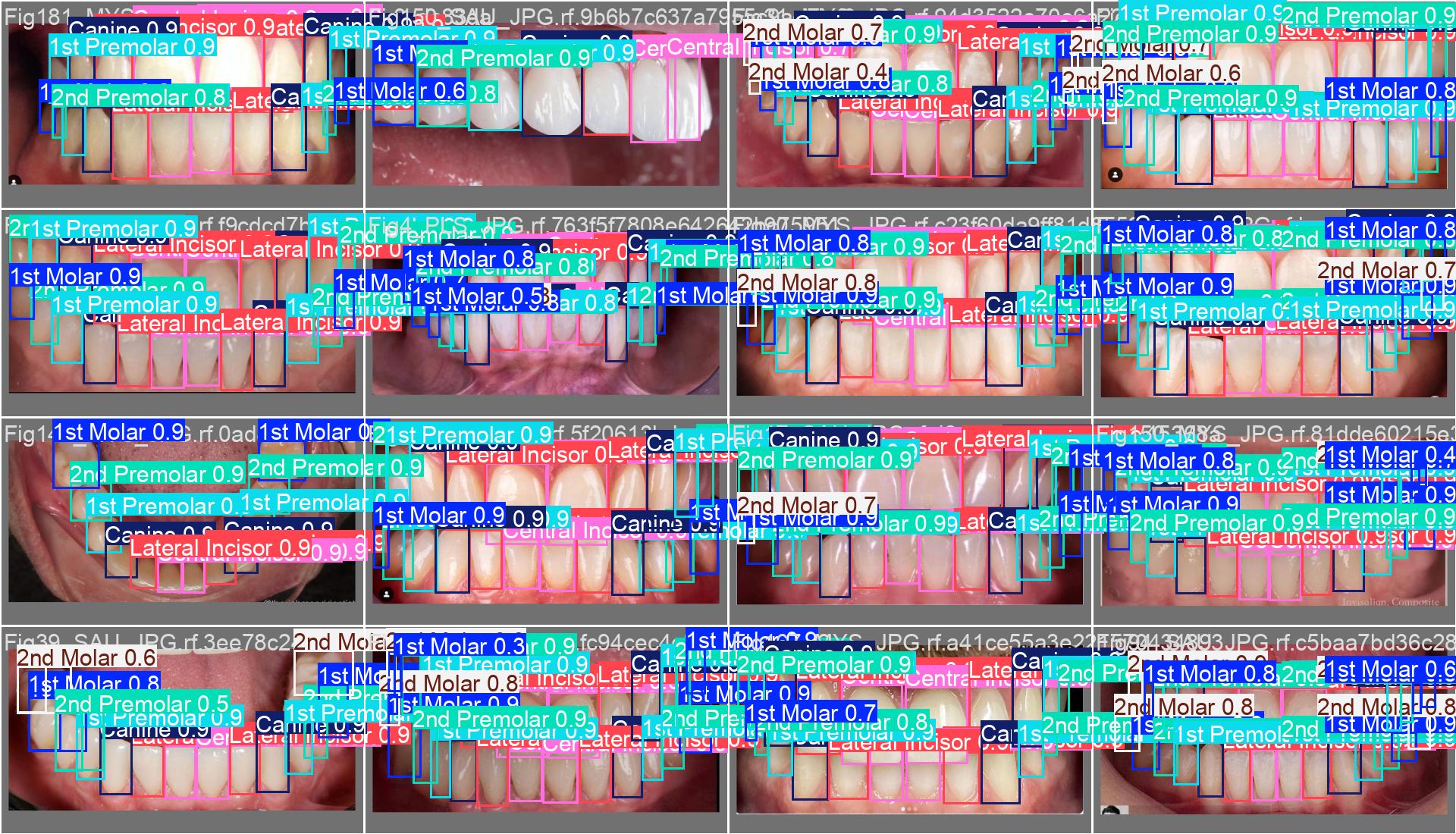
Accurate and automated detection of dental anatomy is essential for diagnosis and treatment planning. This study proposes a Transformer-Embedded YOLOv8 (TEYOLOv8) network to improve detection and classification of seven dental classes. The model enhances localization and segmentation accuracy by embedding an attentive transformer mechanism into the YOLOv8 framework. The TEYOLOv8 architecture integrates data augmentation, feature localization, segmentation, and classification. It employs C2f (Cross-Stage Partial Focus) convolutional blocks to preserve partial segmentation features and introduces a C2fAttn (Cross-Stage Feature Attention) module to capture fine-grained spatial details such as shape and position, addressing feature dissimilarity and loss. The model was trained and evaluated on a custom dental dataset with metrics including mean Average Precision (mAP), precision, and recall. Experimental results demonstrate that TEYOLOv8 achieves superior performance, with precision of 0.954, recall of 0.973, [email protected] of 0.981, and [email protected]:0.95 of 0.794. The integration of the attention mechanism substantially improves feature representation and segmentation quality, enabling precise localization and classification of complex dental structures. Clinical Significance: The TEYOLOv8 model provides an efficient and accurate tool for dental image analysis, supporting precise identification of dental classes. It has strong potential to streamline clinical workflows, improve diagnostic accuracy, and enhance patient outcomes.

Graphical Abstract
Dental Classes Classification using TEYOLOv8 Network

Keywords
attention mechanism
classification
cross-stage feature attention
mean average Precision (mAP)
YOLOv8

Data Availability Statement
Data will be made available on request.

Funding
This work was supported without any funding.

Conflicts of Interest
The authors declare no conflicts of interest.

Ethical Approval and Consent to Participate
Not applicable.

References
  1. MUHAMAD, D. A. H. (2016). Dental and Oral Health. Sciences, 14(4), 124-130.
    [Google Scholar]
  2. Liu, X., Faes, L., Kale, A. U., Wagner, S. K., Fu, D. J., Bruynseels, A., ... & Denniston, A. K. (2019). A comparison of deep learning performance against health-care professionals in detecting diseases from medical imaging: a systematic review and meta-analysis. The lancet digital health, 1(6), e271-e297.
    [CrossRef]   [Google Scholar]
  3. Rozylo-Kalinowska, I. (2020). Introduction to Dental Radiography and Radiology. In Imaging Techniques in Dental Radiology: Acquisition, Anatomic Analysis and Interpretation of Radiographic Images (pp. 1-5). Cham: Springer International Publishing.
    [CrossRef]   [Google Scholar]
  4. Tsuneki, M. (2022). Deep learning models in medical image analysis. Journal of Oral Biosciences, 64(3), 312-320.
    [CrossRef]   [Google Scholar]
  5. Schwendicke, F., Golla, T., Dreher, M., & Krois, J. (2019). Convolutional neural networks for dental image diagnostics: A scoping review. Journal of dentistry, 91, 103226.
    [CrossRef]   [Google Scholar]
  6. Fang, W., Wang, L., & Ren, P. (2019). Tinier-YOLO: A real-time object detection method for constrained environments. Ieee Access, 8, 1935-1944.
    [CrossRef]   [Google Scholar]
  7. Ganguly, A., & Ruby, A. U. (2023). Evaluating CNN architectures using attention mechanisms: Convolutional Block Attention Module, Squeeze, and Excitation for image classification on CIFAR10 dataset.
    [Google Scholar]
  8. Chien, C. T., Ju, R. Y., Chou, K. Y., Xieerke, E., & Chiang, J. S. (2025). YOLOv8-AM: YOLOv8 Based on Effective Attention Mechanisms for Pediatric Wrist Fracture Detection. IEEE Access.
    [CrossRef]   [Google Scholar]
  9. Ghafoor, A., Moon, S. Y., & Lee, B. (2023). Multiclass Segmentation Using Teeth Attention Modules for Dental X-Ray Images. IEEE Access, 11, 123891-123903.
    [CrossRef]   [Google Scholar]
  10. Razaghi, M., Komleh, H. E., Dehghani, F., & Shahidi, Z. (2024, March). Innovative diagnosis of dental diseases using YOLO V8 deep learning model. In 2024 13th Iranian/3rd International Machine Vision and Image Processing Conference (MVIP) (pp. 1-5). IEEE.
    [CrossRef]   [Google Scholar]
  11. Sukegawa, S., Yoshii, K., Hara, T., Tanaka, F., Yamashita, K., Kagaya, T., ... & Furuki, Y. (2022). Is attention branch network effective in classifying dental implants from panoramic radiograph images by deep learning?. PLoS One, 17(7), e0269016.
    [CrossRef]   [Google Scholar]
  12. George, J., Hemanth, T. S., Raju, J., Mattapallil, J. G., & Naveen, N. (2023, August). Dental radiography analysis and diagnosis using YOLOv8. In 2023 9th International Conference on Smart Computing and Communications (ICSCC) (pp. 102-107). IEEE.
    [CrossRef]   [Google Scholar]
  13. Rischen, R. J., Breuning, K. H., Bronkhorst, E. M., & Kuijpers-Jagtman, A. M. (2013). Records needed for orthodontic diagnosis and treatment planning: a systematic review. PLoS one, 8(11), e74186.
    [CrossRef]   [Google Scholar]
  14. Davila, K., Setlur, S., Doermann, D., Kota, B. U., & Govindaraju, V. (2020). Chart mining: A survey of methods for automated chart analysis. IEEE transactions on pattern analysis and machine intelligence, 43(11), 3799-3819.
    [CrossRef]   [Google Scholar]
  15. Kong, M., He, Q., & Li, L. (2018). AI assisted clinical diagnosis & treatment, and development strategy. Strategic Study of Chinese Academy of Engineering, 20(2), 86-91.
    [Google Scholar]
  16. Wang, H., Diao, K., Wu, L., Li, X., Zhou, X., & Liu, X. (2024, December). An Automatic Tooth Position and Dental Disease Detection Algorithm Based on YOLOv8. In 2024 10th International Conference on Computer and Communications (ICCC) (pp. 2058-2062). IEEE.
    [CrossRef]   [Google Scholar]
  17. Akdoğan, S., Öziç, M. Ü., & Tassoker, M. (2025). Development of an AI-Supported clinical tool for assessing mandibular third molar tooth extraction difficulty using panoramic radiographs and YOLO11 Sub-Models. Diagnostics, 15(4), 462.
    [CrossRef]   [Google Scholar]

Cite This Article
APA Style
Chilaka, V. K., Sandula, P., & Thati, J. (2025). Dental Classes Classification using TEYOLOv8 Network. Frontiers in Biomedical Signal Processing, 1(1), 37–48. https://doi.org/10.62762/FBSP.2025.431958
Export Citation
RIS Format
Compatible with EndNote, Zotero, Mendeley, and other reference managers
RIS format data for reference managers
TY  - JOUR
AU  - Chilaka, Victor Kumar
AU  - Sandula, Pavan
AU  - Thati, Jagadeesh
PY  - 2025
DA  - 2025/11/08
TI  - Dental Classes Classification using TEYOLOv8 Network
JO  - Frontiers in Biomedical Signal Processing
T2  - Frontiers in Biomedical Signal Processing
JF  - Frontiers in Biomedical Signal Processing
VL  - 1
IS  - 1
SP  - 37
EP  - 48
DO  - 10.62762/FBSP.2025.431958
UR  - https://www.icck.org/article/abs/FBSP.2025.431958
KW  - attention mechanism
KW  - classification
KW  - cross-stage feature attention
KW  - mean average Precision (mAP)
KW  - YOLOv8
AB  - Accurate and automated detection of dental anatomy is essential for diagnosis and treatment planning. This study proposes a Transformer-Embedded YOLOv8 (TEYOLOv8) network to improve detection and classification of seven dental classes. The model enhances localization and segmentation accuracy by embedding an attentive transformer mechanism into the YOLOv8 framework. The TEYOLOv8 architecture integrates data augmentation, feature localization, segmentation, and classification. It employs C2f (Cross-Stage Partial Focus) convolutional blocks to preserve partial segmentation features and introduces a C2fAttn (Cross-Stage Feature Attention) module to capture fine-grained spatial details such as shape and position, addressing feature dissimilarity and loss. The model was trained and evaluated on a custom dental dataset with metrics including mean Average Precision (mAP), precision, and recall. Experimental results demonstrate that TEYOLOv8 achieves superior performance, with precision of 0.954, recall of 0.973, [email protected] of 0.981, and [email protected]:0.95 of 0.794. The integration of the attention mechanism substantially improves feature representation and segmentation quality, enabling precise localization and classification of complex dental structures. Clinical Significance: The TEYOLOv8 model provides an efficient and accurate tool for dental image analysis, supporting precise identification of dental classes. It has strong potential to streamline clinical workflows, improve diagnostic accuracy, and enhance patient outcomes.
SN  - request pending
PB  - Institute of Central Computation and Knowledge
LA  - English
ER  - 
BibTeX Format
Compatible with LaTeX, BibTeX, and other reference managers
BibTeX format data for LaTeX and reference managers
@article{Chilaka2025Dental,
  author = {Victor Kumar Chilaka and Pavan Sandula and Jagadeesh Thati},
  title = {Dental Classes Classification using TEYOLOv8 Network},
  journal = {Frontiers in Biomedical Signal Processing},
  year = {2025},
  volume = {1},
  number = {1},
  pages = {37-48},
  doi = {10.62762/FBSP.2025.431958},
  url = {https://www.icck.org/article/abs/FBSP.2025.431958},
  abstract = {Accurate and automated detection of dental anatomy is essential for diagnosis and treatment planning. This study proposes a Transformer-Embedded YOLOv8 (TEYOLOv8) network to improve detection and classification of seven dental classes. The model enhances localization and segmentation accuracy by embedding an attentive transformer mechanism into the YOLOv8 framework. The TEYOLOv8 architecture integrates data augmentation, feature localization, segmentation, and classification. It employs C2f (Cross-Stage Partial Focus) convolutional blocks to preserve partial segmentation features and introduces a C2fAttn (Cross-Stage Feature Attention) module to capture fine-grained spatial details such as shape and position, addressing feature dissimilarity and loss. The model was trained and evaluated on a custom dental dataset with metrics including mean Average Precision (mAP), precision, and recall. Experimental results demonstrate that TEYOLOv8 achieves superior performance, with precision of 0.954, recall of 0.973, [email protected] of 0.981, and [email protected]:0.95 of 0.794. The integration of the attention mechanism substantially improves feature representation and segmentation quality, enabling precise localization and classification of complex dental structures. Clinical Significance: The TEYOLOv8 model provides an efficient and accurate tool for dental image analysis, supporting precise identification of dental classes. It has strong potential to streamline clinical workflows, improve diagnostic accuracy, and enhance patient outcomes.},
  keywords = {attention mechanism, classification, cross-stage feature attention, mean average Precision (mAP), YOLOv8},
  issn = {request pending},
  publisher = {Institute of Central Computation and Knowledge}
}

Article Metrics
Citations:

Crossref

0

Scopus

0

Web of Science

0
Article Access Statistics:
Views: 104
PDF Downloads: 41

Publisher's Note
ICCK stays neutral with regard to jurisdictional claims in published maps and institutional affiliations.

Rights and Permissions
CC BY Copyright © 2025 by the Author(s). Published by Institute of Central Computation and Knowledge. This article is an open access article distributed under the terms and conditions of the Creative Commons Attribution (CC BY) license (https://creativecommons.org/licenses/by/4.0/), which permits use, sharing, adaptation, distribution and reproduction in any medium or format, as long as you give appropriate credit to the original author(s) and the source, provide a link to the Creative Commons licence, and indicate if changes were made.
Frontiers in Biomedical Signal Processing

Frontiers in Biomedical Signal Processing

ISSN: request pending (Online) | ISSN: request pending (Print)

Email: [email protected]

Portico

Portico

All published articles are preserved here permanently:
https://www.portico.org/publishers/icck/