

Extended Micromechanical Model for the Hyperelastic Behavior of Elastomers and Identification of Material Parameters Using the Particle Swarm Optimization (PSO) Algorithm




Article Information
Abstract
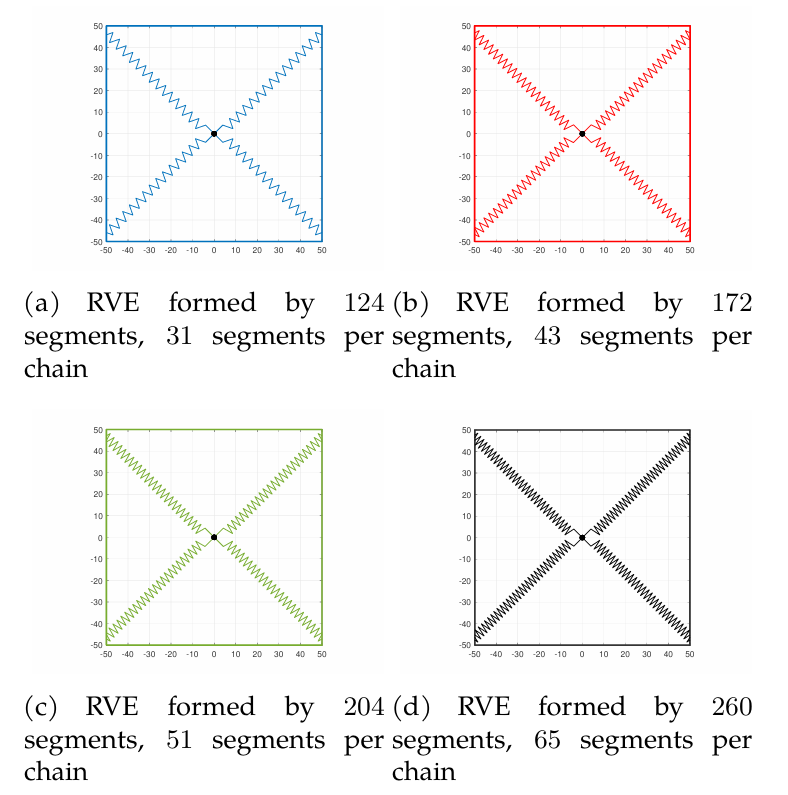
In this work, we propose a new four-parameter micromechanical model to describe the hyperelastic behavior of elastomeric materials. The proposed model extends and improves a previously developed three-parameter micromechanical approach. As in earlier studies, the constitutive behavior is obtained by minimizing the potential energy of a Representative Volume Element (RVE) composed of multiple macromolecular chains. Each chain segment is modeled as a linear spring with stiffness $K$, acting in both tension and compression. To account for rotational flexibility between consecutive segments, nonlinear torsional springs are introduced, whose behavior is described as the sum of two contributions: a sigmoidal function characterized by a limiting moment $M_0$ and a parameter $a$, and a linear term with stiffness $b$ representing resistance during segment unfolding. This four-parameter formulation ($a$, $b$, $M_0$, and $K$) provides greater flexibility for parameter identification and improves the accuracy of the predicted mechanical response. Two identification strategies are considered: a physically motivated approach and an optimization-based method using the Particle Swarm Optimization (PSO) algorithm, which minimizes the discrepancy between numerical predictions and experimental data without requiring gradient information, making it particularly suitable for implicit numerical models. Numerical simulations are carried out on a two-dimensional RVE composed of four chains, and results are compared with Treloar's (1943) experimental data and selected statistical models under uniaxial tension, pure shear, and equibiaxial tension.
Graphical Abstract
Keywords
Data Availability Statement
Funding
Conflicts of Interest
AI Use Statement
Ethical Approval and Consent to Participate
References
- Ouardi, A., Boukamel, A., & Damil, N. (2023). A model for hyperelastic rubber-like materials based on micro-mechanical elements. European Journal of Mechanics-A/Solids, 101, 105036.
[CrossRef] [Google Scholar] - Ouardi, A., Hamdaoui, A., Arfaoui, M., Boukamel, A., & Damil, N. (2025). A 3D micromechanical model for hyperelastic rubber-like materials and its numerical resolution by the Asymptotic Numerical Method (ANM). European Journal of Mechanics-A/Solids, 111, 105594.
[CrossRef] [Google Scholar] - Treloar, L. R. (1943). The elasticity of a network of long-chain molecules—II. Transactions of the Faraday Society, 39, 241-246.
[CrossRef] [Google Scholar] - Khiêm, V. N., Le Cam, J. B., Charles, S., & Itskov, M. (2022). Thermodynamics of strain-induced crystallization in filled natural rubber under uni-and biaxial loadings, Part I: Complete energetic characterization and crystallinity evaluation. Journal of the Mechanics and Physics of Solids, 159, 104701.
[CrossRef] [Google Scholar] - Flory, P. J. (1947). Thermodynamics of crystallization in high polymers. I. Crystallization induced by stretching. The Journal of Chemical Physics, 15(6), 397-408.
[CrossRef] [Google Scholar] - Gent, A. N., Kawahara, S., & Zhao, J. (1998). Crystallization and strength of natural rubber and synthetic cis-1, 4-polyisoprene. Rubber Chemistry and technology, 71(4), 668-678.
[CrossRef] [Google Scholar] - Arruda, E. M., & Boyce, M. C. (1993). A three-dimensional constitutive model for the large stretch behavior of rubber elastic materials. Journal of the Mechanics and Physics of Solids, 41(2), 389-412.
[CrossRef] [Google Scholar] - Ogden, R. W., Saccomandi, G., & Sgura, I. (2004). Fitting hyperelastic models to experimental data. Computational mechanics, 34(6), 484-502.
[CrossRef] [Google Scholar] - Bischoff, J. E., Arruda, E. A., & Grosh, K. (2002). A microstructurally based orthotropic hyperelastic constitutive law. Journal of applied mechanics, 69(5), 570-579.
[CrossRef] [Google Scholar] - Bischoff, J. E., Arruda, E. M., & Grosh, K. (2002). Orthotropic Hyperelasticity in Terms of an Arbitrary Molecular Chain Model. Journal of Applied Mechanics, 69(2), 198-201.
[CrossRef] [Google Scholar] - Kuhl, E., Garikipati, K., Arruda, E. M., & Grosh, K. (2005). Remodeling of biological tissue: mechanically induced reorientation of a transversely isotropic chain network. Journal of the Mechanics and Physics of Solids, 53(7), 1552-1573.
[CrossRef] [Google Scholar] - Pucci, E., & Saccomandi, G. (2002). A note on the Gent model for rubber-like materials. Rubber chemistry and technology, 75(5), 839-852.
[CrossRef] [Google Scholar] - Ogden, R. W. (2003). Nonlinear elasticity, anisotropy, material stability and residual stresses in soft tissue. In Biomechanics of soft tissue in cardiovascular systems (pp. 65-108). Vienna: Springer Vienna.
[CrossRef] [Google Scholar] - Holzapfel, G. A., Gasser, T. C., & Ogden, R. W. (2000). A new constitutive framework for arterial wall mechanics and a comparative study of material models. Journal of elasticity and the physical science of solids, 61(1), 1-48.
[CrossRef] [Google Scholar] - Böl, M., & Reese, S. (2006). Finite element modelling of rubber-like polymers based on chain statistics. International journal of solids and structures, 43(1), 2-26.
[CrossRef] [Google Scholar] - Davidson, J. D., & Goulbourne, N. C. (2013). A nonaffine network model for elastomers undergoing finite deformations. Journal of the Mechanics and Physics of Solids, 61(8), 1784-1797.
[CrossRef] [Google Scholar] - Cochelin, D. B., Damil, N., & Potier-Ferry, M. (2008). Méthode asymptotique numérique. European journal of computational mechanics/revue européenne de mécanique numérique, 17(4), 553-554.
[CrossRef] [Google Scholar] - Cochelin, B., Damil, N., & Potier‐Ferry, M. (1994). Asymptotic–numerical methods and Pade approximants for non‐linear elastic structures. International journal for numerical methods in engineering, 37(7), 1187-1213.
[CrossRef] [Google Scholar] - Vannucci, P., Cochelin, B., Damil, N., & Potier‐Ferry, M. (1998). An asymptotic‐numerical method to compute bifurcating branches. International journal for numerical methods in engineering, 41(8), 1365-1389.
[CrossRef] [Google Scholar] - Hussein, AE, Damil, N., & Potier-Ferry, M. (1998). An asymptotic numerical algorithm for frictionless contact problems. European Journal of Finite Elements , 7 (1-3), 119-130.
[CrossRef] [Google Scholar] - El Kihal, C., Askour, O., Belaasilia, Y., Hamdaoui, A., Braikat, B., Damil, N., & Potier-Ferry, M. (2022). Asymptotic numerical method for finite plasticity. Finite Elements in Analysis and Design, 206, 103759.
[CrossRef] [Google Scholar] - Rammane, M., Mesmoudi, S., Tri, A., Braikat, B., & Damil, N. (2020). Solving the incompressible fluid flows by a high‐order mesh‐free approach. International Journal for Numerical Methods in Fluids, 92(5), 422-435.
[CrossRef] [Google Scholar] - Cadou, J. M., Potier‐Ferry, M., Cochelin, B., & Damil, N. (2001). ANM for stationary Navier–Stokes equations and with Petrov–Galerkin formulation. International Journal for Numerical Methods in Engineering, 50(4), 825-845.
[CrossRef] [Google Scholar] - Medale, M., & Cochelin, B. (2009). A parallel computer implementation of the asymptotic numerical method to study thermal convection instabilities. Journal of Computational Physics, 228(22), 8249-8262.
[CrossRef] [Google Scholar] - Jamal, M., Elasmar, H., Braikat, B., Boutyour, E., Cochelin, B., Damil, N., & Potier-Ferry, M. (2000). Bifurcation indicators. Acta mechanica, 139(1), 129-142.
[CrossRef] [Google Scholar] - Rammane, M., Mesmoudi, S., Tri, A., Braikat, B., & Damil, N. (2022). Mesh‐free model for Hopf's bifurcation points in incompressible fluid flows problems. International Journal for Numerical Methods in Fluids, 94(9), 1566-1581.
[CrossRef] [Google Scholar] - Mezura-Montes, E., & Coello, C. A. C. (2011). Constraint-handling in nature-inspired numerical optimization: past, present and future. Swarm and Evolutionary Computation, 1(4), 173-194.
[CrossRef] [Google Scholar] - Pedersen, M. E. H. (2010). Good parameters for particle swarm optimization. Hvass Lab., Copenhagen, Denmark, Tech. Rep. HL1001, 1551-3203.
[CrossRef] [Google Scholar] - Wang, D., Tan, D., & Liu, L. (2018). Particle swarm optimization algorithm: an overview. Soft computing, 22(2), 387-408.
[CrossRef] [Google Scholar] - MathWorks. (n.d.). particleswarm: Particle swarm optimization. Retrieved from https://www.mathworks.com/help/gads/particleswarm.html
[Google Scholar] - Kuhn, W., & Grün, F. (1942). Beziehungen zwischen elastischen Konstanten und Dehnungsdoppelbrechung hochelastischer Stoffe. Kolloid-Zeitschrift, 101(3), 248-271.
[CrossRef] [Google Scholar] - Ouardi, A., Boukamel, A., & Damil, N. (2022). Towards a macro-chain polymer model using a micromechanical approach. In Constitutive Models for Rubber XII (pp. 112-117). CRC Press.
[Google Scholar] - Trinh, D. K. (2011). Méthodes d'homogénéisation d'ordre supérieur pour les matériaux architecturés (Doctoral dissertation, École Nationale Supérieure des Mines de Paris). https://pastel.hal.science/pastel-00677046/
[Google Scholar] - Treloar, L. R. G. (1975). The physics of rubber elasticity (3rd ed.). Oxford.
[Google Scholar] - Kennedy, J., & Eberhart, R. (1995). Particle swarm optimization. In Proceedings of ICNN'95-international conference on neural networks (Vol. 4, pp. 1942--1948). IEEE.
[CrossRef] [Google Scholar] - Kaliske, M., & Heinrich, G. (1999). An extended tube-model for rubber elasticity: statistical-mechanical theory and finite element implementation. Rubber Chemistry and Technology, 72(4), 602-632.
[CrossRef] [Google Scholar] - Marckmann, G., & Verron, E. (2006). Comparison of hyperelastic models for rubber-like materials. Rubber chemistry and technology, 79(5), 835-858.
[CrossRef] [Google Scholar] - He, H., Zhang, Q., Zhang, Y., Chen, J., Zhang, L., & Li, F. (2022). A comparative study of 85 hyperelastic constitutive models for both unfilled rubber and highly filled rubber nanocomposite material. Nano Materials Science, 4(2), 64-82.
[CrossRef] [Google Scholar]
Cite This Article
TY  - JOUR
AU  - Ouardi, Ayoub
AU  - Boukamel, Adnane
AU  - Damil, Noureddine
PY  - 2026
DA  - 2026/06/08
TI  - Extended Micromechanical Model for the Hyperelastic Behavior of Elastomers and Identification of Material Parameters Using the Particle Swarm Optimization (PSO) Algorithm
JO  - Journal of Carbon Neutrality
T2  - Journal of Carbon Neutrality
JF  - Journal of Carbon Neutrality
VL  - 1
IS  - 1
SP  - 38
EP  - 63
DO  - 10.62762/JCN.2026.518617
UR  - https://www.icck.org/article/abs/JCN.2026.518617
KW  - micromechanical model
KW  - macro-molecular polymer chains
KW  - rubber-like materials
KW  - parameter identification
KW  - Particle Swarm Optimization (PSO)
KW  - hyperelastic
KW  - Asymptotic Numerical Method (ANM)
AB  - In this work, we propose a new four-parameter micromechanical model to describe the hyperelastic behavior of elastomeric materials. The proposed model extends and improves a previously developed three-parameter micromechanical approach. As in earlier studies, the constitutive behavior is obtained by minimizing the potential energy of a Representative Volume Element (RVE) composed of multiple macromolecular chains. Each chain segment is modeled as a linear spring with stiffness $K$, acting in both tension and compression. To account for rotational flexibility between consecutive segments, nonlinear torsional springs are introduced, whose behavior is described as the sum of two contributions: a sigmoidal function characterized by a limiting moment $M_0$ and a parameter $a$, and a linear term with stiffness $b$ representing resistance during segment unfolding. This four-parameter formulation ($a$, $b$, $M_0$, and $K$) provides greater flexibility for parameter identification and improves the accuracy of the predicted mechanical response. Two identification strategies are considered: a physically motivated approach and an optimization-based method using the Particle Swarm Optimization (PSO) algorithm, which minimizes the discrepancy between numerical predictions and experimental data without requiring gradient information, making it particularly suitable for implicit numerical models. Numerical simulations are carried out on a two-dimensional RVE composed of four chains, and results are compared with Treloar's (1943) experimental data and selected statistical models under uniaxial tension, pure shear, and equibiaxial tension.
SN  - pending
PB  - Institute of Central Computation and Knowledge
LA  - English
ER  -
@article{Ouardi2026Extended,
  author = {Ayoub Ouardi and Adnane Boukamel and Noureddine Damil},
  title = {Extended Micromechanical Model for the Hyperelastic Behavior of Elastomers and Identification of Material Parameters Using the Particle Swarm Optimization (PSO) Algorithm},
  journal = {Journal of Carbon Neutrality},
  year = {2026},
  volume = {1},
  number = {1},
  pages = {38-63},
  doi = {10.62762/JCN.2026.518617},
  url = {https://www.icck.org/article/abs/JCN.2026.518617},
  abstract = {In this work, we propose a new four-parameter micromechanical model to describe the hyperelastic behavior of elastomeric materials. The proposed model extends and improves a previously developed three-parameter micromechanical approach. As in earlier studies, the constitutive behavior is obtained by minimizing the potential energy of a Representative Volume Element (RVE) composed of multiple macromolecular chains. Each chain segment is modeled as a linear spring with stiffness \$K\$, acting in both tension and compression. To account for rotational flexibility between consecutive segments, nonlinear torsional springs are introduced, whose behavior is described as the sum of two contributions: a sigmoidal function characterized by a limiting moment \$M\_0\$ and a parameter \$a\$, and a linear term with stiffness \$b\$ representing resistance during segment unfolding. This four-parameter formulation (\$a\$, \$b\$, \$M\_0\$, and \$K\$) provides greater flexibility for parameter identification and improves the accuracy of the predicted mechanical response. Two identification strategies are considered: a physically motivated approach and an optimization-based method using the Particle Swarm Optimization (PSO) algorithm, which minimizes the discrepancy between numerical predictions and experimental data without requiring gradient information, making it particularly suitable for implicit numerical models. Numerical simulations are carried out on a two-dimensional RVE composed of four chains, and results are compared with Treloar's (1943) experimental data and selected statistical models under uniaxial tension, pure shear, and equibiaxial tension.},
  keywords = {micromechanical model, macro-molecular polymer chains, rubber-like materials, parameter identification, Particle Swarm Optimization (PSO), hyperelastic, Asymptotic Numerical Method (ANM)},
  issn = {pending},
  publisher = {Institute of Central Computation and Knowledge}
}
Article Metrics
Publisher's Note
ICCK stays neutral with regard to jurisdictional claims in published maps and institutional affiliations.
Rights and Permissions
 Copyright © 2026 by the Author(s). Published by Institute of Central Computation and Knowledge. This article is an open access article distributed under the terms and conditions of the Creative Commons Attribution (CC BY) license (https://creativecommons.org/licenses/by/4.0/), which permits use, sharing, adaptation, distribution and reproduction in any medium or format, as long as you give appropriate credit to the original author(s) and the source, provide a link to the Creative Commons licence, and indicate if changes were made.