


Journal of Geo-Energy and Environment
ISSN: 3069-3268 (Online)
Email: [email protected]



 Submit Manuscript
Edit a Special Issue
Submit Manuscript
Edit a Special Issue


TY  - JOUR
AU  - Gong, Xin
AU  - He, Jia
AU  - Li, Jing
AU  - Luo, Ang
AU  - Cao, Wen
AU  - Liu, Xing
PY  - 2025
DA  - 2025/11/04
TI  - Professional Evaluation and Distribution Patterns of Shale Gas Reservoirs in the Wufeng Formation-Long 11 Sub-member of Well Block Z205, Sichuan Basin
JO  - Journal of Geo-Energy and Environment
T2  - Journal of Geo-Energy and Environment
JF  - Journal of Geo-Energy and Environment
VL  - 1
IS  - 2
SP  - 96
EP  - 105
DO  - 10.62762/JGEE.2025.365363
UR  - https://www.icck.org/article/abs/JGEE.2025.365363
KW  - Sichuan basin
KW  - z205 well area
KW  - deep shale gas
KW  - TOPSIS algorithm
KW  - reservoir classification evaluation
KW  - reservoir distribution pattern
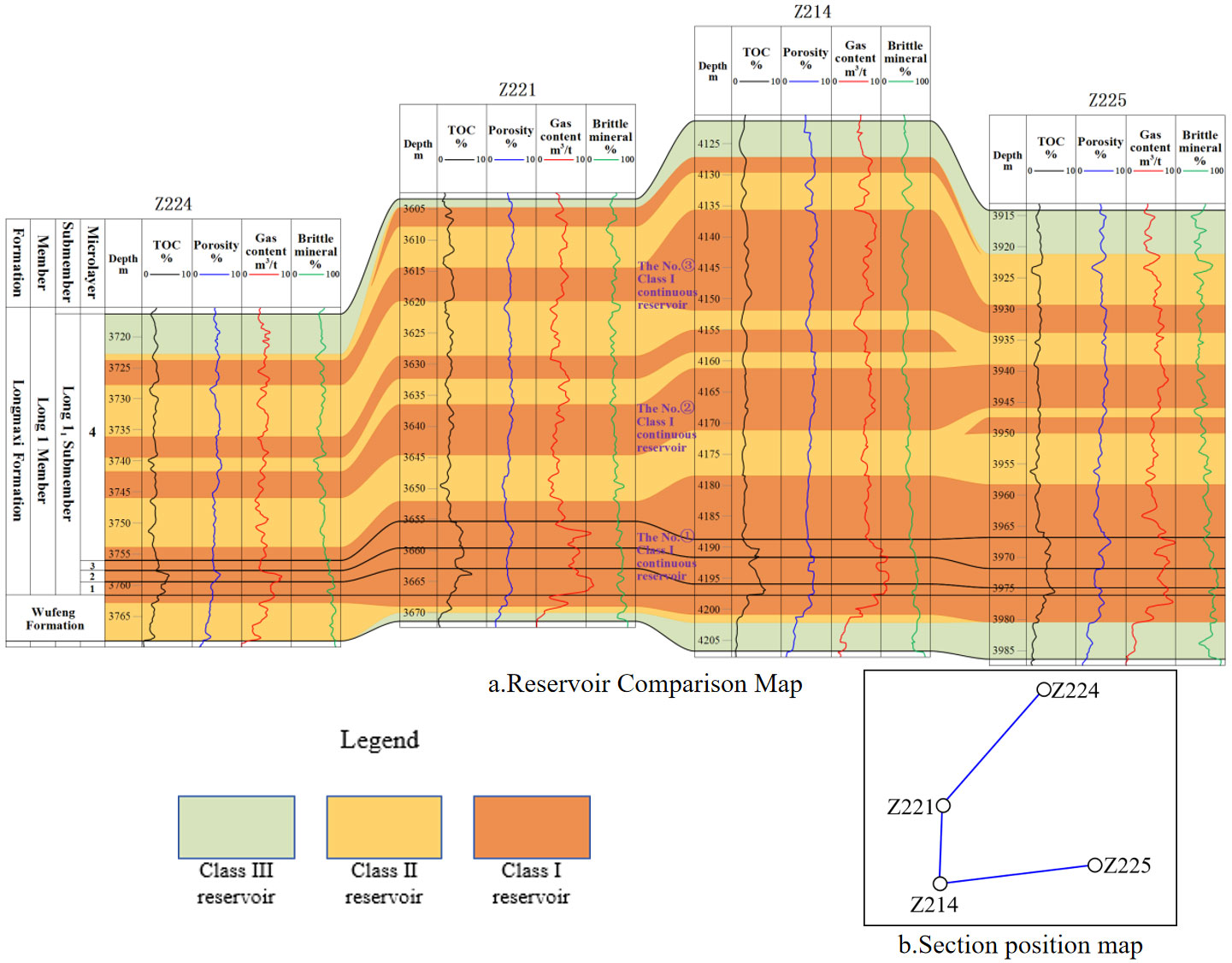
AB  - The deep shale gas ($\geq 3500$ m) in the Z205 well area is a critical exploration and development target in the Sichuan Basin. The shale gas reservoirs of the Upper Ordovician Wufeng Formation -- Lower Silurian Longmaxi Formation (Long 1$_1$ submember) in this area are characterized by deep burial and significant vertical and lateral heterogeneity. The Long 1$_1$ submember is subdivided into the Wufeng Formation, Long 1$_1^1$, Long 1$_1^2$, Long 1$_1^3$, and Long 1$_1^4$. This study conducts a detailed stratigraphic comparison based on integrated logging, core analysis, and analytical test data from the well area, clarifying the longitudinal and lateral distribution patterns of the reservoirs. Utilizing the TOPSIS algorithm, a reservoir classification and evaluation model integrating subjective weights and objective analysis is established. Reservoirs are classified as Class I when $C_i \geq 0.6$, Class II when $0.4 \leq C_i < 0.6$, Class III when $0.2 \leq C_i < 0.4$, and non-reservoir when $C_i < 0.2$. Results indicate significant directional variations in the thickness of each sub-layer within the Wufeng-Long 1$_1$ submember. The main reservoir intervals, Long 1$_1^1$ to Long 1$_1^3$, exhibit an overall thickening trend from north to south and west to east. At least three stable, laterally extensive Class I continuous reservoir units are identified vertically. The No. 1 Class I reservoir is primarily distributed from Long 1$_1^1$ to Long 1$_1^3$ and the basal part of Long 1$_1^4$, being most developed in the central synclinal areas (Huliongchang, Gaoshikuan, and northern Panlongchang Synclines). The No. 2 and No. 3 Class I reservoirs are mainly located within the middle-upper sections of Long 1$_1^4$. They are most developed within the Gaoshikuan Syncline, thinning towards the southern and northern margins. The research outcomes provide significant guidance and reference value for the subsequent exploration, development, and related research of shale gas in the Z205 well area and analogous regions.
SN  - 3069-3268
PB  - Institute of Central Computation and Knowledge
LA  - English
ER  -
@article{Gong2025Profession,
  author = {Xin Gong and Jia He and Jing Li and Ang Luo and Wen Cao and Xing Liu},
  title = {Professional Evaluation and Distribution Patterns of Shale Gas Reservoirs in the Wufeng Formation-Long 11 Sub-member of Well Block Z205, Sichuan Basin},
  journal = {Journal of Geo-Energy and Environment},
  year = {2025},
  volume = {1},
  number = {2},
  pages = {96-105},
  doi = {10.62762/JGEE.2025.365363},
  url = {https://www.icck.org/article/abs/JGEE.2025.365363},
  abstract = {The deep shale gas (\$\geq 3500\$ m) in the Z205 well area is a critical exploration and development target in the Sichuan Basin. The shale gas reservoirs of the Upper Ordovician Wufeng Formation -- Lower Silurian Longmaxi Formation (Long 1\$\_1\$ submember) in this area are characterized by deep burial and significant vertical and lateral heterogeneity. The Long 1\$\_1\$ submember is subdivided into the Wufeng Formation, Long 1\$\_1^1\$, Long 1\$\_1^2\$, Long 1\$\_1^3\$, and Long 1\$\_1^4\$. This study conducts a detailed stratigraphic comparison based on integrated logging, core analysis, and analytical test data from the well area, clarifying the longitudinal and lateral distribution patterns of the reservoirs. Utilizing the TOPSIS algorithm, a reservoir classification and evaluation model integrating subjective weights and objective analysis is established. Reservoirs are classified as Class I when \$C\_i \geq 0.6\$, Class II when \$0.4 \leq C\_i < 0.6\$, Class III when \$0.2 \leq C\_i < 0.4\$, and non-reservoir when \$C\_i < 0.2\$. Results indicate significant directional variations in the thickness of each sub-layer within the Wufeng-Long 1\$\_1\$ submember. The main reservoir intervals, Long 1\$\_1^1\$ to Long 1\$\_1^3\$, exhibit an overall thickening trend from north to south and west to east. At least three stable, laterally extensive Class I continuous reservoir units are identified vertically. The No. 1 Class I reservoir is primarily distributed from Long 1\$\_1^1\$ to Long 1\$\_1^3\$ and the basal part of Long 1\$\_1^4\$, being most developed in the central synclinal areas (Huliongchang, Gaoshikuan, and northern Panlongchang Synclines). The No. 2 and No. 3 Class I reservoirs are mainly located within the middle-upper sections of Long 1\$\_1^4\$. They are most developed within the Gaoshikuan Syncline, thinning towards the southern and northern margins. The research outcomes provide significant guidance and reference value for the subsequent exploration, development, and related research of shale gas in the Z205 well area and analogous regions.},
  keywords = {Sichuan basin, z205 well area, deep shale gas, TOPSIS algorithm, reservoir classification evaluation, reservoir distribution pattern},
  issn = {3069-3268},
  publisher = {Institute of Central Computation and Knowledge}
}
 Copyright © 2025 by the Author(s). Published by Institute of Central Computation and Knowledge. This article is an open access article distributed under the terms and conditions of the Creative Commons Attribution (CC BY) license (https://creativecommons.org/licenses/by/4.0/), which permits use, sharing, adaptation, distribution and reproduction in any medium or format, as long as you give appropriate credit to the original author(s) and the source, provide a link to the Creative Commons licence, and indicate if changes were made.

Portico
All published articles are preserved here permanently:
https://www.portico.org/publishers/icck/