


Journal of Geo-Energy and Environment
ISSN: 3069-3268 (Online)
Email: [email protected]



 Submit Manuscript
Edit a Special Issue
Submit Manuscript
Edit a Special Issue


TY  - JOUR
AU  - He, Zhengxing
AU  - Wang, Huajiang
AU  - Xiang, Jianming
AU  - Chen, Chao
PY  - 2025
DA  - 2025/11/03
TI  - Enhancing the Sustainability of Underground Battery Storage: A Robust SOC Estimation Model Against Thermal Variations for Green Energy Systems
JO  - Journal of Geo-Energy and Environment
T2  - Journal of Geo-Energy and Environment
JF  - Journal of Geo-Energy and Environment
VL  - 1
IS  - 2
SP  - 88
EP  - 95
DO  - 10.62762/JGEE.2025.689319
UR  - https://www.icck.org/article/abs/JGEE.2025.689319
KW  - underground energy storage
KW  - battery energy storage system (BESS)
KW  - state-of-charge (SOC) estimation
KW  - adversarial domain adaptation
KW  - transfer learning
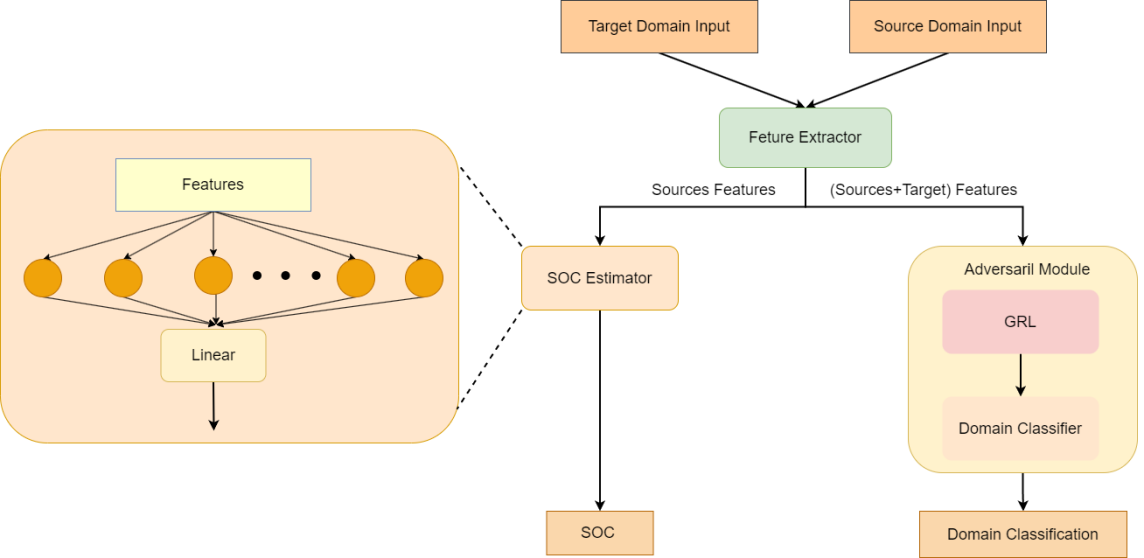
AB  - The widespread adoption of Battery Energy Storage Systems (BESS) is crucial for integrating intermittent renewable sources like solar and wind into the power grid, thereby advancing the goals of green energy. Deploying BESS underground offers a sustainable solution to land constraints and safety concerns. However, the dynamic and complex thermal environment underground severely challenges the accurate State-of-Charge (SOC) estimation, which is vital for the safety, longevity, and operational efficiency of BESS. Data-driven SOC models often suffer from performance degradation due to data distribution shifts caused by temperature fluctuations, especially when operational data for specific underground temperatures is sparse. To tackle this issue, this paper proposes a transfer learning model based on adversarial domain adaptation. The model utilizes a Gated Recurrent Unit (GRU) network for feature extraction and incorporates a Gradient Reversal Layer (GRL) to learn temperature-invariant features through an adversarial training mechanism. This approach effectively transfers knowledge from a data-rich source domain (standard temperature) to data-sparse target domains (varied underground temperatures). Comprehensive experiments on a public battery dataset covering a wide temperature range (-20 ◦C to 40 ◦C) demonstrate that our method significantly reduces SOC estimation errors under unseen thermal conditions compared to conventional models. The proposed solution enhances the reliability and sustainability of underground BESS, contributing to more resilient and efficient green energy infrastructure.
SN  - 3069-3268
PB  - Institute of Central Computation and Knowledge
LA  - English
ER  -
@article{He2025Enhancing,
  author = {Zhengxing He and Huajiang Wang and Jianming Xiang and Chao Chen},
  title = {Enhancing the Sustainability of Underground Battery Storage: A Robust SOC Estimation Model Against Thermal Variations for Green Energy Systems},
  journal = {Journal of Geo-Energy and Environment},
  year = {2025},
  volume = {1},
  number = {2},
  pages = {88-95},
  doi = {10.62762/JGEE.2025.689319},
  url = {https://www.icck.org/article/abs/JGEE.2025.689319},
  abstract = {The widespread adoption of Battery Energy Storage Systems (BESS) is crucial for integrating intermittent renewable sources like solar and wind into the power grid, thereby advancing the goals of green energy. Deploying BESS underground offers a sustainable solution to land constraints and safety concerns. However, the dynamic and complex thermal environment underground severely challenges the accurate State-of-Charge (SOC) estimation, which is vital for the safety, longevity, and operational efficiency of BESS. Data-driven SOC models often suffer from performance degradation due to data distribution shifts caused by temperature fluctuations, especially when operational data for specific underground temperatures is sparse. To tackle this issue, this paper proposes a transfer learning model based on adversarial domain adaptation. The model utilizes a Gated Recurrent Unit (GRU) network for feature extraction and incorporates a Gradient Reversal Layer (GRL) to learn temperature-invariant features through an adversarial training mechanism. This approach effectively transfers knowledge from a data-rich source domain (standard temperature) to data-sparse target domains (varied underground temperatures). Comprehensive experiments on a public battery dataset covering a wide temperature range (-20 ◦C to 40 ◦C) demonstrate that our method significantly reduces SOC estimation errors under unseen thermal conditions compared to conventional models. The proposed solution enhances the reliability and sustainability of underground BESS, contributing to more resilient and efficient green energy infrastructure.},
  keywords = {underground energy storage, battery energy storage system (BESS), state-of-charge (SOC) estimation, adversarial domain adaptation, transfer learning},
  issn = {3069-3268},
  publisher = {Institute of Central Computation and Knowledge}
}
 Copyright © 2025 by the Author(s). Published by Institute of Central Computation and Knowledge. This article is an open access article distributed under the terms and conditions of the Creative Commons Attribution (CC BY) license (https://creativecommons.org/licenses/by/4.0/), which permits use, sharing, adaptation, distribution and reproduction in any medium or format, as long as you give appropriate credit to the original author(s) and the source, provide a link to the Creative Commons licence, and indicate if changes were made.

Portico
All published articles are preserved here permanently:
https://www.portico.org/publishers/icck/