
Hydrocarbon Preservation Conditions and Evaluation of the Maokou Formation in the Leshan-Yibin Area, Southern Sichuan Basin, China





Article Information
Abstract
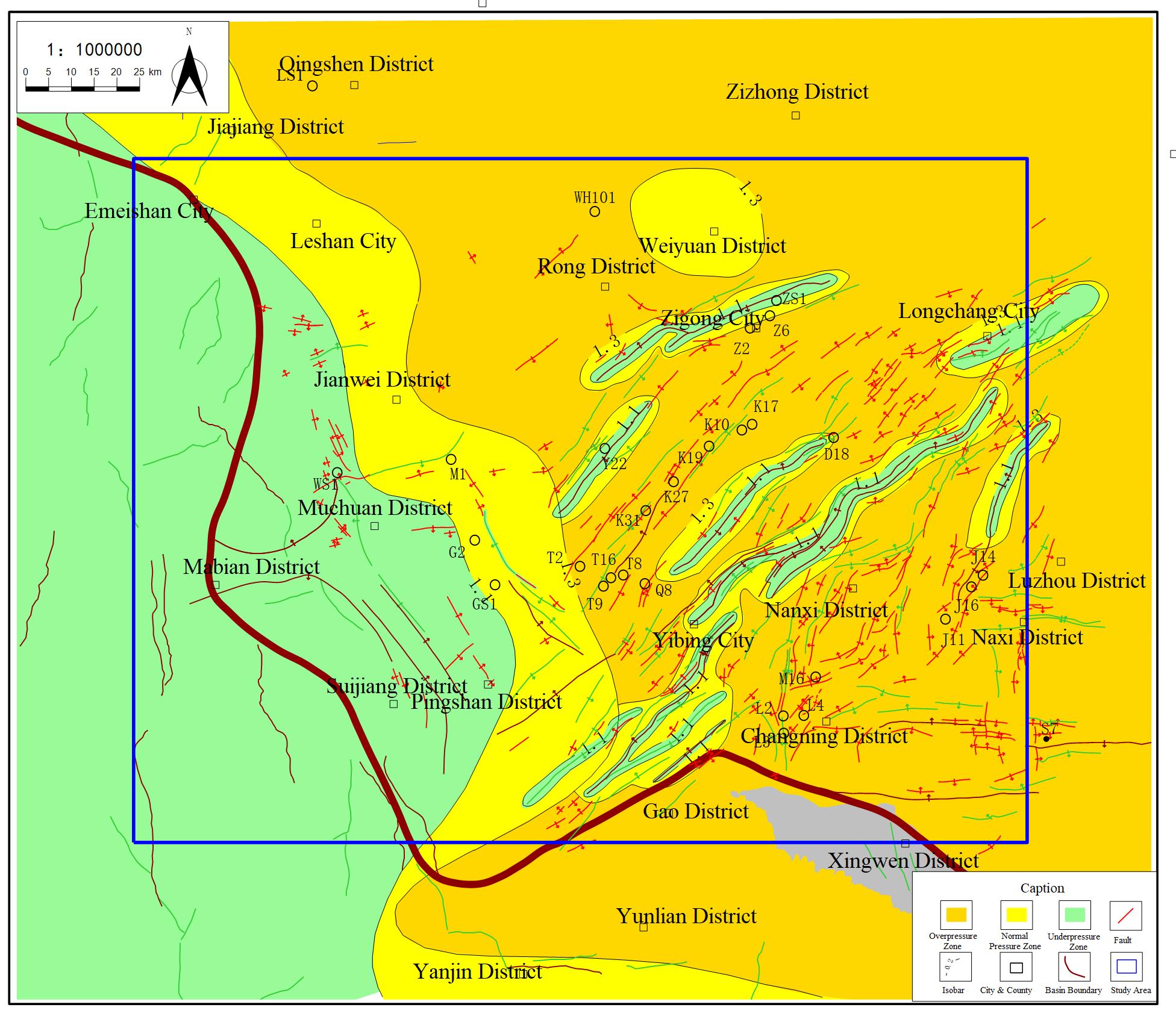
The southern Sichuan Basin is rich in natural gas and is a key area for hydrocarbon exploration. Due to multi-phase tectonic movements, structural characteristics and preservation conditions are critical for gas accumulation. Focusing on the Middle Permian Maokou Formation in the LY area, this study analyzes the regional and local structural framework to assess structural features and their impact on preservation conditions. Using indicators such as deformation intensity, caprock properties, formation water chemistry, and pressure coefficients, an evaluation system is established to identify favorable exploration zones. Results show that the LY area lies in the southern Sichuan low-steep structural belt, dominated by NE- and NWW-trending systems. Structural styles include back-thrust combinations, fault-propagation folds, and pop-up structures. Back-thrust and pop-up structures severely compromise preservation, while fault-propagation folds with small blind faults favor accumulation. Favorable preservation areas are mainly in Ziliujing and Kongtan, characterized by stable geology, thick caprocks, and younger exposed strata, indicating good sealing. Overall, the Maokou Formation exhibits favorable hydrocarbon accumulation conditions.
Graphical Abstract
Keywords
Data Availability Statement
Funding
Conflicts of Interest
AI Use Statement
Ethical Approval and Consent to Participate
References
- Wei, G., Yang, W., Liu, M., Xie, W., Jin, H., Wu, S., ... & Hao, C. (2020). Distribution rules, main controlling factors and exploration directions of giant gas fields in the Sichuan Basin. Natural Gas Industry B, 7(1), 1-12.
[CrossRef] [Google Scholar] - Bin, L. I., & Qiang, G. U. O. (2020). Influence of tectonic evolution of foreland basin in northwestern Sichuan Basin on Paleozoic marine hydrocarbon accumulation. Natural Gas Geoscience, 31(7), 993-1003.
[CrossRef] [Google Scholar] - Li, H., Qin, Q., Li, C., Radwan, A. E., Wang, J., & Fan, C. (2026). Quantitative characterization of complex multi-scale fractures in low-permeable sandstone reservoir: Insights from geological and mathematical approach. Geomech. Geophys. Geo-energ. Geo-resour., 12, 39.
[CrossRef] [Google Scholar] - Yang, G., Wang, H., Shen, H., Yang, Y., Jia, S., Chen, W., ... & Li, Y. (2015). Characteristics and exploration prospects of Middle Permian reservoirs in the Sichuan Basin. Natural Gas Industry B, 2(5), 399-405.
[CrossRef] [Google Scholar] - Huang, Y., Wang, A., Xiao, K., Lin, T., & Jin, W. (2022). Types and genesis of sweet spots in the tight sandstone gas reservoirs: Insights from the Xujiahe Formation, northern Sichuan Basin, China. Energy Geoscience, 3(3), 270-281.
[CrossRef] [Google Scholar] - Li, H., Qin, Q., Zhang, B., Ge, X., Hu, X., Fan, C., & Tang, H. (2020). Tectonic fracture formation and distribution in ultradeep marine carbonate gas reservoirs: A case study of the maokou formation in the jiulongshan gas field, sichuan basin, southwest China. Energy & Fuels, 34(11), 14132-14146.
[CrossRef] [Google Scholar] - Han, Y., Li, S., Han, W., Zhao, H., Liu, G., & Hao, Y. (2022). Pore characteristics of marl reservoir in Maokou Formation of Middle Permian, southeastern Sichuan Basin. Petroleum Geology & Experiment, 44(4), 666-676.
[CrossRef] [Google Scholar] - Huang, S., & Jiang, Q. (2019). Type and distribution of Mid-Permian Maokou Formation karst reservoirs in southern Sichuan Basin, SW China. Petroleum Exploration and Development, 46(2), 293-300.
[CrossRef] [Google Scholar] - Su, W., Jiang, Q., Chen, Z., Wang, Z., Jiang, H., Bian, C., ... & Wu, Y. (2015). Sequence stratigraphic features of the Middle Permian Maokou Formation in the Sichuan Basin and their controls on source rocks and reservoirs. Natural Gas Industry B, 2(5), 421-429.
[CrossRef] [Google Scholar] - YAO, H., ZHANG, P., HE, X., GAO, Y., GAO, Q., WAN, J., & ZHOU, D. (2025). Classification and exploration practices of shale gas reservoirs in the Wufeng-Longmaxi formations in the Sichuan Basin and its periphery. Oil & Gas Geology, 46(6), 1807-1822.
[CrossRef] [Google Scholar] - Fan, C., Nie, S., Li, H., Pan, Q., Shi, X., Qin, S., ... & Yang, Z. (2024). Geological characteristics and major factors controlling the high yield of tight oil in the Da’anzhai member of the western Gongshanmiao in the central Sichuan basin, China. Geomechanics and Geophysics for Geo-Energy and Geo-Resources, 10(1), 67.
[CrossRef] [Google Scholar] - Tingxu, Y. U., Tao, J. I. N., Yong, L. U. O., Zhongshan, Y. I. N., Hanyou, Z. H. U., & Mingcai, T. I. A. N. (2023). Coalbed methane resource potential and favorable area optimization in Yibin Area, Southern Sichuan. Coal Science and Technology, 50(9), 130-137. https://mtkxjs.com.cn/en/article/id/b3c39270-2c6f-4c2e-a355-dfe62cf9ad16
[Google Scholar] - Fan, C., Cao, H., Li, J., Xia, M., Liu, J., Liang, J., ... & Zhu, H. (2023). Comprehensive Evaluation of the Hydrocarbon Preservation Conditions in the Complex Tectonic Area of the Southwestern Sichuan Basin, China. Geofluids, 2023(1), 6415397.
[CrossRef] [Google Scholar] - Liu, J., Xia, M., Feng, B., Hu, J., Liang, J., Fan, C., ... & Li, H. (2025). Multi-Indicator comprehensive evaluation of middle Permian hydrocarbon preservation conditions in Western Sichuan and its exploration significance. Applied Earth Science, 25726838261429594.
[CrossRef] [Google Scholar] - Zeng, S., Qiu, N., Li, H., Gao, J., Long, K., Jia, J., & Zhu, X. (2023). Generation and distribution of overpressure in ultra-deep carbonate reservoirs controlled by intra-cratonic strike-slip faults: The Ordovician of Shuntuoguole area in the Tarim Basin. Marine and Petroleum Geology, 158, 106515.
[CrossRef] [Google Scholar] - Hao, B., Zhao, W., Hu, S., Shi, S., Gao, P., Wang, T., ... & Jiang, H. (2018). Bitumen formation of Cambrian Longwangmiao Formation in the central Sichuan and its implication for hydrocarbon accumulation. Petroleum Research, 3(1), 44-56.
[CrossRef] [Google Scholar] - Zhang, J., Liao, Y., Lu, P., Li, W., Zhu, K., Li, Z., Tian, T., Wu, J., Sun, W., Liu, S., & Deng, B. (2024). Three-stage hydrocarbon accumulations in the Middle Permian in the Central Sichuan Basin. Frontiers in Earth Science, 12, 1369986.
[CrossRef] [Google Scholar] - Shen, C., Yuan, H., Kuang, M., Zhang, X., Chen, C., Ye, Z., ... & Wang, B. (2024). Sources of natural gas in the Middle-Permian carbonate succession in the central-northern Sichuan Basin, Southwest China. Journal of Asian Earth Sciences, 268, 106164.
[CrossRef] [Google Scholar] - Xiong, L., Dong, X., Xiong, Y., Wang, T., Luo, S., Wang, B., Shi, K., Yao, Y., Wang, E., & Liu, B. (2025). Types and controlling factors of tight carbonate reservoirs in the Member 1 of Permian Maokou Formation in southern Sichuan Basin. Acta Petrolei Sinica, 46(10), 1875-1891.
[CrossRef] [Google Scholar] - Yang, R., Yang, X., Li, Y., Fan, C., Li, Y., Huang, Z., ... & Fan, X. (2025). Multi-stage dolomitization controlled by sedimentary facies and basement faults: Insights from the Middle Permian Maokou Formation of the Eastern Sichuan Basin, SW China. Marine and Petroleum Geology, 176, 107334.
[CrossRef] [Google Scholar] - Chen, Y., Qin, J., Wang, Y., & Wang, G. (2016). A discussion of hydrocarbon accumulation characteristics of carbonate rock in the Sichuan Basin. Journal of Computational and Theoretical Nanoscience, 13(12), 10428-10432.
[CrossRef] [Google Scholar] - Ouyang, S., Lü, X., Quan, H., Awan, R. S., Zhou, J., & Wang, R. (2023). Evolution process and factors influencing the tight carbonate caprock: Ordovician Yingshan Formation from the northern slope of the Tazhong uplift, Tarim Basin, China. Marine and Petroleum Geology, 147, 105998.
[CrossRef] [Google Scholar] - Mgimba, M. M., Jiang, S., & Mwakipunda, G. C. (2022). The identification of normal to underpressured formations in the Southeastern Sichuan basin. Journal of Petroleum Science and Engineering, 219, 111085.
[CrossRef] [Google Scholar] - Guisong, H. E., Bin, S. U. N., Yuqiao, G. A. O., Xiao, C. A. I., & Wei, X. I. A. (2025). Main factors controlling unconventional gas enrichment and high production in the first member of Permian Maokou Formation, southeastern Sichuan Basin, SW China. Petroleum Exploration and Development, 52(2), 408-421.
[CrossRef] [Google Scholar] - Xu, Q., Qiu, N., Liu, W., Shen, A., Wang, X., & Zhang, G. (2018). Characteristics of the temperature–pressure field evolution of Middle Permian system in the northwest of Sichuan Basin. Energy Exploration & Exploitation, 36(4), 705-726.
[CrossRef] [Google Scholar] - Yang, Y., Yang, Y., Wen, L., Zhang, X., Chen, C., Chen, K., ... & Xie, C. (2021). New progress and prospect of Middle Permian natural gas exploration in the Sichuan Basin. Natural Gas Industry B, 8(1), 35-47.
[CrossRef] [Google Scholar] - Xu, G., Gong, D., Yuan, H., Li, C., Wang, G., Hu, X., ... & Zhu, J. (2011). Fluid geochemical features and preservation conditions of marine stratum in typical structure of Jianghan plain area. Journal of Earth Science, 22(6), 768-779.
[CrossRef] [Google Scholar] - Tianyu, L., Jun, J., Ying, T., Rong, Z. H. U., & Yifeng, L. I. U. (2020). Chemical characteristics of formation water and the relationship with oil and gas preservation on northwestern margin of Junggar Basin. Petroleum Geology and Experiment, 42(6), 972-980.
[CrossRef] [Google Scholar] - Buryakovsky, L., Eremenko, N. A., Gorfunkel, M. V., & Chilingarian, G. V. (2005). Geology and geochemistry of oil and gas (Vol. 52). Elsevier.
[Google Scholar] - Zhao, W., Li, W., Yu, Z., Wang, X., Lu, X., & Feng, Q. (2020). Formation mechanisms of deep and ultra-deep overpressure caprocks and their relationships with super-large gas fields in the petroliferous basins of China. Natural Gas Industry B, 7(5), 443–452.
[CrossRef] [Google Scholar]
Cited By (15)
-
Yansong Wang, Yifan Gu, Junwei Pu, Lin Jiang, Yuqiang Jiang, Kun Zhang, Hu Li. A Review of Molecular Simulation Techniques Applied in Microscopic Occurrence Patterns of Shale Gas.
ACS Earth and Space Chemistry, 2026 , 10 (6).
[CrossRef] -
Yuan He, Chenglong Li, Yong Li, Hongyu Long, Ya Zhang, Chi Zhang, Huachuan Jiang, Di Cheng. Characteristics and Sedimentary‐Diagenetic Model of Carbonate Rocks From Member 1 of the Cambrian Canglangpu Formation in the Sichuan Basin, SW China.
Journal of Petroleum Geology, 2026 .
[CrossRef] -
Yongjiang Yu, Ning Liu, Guoning Zhang, Jiaming Liu, Jijie Wei, Hu Li. Damage characteristics and constitutive modeling of coal under real-time temperatures.
PLOS One, 2026 , 21 (7).
[CrossRef] -
Hu Li, Qingchao Li. Multi-scale fractures and faults in tight reservoirs: from characterization to engineering applications.
Scientific Reports, 2026 , 16 (1).
[CrossRef] -
Zhijun Pan, Hongye Feng, Tao Long, Zhe Cao, Xin Wang, Xu Han, Jian Han, Xiaohe Zhang, Yuqing Wang, Hongjian Zhu. Raman spectroscopy characterization and maturity evolution of organic carbon in shale-related fault rocks.
Frontiers in Earth Science, 2026 , 14 .
[CrossRef] -
Lijun Ran, Geyun Xie, Xin Hu, Jing Luo, Gang Yuan, Kaifa Li. Sedimentation–diagenesis–tectonics coupling and its control on gas reservoir development in Sinian carbonates, western Deyang-Anyue Rift Trough, Sichuan Basin.
Frontiers in Earth Science, 2026 , 14 .
[CrossRef] -
Wei-Shi Tang, Kun Zhang, Xue-Ying Wang, Hu Li, Jing-Hao Fu, Hu-Lin Niu, Yan Song, Cheng-Zao Jia, Yuan-Yuan Wang. Coupled mechanism between siliceous mineral evolution and connected pore development in deep marine shale.
Petroleum Science, 2026 .
[CrossRef] -
Shanchi Chen, Fengming Xu, Rui Zhang, Bingxi Li, Xiangyu Li. Topological structure of fault network system and control factors of reservoirs.
Frontiers in Earth Science, 2026 , 14 .
[CrossRef] -
Jing Li, Wenping Liu, Yadong Yang, Xunxi Qiu, Xin Gong, Hu Li, Jia He, Xing Liu, Zhi Gao, Ang Luo, Cheng Yang. Main Controlling Factors and Three-Dimensional Development Potential of Deep to Ultra-Deep Shale Gas in the Luzhou Area, Sichuan Basin.
Processes, 2026 , 14 (9).
[CrossRef] -
Jinfeng Zhang, Chenggang Liang, Yiwei Chen, Tianlu Xu, Jinhua Liu, Weishi Tang, Hangfeng Gou. Reservoir characteristics and sweet spot prediction of mixed tight oil reservoirs in the saline lacustrine Lucaogou Formation, Jimusaer Sag, Junggar Basin, China.
Applied Earth Science: Transactions of the Institutions of Mining and Metallurgy, 2026 .
[CrossRef] -
Wenhao Zhang, Dandan Wang, Shizhen Li, Xingui Zhou, Yuanlin Meng, Yunbo Zhang, Minfei Wang, Hu Li. Geochemical characteristics and hydrocarbon generation potential of lower cretaceous source rocks in the eastern peripheral basin group of the Songliao Basin, Northeastern China.
Frontiers in Earth Science, 2026 , 14 .
[CrossRef] -
Qibing Wen, Liangjun Xu, Licheng Yang, Xin Chen, Xinrui Yang, Siyuan Chang, Lu Xu, Huilin Li, Tong Xia, Dongxi Liu, Ziyang Tang. Shale reservoir characteristics and exploration potential of the Permian Wujiaoping Formation in the Nanya Syncline, Sichuan Basin, China.
Applied Earth Science: Transactions of the Institutions of Mining and Metallurgy, 2026 .
[CrossRef] -
Yibo Li. Directional permeability anisotropy of 1 mm3 sandstone digital sub-samples under fixed micro-CT field of view and its relationship with tortuosity anisotropy.
Scientific Reports, 2026 , 16 (1).
[CrossRef] -
Xia Shen, Zhongcheng Li, Liang Yang, Hongchao Liu, Lei Song, Jijun Li. Origin and Enrichment Conditions of Shallow Shale Gas in the Qing 1 Member, Southeastern Uplift, Songliao Basin.
Journal of Petroleum Geology, 2026 , 49 (4).
[CrossRef] -
Hao Ma, Junbin Chen, Nianfeng Li, Hua Chen, Bin Liu, Siqi Xiao. Sedimentary Characteristics of the Wufeng–Longmaxi Formation Shales and Their Controlling Mechanisms on Shale Gas Accumulation in the Mugan Syncline, Northeastern Yunnan, China.
Processes, 2026 , 14 (11).
[CrossRef]
Cite This Article
TY  - JOUR
AU  - Qin, Sumei
AU  - Lian, Chengbo
AU  - Geng, Chao
AU  - Dai, Yuzhe
AU  - Qu, Fang
AU  - Fan, Cunhui
AU  - Li, Hu
PY  - 2026
DA  - 2026/04/16
TI  - Hydrocarbon Preservation Conditions and Evaluation of the Maokou Formation in the Leshan-Yibin Area, Southern Sichuan Basin, China
JO  - Journal of Geo-Energy and Environment
T2  - Journal of Geo-Energy and Environment
JF  - Journal of Geo-Energy and Environment
VL  - 2
IS  - 2
SP  - 132
EP  - 146
DO  - 10.62762/JGEE.2026.299392
UR  - https://www.icck.org/article/abs/jgee.2026.299392
KW  - structural characteristics
KW  - preservation conditions
KW  - Maokou Formation
KW  - evaluation system
KW  - favorable area optimization
KW  - LY area
AB  - The southern Sichuan Basin is rich in natural gas and is a key area for hydrocarbon exploration. Due to multi-phase tectonic movements, structural characteristics and preservation conditions are critical for gas accumulation. Focusing on the Middle Permian Maokou Formation in the LY area, this study analyzes the regional and local structural framework to assess structural features and their impact on preservation conditions. Using indicators such as deformation intensity, caprock properties, formation water chemistry, and pressure coefficients, an evaluation system is established to identify favorable exploration zones. Results show that the LY area lies in the southern Sichuan low-steep structural belt, dominated by NE- and NWW-trending systems. Structural styles include back-thrust combinations, fault-propagation folds, and pop-up structures. Back-thrust and pop-up structures severely compromise preservation, while fault-propagation folds with small blind faults favor accumulation. Favorable preservation areas are mainly in Ziliujing and Kongtan, characterized by stable geology, thick caprocks, and younger exposed strata, indicating good sealing. Overall, the Maokou Formation exhibits favorable hydrocarbon accumulation conditions.
SN  - 3069-3268
PB  - Institute of Central Computation and Knowledge
LA  - English
ER  -
@article{Qin2026Hydrocarbo,
  author = {Sumei Qin and Chengbo Lian and Chao Geng and Yuzhe Dai and Fang Qu and Cunhui Fan and Hu Li},
  title = {Hydrocarbon Preservation Conditions and Evaluation of the Maokou Formation in the Leshan-Yibin Area, Southern Sichuan Basin, China},
  journal = {Journal of Geo-Energy and Environment},
  year = {2026},
  volume = {2},
  number = {2},
  pages = {132-146},
  doi = {10.62762/JGEE.2026.299392},
  url = {https://www.icck.org/article/abs/jgee.2026.299392},
  abstract = {The southern Sichuan Basin is rich in natural gas and is a key area for hydrocarbon exploration. Due to multi-phase tectonic movements, structural characteristics and preservation conditions are critical for gas accumulation. Focusing on the Middle Permian Maokou Formation in the LY area, this study analyzes the regional and local structural framework to assess structural features and their impact on preservation conditions. Using indicators such as deformation intensity, caprock properties, formation water chemistry, and pressure coefficients, an evaluation system is established to identify favorable exploration zones. Results show that the LY area lies in the southern Sichuan low-steep structural belt, dominated by NE- and NWW-trending systems. Structural styles include back-thrust combinations, fault-propagation folds, and pop-up structures. Back-thrust and pop-up structures severely compromise preservation, while fault-propagation folds with small blind faults favor accumulation. Favorable preservation areas are mainly in Ziliujing and Kongtan, characterized by stable geology, thick caprocks, and younger exposed strata, indicating good sealing. Overall, the Maokou Formation exhibits favorable hydrocarbon accumulation conditions.},
  keywords = {structural characteristics, preservation conditions, Maokou Formation, evaluation system, favorable area optimization, LY area},
  issn = {3069-3268},
  publisher = {Institute of Central Computation and Knowledge}
}
Publisher's Note
ICCK stays neutral with regard to jurisdictional claims in published maps and institutional affiliations.
Rights and Permissions
 Copyright © 2026 by the Author(s). Published by Institute of Central Computation and Knowledge. This article is an open access article distributed under the terms and conditions of the Creative Commons Attribution (CC BY) license (https://creativecommons.org/licenses/by/4.0/), which permits use, sharing, adaptation, distribution and reproduction in any medium or format, as long as you give appropriate credit to the original author(s) and the source, provide a link to the Creative Commons licence, and indicate if changes were made.


Portico
