

The Application Prospects of Embodied Intelligence in Oil and Gas Field Laboratories



Article Information
Abstract
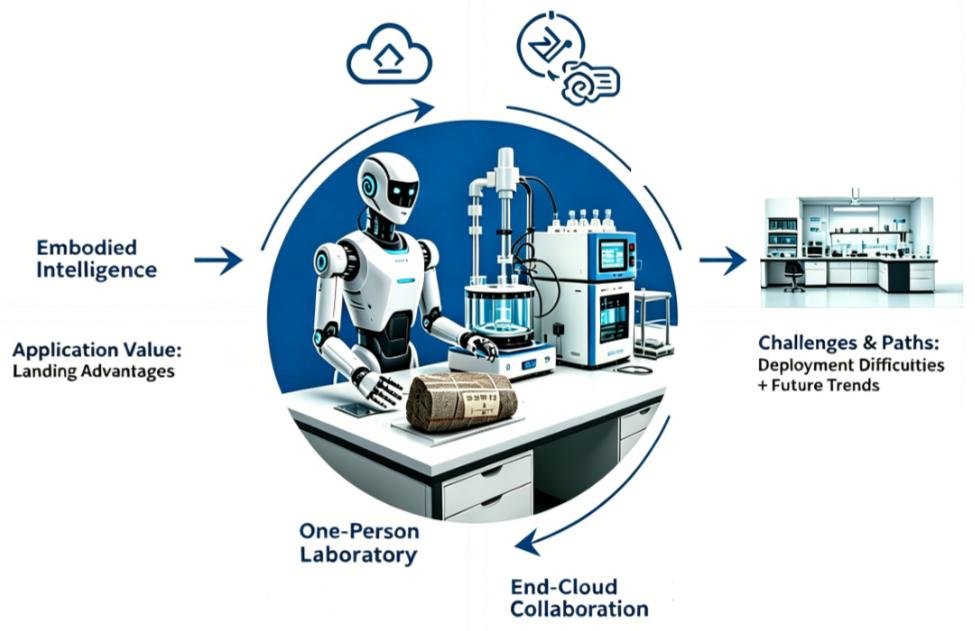
Oil and gas testing laboratories have long encountered structural challenges including unclear functional roles, the disconnection between research and testing, and ongoing talent attrition, necessitating an intelligent transformation. Embodied intelligence, as an emerging paradigm integrating AI and robotics, features a local inference model of "cloud-device collaboration" that overcomes the limitations of traditional AI detached from the physical environment. Embodied intelligence enables laboratories to transition from "passive testing" to "proactive, intelligence-driven operations". Nonetheless, current deployment remains constrained by high costs and limited technological maturity. A phased, pilot-first implementation strategy is therefore recommended, prioritizing application validation in scenarios such as repetitive testing and high-risk operations. On this basis, the AI-driven "One-Person Laboratory" (OPL)—as a concrete manifestation of the "one-person company" concept within the scientific research domain—is expected to foster a new ecosystem of smart laboratories characterized by human-AI collaboration and complementary strengths, serving as a powerful supplement to the existing research system.
Graphical Abstract
Keywords
Data Availability Statement
Funding
Conflicts of Interest
AI Use Statement
Ethical Approval and Consent to Participate
References
- Wang, J., Luo, X., Zhang, X., & Du, S. (2025). Artificial General Intelligence (AGI) Applications and Prospect in Oil and Gas Reservoir Development. Processes, 13(5), 1413.
[CrossRef] [Google Scholar] - Feng, X., Peng, X., Li, L., Mei, Q., Zhao, Z., Li, Y., Li, T., Zhang, C., & Qi, T. (2023). Artificial intelligence techniques and their application to gas reservoir engineering. Natural Gas Exploration and Development, 46(1), 65–76.
[CrossRef] [Google Scholar] - Kang, C., Haotian, P., Juncheng, D., Qingsong, T., Bing, H., Cong, T., & Song, H. (2022). Relation of effective seismic-data bandwidth to resolution. Natural Gas Exploration and Development, 45(4), 33-39.
[CrossRef] [Google Scholar] - Hui, G., Ren, Y., Bi, J., Wang, M., & Liu, C. (2025). Artificial intelligence applications and challenges in oil and gas exploration and development. Advances in Geo-Energy Research, 17(3), 179-183.
[CrossRef] [Google Scholar] - Liang, X., Xing, Z., Gong, H., Wang, G., Lu, X., & Han, G. (2025). Intelligent fault diagnosis method for plunger lift systems integrating knowledge graph constraints. Energy Reports, 14, 5137-5156.
[CrossRef] [Google Scholar] - Yang, J., Lin, C. F., Zou, C., Yu, Z., Wang, Y., & Qin, Y. (2024). Advances in high-performance optical frequency domain distributed fiber optical measuring and sensing technology. Acta Optica Sinica, 44(1), 0106002. https://www.researching.cn/articles/OJ4ed158d430808697
[Google Scholar] - Lu, P., Lalam, N., Badar, M., Liu, B., Chorpening, B. T., Buric, M. P., & Ohodnicki, P. R. (2019). Distributed optical fiber sensing: Review and perspective. Applied physics reviews, 6(4), 041302.
[CrossRef] [Google Scholar] - Taifa, I. W., Mahundi, R. A., & Mahabi, V. (2025). Exploring the applicability of industry 4.0 technologies in oil and gas pipeline leakage monitoring: Results from an empirical study. Journal of Industrial Information Integration, 46, 100857.
[CrossRef] [Google Scholar] - AlAbdouli, M. A., & Al-Shihabi, S. (2025). Artificial Intelligence and Its Performance Impacts in the Oil and Gas Industry: Challenges, Insights, and Evaluation Approaches. Results in Engineering, 107636.
[CrossRef] [Google Scholar] - Wang, X., Wang, Y., Yang, J., Wang, X., Meng, Z., Liu, Z., & Wang, F. Y. (2024). A paradigm shift for modeling and operation of oil and gas: From industry 4.0 in CPS to industry 5.0 in CPSS. IEEE Transactions on Industrial Informatics, 20(7), 9186-9193.
[CrossRef] [Google Scholar] - Wanasinghe, T. R., Wroblewski, L., Petersen, B. K., Gosine, R. G., James, L. A., De Silva, O., ... & Warrian, P. J. (2020). Digital twin for the oil and gas industry: Overview, research trends, opportunities, and challenges. IEEE Access, 8, 104175-104197.
[CrossRef] [Google Scholar] - Liu, H., Ren, Y. L., Li, X., Hu, Y. X., Wu, J. P., Li, B., ... & Fang, W. K. (2022). Rock thin-section analysis and identification based on artificial intelligent technique. Petroleum Science, 19(4), 1605-1621.
[CrossRef] [Google Scholar] - Transeth, A. A., Schjølberg, I., Lekkas, A. M., Risholm, P., Mohammed, A., Skaldebø, M., ... & Py, F. (2022). Autonomous subsea intervention (SEAVENTION). IFAC-PapersOnLine, 55(31), 387-394.
[CrossRef] [Google Scholar] - Javaid, M., Haleem, A., Singh, R. P., & Suman, R. (2021). Substantial capabilities of robotics in enhancing industry 4.0 implementation. Cognitive Robotics, 1, 58-75.
[CrossRef] [Google Scholar] - Duan, J., Yu, S., Tan, H. L., Zhu, H., & Tan, C. (2022). A survey of embodied ai: From simulators to research tasks. IEEE Transactions on Emerging Topics in Computational Intelligence, 6(2), 230-244.
[CrossRef] [Google Scholar] - Ji, T., Luo, Y., Sun, F., Jing, M., He, F., & Huang, W. (2022). When to update your model: Constrained model-based reinforcement learning. Advances in neural information processing systems, 35, 23150-23163.
[Google Scholar] - Cao, J., Yu, Z., Zhu, B., Cao, M., & Yang, J. (2025). Construction and efficiency analysis of an embedded system-based verification platform for edge computing. Scientific reports, 15(1), 26114.
[CrossRef] [Google Scholar] - Qiu, T., Chi, J., Zhou, X., Ning, Z., Atiquzzaman, M., & Wu, D. O. (2020). Edge computing in industrial internet of things: Architecture, advances and challenges. IEEE communications surveys & tutorials, 22(4), 2462-2488.
[CrossRef] [Google Scholar] - Yang, W., & Pan, C. (2025). Edge Network Data Scheduling Optimization Method Integrating Improved Jaya and Cluster Center Selection Algorithm. Journal of Electronics & Information Technology, 47(11), 4405–4418. http://dx.doi.org/10.11999/JEIT250317
[Google Scholar] - Barbone, A., Bicocchi, N., Martinelli, M., Morandi, R., & Picone, M. (2026). On-device AI and digital twins: A synergistic approach to intelligent cyber-physical systems. Future Generation Computer Systems, 175, 108068.
[CrossRef] [Google Scholar] - Ren, J., Zhang, D., He, S., Zhang, Y., & Li, T. (2019). A survey on end-edge-cloud orchestrated network computing paradigms: Transparent computing, mobile edge computing, fog computing, and cloudlet. ACM Computing Surveys (CSUR), 52(6), 1-36.
[CrossRef] [Google Scholar] - Chen, J., & Ran, X. (2019). Deep learning with edge computing: A review. Proceedings of the IEEE, 107(8), 1655-1674.
[CrossRef] [Google Scholar] - Yousefpour, A., Fung, C., Nguyen, T., Kadiyala, K., Jalali, F., Niakanlahiji, A., ... & Jue, J. P. (2019). All one needs to know about fog computing and related edge computing paradigms: A complete survey. Journal of systems architecture, 98, 289-330.
[CrossRef] [Google Scholar] - Dang, L., He, J., Lui, M., Huang, M., & Kong, B. (2022). Innovative development of laboratory in oil and gas companies: An example from PetroChina Southwest Oil & Gasfield Company. Natural Gas Technology and Economy, 16(3), 71–77. http://www.trqjszz.com/EN/10.3969/j.issn.2095-1132.2022.03.011
[Google Scholar] - Curtis, M. E., Sondergeld, C. H., Ambrose, R. J., & Rai, C. S. (2012). Microstructural investigation of gas shales in two and three dimensions using nanometer-scale resolution imaging. AAPG bulletin, 96(4), 665-677.
[CrossRef] [Google Scholar] - Josh, M., Esteban, L., Delle Piane, C., Sarout, J., Dewhurst, D. N., & Clennell, M. B. (2012). Laboratory characterisation of shale properties. Journal of Petroleum Science and Engineering, 88, 107-124.
[CrossRef] [Google Scholar] - Floridi, L., Cowls, J., Beltrametti, M., Chatila, R., Chazerand, P., Dignum, V., ... & Vayena, E. (2018). AI4People—An ethical framework for a good AI society: Opportunities, risks, principles, and recommendations. Minds and machines, 28(4), 689-707.
[CrossRef] [Google Scholar] - Bryson, J. J. (2010). Robots should be slaves. Close engagements with artificial companions: Key social, psychological, ethical and design issues, 8(January 2010), 63-74.
[CrossRef] [Google Scholar] - Börner, K., Contractor, N., Falk-Krzesinski, H. J., Fiore, S. M., Hall, K. L., Keyton, J., ... & Uzzi, B. (2010). A multi-level systems perspective for the science of team science. Science translational medicine, 2(49), 49cm24-49cm24.
[CrossRef] [Google Scholar]
Cite This Article
TY  - JOUR
AU  - Kang, Qiang
AU  - He, Jiahuan
AU  - Tian, Xingwang
AU  - Yao, Hongyu
AU  - Tang, Ruilong
AU  - Tan, Jie
AU  - Yang, Hang
PY  - 2026
DA  - 2026/06/09
TI  - The Application Prospects of Embodied Intelligence in Oil and Gas Field Laboratories
JO  - Journal of Geo-Energy and Environment
T2  - Journal of Geo-Energy and Environment
JF  - Journal of Geo-Energy and Environment
VL  - 2
IS  - 3
SP  - 178
EP  - 184
DO  - 10.62762/JGEE.2026.553515
UR  - https://www.icck.org/article/abs/JGEE.2026.553515
KW  - laboratory
KW  - embodied intelligence
KW  - analytical testing
KW  - application prospects
KW  - challenges
AB  - Oil and gas testing laboratories have long encountered structural challenges including unclear functional roles, the disconnection between research and testing, and ongoing talent attrition, necessitating an intelligent transformation. Embodied intelligence, as an emerging paradigm integrating AI and robotics, features a local inference model of "cloud-device collaboration" that overcomes the limitations of traditional AI detached from the physical environment. Embodied intelligence enables laboratories to transition from "passive testing" to "proactive, intelligence-driven operations". Nonetheless, current deployment remains constrained by high costs and limited technological maturity. A phased, pilot-first implementation strategy is therefore recommended, prioritizing application validation in scenarios such as repetitive testing and high-risk operations. On this basis, the AI-driven "One-Person Laboratory" (OPL)—as a concrete manifestation of the "one-person company" concept within the scientific research domain—is expected to foster a new ecosystem of smart laboratories characterized by human-AI collaboration and complementary strengths, serving as a powerful supplement to the existing research system.
SN  - 3069-3268
PB  - Institute of Central Computation and Knowledge
LA  - English
ER  -
@article{Kang2026The,
  author = {Qiang Kang and Jiahuan He and Xingwang Tian and Hongyu Yao and Ruilong Tang and Jie Tan and Hang Yang},
  title = {The Application Prospects of Embodied Intelligence in Oil and Gas Field Laboratories},
  journal = {Journal of Geo-Energy and Environment},
  year = {2026},
  volume = {2},
  number = {3},
  pages = {178-184},
  doi = {10.62762/JGEE.2026.553515},
  url = {https://www.icck.org/article/abs/JGEE.2026.553515},
  abstract = {Oil and gas testing laboratories have long encountered structural challenges including unclear functional roles, the disconnection between research and testing, and ongoing talent attrition, necessitating an intelligent transformation. Embodied intelligence, as an emerging paradigm integrating AI and robotics, features a local inference model of "cloud-device collaboration" that overcomes the limitations of traditional AI detached from the physical environment. Embodied intelligence enables laboratories to transition from "passive testing" to "proactive, intelligence-driven operations". Nonetheless, current deployment remains constrained by high costs and limited technological maturity. A phased, pilot-first implementation strategy is therefore recommended, prioritizing application validation in scenarios such as repetitive testing and high-risk operations. On this basis, the AI-driven "One-Person Laboratory" (OPL)—as a concrete manifestation of the "one-person company" concept within the scientific research domain—is expected to foster a new ecosystem of smart laboratories characterized by human-AI collaboration and complementary strengths, serving as a powerful supplement to the existing research system.},
  keywords = {laboratory, embodied intelligence, analytical testing, application prospects, challenges},
  issn = {3069-3268},
  publisher = {Institute of Central Computation and Knowledge}
}
Article Metrics
Publisher's Note
ICCK stays neutral with regard to jurisdictional claims in published maps and institutional affiliations.
Rights and Permissions
 Copyright © 2026 by the Author(s). Published by Institute of Central Computation and Knowledge. This article is an open access article distributed under the terms and conditions of the Creative Commons Attribution (CC BY) license (https://creativecommons.org/licenses/by/4.0/), which permits use, sharing, adaptation, distribution and reproduction in any medium or format, as long as you give appropriate credit to the original author(s) and the source, provide a link to the Creative Commons licence, and indicate if changes were made.


Portico
