
B2-GraftingNet: A Hybrid Deep-Machine Learning Framework with Explainable AI for Automated Grape Leaf Disease Detection





Article Information
Abstract
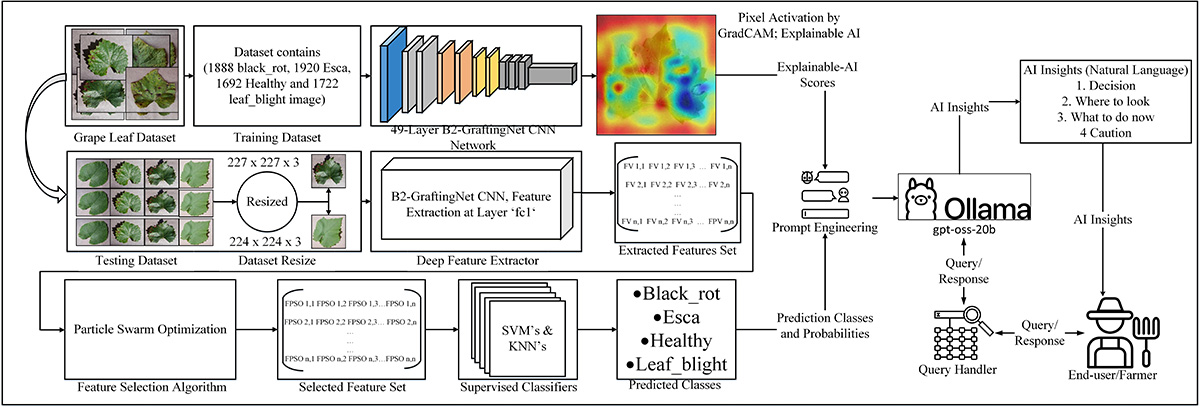
Plant diseases increasingly threaten global agriculture due to climate change, yet manual diagnosis remains challenging. We introduce B2-GraftingNet, a lightweight deep-learning framework for automated grape-leaf disease detection that combines a VGG16 backbone with Inception-style blocks to learn robust multi-scale cues. Binary Particle Swarm Optimization selects the most informative features before classification. On the public Kaggle grape-leaf dataset, a cubic SVM classifier achieves 99.56% peak accuracy, surpassing standard pretrained CNNs (VGG16/VGG19: 34.04%, Xception: 97.95%, Darknet: 94.91%, ResNet-50: 98.44%) while being faster and lighter. For transparency, we incorporate Grad-CAM, LIME, and occlusion-sensitivity with a local 20B-parameter LLM via Ollama, which processes ROI-aware XAI summaries and provides plain-language guidance in structured sections (verdict, where to look, what to do next, caution) without suggesting specific treatments.
Graphical Abstract
Keywords
Data Availability Statement
Funding
Conflicts of Interest
AI Use Statement
Ethical Approval and Consent to Participate
References
- Intelligence, M. (2024, February 15). Grapes—Market Share Analysis, Industry Trends & Statistics, Growth Forecasts (2024—2029). Retrieved from https://www.giiresearch.com/report/moi1443985-grapes-market-share-analysis-industry-trends.html
[Google Scholar] - Guha, A. (2025). Common Diseases of Field Crops and Their Management. Educohack Press.
[Google Scholar] - Wilcox, W. F., Gubler, W. D., & Uyemoto, J. K. (2015). Compendium of Grape Diseases, Disorders, and Pests (2nd ed.). APS Press.
[Google Scholar] - Ammoniaci, M., Kartsiotis, S. P., Perria, R., & Storchi, P. (2021). State of the art of monitoring technologies and data processing for precision viticulture. Agriculture, 11(3), 201.
[CrossRef] [Google Scholar] - Ferro, M. V., & Catania, P. (2023). Technologies and innovative methods for precision viticulture: a comprehensive review. Horticulturae, 9(3), 399.
[CrossRef] [Google Scholar] - Moreno, H., & Andújar, D. (2023). Proximal sensing for geometric characterization of vines: A review of the latest advances. Computers and Electronics in Agriculture, 210, 107901.
[CrossRef] [Google Scholar] - Anastasiou, E., Fountas, S., Voulgaraki, M., Psiroukis, V., Koutsiaras, M., Kriezi, O., ... & Gómez-Barbero, M. (2023). Precision farming technologies for crop protection: A meta-analysis. Smart Agricultural Technology, 5, 100323.
[CrossRef] [Google Scholar] - Bhat, S. A., & Huang, N. F. (2021). Big data and ai revolution in precision agriculture: Survey and challenges. IEEE Access, 9, 110209-110222.
[CrossRef] [Google Scholar] - Olorunfemi, B. O., Nwulu, N. I., Adebo, O. A., & Kavadias, K. A. (2024). Advancements in machine visions for fruit sorting and grading: A bibliometric analysis, systematic review, and future research directions. Journal of Agriculture and Food Research, 16, 101154.
[CrossRef] [Google Scholar] - Habib, M. T., Arif, M. A. I., Shorif, S. B., Uddin, M. S., & Ahmed, F. (2021). Machine vision-based fruit and vegetable disease recognition: a review. Computer Vision and Machine Learning in Agriculture, 143-157.
[CrossRef] [Google Scholar] - Kuan, Y. N., Goh, K. M., & Lim, L. L. (2025). Systematic review on machine learning and computer vision in precision agriculture: Applications, trends, and emerging techniques. Engineering Applications of Artificial Intelligence, 148, 110401.
[CrossRef] [Google Scholar] - Kamilaris, A., & Prenafeta-Boldú, F. X. (2018). Deep learning in agriculture: A survey. Computers and Electronics in Agriculture, 147, 70–90.
[CrossRef] [Google Scholar] - Sladojevic, S., Arsenovic, M., Anderla, A., Culibrk, D., & Stefanovic, D. (2016). Deep neural networks based recognition of plant diseases by leaf image classification. Computational intelligence and neuroscience, 2016(1), 3289801.
[CrossRef] [Google Scholar] - Mavridou, E., Vrochidou, E., Papakostas, G. A., Pachidis, T., & Kaburlasos, V. G. (2019). Machine vision systems in precision agriculture for crop farming. Journal of Imaging, 5(12), 89.
[CrossRef] [Google Scholar] - Minhans, K., Sharma, S., Sheikh, I., Alhewairini, S. S., & Sayyed, R. (2025). Artificial Intelligence and Plant Disease Management: An Agro-Innovative Approach. Journal of Phytopathology, 173(3), e70084.
[CrossRef] [Google Scholar] - Jafar, A., Bibi, N., Naqvi, R. A., Sadeghi-Niaraki, A., & Jeong, D. (2024). Revolutionizing agriculture with artificial intelligence: plant disease detection methods, applications, and their limitations. Frontiers in Plant Science, 15, 1356260.
[CrossRef] [Google Scholar] - Sharma, S., Gahlawat, V. K., Rahul, K., Mor, R. S., & Malik, M. (2021). Sustainable innovations in the food industry through artificial intelligence and big data analytics. Logistics, 5(4), 66.
[CrossRef] [Google Scholar] - Mohanty, S. P., Hughes, D. P., & Salathé, M. (2016). Using deep learning for image-based plant disease detection. Frontiers in plant science, 7, 1419.
[CrossRef] [Google Scholar] - Too, E. C., Yujian, L., Njuki, S., & Yingchun, L. (2019). A comparative study of fine-tuning deep learning models for plant disease identification. Computers and Electronics in Agriculture, 161, 272-279.
[CrossRef] [Google Scholar] - Sharma, K., & Shivandu, S. K. (2024). Integrating artificial intelligence and Internet of Things (IoT) for enhanced crop monitoring and management in precision agriculture. Sensors International, 5, 100292.
[CrossRef] [Google Scholar] - Cai, C., Wang, Q., Cai, W., Yang, Y., Hu, Y., Li, L., Wang, Y., & Zhou, G. (2023). Identification of grape leaf diseases based on VN-BWT and Siamese DWOAM-DRNet. Engineering Applications of Artificial Intelligence, 123, 106341.
[CrossRef] [Google Scholar] - Wang, G., Sun, Y., & Wang, J. (2017). Automatic image‐based plant disease severity estimation using deep learning. Computational intelligence and neuroscience, 2017(1), 2917536.
[CrossRef] [Google Scholar] - Fu, X., Zeng, D., Huang, Y., Zhang, X. P., & Ding, X. (2016). A weighted variational model for simultaneous reflectance and illumination estimation. In Proceedings of the IEEE conference on computer vision and pattern recognition (pp. 2782-2790).
[CrossRef] [Google Scholar] - Chattopadhay, A., Sarkar, A., Howlader, P., & Balasubramanian, V. N. (2018, March). Grad-cam++: Generalized gradient-based visual explanations for deep convolutional networks. In 2018 IEEE winter conference on applications of computer vision (WACV) (pp. 839-847). IEEE.
[CrossRef] [Google Scholar] - Javidan, S. M., Banakar, A., Vakilian, K. A., & Ampatzidis, Y. (2023). Diagnosis of grape leaf diseases using automatic K-means clustering and machine learning. Smart agricultural technology, 3, 100081.
[CrossRef] [Google Scholar] - Szegedy, C., Liu, W., Jia, Y., Sermanet, P., Reed, S., Anguelov, D., ... & Rabinovich, A. (2015). Going deeper with convolutions. In Proceedings of the IEEE conference on computer vision and pattern recognition (pp. 1-9).
[CrossRef] [Google Scholar] - Subramanya, S. G., & Parkavi, A. (2025, January). Performance Evaluation of EfficientNet Models in Grape Leaf Disease Classification. In 2025 International Conference on Intelligent Systems and Computational Networks (ICISCN) (pp. 1-6). IEEE.
[CrossRef] [Google Scholar] - Kaur, N., & Devendran, V. (2024). A novel framework for semi-automated system for grape leaf disease detection. Multimedia Tools and Applications, 83(17), 50733-50755.
[CrossRef] [Google Scholar] - Mirjalili, S., Mirjalili, S. M., & Lewis, A. (2014). Grey wolf optimizer. Advances in engineering software, 69, 46-61.
[CrossRef] [Google Scholar] - Shah, S. A. H., Shah, S. T. H., Fayyaz, A. M., Shah, S. B. H., Yasmin, M., Raza, M., ... & Deriu, M. A. (2025). Improving Biomedical Image Pattern Identification by Deep B4‐GraftingNet: Application to Pneumonia Detection. IET Image Processing, 19(1), e70064.
[CrossRef] [Google Scholar] - Agarwal, S., Ahmad, L., Ai, J., Altman, S., Applebaum, A., Arbus, E., ... & Zhao, S. (2025). gpt-oss-120b & gpt-oss-20b model card. arXiv preprint arXiv:2508.10925.
[Google Scholar] - Simonyan, K., & Zisserman, A. (2014). Very deep convolutional networks for large-scale image recognition. arXiv preprint arXiv:1409.1556.
[Google Scholar] - Szegedy, C., Vanhoucke, V., Ioffe, S., Shlens, J., & Wojna, Z. (2016). Rethinking the inception architecture for computer vision. In Proceedings of the IEEE conference on computer vision and pattern recognition (pp. 2818-2826).
[CrossRef] [Google Scholar] - Gundale, S. (2020). Grapes images (Version 1.0) [Dataset]. Kaggle. Retrieved from https://www.kaggle.com/datasets/sakashgundale/grapes-images
[Google Scholar] - Kingma, D. P., & Ba, J. (2014). Adam: A method for stochastic optimization. arXiv preprint arXiv:1412.6980.
[Google Scholar] - Ioffe, S., & Szegedy, C. (2015, June). Batch normalization: Accelerating deep network training by reducing internal covariate shift. In International conference on machine learning (pp. 448-456). pmlr.
[Google Scholar] - Schutte, J. F., & Groenwold, A. A. (2005). A study of global optimization using particle swarms. Journal of global optimization, 31(1), 93-108.
[CrossRef] [Google Scholar] - Jiang, Y., Hu, T., Huang, C., & Wu, X. (2007). An improved particle swarm optimization algorithm. Applied Mathematics and Computation, 193(1), 231-239.
[CrossRef] [Google Scholar] - Cortes, C., & Vapnik, V. (1995). Support-vector networks. Machine learning, 20(3), 273-297.
[CrossRef] [Google Scholar] - Cover, T., & Hart, P. (1967). Nearest neighbor pattern classification. IEEE transactions on information theory, 13(1), 21-27.
[CrossRef] [Google Scholar] - Xue, B., Zhang, M., & Browne, W. N. (2012). Particle swarm optimization for feature selection in classification: A multi-objective approach. IEEE transactions on cybernetics, 43(6), 1656-1671.
[CrossRef] [Google Scholar] - Shah, S. B. H., Naseer, F., Shah, S. A. H., Razzaq, K., Javaid, T., Asghar, Q., ... & Deriu, M. A. (2025). B2-GraftingNet: A Hybrid Deep-Machine Learning Framework with Explainable AI for Automated Grape Leaf Disease Detection.
[CrossRef] [Google Scholar] - Selvaraju, R. R., Cogswell, M., Das, A., Vedantam, R., Parikh, D., & Batra, D. (2017, October). Grad-CAM: Visual Explanations from Deep Networks via Gradient-Based Localization. In 2017 IEEE International Conference on Computer Vision (ICCV) (pp. 618-626). IEEE.
[CrossRef] [Google Scholar] - Ribeiro, M. T., Singh, S., & Guestrin, C. (2016, August). `` Why should i trust you?'' Explaining the predictions of any classifier. In Proceedings of the 22nd ACM SIGKDD international conference on knowledge discovery and data mining (pp. 1135-1144).
[CrossRef] [Google Scholar] - Bolmer, E., Abulaitijiang, A., Kusche, J., & Roscher, R. (2022, July). Occlusion sensitivity analysis of neural network architectures for eddy detection. In IGARSS 2022-2022 IEEE International Geoscience and Remote Sensing Symposium (pp. 623-626). IEEE.
[CrossRef] [Google Scholar] - Karthik, R., Menaka, R., Ompirakash, S., Murugan, P. B., Meenakashi, M., Lingaswamy, S., & Won, D. (2024). GrapeLeafNet: A dual-track feature fusion network with inception-ResNet and shuffle-transformer for accurate grape leaf disease identification. IEEE Access, 12, 19612-19624.
[CrossRef] [Google Scholar] - Shah, S. B. H., Naseer, F., Shah, S. A. H., Razzaq, K., Javaid, T., Asghar, Q., Zaidi, G. B., Di Benedetto, G., Hussain, S. B., Shah, S. T. H., & Deriu, M. A. (2025). Model of B2-GraftingNet: End-to-End Grape Leaf Diagnosis with Explainable AI and a Chat-Guided Agronomy Assistant.
[CrossRef] [Google Scholar] - Steinwart, I., & Scovel, C. (2007). Fast rates for support vector machines using Gaussian kernels. The Annals of Statistics, 35(1), 575--607.
[CrossRef] [Google Scholar] - Guo, G., Wang, H., Bell, D., Bi, Y., & Greer, K. (2003). KNN model-based approach in classification. In OTM Confederated International Conferences "On the Move to Meaningful Internet Systems" (pp. 986--996). Berlin, Heidelberg: Springer Berlin Heidelberg.
[CrossRef] [Google Scholar] - Landis, J. R., & Koch, G. G. (1977). The Measurement of Observer Agreement for Categorical Data. Biometrics, 33(1), 159–174.
[CrossRef] [Google Scholar]
Cited By (1)
-
Syed Taimoor Hussain Shah, Syed Adil Hussain Shah, Silvia Godio, Karim Kassem, Shahzad Ahmad Qureshi, Syed Bilal Hussain, Marco Agostino Deriu. Explainable AI-based two-stage Swin transformer for grapevine leaf-based variety and disease classification.
Information Processing in Agriculture, 2026 .
[CrossRef]
Cite This Article
TY  - JOUR
AU  - Shah, Syed Baqir Hussain
AU  - Naseer, Farwa
AU  - Shah, Syed Adil Hussain
AU  - Razzaq, Kashif
AU  - Javed, Tahir
AU  - Asghar, Qandeel
AU  - Zaidi, Gohar Bano
AU  - Benedetto, Giacomo Di
AU  - Shah, Syed Taimoor Hussain
AU  - Hussain, Syed Bilal
AU  - Deriu, Marco Agostino
PY  - 2026
DA  - 2026/03/31
TI  - B2-GraftingNet: A Hybrid Deep-Machine Learning Framework with Explainable AI for Automated Grape Leaf Disease Detection
JO  - ICCK Journal of Image Analysis and Processing
T2  - ICCK Journal of Image Analysis and Processing
JF  - ICCK Journal of Image Analysis and Processing
VL  - 2
IS  - 1
SP  - 27
EP  - 52
DO  - 10.62762/JIAP.2026.937901
UR  - https://www.icck.org/article/abs/jiap.2026.937901
KW  - deep learning
KW  - grape diseases
KW  - binary particle swarm optimization
KW  - XAI
KW  - LLM-guided interpretation
AB  - Plant diseases increasingly threaten global agriculture due to climate change, yet manual diagnosis remains challenging. We introduce B2-GraftingNet, a lightweight deep-learning framework for automated grape-leaf disease detection that combines a VGG16 backbone with Inception-style blocks to learn robust multi-scale cues. Binary Particle Swarm Optimization selects the most informative features before classification. On the public Kaggle grape-leaf dataset, a cubic SVM classifier achieves 99.56% peak accuracy, surpassing standard pretrained CNNs (VGG16/VGG19: 34.04%, Xception: 97.95%, Darknet: 94.91%, ResNet-50: 98.44%) while being faster and lighter. For transparency, we incorporate Grad-CAM, LIME, and occlusion-sensitivity with a local 20B-parameter LLM via Ollama, which processes ROI-aware XAI summaries and provides plain-language guidance in structured sections (verdict, where to look, what to do next, caution) without suggesting specific treatments.
SN  - 3068-6679
PB  - Institute of Central Computation and Knowledge
LA  - English
ER  -
@article{Shah2026B2Grafting,
  author = {Syed Baqir Hussain Shah and Farwa Naseer and Syed Adil Hussain Shah and Kashif Razzaq and Tahir Javed and Qandeel Asghar and Gohar Bano Zaidi and Giacomo Di Benedetto and Syed Taimoor Hussain Shah and Syed Bilal Hussain and Marco Agostino Deriu},
  title = {B2-GraftingNet: A Hybrid Deep-Machine Learning Framework with Explainable AI for Automated Grape Leaf Disease Detection},
  journal = {ICCK Journal of Image Analysis and Processing},
  year = {2026},
  volume = {2},
  number = {1},
  pages = {27-52},
  doi = {10.62762/JIAP.2026.937901},
  url = {https://www.icck.org/article/abs/jiap.2026.937901},
  abstract = {Plant diseases increasingly threaten global agriculture due to climate change, yet manual diagnosis remains challenging. We introduce B2-GraftingNet, a lightweight deep-learning framework for automated grape-leaf disease detection that combines a VGG16 backbone with Inception-style blocks to learn robust multi-scale cues. Binary Particle Swarm Optimization selects the most informative features before classification. On the public Kaggle grape-leaf dataset, a cubic SVM classifier achieves 99.56\% peak accuracy, surpassing standard pretrained CNNs (VGG16/VGG19: 34.04\%, Xception: 97.95\%, Darknet: 94.91\%, ResNet-50: 98.44\%) while being faster and lighter. For transparency, we incorporate Grad-CAM, LIME, and occlusion-sensitivity with a local 20B-parameter LLM via Ollama, which processes ROI-aware XAI summaries and provides plain-language guidance in structured sections (verdict, where to look, what to do next, caution) without suggesting specific treatments.},
  keywords = {deep learning, grape diseases, binary particle swarm optimization, XAI, LLM-guided interpretation},
  issn = {3068-6679},
  publisher = {Institute of Central Computation and Knowledge}
}
Publisher's Note
ICCK stays neutral with regard to jurisdictional claims in published maps and institutional affiliations.
Rights and Permissions
 Copyright © 2026 by the Author(s). Published by Institute of Central Computation and Knowledge. This article is an open access article distributed under the terms and conditions of the Creative Commons Attribution (CC BY) license (https://creativecommons.org/licenses/by/4.0/), which permits use, sharing, adaptation, distribution and reproduction in any medium or format, as long as you give appropriate credit to the original author(s) and the source, provide a link to the Creative Commons licence, and indicate if changes were made.


Portico
