
Observer-Based Event-Triggered Scheme for Finite-Time Control of Discrete-Time Linear Time-Varying Networked Control Systems




Article Information
Abstract
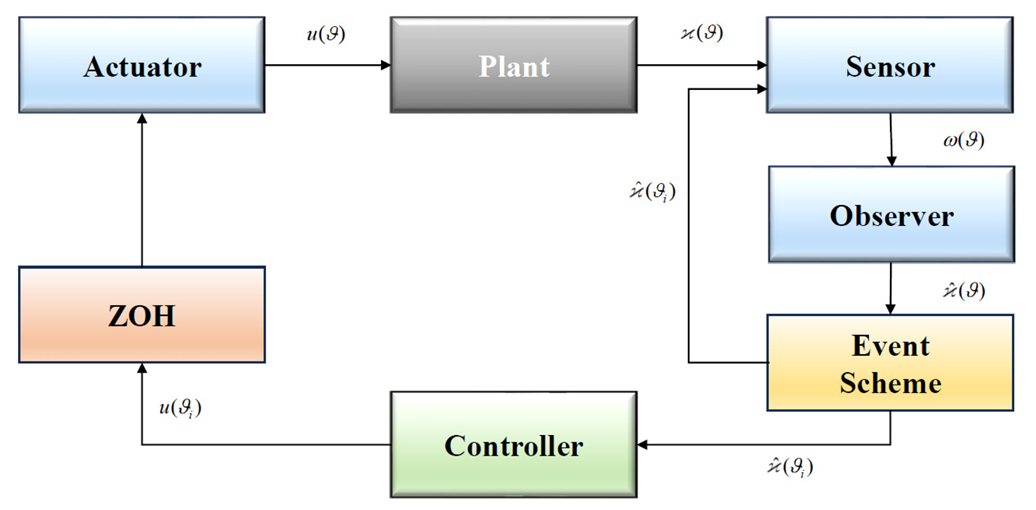
This article investigates the finite-time boundedness (FTB) problem for a class of observer-based discrete linear time-varying networked control systems (DLTNCSs). The interval matrix method (IMM) is adopted to handle the bounded time-varying coefficient via an uncertain convex-hull representation, and a maximum absolute value method (MAM) is also established to solve the time-varying coefficient for comparison. An observer-based event-triggered controller (ETC) is then developed, and sufficient linear matrix inequality (LMI) conditions are derived to obtain the admissible controller gain. Moreover, an implementable algorithm is provided for minimizing the energy consumption. Two numerical examples show that the IMM yields smaller estimation errors and lower energy consumption than the MAM.
Graphical Abstract
Keywords
Data Availability Statement
Funding
Conflicts of Interest
AI Use Statement
Ethical Approval and Consent to Participate
References
- Zeng, H. B., Zhu, Z. J., Peng, T. S., Wang, W., & Zhang, X. M. (2024). Robust tracking control design for a class of nonlinear networked control systems considering bounded package dropouts and external disturbance. IEEE Transactions on Fuzzy Systems, 32(6), 3608-3617.
[CrossRef] [Google Scholar] - Zhang, T., Wang, G., Xue, C., Wang, J., Nixon, M., & Han, S. (2024). Time-sensitive networking (TSN) for industrial automation: Current advances and future directions. ACM Computing Surveys, 57(2), 1-38.
[CrossRef] [Google Scholar] - Ge, X., Han, Q. L., Zhang, X. M., & Ding, D. (2023). Communication resource-efficient vehicle platooning control with various spacing policies. IEEE/CAA Journal of Automatica Sinica, 11(2), 362-376.
[CrossRef] [Google Scholar] - Wang, N., Li, H., Lu, X., Li, X., & Zhang, H. (2025). Decentralized linear–quadratic control and stabilization for networked control systems with d-step delay. Automatica, 177, 112348.
[CrossRef] [Google Scholar] - Xu, N., Liu, X., Li, Y., Zong, G., Zhao, X., & Wang, H. (2024). Dynamic event-triggered control for a class of uncertain strict-feedback systems via an improved adaptive neural networks backstepping approach. IEEE transactions on automation science and engineering, 22, 2041-2050.
[CrossRef] [Google Scholar] - Aslam, M. S., Radhika, T., Chandrasekar, A., & Zhu, Q. (2024). Improved event-triggered-based output tracking for a class of delayed networked T–S fuzzy systems. International Journal of Fuzzy Systems, 26(4), 1247-1260.
[CrossRef] [Google Scholar] - Chang, L., & Hou, Z. (2024). Sampled-data model-free adaptive integral sliding mode control for nonlinear continuous-time networked control systems with fading channels and packet dropouts. Neurocomputing, 589, 127708.
[CrossRef] [Google Scholar] - Zheng, Q., Xu, S., & Yan, H. (2024). Observer-based quantized guaranteed cost control of fuzzy networked control systems with unreliable links and its applications. IEEE Transactions on Fuzzy Systems, 32(9), 5214-5225.
[CrossRef] [Google Scholar] - Zhang, Y., Wang, Z., Zou, L., Chen, Y., & Lu, G. (2024). Ultimately Bounded Output Feedback Control for Networked Nonlinear Systems With Unreliable Communication Channel: A Buffer-Aided Strategy. IEEE/CAA Journal of Automatica Sinica, 11(7), 1566-1578.
[CrossRef] [Google Scholar] - Yang, J., Xie, J., & Liu, F. (2024). Observer design and interval estimation of time-delay discrete-time linear systems with external disturbance and measurement noise. Control Theory and Technology, 22(1), 69-80.
[CrossRef] [Google Scholar] - Lv, J., Ju, X., & Wang, C. (2025). Neural network prescribed-time observer-based output-feedback control for uncertain pure-feedback nonlinear systems. Expert Systems with Applications, 264, 125813.
[CrossRef] [Google Scholar] - Zhao, N., Zhang, H., Qiu, X., & Agarwal, R. K. (2025). Observer-Based Periodic Event-Triggered Adaptive Fuzzy Control for Networked Nonlinear Systems. IEEE Transactions on Cybernetics, 55(7), 3171-3181.
[CrossRef] [Google Scholar] - Shan, Y., Xie, X., Sun, J., & Park, J. H. (2024). Observer-based adaptive event-triggered control for nonlinear networked systems under multiple cyber attacks. IEEE Transactions on Fuzzy Systems, 32(9), 5272-5284.
[CrossRef] [Google Scholar] - Chen, G., Zeng, H., Zhu, S., Wen, S., & Hu, J. (2025). Finite-time ${H_{\infty$ control and energy cost optimization for nonlinear delayed systems through switching analysis and interval matrix method. Science China Information Sciences, 68(3), 139202.
[CrossRef] [Google Scholar] - Yao, Q., Wei, T., Lin, P., & Wang, L. (2024). Finite-time boundedness of impulsive delayed reaction–diffusion stochastic neural networks. IEEE Transactions on Neural Networks and Learning Systems, 36(3), 4794-4804.
[CrossRef] [Google Scholar] - Zeng, H., Chen, G., Wen, S., & Gunasekaran, N. (2025). Finite-time {$H_{\infty$ synchronization control for nonlinear time-varying systems through the state-dependent switching PI controller and interval matrix method. Journal of the Franklin Institute, 363(1), 108257.
[CrossRef] [Google Scholar] - Liu, X., Li, W., Wang, J., & Li, Y. (2022). Robust finite-time stability for uncertain discrete-time stochastic nonlinear systems with time-varying delay. Entropy, 24(6), 828.
[CrossRef] [Google Scholar] - Wang, Y., Liu, Y., Zhao, N., & Mathiyalagan, K. (2026). Finite-time dynamic event-triggered non-fragile state estimation for time-varying systems under mixed cyber attacks. Journal of the Franklin Institute, 108523.
[CrossRef] [Google Scholar] - Guan, X., Hu, Y., & Peng, K. (2024). Finite-time switching-like sliding mode fault-tolerant control for discrete-time cyber-physical systems under DoS attacks and intermittent faults. Applied Mathematics and Computation, 469, 128530.
[CrossRef] [Google Scholar] - Wang, X., Sun, J., Wang, G., Allgöwer, F., & Chen, J. (2023). Data-driven control of distributed event-triggered network systems. IEEE/CAA Journal of Automatica Sinica, 10(2), 351-364.
[CrossRef] [Google Scholar] - Lin, P., Deng, F., Zhao, X., Wan, F., & Huangs, Y. (2025). Stability analysis of networked stochastic systems with time delays under deception attacks by sampled-data control. IEEE Transactions on Systems, Man, and Cybernetics: Systems, 55(4), 2950-2960.
[CrossRef] [Google Scholar] - Ge, X., Xiao, S., Han, Q. L., Zhang, X. M., & Ding, D. (2021). Dynamic event-triggered scheduling and platooning control co-design for automated vehicles over vehicular ad-hoc networks. IEEE/CAA Journal of Automatica Sinica, 9(1), 31-46.
[CrossRef] [Google Scholar] - Wang, W., Postoyan, R., Nešić, D., & Heemels, W. P. M. H. (2019). Periodic event-triggered control for nonlinear networked control systems. IEEE Transactions on Automatic Control, 65(2), 620-635.
[CrossRef] [Google Scholar] - Molin, A., & Hirche, S. (2012). On the optimality of certainty equivalence for event-triggered control systems. IEEE Transactions on Automatic Control, 58(2), 470-474.
[CrossRef] [Google Scholar] - Dolk, V. S., Tesi, P., De Persis, C., & Heemels, W. P. M. H. (2016). Event-triggered control systems under denial-of-service attacks. IEEE Transactions on Control of Network Systems, 4(1), 93-105.
[CrossRef] [Google Scholar] - Shi, Y., & Nekouei, E. (2024). Quantization and event-triggered policy design for encrypted networked control. IEEE/CAA Journal of Automatica Sinica, 11(4), 946-955.
[CrossRef] [Google Scholar] - Cao, J., Yang, Z., Dai, S., Liu, J., & Zha, L. (2024). Event‐triggered tracking control for networked control systems under diversified attacks. International Journal of Robust and Nonlinear Control, 34(18), 12167-12186.
[CrossRef] [Google Scholar] - Ma, Y., Jia, X., & Zhang, Q. (2018). Robust observer-based finite-time $H_{\infty$ control for discrete-time singular Markovian jumping system with time delay and actuator saturation. Nonlinear Analysis: Hybrid Systems, 28, 1-22.
[CrossRef] [Google Scholar] - Chen, G., Zeng, H., Yang, J., & Hu, J. (2024). Finite-time interval stabilization for time-varying stochastic delayed systems via interval matrix method by piecewise controllers. Systems & Control Letters, 187, 105784.
[CrossRef] [Google Scholar] - Boyd, S., El Ghaoui, L., Feron, E., & Balakrishnan, V. (1994). Linear matrix inequalities in system and control theory. Society for industrial and applied mathematics. https://epubs.siam.org/doi/pdf/10.1137/1.9781611970777.bm
[Google Scholar]
Cited By (1)
-
Pingge Chen, Haibo Zeng, Chenjie Xu. Exponential synchronization of reaction-diffusion neural networks via asynchronous sampled-data event-triggered control.
Electronic Research Archive, 2026 , 34 (10).
[CrossRef]
Cite This Article
TY  - JOUR
AU  - Zeng, Huimin
AU  - Chen, Guici
AU  - Wang, Xinya
PY  - 2026
DA  - 2026/06/02
TI  - Observer-Based Event-Triggered Scheme for Finite-Time Control of Discrete-Time Linear Time-Varying Networked Control Systems
JO  - Journal of Nonlinear Dynamics and Applications
T2  - Journal of Nonlinear Dynamics and Applications
JF  - Journal of Nonlinear Dynamics and Applications
VL  - 2
IS  - 2
SP  - 108
EP  - 118
DO  - 10.62762/JNDA.2026.314876
UR  - https://www.icck.org/article/abs/jnda.2026.314876
KW  - event-triggered controller (ETC)
KW  - discrete linear time-varying networked control systems (DLTNCSs)
KW  - finite-time boundedness (FTB)
KW  - optimization algorithm
AB  - This article investigates the finite-time boundedness (FTB) problem for a class of observer-based discrete linear time-varying networked control systems (DLTNCSs). The interval matrix method (IMM) is adopted to handle the bounded time-varying coefficient via an uncertain convex-hull representation, and a maximum absolute value method (MAM) is also established to solve the time-varying coefficient for comparison. An observer-based event-triggered controller (ETC) is then developed, and sufficient linear matrix inequality (LMI) conditions are derived to obtain the admissible controller gain. Moreover, an implementable algorithm is provided for minimizing the energy consumption. Two numerical examples show that the IMM yields smaller estimation errors and lower energy consumption than the MAM.
SN  - 3069-6313
PB  - Institute of Central Computation and Knowledge
LA  - English
ER  -
@article{Zeng2026ObserverBa,
  author = {Huimin Zeng and Guici Chen and Xinya Wang},
  title = {Observer-Based Event-Triggered Scheme for Finite-Time Control of Discrete-Time Linear Time-Varying Networked Control Systems},
  journal = {Journal of Nonlinear Dynamics and Applications},
  year = {2026},
  volume = {2},
  number = {2},
  pages = {108-118},
  doi = {10.62762/JNDA.2026.314876},
  url = {https://www.icck.org/article/abs/jnda.2026.314876},
  abstract = {This article investigates the finite-time boundedness (FTB) problem for a class of observer-based discrete linear time-varying networked control systems (DLTNCSs). The interval matrix method (IMM) is adopted to handle the bounded time-varying coefficient via an uncertain convex-hull representation, and a maximum absolute value method (MAM) is also established to solve the time-varying coefficient for comparison. An observer-based event-triggered controller (ETC) is then developed, and sufficient linear matrix inequality (LMI) conditions are derived to obtain the admissible controller gain. Moreover, an implementable algorithm is provided for minimizing the energy consumption. Two numerical examples show that the IMM yields smaller estimation errors and lower energy consumption than the MAM.},
  keywords = {event-triggered controller (ETC), discrete linear time-varying networked control systems (DLTNCSs), finite-time boundedness (FTB), optimization algorithm},
  issn = {3069-6313},
  publisher = {Institute of Central Computation and Knowledge}
}
Publisher's Note
ICCK stays neutral with regard to jurisdictional claims in published maps and institutional affiliations.
Rights and Permissions


Portico
