

Towards a Conscientious Internationalized Curriculum in Sustaining Future Education and Research in the Philippines: A Case Study of the Communication Arts Curriculum at the Philippine Women’s University


Article Information
Abstract
Multilayered processes of globalization have loosened higher education’s nationalistic frameworks by embedding internationalization, a process deemed crucial for preparing students to become global citizens. The core thesis of the paper positions an internationalized curriculum as fostering a disposition toward critical thinking, agency, and empathy in a post-truth world. The argument leans toward developing a conscientious internationalization curriculum grounded in critical pedagogy. This can be achieved by intertwining the syllabus and pedagogy with the ideas of Paulo Freire and Sara Ahmed to cultivate a critical disposition in thinking, doing, and reflecting. The study explores this disposition through a qualitative analysis of student perceptions in the course "The Contemporary World" at the Philippine Women’s University, which, according to the Commission on Higher Education (CHED), aims to inculcate a sense of global citizenship and ethical responsibility among learners. The findings call for incorporating pedagogical strategies that empower both students and teachers to develop self-actualization and critical thinking skills through a conscientious internationalized curriculum, helping to challenge orthodoxy, pro-Western bias, and falsehoods in a post-truth era marked by social injustice and the manipulation of facts. The implications of the findings point toward enhancing epistemic vigilance through such a curriculum, equipping learners to become better-informed global citizens.
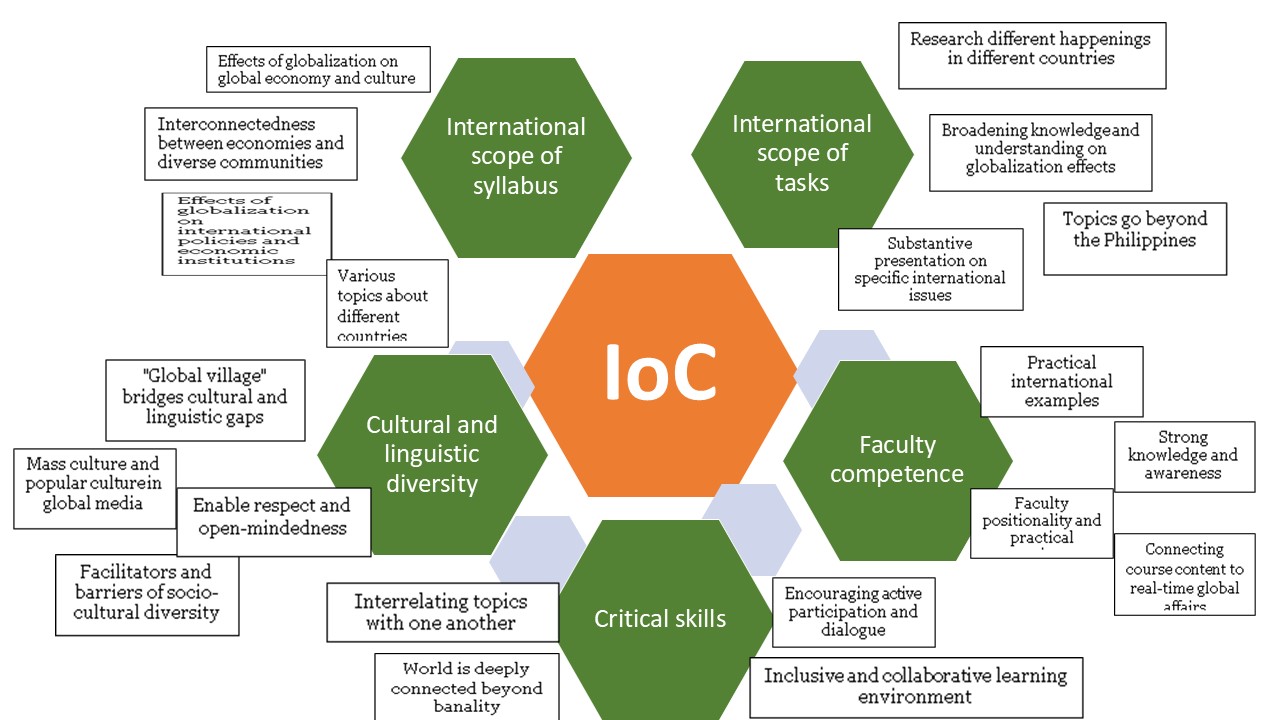
Graphical Abstract
Keywords
Data Availability Statement
Funding
Conflicts of Interest
AI Use Statement
Ethical Approval and Consent to Participate
References
- Knight, J. (2003). Updated Internationalization Definition. International Higher Education, (33), 2–3.
[CrossRef] [Google Scholar] - Stohl, M. (2007). We have met the enemy and he is us: The role of the faculty in the internationalization of higher education in the coming decade. Journal of Studies in International Education, 11(3-4), 359-372.
[CrossRef] [Google Scholar] - Soria, K. M., & Troisi, J. (2014). Internationalization at home alternatives to study abroad: Implications for students’ development of global, international, and intercultural competencies. Journal of studies in international education, 18(3), 261-280.
[CrossRef] [Google Scholar] - Marginson, S. (2010). Higher education in the global knowledge economy. Procedia-Social and Behavioral Sciences, 2(5), 6962-6980.
[CrossRef] [Google Scholar] - Marginson, S., & van der Wende, M. (2007). Globalisation and Higher Education (No. 8). OECD Publishing.
[CrossRef] [Google Scholar] - Hawawini, G. The internationalization of higher education institutions: a critical review and a radical proposal.
[CrossRef] [Google Scholar] - De Wit, H. (2020). Internationalization of higher education: The need for a more ethical and qualitative approach. Journal of International Students, 10(1), i-iv.
[CrossRef] [Google Scholar] - Knight, J. (2004). Internationalization remodeled: Definition, approaches, and rationales. Journal of studies in international education, 8(1), 5-31.
[CrossRef] [Google Scholar] - Stier, J. (2004). Taking a critical stance toward internationalization ideologies in higher education: Idealism, instrumentalism and educationalism. Globalisation, Societies and Education, 2(1), 1-28.
[CrossRef] [Google Scholar] - Van der Wende, M. C. (2001). Internationalisation policies: About new trends and contrasting paradigms. Higher education policy, 14(3), 249-259.
[CrossRef] [Google Scholar] - OECD. (2021). Education at a Glance 2021: OECD Indicators. OECD Publishing.
[CrossRef] [Google Scholar] - Institute of International Education (IIE). (2022, January 24). Republic of the Philippines. Project Atlas. Retrieved from https://www.iie.org/research-initiatives/project-atlas/explore-data/republic-of-the-philippines/
[Google Scholar] - Rehal, S. S. (2012). African student mobility in the Philippines: An explorative study in Metro Manila and Cavite. OSSREA Bulletin, 9(2), 29-39.
[Google Scholar] - Rehal, S. S. (2013). African student mobility in the Philippines: trends in opportunities towards global excellence in higher education. In the proceedings of the International Research Conference in Higher Education (pp. 3-4).
[Google Scholar] - Bayudan-Dacuycuy, C., Luzon, P. E. D., & Zambrano, S. J. (2024). Cross-border student mobility and improvements in the philippine tertiary education program relevance and learning outcomes (No. 2024-21). PIDS Discussion Paper Series.
[CrossRef] [Google Scholar] - Ramirez, V. E. (2016, November). Migrant Education in Philippine Higher Education Institutions: Drivers, Experience and Challenges to Continuous Quality Improvement. University of Asia and the Pacific.
[CrossRef] [Google Scholar] - Republic of the Philippines. (2000). Executive Order No. 285: Amending the guidelines governing the entry and stay of foreign students in the Philippines and the establishment of an inter-agency committee on foreign students for the purpose. Supreme Court E-Library. Retrieved from https://elibrary.judiciary.gov.ph/thebookshelf/showdocsfriendly/5/8612
[Google Scholar] - Commission on Higher Education. (2016). CMO No. 55, series of 2016: Policy framework and strategies on the internationalization of Philippine higher education. Commission on Higher Education. Quezon City, Philippines: Commission on Higher Education.
[Google Scholar] - Cinches, M. F. C., Russell, R. L. V., Borbon, M. L. F. C., & Chavez, J. C. (2017). Internationalization of higher education institutions: The Case of Four HEIs in the Philippines. Liceo Journal of Higher Education Research, 12(1). http://dx.doi.org/10.7828/ljher.v12i1.961
[Google Scholar] - Chan, S. J. (2012). Shifting patterns of student mobility in Asia. Higher Education Policy, 25(2), 207-224.
[CrossRef] [Google Scholar] - Nayyar, D. (2007). Globalisation: What Does It Mean for Higher Education?. Economic and Political Weekly, 30-35.
[Google Scholar] - Bambergera, A., Morrisa, P., & Yeminib, M. (2019). Neoliberalism, internationalization and higher education: connections, contradictions and alternatives. Discourse: Studies in the Cultural Politics of Education, 40(2), 2013-216.
[CrossRef] [Google Scholar] - Putty, R. (2025). Sustainability in Internationalization of Higher Education: Curriculum Internationalization as a Means to an End?. In Internationalization of Higher Education (pp. 102-115). Routledge.
[Google Scholar] - Hauptman Komotar, M. (2019). Global university rankings and their impact on the internationalisation of higher education. European Journal of Education, 54(2), 299-310.
[CrossRef] [Google Scholar] - Leask, B. (2015). Internationalizing the Curriculum. Routledge.
[Google Scholar] - Osakwe, N. N. (2017). Internationalizing Courses: A Faculty Development Process. International Research and Review: Journal of Phi Beta Delta, 6(2), 1-31.
[Google Scholar] - Scott, J. B. (2023). Rearticulating civic engagement through cultural studies and service-learning. In Civic Engagement and Technical Communication (pp. 289-306). Routledge.
[CrossRef] [Google Scholar] - Lasco, G. (2023, June 16). The trouble with university rankings. Philippine Daily Inquirer. Retrieved from https://opinion.inquirer.net/164083/the-trouble-with-university-rankings-1
[Google Scholar] - Moustafa, K. (2024). University rankings: Time to reconsider. BioImpacts: BI, 15, 30290.
[CrossRef] [Google Scholar] - Altbach, P., & De Wit, H. (2018). Are we facing a fundamental challenge to higher education internationalization?. International Higher Education, (93), 2-4.
[CrossRef] [Google Scholar] - Killick, D. (2009). Curriculum internationalisation: Identity, graduate attributes and altermodernity. Enhancing Learning in the Social Sciences, 2(1), 1-33.
[CrossRef] [Google Scholar] - Stein, S. (2018). Rethinking Critical Approaches to Global and Developmental Education. Policy & Practice: A Developmental Education Review, 27(Autumn), 1-13.
[Google Scholar] - Liang, S. (2025). Curriculum Internationalization: Aligned with Equity and Social Justice? Considerations and Perceptions from International Graduate Students in Canada. Journal of Comparative & International Higher Education, 17(2), 143-158.
[CrossRef] [Google Scholar] - Lilleker, D. (2018). Politics in a post-truth era. International Journal of Media & Cultural Politics, 14(3), 277-282.
[CrossRef] [Google Scholar] - Ghosh, B. (2022). Politics of Manufacturing Consent in a Post-Truth Society. Journal of Developing Societies, 38(1), 7-26.
[CrossRef] [Google Scholar] - Greene, J. A., Cartiff, B. M., Duke, R. F., & Deekens, V. M. (2019). A nation of curators: Educating Students to be Critical Consumers and Users of Online Information.
[CrossRef] [Google Scholar] - Kahneman, D. (2011). Thinking, fast and slow. Farrar, Straus and Giroux.
[Google Scholar] - Stanovich, K. E. (2011). Rationality and the reflective mind. Oxford University Press.
[CrossRef] [Google Scholar] - Sinatra, G. M., & Lombardi, D. (2020). Evaluating sources of scientific evidence and claims in the post-truth era may require plausibility judgments. Educational Psychologist, 55(3), 120–131.
[CrossRef] [Google Scholar] - Gibbs, P. (2019). Why Academics Should Have a Duty of Truth Telling in an Epoch of Post-Truth? Higher Education, 78(3), 501–510.
[CrossRef] [Google Scholar] - Hopkin, J. & Rosamond, B. (2017). Post-Truth Politics, Bullshit and Bad Ideas: ‘Deficit Fetishism’ in the UK. New Political Economy, 23(6), 641–55.
[CrossRef] [Google Scholar] - Parker, J. (2024). The Role of Higher Education in the Post-Truth Era. Journal of Political Science Education, 20(3), 391–404.
[CrossRef] [Google Scholar] - Longden, B. (2008). Changing Identities in Higher Education: Voicing Perspectives-Edited by Ronald Barnett and Robert Di Napoli.
[CrossRef] [Google Scholar] - Ledger, S., & Kawalilak, C. (2020). Conscientious internationalisation in higher education: Contextual complexities and comparative tensions. Asia Pacific Education Review, 21(4), 653-665.
[CrossRef] [Google Scholar] - Vishwanath, T. & Mummery, J. (2019). Reflecting critically on the critical disposition within Internationalisation of the Curriculum (IoC): the developmental journey of a curriculum design team. Higher Education Research & Development, 38(2), 354–368.
[CrossRef] [Google Scholar] - Snauwaert, D. (2009). Human rights and cosmopolitan democratic education. Philosophical Studies in Education, 40(1), 94–103.
[Google Scholar] - Ahmed, S. (2006). The nonperformativity of antiracism. Meridians, 7(1), 104-126.
[CrossRef] [Google Scholar] - Freire, P. (2020). Pedagogy of the oppressed. In Toward a sociology of education (pp. 374-386). Routledge.
[Google Scholar] - Sperduti, V. R. (2017). Internationalization as westernization in higher education. Journal of Comparative & International Higher Education, 9(1), 4.
[CrossRef] [Google Scholar] - Arum, S., & Van de Water, J. (1992). The need for a definition of international education in US universities. Bridges to the future: Strategies for internationalizing higher education, 191-203.
[Google Scholar] - De Wit, H. (1995). Strategies for internationalisation of higher education: A comparative study of Australia, Canada, Europe and the United States of America. European Association for International Education.
[Google Scholar] - Leask, B. (2013). Internationalization of the curriculum and the disciplines: Current perspectives and directions for the future. Journal of Studies in International Education, 17(2), 99-102.
[CrossRef] [Google Scholar] - Leask, B. (2013b). Internationalizing the curriculum in the disciplines – imagining new possibilities. Journal of Studies in International Education, 17(2), 103–118.
[CrossRef] [Google Scholar] - Bamberger, A., Mulvey, B., & Yan, F. (2026). Internationalization in higher education beyond the Western horizon: critical perspectives. Comparative Education, 62(1), 1–17.
[CrossRef] [Google Scholar] - Nguyen, H. T., Phan, H. L. T., & Tran, L. T. (2023). Internationalisation of the curriculum in Vietnamese higher education: mediating between ‘Western’ and local imaginaries. Compare: A Journal of Comparative and International Education, 53(6), 1080-1097.
[CrossRef] [Google Scholar] - Ndaipa, C. J., Edström, K., Langa, P., & Geschwind, L. (2023). Internationalisation of the curriculum in higher education: A case from a Mozambican university. Cogent Education, 10(1), 2188773.
[CrossRef] [Google Scholar] - Le Grange, L. (2020). Decolonising the university curriculum: The what, why and how. In Transnational education and curriculum studies (pp. 216-233). Routledge.
[CrossRef] [Google Scholar] - Ndlovu-Gatsheni, S. J. (2021). Internationalisation of higher education for pluriversity: A decolonial reflection. Journal of the British Academy, 9s1(1), 77–98.
[CrossRef] [Google Scholar] - David, S. A. (2024). Dynamics and impacts of internationalisation on curriculum and instruction in higher education. Journal of Further and Higher Education, 48(5), 510-523.
[CrossRef] [Google Scholar] - Rosaroso, R. C., Yap, C., & Gador, S. (2015). Current Initiatives on Internationalization of Education in Selected Higher Education Institutions in the Philippines. Asia Pacific Journal of Education, Arts and Sciences, 2(4), 23-30.
[Google Scholar] - Balagtas, M. U., Papango, M. P., Reyes, Z. Q., Ubiña, M. M., & Atweh, B. (2012). Development of a Rubric on the Internationalization of Teacher Education Institutions in the Philippines and Beyond. The Normal Lights, 6(1).
[CrossRef] [Google Scholar] - Diano, Jr., F. M., Kilag, O. K. T., Buanoy, B., Malbas, M. H., Catacutan, A. B., Tiongzon, B. D., & Abendan, C. F. K. (2023). Towards Global Competence: Innovations in the Philippine Curriculum for Addressing International Challenges. Excellencia: International Multi-Disciplinary Journal of Education, 1(4), 295-307.
[Google Scholar] - Reich, J. C. (2012). Global learning as general education for the twenty-first century. Educational Research and Reviews, 7(21), 464.
[CrossRef] [Google Scholar] - Braun, V., & Clarke, V. (2006). Using thematic analysis in psychology. Qualitative Research in Psychology, 3(2), 77–101.
[CrossRef] [Google Scholar] - Byrne, D. (2022). A worked example of Braun and Clarke’s approach to reflexive thematic analysis. Quality & quantity, 56(3), 1391-1412.
[CrossRef] [Google Scholar] - Leech, N. L., & Onwuegbuzie, A. J. (2008). Qualitative data analysis: A compendium of techniques and a framework for selection for school psychology research and beyond. School Psychology Quarterly, 23(4), 587–604.
[CrossRef] [Google Scholar] - Ahmed, S. K., Mohammed, R. A., Nashwan, A. J., Ibrahim, R. H., Abdalla, A. Q., Ameen, B. M. M., & Khdhir, R. M. (2025). Using thematic analysis in qualitative research. Journal of Medicine, Surgery, and Public Health, 6(100198).
[CrossRef] [Google Scholar] - O’Connor, C., & Joffe, H. (2020). Intercoder reliability in qualitative research: Debates and practical guidelines. International journal of qualitative methods, 19, 1609406919899220.
[CrossRef] [Google Scholar] - Leask, B. (2001). Bridging the Gap: Internationalizing University Curricula. Journal of Studies in International Education, 5(2), 100-115.
[CrossRef] [Google Scholar] - Torres, C. A., & Yan, L. (2022). Paulo Freire and the state-of-the-art of the international journal of lifelong education. Invited article in celebration of 40 years of IJLE. International Journal of Lifelong Education, 41(6), 651-665.
[CrossRef] [Google Scholar] - Schugurensky, D., & Myers, J. (2003). A framework to explore lifelong learning: The case of the civic education of civics teachers. International Journal of Lifelong Education, 22(4), 325–352.
[CrossRef] [Google Scholar] - Costa, C., Bhatia, P., Murphy, M., & Pereira, A. L. (2023). Digital education colonized by design: Curriculum reimagined. Education Sciences, 13(9), 895.
[CrossRef] [Google Scholar] - Selwyn, N. (2016). Is technology good for education?. Polity Press.
[Google Scholar] - Tavares, V. (Ed.). (2023). Social justice, decoloniality, and southern epistemologies within language education: Theories, knowledge, and practices on TESOL from Brazil. Routledge.
[CrossRef] [Google Scholar] - Andreotti, V. (2011). Actionable postcolonial theory in education. Palgrave Macmillan.
[CrossRef] [Google Scholar] - Rizvi, F. (2009). Towards cosmopolitan learning. Studies in the Cultural Politics of Education, 30(3), 253–268.
[CrossRef] [Google Scholar] - Breit, R., Obijiofor, L., & Fitzgerald, R. (2013). Internationalization as De-Westernization of the Curriculum: The case of Journalism at an Australian University. Journal of Studies in International Education, 17(2), 119–135.
[CrossRef] [Google Scholar] - Taylor, C. (2004). Modern social imaginaries. Duke University Press.
[CrossRef] [Google Scholar] - Bruhn-Zass, E. (2021). Virtual Internationalization to Support Comprehensive Internationalization in Higher Education. Journal of Studies in International Education, 26(2), 240-258.
[CrossRef] [Google Scholar] - Fragouli, E. (2020). Internationalizing the Curriculum. International Journal of Higher Education Management, 6(2), 18-30.
[CrossRef] [Google Scholar] - Whalley, T. R., Langley, L., & Villarreal, L. (1997). Best practice guidelines for internationalizing the curriculum. The Ministry.
[Google Scholar] - Barnett, R. (2000). University knowledge in an age of super complexity. Higher Education, 40(4), 409–422.
[CrossRef] [Google Scholar] - Schuerholz-Lehr, S., Caws, C., Van Gyn, G., & Preece, A. (2007). Internationalizing the Higher Education Curriculum: An Emerging Model for Transforming Faculty Perspectives. Canadian Journal of Higher Education, 37(1), 67-94.
[CrossRef] [Google Scholar] - Brewer, E., & Leask, B. (2023). Internationalizing the curriculum, teaching, and learning. In The handbook of international higher education (pp. 242-264). Routledge.
[Google Scholar] - Gal, A. M. (2020, January 18). The road less travelled to internationalisation of HE. University World News.
[Google Scholar] - Leask, B. (2010). “Beside me is an empty chair: The student experience of internationalization,” in E. Jones (ed.), Internationalization and the Student Voice: Higher Education Perspectives (pp. 3–17). Routledge.
[Google Scholar] - Bourn, D. (2011). From internationalization to global perspectives. Higher Education Research & Development, 30(5), 559–571.
[CrossRef] [Google Scholar] - Ahmed, S. (2007a). You end up doing the document rather than doing the doing’: Diversity, race equality and the politics of documentation. Ethnic and Racial Studies, 30(4), 590–609.
[CrossRef] [Google Scholar] - Ahmed, S. (2007b). The language of diversity. Ethnic and Racial Studies, 30(2), 235–256.
[CrossRef] [Google Scholar] - Bourn, D., & Shiel, C. (2009). Global perspectives: aligning agendas?. Environmental Education Research, 15(6), 661-677.
[CrossRef] [Google Scholar] - Tight, M. (2022). Internationalisation of higher education beyond the West: challenges and opportunities – the research evidence. Educational Research and Evaluation, 27(3–4), 239–259.
[CrossRef] [Google Scholar] - Rizvi, F. & Lingard, B. (2010). Globalizing Education Policy. Routledge.
[CrossRef] [Google Scholar] - Ward-Seidel, A. R., & Bentley, L. (2025). Teacher preparation needs critical consciousness. Social and Emotional Learning: Research, Practice, and Policy, 5, 100119.
[CrossRef] [Google Scholar] - Gacel-Ávila, J. (2005). The Internationalisation of Higher Education: A Paradigm for Global Citizenry. Journal of Studies in International Education, 9(2), 121-136.
[CrossRef] [Google Scholar]
Cite This Article
TY  - JOUR
AU  - Rehal, Satwinder
AU  - Obrique, Jairus Christian G.
PY  - 2026
DA  - 2026/04/21
TI  - Towards a Conscientious Internationalized Curriculum in Sustaining Future Education and Research in the Philippines: A Case Study of the Communication Arts Curriculum at the Philippine Women’s University
JO  - PWU Journal of Research, Innovation, and Transformation
T2  - PWU Journal of Research, Innovation, and Transformation
JF  - PWU Journal of Research, Innovation, and Transformation
VL  - 1
IS  - 2
SP  - 73
EP  - 91
DO  - 10.62762/JRIT.2025.875175
UR  - https://www.icck.org/article/abs/JRIT.2025.875175
KW  - conscientious internationalized curriculum
KW  - critical pedagogy
KW  - post-truth
KW  - qualitative research
KW  - Philippine Women’s University
AB  - Multilayered processes of globalization have loosened higher education’s nationalistic frameworks by embedding internationalization, a process deemed crucial for preparing students to become global citizens. The core thesis of the paper positions an internationalized curriculum as fostering a disposition toward critical thinking, agency, and empathy in a post-truth world. The argument leans toward developing a conscientious internationalization curriculum grounded in critical pedagogy. This can be achieved by intertwining the syllabus and pedagogy with the ideas of Paulo Freire and Sara Ahmed to cultivate a critical disposition in thinking, doing, and reflecting. The study explores this disposition through a qualitative analysis of student perceptions in the course "The Contemporary World" at the Philippine Women’s University, which, according to the Commission on Higher Education (CHED), aims to inculcate a sense of global citizenship and ethical responsibility among learners. The findings call for incorporating pedagogical strategies that empower both students and teachers to develop self-actualization and critical thinking skills through a conscientious internationalized curriculum, helping to challenge orthodoxy, pro-Western bias, and falsehoods in a post-truth era marked by social injustice and the manipulation of facts. The implications of the findings point toward enhancing epistemic vigilance through such a curriculum, equipping learners to become better-informed global citizens.
SN  - 3071-4001
PB  - Institute of Central Computation and Knowledge
LA  - English
ER  -
@article{Rehal2026Towards,
  author = {Satwinder Rehal and Jairus Christian G. Obrique},
  title = {Towards a Conscientious Internationalized Curriculum in Sustaining Future Education and Research in the Philippines: A Case Study of the Communication Arts Curriculum at the Philippine Women’s University},
  journal = {PWU Journal of Research, Innovation, and Transformation},
  year = {2026},
  volume = {1},
  number = {2},
  pages = {73-91},
  doi = {10.62762/JRIT.2025.875175},
  url = {https://www.icck.org/article/abs/JRIT.2025.875175},
  abstract = {Multilayered processes of globalization have loosened higher education’s nationalistic frameworks by embedding internationalization, a process deemed crucial for preparing students to become global citizens. The core thesis of the paper positions an internationalized curriculum as fostering a disposition toward critical thinking, agency, and empathy in a post-truth world. The argument leans toward developing a conscientious internationalization curriculum grounded in critical pedagogy. This can be achieved by intertwining the syllabus and pedagogy with the ideas of Paulo Freire and Sara Ahmed to cultivate a critical disposition in thinking, doing, and reflecting. The study explores this disposition through a qualitative analysis of student perceptions in the course "The Contemporary World" at the Philippine Women’s University, which, according to the Commission on Higher Education (CHED), aims to inculcate a sense of global citizenship and ethical responsibility among learners. The findings call for incorporating pedagogical strategies that empower both students and teachers to develop self-actualization and critical thinking skills through a conscientious internationalized curriculum, helping to challenge orthodoxy, pro-Western bias, and falsehoods in a post-truth era marked by social injustice and the manipulation of facts. The implications of the findings point toward enhancing epistemic vigilance through such a curriculum, equipping learners to become better-informed global citizens.},
  keywords = {conscientious internationalized curriculum, critical pedagogy, post-truth, qualitative research, Philippine Women’s University},
  issn = {3071-4001},
  publisher = {Institute of Central Computation and Knowledge}
}
Article Metrics
Publisher's Note
ICCK stays neutral with regard to jurisdictional claims in published maps and institutional affiliations.
Rights and Permissions
 Copyright © 2026 by the Author(s). Published by Institute of Central Computation and Knowledge. This article is an open access article distributed under the terms and conditions of the Creative Commons Attribution (CC BY) license (https://creativecommons.org/licenses/by/4.0/), which permits use, sharing, adaptation, distribution and reproduction in any medium or format, as long as you give appropriate credit to the original author(s) and the source, provide a link to the Creative Commons licence, and indicate if changes were made.

Portico
