

A TAM-based Human-Machine Synergy Model for Automation and Industry 4.0 Adoption


Article Information
Abstract
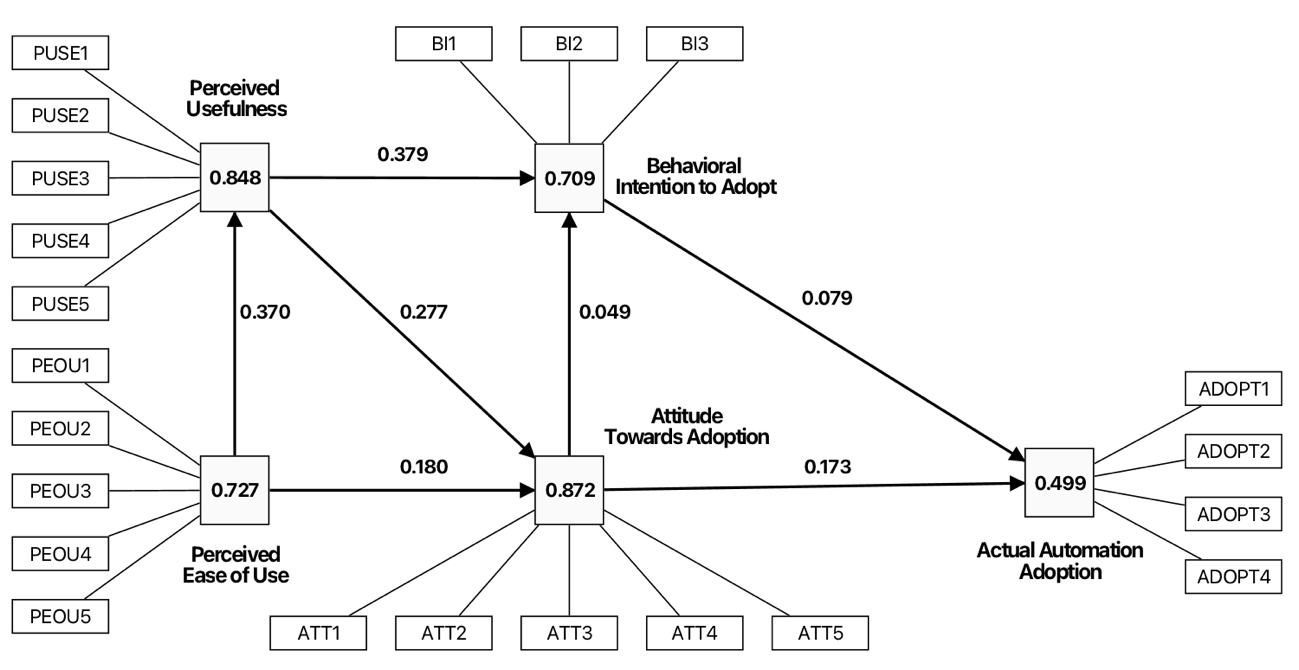
The acceleration of Industry 4.0 has compelled enterprises to integrate automation, cyber-physical systems, and analytics into everyday operations. Despite rapid digitalization, the effectiveness of these initiatives depends largely on the human capacity to accept and collaborate with machines. This study applies the Technology Acceptance Model (TAM) to examine behavioral and organizational factors influencing automation adoption among 900 professionals across manufacturing, logistics, and service sectors. Using descriptive-correlational design and partial least squares structural equation modeling (PLS-SEM), the study investigates how perceived usefulness (PU) and perceived ease of use (PEOU) shape attitude (ATT) and behavioral intention (BI). Findings reveal that PU strongly predicts ATT and BI, while PEOU enhances PU and positive attitude toward technology. The proposed Human–Machine Synergy Framework situates these constructs within a socio-technical context, showing that automation readiness in enterprises arises when human competence and institutional scaffolding evolve together. The study enriches local Industry 4.0 scholarship and provides actionable guidance for managers, policymakers, and educators promoting inclusive digital transformation.
Graphical Abstract
Keywords
Data Availability Statement
Funding
Conflicts of Interest
AI Use Statement
Ethical Approval and Consent to Participate
References
- Rajamanickam, M., Royan, E. N. J. G., Ramaswamy, G., Rajendran, M., & Vadivelu, V. (2023). Fourth industrial revolution: industry 4.0. Integration of Mechanical and Manufacturing Engineering with IoT: A Digital Transformation, 41-84.
[CrossRef] [Google Scholar] - Martinelli, A., Mina, A., & Moggi, M. (2021). The enabling technologies of industry 4.0: examining the seeds of the fourth industrial revolution. Industrial and Corporate Change, 30(1), 161-188.
[CrossRef] [Google Scholar] - Aldaba, R. (2024). Philippine industrial policy journey: transforming the economy in the new digital age. Philippine Review of Economics (Online ISSN 2984-8156), 61(1), 8-43.
[Google Scholar] - Dadios, E. P., Culaba, A. B., Albert, J. R. G., Paqueo, V. B., Orbeta, A. C., Serafica, R. B., ... & Bairan, J. C. A. C. (2018). Preparing the Philippines for the fourth industrial revolution: A scoping study (No. 2018-11). PIDS discussion paper series.
[Google Scholar] - Segate, R. V., & Daly, A. (2024). Encoding the enforcement of safety standards into smart robots to harness their computing sophistication and collaborative potential: A legal risk assessment for European Union policymakers. European Journal of Risk Regulation, 15(3), 665-704.
[CrossRef] [Google Scholar] - Aivazidou, E., & Tsolakis, N. (2023). Transitioning towards human–robot synergy in agriculture: A systems thinking perspective. Systems Research and Behavioral Science, 40(3), 536-551.
[CrossRef] [Google Scholar] - Venkatesh, V., Morris, M. G., Davis, G. B., & Davis, F. D. (2003). User acceptance of information technology: Toward a unified view1. MIS quarterly, 27(3), 425-478.
[CrossRef] [Google Scholar] - Davis, F. D., Bagozzi, R. P., & Warshaw, P. R. (1989). Technology acceptance model. J Manag Sci, 35(8), 982-1003.
[CrossRef] [Google Scholar] - Liang, N., & Wang, X. (2026). Determinants of Digital Museum Users’ Continuance Intention—An Integrated Model Combining an Enhanced TAM3 and UTAUT. Sustainability, 18(1), 492.
[CrossRef] [Google Scholar] - Li, J., Che Me, R., Ahmad, F. A., & Zhu, Q. (2025). Development and validation of an ageing-oriented smart products design framework based on technology acceptance model (TAM). Disability and Rehabilitation: Assistive Technology, 1-27.
[CrossRef] [Google Scholar] - Bansal, P., Kumar, R., Kumar, A., & Dasig Jr, D. D. (Eds.). (2024). Artificial intelligence and communication techniques in Industry 5.0. CRC Press.
[Google Scholar] - Schwab, K. (2017). The Fourth Industrial Revolution. Crown Business.
[Google Scholar] - AL-Refaey, M. R., Tyagi, A. K., AL-Ghamdi, A. S. A. M., & Kukreja, S. (Eds.). (2024). Topics in Artificial Intelligence Applied to Industry 4.0. John Wiley & Sons.
[Google Scholar] - Oke, J. A., Karimzadeh, S., Oviroh, P. O., Ukoba, K., Imoisili, P. E., & Jen, T. C. (2025). Smart Materials and Energy in the Fourth Industrial Revolution. CRC Press.
[CrossRef] [Google Scholar] - Dhiman, M. T., Malik, M. A., Kumar, A., & Kamboj, M. G. (2025). Artificial Intelligence Synergies: A Multidisciplinary Outlook. Chyren Publication.
[Google Scholar] - Quimba, F. M. A., Serafica, R. B., Bayudan-Dacuycuy, C., Andrada, A. E., & Moreno, N. I. S. (2023). Green and Digital: Managing the Twin Transition toward Sustainable Development (No. 2023-21). PIDS Discussion Paper Series.
[CrossRef] [Google Scholar] - Kumar, L., & Sharma, R. K. (2025). Adapting to Industry 4.0: evaluating SMEs preparedness through a comprehensive digital readiness assessment maturity model by validating stakeholders’ perceptions. Business Process Management Journal.
[CrossRef] [Google Scholar] - Adel, A. (2024). The convergence of intelligent tutoring, robotics, and IoT in smart education for the transition from industry 4.0 to 5.0. Smart Cities, 7(1), 325-369.
[CrossRef] [Google Scholar] - Balasubramanian, P. (2023). Automation in data science, software, and information services. In Springer Handbook of Automation (pp. 989-1014). Cham: Springer International Publishing.
[CrossRef] [Google Scholar] - McDonald, S. D. (2024). The Impact of Data Analytics, Automation, AI, and IoT on Vietnam’s Logistics Industry. In Transforming Logistics in a Developing Nation: Vietnam’s Technology Imperative (pp. 53-72). Singapore: Springer Nature Singapore.
[CrossRef] [Google Scholar] - Kalogiannis, D. (2025). The Impact of Digital Skills Perceptions on Work-Related Anxiety and Motivation Among Late-Career Employees Within the Grey Digital Divide.
[Google Scholar] - Brougham, D., & Haar, J. (2018). Smart technology, artificial intelligence, robotics, and algorithms (STARA): Employees’ perceptions of our future workplace. Journal of Management & Organization, 24(2), 239-257.
[CrossRef] [Google Scholar] - Islam, M. T., Sepanloo, K., Woo, S., Woo, S. H., & Son, Y. J. (2025). A review of the industry 4.0 to 5.0 transition: exploring the intersection, challenges, and opportunities of technology and human–machine collaboration. Machines, 13(4), 267.
[CrossRef] [Google Scholar] - Scherer, R., Siddiq, F., & Tondeur, J. (2019). The technology acceptance model (TAM): A meta-analytic structural equation modeling approach to explaining teachers’ adoption of digital technology in education. Computers & Education, 128, 13–35.
[CrossRef] [Google Scholar] - Low, M. P., Wut, T. M., & Pok, W. F. (2025). Artificial intelligence facilitators in higher education institutions: A student-centric exploration with comparative analysis in Asian countries. Education and Information Technologies, 30(13), 18485-18511.
[CrossRef] [Google Scholar] - Green, G. (2024). Analysis of the mediating effect of resistance to change, perceived ease of use, and behavioral intention to use technology-based learning among younger and older nursing students. Journal of Professional Nursing, 50, 66-72.
[CrossRef] [Google Scholar] - Ollerenshaw, A., Corbett, J., & Thompson, H. (2021). Increasing the digital literacy skills of regional SMEs through high-speed broadband access. Small Enterprise Research, 28(2), 115-133.
[CrossRef] [Google Scholar] - Li, X., Zhang, J., & Yang, J. (2024). The effect of computer self-efficacy on the behavioral intention to use translation technologies among college students: Mediating role of learning motivation and cognitive engagement. Acta Psychologica, 246, 104259.
[CrossRef] [Google Scholar] - Schuetz, S., Kuai, L., Lacity, M. C., & Steelman, Z. (2025). A qualitative systematic review of trust in technology. Journal of Information Technology, 40(1), 55-76.
[CrossRef] [Google Scholar] - Silva, P. (2015). Davis' technology acceptance model (TAM)(1989). Information seeking behavior and technology adoption: Theories and trends, 205-219.
[CrossRef] [Google Scholar]
Cite This Article
TY  - JOUR
AU  - Jr, Daniel Dasig
AU  - Torres, Chester Bryan
AU  - Talion, Fernando
AU  - Ditan, Carolina
AU  - Siahan, Antonius
PY  - 2026
DA  - 2026/04/08
TI  - A TAM-based Human-Machine Synergy Model for Automation and Industry 4.0 Adoption
JO  - PWU Journal of Research, Innovation, and Transformation
T2  - PWU Journal of Research, Innovation, and Transformation
JF  - PWU Journal of Research, Innovation, and Transformation
VL  - 1
IS  - 2
SP  - 65
EP  - 72
DO  - 10.62762/JRIT.2026.810897
UR  - https://www.icck.org/article/abs/JRIT.2026.810897
KW  - technology acceptance model
KW  - automation adoption
KW  - industry 4.0
KW  - human–machine synergy
AB  - The acceleration of Industry 4.0 has compelled enterprises to integrate automation, cyber-physical systems, and analytics into everyday operations. Despite rapid digitalization, the effectiveness of these initiatives depends largely on the human capacity to accept and collaborate with machines. This study applies the Technology Acceptance Model (TAM) to examine behavioral and organizational factors influencing automation adoption among 900 professionals across manufacturing, logistics, and service sectors. Using descriptive-correlational design and partial least squares structural equation modeling (PLS-SEM), the study investigates how perceived usefulness (PU) and perceived ease of use (PEOU) shape attitude (ATT) and behavioral intention (BI). Findings reveal that PU strongly predicts ATT and BI, while PEOU enhances PU and positive attitude toward technology. The proposed Human–Machine Synergy Framework situates these constructs within a socio-technical context, showing that automation readiness in enterprises arises when human competence and institutional scaffolding evolve together. The study enriches local Industry 4.0 scholarship and provides actionable guidance for managers, policymakers, and educators promoting inclusive digital transformation.
SN  - 3071-4001
PB  - Institute of Central Computation and Knowledge
LA  - English
ER  -
@article{Jr2026A,
  author = {Daniel Dasig Jr and Chester Bryan Torres and Fernando Talion and Carolina Ditan and Antonius Siahan},
  title = {A TAM-based Human-Machine Synergy Model for Automation and Industry 4.0 Adoption},
  journal = {PWU Journal of Research, Innovation, and Transformation},
  year = {2026},
  volume = {1},
  number = {2},
  pages = {65-72},
  doi = {10.62762/JRIT.2026.810897},
  url = {https://www.icck.org/article/abs/JRIT.2026.810897},
  abstract = {The acceleration of Industry 4.0 has compelled enterprises to integrate automation, cyber-physical systems, and analytics into everyday operations. Despite rapid digitalization, the effectiveness of these initiatives depends largely on the human capacity to accept and collaborate with machines. This study applies the Technology Acceptance Model (TAM) to examine behavioral and organizational factors influencing automation adoption among 900 professionals across manufacturing, logistics, and service sectors. Using descriptive-correlational design and partial least squares structural equation modeling (PLS-SEM), the study investigates how perceived usefulness (PU) and perceived ease of use (PEOU) shape attitude (ATT) and behavioral intention (BI). Findings reveal that PU strongly predicts ATT and BI, while PEOU enhances PU and positive attitude toward technology. The proposed Human–Machine Synergy Framework situates these constructs within a socio-technical context, showing that automation readiness in enterprises arises when human competence and institutional scaffolding evolve together. The study enriches local Industry 4.0 scholarship and provides actionable guidance for managers, policymakers, and educators promoting inclusive digital transformation.},
  keywords = {technology acceptance model, automation adoption, industry 4.0, human–machine synergy},
  issn = {3071-4001},
  publisher = {Institute of Central Computation and Knowledge}
}
Article Metrics
Publisher's Note
ICCK stays neutral with regard to jurisdictional claims in published maps and institutional affiliations.
Rights and Permissions
 Copyright © 2026 by the Author(s). Published by Institute of Central Computation and Knowledge. This article is an open access article distributed under the terms and conditions of the Creative Commons Attribution (CC BY) license (https://creativecommons.org/licenses/by/4.0/), which permits use, sharing, adaptation, distribution and reproduction in any medium or format, as long as you give appropriate credit to the original author(s) and the source, provide a link to the Creative Commons licence, and indicate if changes were made.


Portico
