-
CiteScore
-
Impact Factor
Volume 1, Issue 1, Journal of Reliable and Secure Computing
Volume 1, Issue 1, 2025
Submit Manuscript Edit a Special Issue
Article QR Code
Article QR Code
Scan the QR code for reading
Popular articles
Journal of Reliable and Secure Computing, Volume 1, Issue 1, 2025: 4-24

Open Access | Review Article | 02 November 2025
Privacy and Trust in Blockchain-Federated Intrusion Detection Systems: Taxonomy, Challenges and Perspectives
1 College of Computer Science and Engineering, Shandong University of Science and Technology, Qingdao 266590, China
2 Department of Computer Science, Universiti Tunku Abdul Rahman, Kampar 31900, Malaysia
3 Department of Mathematics, SSV Post Graduate College, Hapur 245101, India
4 Yoobee Colleges of Creative Innovation, Auckland 1010, New Zealand
* Corresponding Author: Chin Soon Ku, [email protected]
Received: 05 October 2025, Accepted: 31 October 2025, Published: 02 November 2025  
Abstract
Intrusion Detection Systems (IDS) play a critical role in protecting modern networks, but traditional centralized designs raise serious concerns regarding data privacy, trust, and scalability. Federated Learning (FL) reduces privacy risks through decentralized model training, and blockchain enhances trust by providing immutability and transparency. Combining these technologies creates a promising paradigm for secure and trustworthy IDS. This paper presents a comprehensive survey of blockchain-federated IDS with a particular focus on privacy and trust. The key contribution is a multi-dimensional taxonomy that integrates IDS architectures, FL strategies, blockchain types, and consensus mechanisms, providing a clear and structured view of this emerging field. We categorize threats into data, communication, and model levels, and map representative defense mechanisms to each. We also review applications in vehicular networks, industrial and medical Internet of Things (IoT), and metaverse scenarios. Finally, we highlight key challenges, including non-IID data, lightweight consensus, incentive mechanisms, and poisoning-resilient aggregation, and outline future research directions.

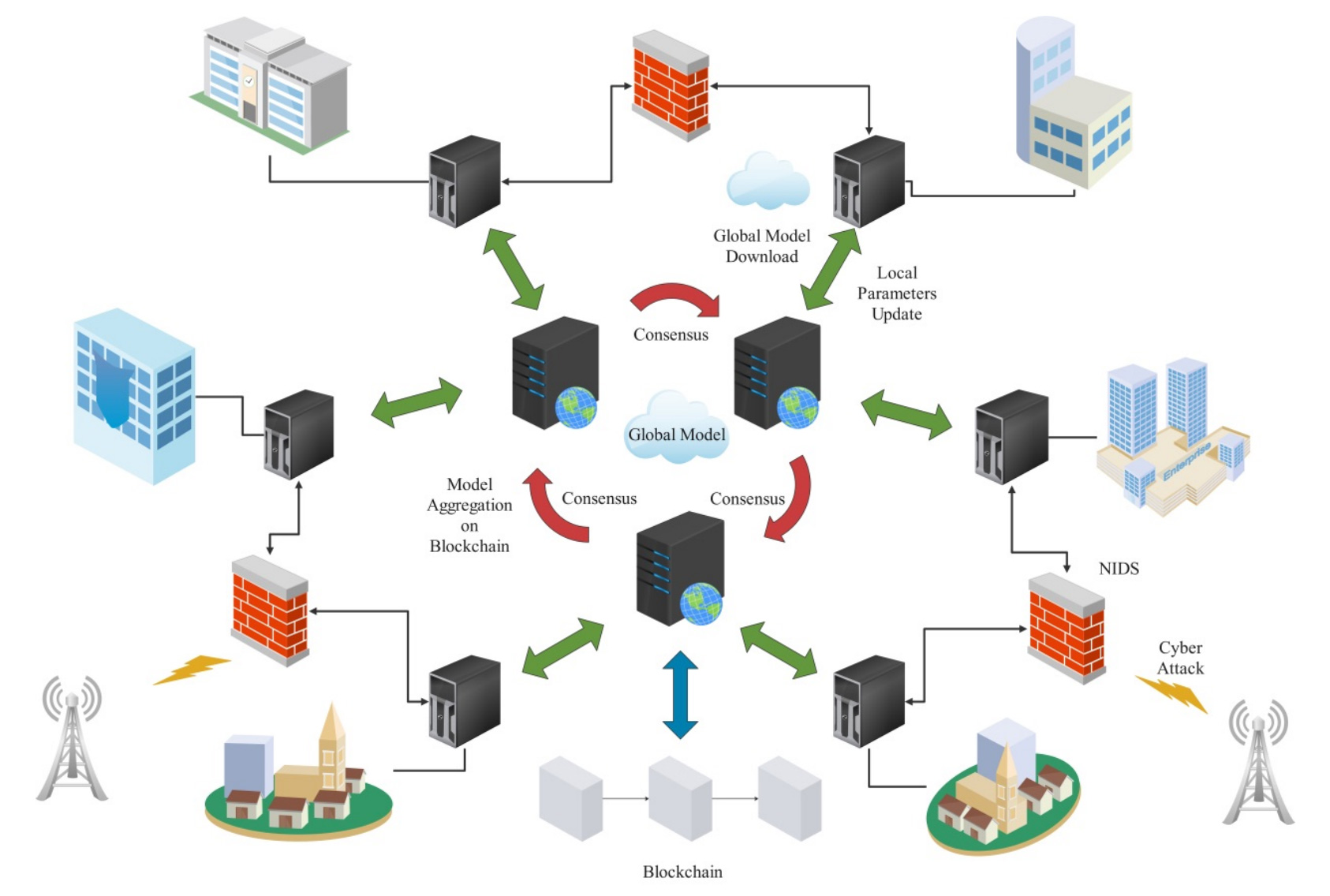
Graphical Abstract
Privacy and Trust in Blockchain-Federated Intrusion Detection Systems: Taxonomy, Challenges and Perspectives

Keywords
intrusion detection systems
federated learning
blockchain
privacy
trust

Data Availability Statement
Not applicable.

Funding
This work was supported without any funding.

Conflicts of Interest
The authors declare no conflicts of interest.

Ethical Approval and Consent to Participate
Not applicable.

References
  1. Chen, J., & Ran, X. (2019). Deep learning with edge computing: A review. Proceedings of the IEEE, 107(8), 1655-1674.
    [CrossRef]   [Google Scholar]
  2. Qiu, T., Chi, J., Zhou, X., Ning, Z., Atiquzzaman, M., & Wu, D. O. (2020). Edge computing in industrial internet of things: Architecture, advances and challenges. IEEE communications surveys & tutorials, 22(4), 2462-2488.
    [CrossRef]   [Google Scholar]
  3. Deng, J., Wang, W., Wang, L., Bashir, A. K., Gadekallu, T. R., Feng, H., ... & Fang, K. (2025). FIDSUS: Federated Intrusion Detection for Securing UAV Swarms in Smart Aerial Computing. IEEE Internet of Things Journal.
    [CrossRef]   [Google Scholar]
  4. Li, Q., Wen, Z., Wu, Z., Hu, S., Wang, N., Li, Y., ... & He, B. (2021). A survey on federated learning systems: Vision, hype and reality for data privacy and protection. IEEE Transactions on Knowledge and Data Engineering, 35(4), 3347-3366.
    [CrossRef]   [Google Scholar]
  5. Lu, Y. (2019). The blockchain: State-of-the-art and research challenges. Journal of Industrial Information Integration, 15, 80-90.
    [CrossRef]   [Google Scholar]
  6. Monrat, A. A., Schelén, O., & Andersson, K. (2019). A survey of blockchain from the perspectives of applications, challenges, and opportunities. Ieee Access, 7, 117134-117151.
    [CrossRef]   [Google Scholar]
  7. Chen, C. M., Hao, Y., Kumari, S., & Amoon, M. (2025). An Intelligent Blockchain-Enabled Authentication Protocol for Transportation Cyber-Physical Systems. IEEE Transactions on Intelligent Transportation Systems.
    [CrossRef]   [Google Scholar]
  8. Yang, Z., Liu, X., Li, T., Wu, D., Wang, J., Zhao, Y., & Han, H. (2022). A systematic literature review of methods and datasets for anomaly-based network intrusion detection. Computers & Security, 116, 102675.
    [CrossRef]   [Google Scholar]
  9. Halbouni, A., Gunawan, T. S., Habaebi, M. H., Halbouni, M., Kartiwi, M., & Ahmad, R. (2022). Machine learning and deep learning approaches for cybersecurity: A review. IEEE Access, 10, 19572-19585.
    [CrossRef]   [Google Scholar]
  10. Thakkar, A., & Lohiya, R. (2022). A survey on intrusion detection system: feature selection, model, performance measures, application perspective, challenges, and future research directions. Artificial Intelligence Review, 55(1), 453-563.
    [CrossRef]   [Google Scholar]
  11. Agrawal, S., Sarkar, S., Aouedi, O., Yenduri, G., Piamrat, K., Alazab, M., ... & Gadekallu, T. R. (2022). Federated learning for intrusion detection system: Concepts, challenges and future directions. Computer Communications, 195, 346-361.
    [CrossRef]   [Google Scholar]
  12. Arisdakessian, S., Wahab, O. A., Mourad, A., Otrok, H., & Guizani, M. (2022). A survey on IoT intrusion detection: Federated learning, game theory, social psychology, and explainable AI as future directions. IEEE Internet of Things Journal, 10(5), 4059-4092.
    [CrossRef]   [Google Scholar]
  13. Alfandi, O., Khanji, S., Ahmad, L., & Khattak, A. (2021). A survey on boosting IoT security and privacy through blockchain: Exploration, requirements, and open issues. Cluster Computing, 24(1), 37-55.
    [CrossRef]   [Google Scholar]
  14. Issa, W., Moustafa, N., Turnbull, B., Sohrabi, N., & Tari, Z. (2023). Blockchain-based federated learning for securing internet of things: A comprehensive survey. ACM Computing Surveys, 55(9), 1-43.
    [CrossRef]   [Google Scholar]
  15. Waheed, N., He, X., Ikram, M., Usman, M., Hashmi, S. S., & Usman, M. (2020). Security and privacy in IoT using machine learning and blockchain: Threats and countermeasures. ACM computing surveys (csur), 53(6), 1-37.
    [CrossRef]   [Google Scholar]
  16. Lata, S., & Singh, D. (2022). Intrusion detection system in cloud environment: Literature survey & future research directions. International Journal of Information Management Data Insights, 2(2), 100134.
    [CrossRef]   [Google Scholar]
  17. Campos, E. M., Saura, P. F., González-Vidal, A., Hernández-Ramos, J. L., Bernabe, J. B., Baldini, G., & Skarmeta, A. (2022). Evaluating Federated Learning for intrusion detection in Internet of Things: Review and challenges. Computer Networks, 203, 108661.
    [CrossRef]   [Google Scholar]
  18. Ahmad, Z., Shahid Khan, A., Wai Shiang, C., Abdullah, J., & Ahmad, F. (2021). Network intrusion detection system: A systematic study of machine learning and deep learning approaches. Transactions on Emerging Telecommunications Technologies, 32(1), e4150.
    [CrossRef]   [Google Scholar]
  19. Ghimire, B., & Rawat, D. B. (2022). Recent advances on federated learning for cybersecurity and cybersecurity for federated learning for internet of things. IEEE Internet of Things Journal, 9(11), 8229-8249.
    [CrossRef]   [Google Scholar]
  20. Zaman, S., Tauqeer, H., Ahmad, W., Shah, S. M. A., & Ilyas, M. (2020, November). Implementation of intrusion detection system in the internet of things: A survey. In 2020 IEEE 23rd International Multitopic Conference (INMIC) (pp. 1-6). IEEE.
    [CrossRef]   [Google Scholar]
  21. Samita, S., Chhabra, I., & Gautam, N. (2022, November). Survey Paper on IoT based Intrusion Detection System: Datasets and Techniques. In 2022 3rd International Conference on Computing, Analytics and Networks (ICAN) (pp. 1-9). IEEE.
    [CrossRef]   [Google Scholar]
  22. Chen, L., Lv, H., Fan, K., Yang, H., Kuang, X., Xu, A., & Yang, Y. (2020, October). A survey: Machine learning based security analytics approaches and applications of blockchain in network security. In 2020 3rd International Conference on Smart Blockchain (SmartBlock) (pp. 17-22). IEEE.
    [CrossRef]   [Google Scholar]
  23. Mothukuri, V., Parizi, R. M., Pouriyeh, S., Huang, Y., Dehghantanha, A., & Srivastava, G. (2021). A survey on security and privacy of federated learning. Future Generation Computer Systems, 115, 619-640.
    [CrossRef]   [Google Scholar]
  24. Nguyen, D. C., Ding, M., Pham, Q. V., Pathirana, P. N., Le, L. B., Seneviratne, A., ... & Poor, H. V. (2021). Federated learning meets blockchain in edge computing: Opportunities and challenges. IEEE Internet of Things Journal, 8(16), 12806-12825.
    [CrossRef]   [Google Scholar]
  25. Martinez, C. V., & Vogel-Heuser, B. (2021). A host intrusion detection system architecture for embedded industrial devices. journal of the Franklin Institute, 358(1), 210-236.
    [CrossRef]   [Google Scholar]
  26. Subba, B., & Gupta, P. (2021). A tfidfvectorizer and singular value decomposition based host intrusion detection system framework for detecting anomalous system processes. Computers & Security, 100, 102084.
    [CrossRef]   [Google Scholar]
  27. Hu, M., Wang, J., Zhao, W., Zeng, Q., & Luo, L. (2025). FlowMalTrans: Unsupervised Binary Code Translation for Malware Detection Using Flow-Adapter Architecture. arXiv preprint arXiv:2508.20212.
    [Google Scholar]
  28. Chaabouni, N., Mosbah, M., Zemmari, A., Sauvignac, C., & Faruki, P. (2019). Network intrusion detection for IoT security based on learning techniques. IEEE Communications Surveys & Tutorials, 21(3), 2671-2701.
    [CrossRef]   [Google Scholar]
  29. Ferdiana, R. (2020, November). A systematic literature review of intrusion detection system for network security: Research trends, datasets and methods. In 2020 4th International Conference on Informatics and Computational Sciences (ICICoS) (pp. 1-6). IEEE.
    [CrossRef]   [Google Scholar]
  30. Khraisat, A., Gondal, I., Vamplew, P., & Kamruzzaman, J. (2019). Survey of intrusion detection systems: techniques, datasets and challenges. Cybersecurity, 2(1), 1-22.
    [CrossRef]   [Google Scholar]
  31. Li, W., Wang, Y., & Li, J. (2022). Enhancing blockchain-based filtration mechanism via IPFS for collaborative intrusion detection in IoT networks. Journal of Systems Architecture, 127, 102510.
    [CrossRef]   [Google Scholar]
  32. Otoum, Y., & Nayak, A. (2021). As-ids: Anomaly and signature based ids for the internet of things. Journal of Network and Systems Management, 29(3), 23.
    [CrossRef]   [Google Scholar]
  33. Maseer, Z. K., Yusof, R., Bahaman, N., Mostafa, S. A., & Foozy, C. F. M. (2021). Benchmarking of machine learning for anomaly based intrusion detection systems in the CICIDS2017 dataset. IEEE access, 9, 22351-22370.
    [CrossRef]   [Google Scholar]
  34. Ingre, B., & Yadav, A. (2015, January). Performance analysis of NSL-KDD dataset using ANN. In 2015 international conference on signal processing and communication engineering systems (pp. 92-96). IEEE.
    [CrossRef]   [Google Scholar]
  35. Gao, B., Bu, B., Zhang, W., & Li, X. (2021). An intrusion detection method based on machine learning and state observer for train-ground communication systems. IEEE Transactions on Intelligent Transportation Systems, 23(7), 6608-6620.
    [CrossRef]   [Google Scholar]
  36. Gao, Y., Liu, Y., Jin, Y., Chen, J., & Wu, H. (2018). A novel semi-supervised learning approach for network intrusion detection on cloud-based robotic system. IEEe Access, 6, 50927-50938.
    [CrossRef]   [Google Scholar]
  37. Imamverdiyev, Y., & Abdullayeva, F. (2018). Deep learning method for denial of service attack detection based on restricted Boltzmann machine. Big data, 6(2), 159-169.
    [CrossRef]   [Google Scholar]
  38. Zhu, K., Chen, Z., Peng, Y., & Zhang, L. (2019). Mobile edge assisted literal multi-dimensional anomaly detection of in-vehicle network using LSTM. IEEE Transactions on Vehicular Technology, 68(5), 4275-4284.
    [CrossRef]   [Google Scholar]
  39. Wu, Y., Nie, L., Wang, S., Ning, Z., & Li, S. (2021). Intelligent intrusion detection for internet of things security: A deep convolutional generative adversarial network-enabled approach. IEEE Internet of Things Journal, 10(4), 3094-3106.
    [CrossRef]   [Google Scholar]
  40. Leng, J., Zhou, M., Zhao, J. L., Huang, Y., & Bian, Y. (2020). Blockchain security: A survey of techniques and research directions. IEEE Transactions on Services Computing, 15(4), 2490-2510.
    [CrossRef]   [Google Scholar]
  41. Wu, T. Y., Wu, H., Tang, M., Kumari, S., & Chen, C. M. (2025). Unleashing the Potential of Metaverse in Social IoV: An Authentication Protocol Based on Blockchain. Computers, Materials & Continua, 84(2). http://dx.doi.org/10.32604/cmc.2025.065717
    [Google Scholar]
  42. Yuen, T. H. (2020). PAChain: Private, authenticated & auditable consortium blockchain and its implementation. Future Generation Computer Systems, 112, 913-929.
    [CrossRef]   [Google Scholar]
  43. Tschorsch, F., & Scheuermann, B. (2016). Bitcoin and beyond: A technical survey on decentralized digital currencies. IEEE Communications Surveys & Tutorials, 18(3), 2084-2123.
    [CrossRef]   [Google Scholar]
  44. Chen, H., Pendleton, M., Njilla, L., & Xu, S. (2020). A survey on ethereum systems security: Vulnerabilities, attacks, and defenses. ACM Computing Surveys (CSUR), 53(3), 1-43.
    [CrossRef]   [Google Scholar]
  45. Pahlajani, S., Kshirsagar, A., & Pachghare, V. (2019, April). Survey on private blockchain consensus algorithms. In 2019 1st International Conference on Innovations in Information and Communication Technology (ICIICT) (pp. 1-6). IEEE.
    [CrossRef]   [Google Scholar]
  46. Dai, H. N., Zheng, Z., & Zhang, Y. (2019). Blockchain for Internet of Things: A survey. IEEE internet of things journal, 6(5), 8076-8094.
    [CrossRef]   [Google Scholar]
  47. Androulaki, E., Barger, A., Bortnikov, V., Cachin, C., Christidis, K., De Caro, A., ... & Yellick, J. (2018, April). Hyperledger fabric: a distributed operating system for permissioned blockchains. In Proceedings of the thirteenth EuroSys conference (pp. 1-15).
    [CrossRef]   [Google Scholar]
  48. Xu, J., Wang, C., & Jia, X. (2023). A survey of blockchain consensus protocols. ACM Computing Surveys, 55(13s), 1-35.
    [CrossRef]   [Google Scholar]
  49. Meng, Y., Cao, Z., & Qu, D. (2018, November). A committee-based byzantine consensus protocol for blockchain. In 2018 IEEE 9th International Conference on Software Engineering and Service Science (ICSESS) (pp. 1-6). IEEE.
    [CrossRef]   [Google Scholar]
  50. Zou, W., Lo, D., Kochhar, P. S., Le, X. B. D., Xia, X., Feng, Y., ... & Xu, B. (2019). Smart contract development: Challenges and opportunities. IEEE transactions on software engineering, 47(10), 2084-2106.
    [CrossRef]   [Google Scholar]
  51. McMahan, B., Moore, E., Ramage, D., Hampson, S., & y Arcas, B. A. (2017, April). Communication-efficient learning of deep networks from decentralized data. In Artificial intelligence and statistics (pp. 1273-1282). PMLR.
    [Google Scholar]
  52. Rieke, N., Hancox, J., Li, W., Milletari, F., Roth, H. R., Albarqouni, S., ... & Cardoso, M. J. (2020). The future of digital health with federated learning. NPJ digital medicine, 3(1), 119.
    [CrossRef]   [Google Scholar]
  53. Liu, Y., Kang, Y., Xing, C., Chen, T., & Yang, Q. (2020). A secure federated transfer learning framework. IEEE Intelligent Systems, 35(4), 70-82.
    [CrossRef]   [Google Scholar]
  54. Sun, T., Li, D., & Wang, B. (2022). Decentralized federated averaging. IEEE Transactions on Pattern Analysis and Machine Intelligence, 45(4), 4289-4301.
    [CrossRef]   [Google Scholar]
  55. Zhao, C., Zhao, S., Zhao, M., Chen, Z., Gao, C. Z., Li, H., & Tan, Y. A. (2019). Secure multi-party computation: theory, practice and applications. Information Sciences, 476, 357-372.
    [CrossRef]   [Google Scholar]
  56. Ma, Z., Liu, L., Meng, W., Luo, X., Wang, L., & Li, W. (2023). ADCL: toward an adaptive network intrusion detection system using collaborative learning in IoT networks. IEEE Internet of Things Journal, 10(14), 12521-12536.
    [CrossRef]   [Google Scholar]
  57. Park, C., Lee, J., Kim, Y., Park, J. G., Kim, H., & Hong, D. (2022). An enhanced AI-based network intrusion detection system using generative adversarial networks. IEEE Internet of Things Journal, 10(3), 2330-2345.
    [CrossRef]   [Google Scholar]
  58. Nguyen, T. G., Phan, T. V., Nguyen, B. T., So-In, C., Baig, Z. A., & Sanguanpong, S. (2019). Search: A collaborative and intelligent nids architecture for sdn-based cloud iot networks. IEEE access, 7, 107678-107694.
    [CrossRef]   [Google Scholar]
  59. Hui, S., Wang, Z., Hou, X., Wang, X., Wang, H., Li, Y., & Jin, D. (2020). Systematically quantifying IoT privacy leakage in mobile networks. IEEE Internet of Things Journal, 8(9), 7115-7125.
    [CrossRef]   [Google Scholar]
  60. Celik, Z. B., Babun, L., Sikder, A. K., Aksu, H., Tan, G., McDaniel, P., & Uluagac, A. S. (2018). Sensitive information tracking in commodity {IoT. In 27th USENIX Security Symposium (USENIX Security 18) (pp. 1687-1704).
    [Google Scholar]
  61. Niksefat, S., Kaghazgaran, P., & Sadeghiyan, B. (2017). Privacy issues in intrusion detection systems: A taxonomy, survey and future directions. Computer Science Review, 25, 69-78.
    [CrossRef]   [Google Scholar]
  62. Arshad, J., Azad, M. A., Amad, R., Salah, K., Alazab, M., & Iqbal, R. (2020). A review of performance, energy and privacy of intrusion detection systems for IoT. Electronics, 9(4), 629.
    [CrossRef]   [Google Scholar]
  63. Li, Y., Zhu, L., Wang, H., Yu, F. R., & Liu, S. (2020). A cross-layer defense scheme for edge intelligence-enabled CBTC systems against MitM attacks. IEEE Transactions on Intelligent Transportation Systems, 22(4), 2286-2298.
    [CrossRef]   [Google Scholar]
  64. Guo, Y., Zhang, H., Zhang, L., Fang, L., & Li, F. (2019). A game theoretic approach to cooperative intrusion detection. Journal of computational science, 30, 118-126.
    [CrossRef]   [Google Scholar]
  65. Kumar, P., Tripathi, R., & P. Gupta, G. (2021, January). P2IDF: A privacy-preserving based intrusion detection framework for software defined Internet of Things-fog (SDIoT-Fog). In Adjunct proceedings of the 2021 international conference on distributed computing and networking (pp. 37-42).
    [CrossRef]   [Google Scholar]
  66. Ng, A. (2011). Sparse autoencoder. CS294A Lecture notes, 72(2011), 1-19. https://graphics.stanford.edu/courses/cs233-21-spring/ReferencedPapers/SAE.pdf
    [Google Scholar]
  67. Fakirah, J., Zishan, L. M., Mooruth, R., Johnstone, M. N., & Yang, W. (2021). A low-cost machine learning based network intrusion detection system with data privacy preservation. arXiv preprint arXiv:2107.02362.
    [Google Scholar]
  68. Rahman, S. A., Tout, H., Talhi, C., & Mourad, A. (2020). Internet of things intrusion detection: Centralized, on-device, or federated learning?. IEEE network, 34(6), 310-317.
    [CrossRef]   [Google Scholar]
  69. Li, B., Wu, Y., Song, J., Lu, R., Li, T., & Zhao, L. (2020). DeepFed: Federated deep learning for intrusion detection in industrial cyber–physical systems. IEEE Transactions on Industrial Informatics, 17(8), 5615-5624.
    [CrossRef]   [Google Scholar]
  70. Khan, I. A., Pi, D., Abbas, M. Z., Zia, U., Hussain, Y., & Soliman, H. (2022). Federated-SRUs: A federated-simple-recurrent-units-based IDS for accurate detection of cyber attacks against IoT-augmented industrial control systems. IEEE Internet of Things Journal, 10(10), 8467-8476.
    [CrossRef]   [Google Scholar]
  71. Lu, Y., Huang, X., Dai, Y., Maharjan, S., & Zhang, Y. (2020). Federated learning for data privacy preservation in vehicular cyber-physical systems. IEEE Network, 34(3), 50-56.
    [CrossRef]   [Google Scholar]
  72. Li, K., Zhou, H., Tu, Z., Wang, W., & Zhang, H. (2020). Distributed network intrusion detection system in satellite-terrestrial integrated networks using federated learning. IEEE Access, 8, 214852-214865.
    [CrossRef]   [Google Scholar]
  73. Liu, W., Xu, X., Wu, L., Qi, L., Jolfaei, A., Ding, W., & Khosravi, M. R. (2022). Intrusion detection for maritime transportation systems with batch federated aggregation. IEEE transactions on intelligent transportation systems, 24(2), 2503-2514.
    [CrossRef]   [Google Scholar]
  74. Singh, P., Gaba, G. S., Kaur, A., Hedabou, M., & Gurtov, A. (2022). Dew-cloud-based hierarchical federated learning for intrusion detection in IoMT. IEEE journal of biomedical and health informatics, 27(2), 722-731.
    [CrossRef]   [Google Scholar]
  75. Aono, Y., Hayashi, T., Wang, L., & Moriai, S. (2017). Privacy-preserving deep learning via additively homomorphic encryption. IEEE transactions on information forensics and security, 13(5), 1333-1345.
    [CrossRef]   [Google Scholar]
  76. Zhu, L., Liu, Z., & Han, S. (2019). Deep leakage from gradients. Advances in neural information processing systems, 32.
    [Google Scholar]
  77. Zhao, B., Mopuri, K. R., & Bilen, H. (2020). idlg: Improved deep leakage from gradients. arXiv preprint arXiv:2001.02610.
    [Google Scholar]
  78. Abadi, M., Chu, A., Goodfellow, I., McMahan, H. B., Mironov, I., Talwar, K., & Zhang, L. (2016, October). Deep learning with differential privacy. In Proceedings of the 2016 ACM SIGSAC conference on computer and communications security (pp. 308-318).
    [CrossRef]   [Google Scholar]
  79. Ruzafa-Alcázar, P., Fernández-Saura, P., Mármol-Campos, E., González-Vidal, A., Hernández-Ramos, J. L., Bernal-Bernabe, J., & Skarmeta, A. F. (2021). Intrusion detection based on privacy-preserving federated learning for the industrial IoT. IEEE Transactions on Industrial Informatics, 19(2), 1145-1154.
    [CrossRef]   [Google Scholar]
  80. Acar, A., Aksu, H., Uluagac, A. S., & Conti, M. (2018). A survey on homomorphic encryption schemes: Theory and implementation. ACM Computing Surveys (Csur), 51(4), 1-35.
    [CrossRef]   [Google Scholar]
  81. Liu, X., Li, H., Xu, G., Chen, Z., Huang, X., & Lu, R. (2021). Privacy-enhanced federated learning against poisoning adversaries. IEEE Transactions on Information Forensics and Security, 16, 4574-4588.
    [CrossRef]   [Google Scholar]
  82. Zhou, C., Fu, A., Yu, S., Yang, W., Wang, H., & Zhang, Y. (2020). Privacy-preserving federated learning in fog computing. IEEE Internet of Things Journal, 7(11), 10782-10793.
    [CrossRef]   [Google Scholar]
  83. Friha, O., Ferrag, M. A., Benbouzid, M., Berghout, T., Kantarci, B., & Choo, K. K. R. (2023). 2DF-IDS: Decentralized and differentially private federated learning-based intrusion detection system for industrial IoT. Computers & Security, 127, 103097.
    [CrossRef]   [Google Scholar]
  84. Kim, H., Park, J., Bennis, M., & Kim, S. L. (2019). Blockchained on-device federated learning. IEEE Communications Letters, 24(6), 1279-1283.
    [CrossRef]   [Google Scholar]
  85. Li, Y., Chen, C., Liu, N., Huang, H., Zheng, Z., & Yan, Q. (2020). A blockchain-based decentralized federated learning framework with committee consensus. IEEE Network, 35(1), 234-241.
    [CrossRef]   [Google Scholar]
  86. Otoum, S., Al Ridhawi, I., & Mouftah, H. (2021). Securing critical IoT infrastructures with blockchain-supported federated learning. IEEE Internet of Things Journal, 9(4), 2592-2601.
    [CrossRef]   [Google Scholar]
  87. Liu, H., Zhang, S., Zhang, P., Zhou, X., Shao, X., Pu, G., & Zhang, Y. (2021). Blockchain and federated learning for collaborative intrusion detection in vehicular edge computing. IEEE Transactions on Vehicular Technology, 70(6), 6073-6084.
    [CrossRef]   [Google Scholar]
  88. He, X., Chen, Q., Tang, L., Wang, W., & Liu, T. (2022). CGAN-based collaborative intrusion detection for UAV networks: A blockchain-empowered distributed federated learning approach. IEEE Internet of Things Journal, 10(1), 120-132.
    [CrossRef]   [Google Scholar]
  89. Abdel-Basset, M., Moustafa, N., & Hawash, H. (2022). Privacy-preserved cyberattack detection in Industrial Edge of Things (IEoT): A blockchain-orchestrated federated learning approach. IEEE Transactions on Industrial Informatics, 18(11), 7920-7934.
    [CrossRef]   [Google Scholar]
  90. Zaabar, B., Cheikhrouhou, O., & Abid, M. (2022, November). Intrusion detection system for IoMT through blockchain-based federated learning. In 2022 15th International Conference on Security of Information and Networks (SIN) (pp. 01-08). IEEE.
    [CrossRef]   [Google Scholar]
  91. Truong, V. T., & Le, L. B. (2023). MetaCIDS: Privacy-preserving collaborative intrusion detection for metaverse based on blockchain and online federated learning. IEEE Open Journal of the Computer Society, 4, 253-266.
    [CrossRef]   [Google Scholar]
  92. Shlezinger, N., Chen, M., Eldar, Y. C., Poor, H. V., & Cui, S. (2020). UVeQFed: Universal vector quantization for federated learning. IEEE Transactions on Signal Processing, 69, 500-514.
    [CrossRef]   [Google Scholar]
  93. Pokhrel, S. R., & Choi, J. (2020). Federated learning with blockchain for autonomous vehicles: Analysis and design challenges. IEEE Transactions on Communications, 68(8), 4734-4746.
    [CrossRef]   [Google Scholar]
  94. Lu, Y., Huang, X., Zhang, K., Maharjan, S., & Zhang, Y. (2020). Communication-efficient federated learning for digital twin edge networks in industrial IoT. IEEE Transactions on Industrial Informatics, 17(8), 5709-5718.
    [CrossRef]   [Google Scholar]
  95. Zhao, Y., Li, M., Lai, L., Suda, N., Civin, D., & Chandra, V. (2018). Federated learning with non-iid data. arXiv preprint arXiv:1806.00582.
    [Google Scholar]
  96. Briggs, C., Fan, Z., & Andras, P. (2020, July). Federated learning with hierarchical clustering of local updates to improve training on non-IID data. In 2020 international joint conference on neural networks (IJCNN) (pp. 1-9). IEEE.
    [CrossRef]   [Google Scholar]
  97. Sattler, F., Wiedemann, S., Müller, K. R., & Samek, W. (2019). Robust and communication-efficient federated learning from non-iid data. IEEE transactions on neural networks and learning systems, 31(9), 3400-3413.
    [CrossRef]   [Google Scholar]
  98. Zhu, H., Xu, J., Liu, S., & Jin, Y. (2021). Federated learning on non-IID data: A survey. Neurocomputing, 465, 371-390.
    [CrossRef]   [Google Scholar]
  99. Jiang, J., Li, Y., Nie, J., Li, J., Wen, B., & Gadekallu, T. R. (2025). Integrating large language models with cross-modal data fusion for advanced intelligent transportation systems in sustainable cities development. Applied Soft Computing, 113278.
    [CrossRef]   [Google Scholar]
  100. Preuveneers, D., Rimmer, V., Tsingenopoulos, I., Spooren, J., Joosen, W., & Ilie-Zudor, E. (2018). Chained anomaly detection models for federated learning: An intrusion detection case study. Applied Sciences, 8(12), 2663.
    [CrossRef]   [Google Scholar]
  101. Hieu, N. Q., Tran, T. A., Nguyen, C. L., Niyato, D., Kim, D. I., & Elmroth, E. (2022). Deep reinforcement learning for resource management in blockchain-enabled federated learning network. IEEE Networking Letters, 4(3), 137-141.
    [CrossRef]   [Google Scholar]
  102. Lu, Y., Huang, X., Zhang, K., Maharjan, S., & Zhang, Y. (2020). Low-latency federated learning and blockchain for edge association in digital twin empowered 6G networks. IEEE Transactions on Industrial Informatics, 17(7), 5098-5107.
    [CrossRef]   [Google Scholar]
  103. Liu, Y., Wang, K., Lin, Y., & Xu, W. (2019). $\mathsf {LightChain $: a lightweight blockchain system for industrial internet of things. IEEE Transactions on Industrial Informatics, 15(6), 3571-3581.
    [CrossRef]   [Google Scholar]
  104. Bandara, E., Tosh, D., Foytik, P., Shetty, S., Ranasinghe, N., & De Zoysa, K. (2021). Tikiri—Towards a lightweight blockchain for IoT. Future Generation Computer Systems, 119, 154-165.
    [CrossRef]   [Google Scholar]
  105. Hassija, V., Chamola, V., Garg, S., Krishna, D. N. G., Kaddoum, G., & Jayakody, D. N. K. (2020). A blockchain-based framework for lightweight data sharing and energy trading in V2G network. IEEE Transactions on Vehicular Technology, 69(6), 5799-5812.
    [CrossRef]   [Google Scholar]
  106. Biswas, S., Sharif, K., Li, F., Maharjan, S., Mohanty, S. P., & Wang, Y. (2019). PoBT: A lightweight consensus algorithm for scalable IoT business blockchain. IEEE Internet of Things Journal, 7(3), 2343-2355.
    [CrossRef]   [Google Scholar]
  107. Toyoda, K., & Zhang, A. N. (2019, December). Mechanism design for an incentive-aware blockchain-enabled federated learning platform. In 2019 IEEE international conference on big data (Big Data) (pp. 395-403). IEEE.
    [CrossRef]   [Google Scholar]
  108. Weng, J., Weng, J., Zhang, J., Li, M., Zhang, Y., & Luo, W. (2019). Deepchain: Auditable and privacy-preserving deep learning with blockchain-based incentive. IEEE Transactions on Dependable and Secure Computing, 18(5), 2438-2455.
    [CrossRef]   [Google Scholar]
  109. Wang, J., Li, M., He, Y., Li, H., Xiao, K., & Wang, C. (2018). A blockchain based privacy-preserving incentive mechanism in crowdsensing applications. Ieee Access, 6, 17545-17556.
    [CrossRef]   [Google Scholar]
  110. Zhang, J., Chen, B., Cheng, X., Binh, H. T. T., & Yu, S. (2020). PoisonGAN: Generative poisoning attacks against federated learning in edge computing systems. IEEE Internet of Things Journal, 8(5), 3310-3322.
    [CrossRef]   [Google Scholar]
  111. Han, D., Wang, Z., Zhong, Y., Chen, W., Yang, J., Lu, S., ... & Yin, X. (2021). Evaluating and improving adversarial robustness of machine learning-based network intrusion detectors. IEEE Journal on Selected Areas in Communications, 39(8), 2632-2647.
    [CrossRef]   [Google Scholar]
  112. Zhou, X., Liang, W., Li, W., Yan, K., Shimizu, S., & Wang, K. I. K. (2021). Hierarchical adversarial attacks against graph-neural-network-based IoT network intrusion detection system. IEEE Internet of Things Journal, 9(12), 9310-9319.
    [CrossRef]   [Google Scholar]
  113. Qayyum, A., Janjua, M. U., & Qadir, J. (2022). Making federated learning robust to adversarial attacks by learning data and model association. Computers & Security, 121, 102827.
    [CrossRef]   [Google Scholar]
  114. Guyon, I., & Elisseeff, A. (2003). An introduction to variable and feature selection. Journal of machine learning research, 3(Mar), 1157-1182.
    [Google Scholar]
  115. He, K., Kim, D. D., & Asghar, M. R. (2023). Adversarial machine learning for network intrusion detection systems: A comprehensive survey. IEEE Communications Surveys & Tutorials, 25(1), 538-566.
    [Google Scholar]
  116. Nair, A. K., Raj, E. D., & Sahoo, J. (2023). A robust analysis of adversarial attacks on federated learning environments. Computer Standards & Interfaces, 86, 103723.
    [CrossRef]   [Google Scholar]

Cite This Article
APA Style
Cao, Y., Ku, C. S., Kumar, R. & Khan, A. (2025). Privacy and Trust in Blockchain-Federated Intrusion Detection Systems: Taxonomy, Challenges and Perspectives. Journal of Reliable and Secure Computing, 1(1), 4–24. https://doi.org/10.62762/JRSC.2025.399812
Export Citation
RIS Format
Compatible with EndNote, Zotero, Mendeley, and other reference managers
RIS format data for reference managers
TY  - JOUR
AU  - Cao, Yuan
AU  - Ku, Chin Soon
AU  - Kumar, Rahul
AU  - Khan, Arshad
PY  - 2025
DA  - 2025/11/02
TI  - Privacy and Trust in Blockchain-Federated Intrusion Detection Systems: Taxonomy, Challenges and Perspectives
JO  - Journal of Reliable and Secure Computing
T2  - Journal of Reliable and Secure Computing
JF  - Journal of Reliable and Secure Computing
VL  - 1
IS  - 1
SP  - 4
EP  - 24
DO  - 10.62762/JRSC.2025.399812
UR  - https://www.icck.org/article/abs/JRSC.2025.399812
KW  - intrusion detection systems
KW  - federated learning
KW  - blockchain
KW  - privacy
KW  - trust
AB  - Intrusion Detection Systems (IDS) play a critical role in protecting modern networks, but traditional centralized designs raise serious concerns regarding data privacy, trust, and scalability. Federated Learning (FL) reduces privacy risks through decentralized model training, and blockchain enhances trust by providing immutability and transparency. Combining these technologies creates a promising paradigm for secure and trustworthy IDS. This paper presents a comprehensive survey of blockchain-federated IDS with a particular focus on privacy and trust. The key contribution is a multi-dimensional taxonomy that integrates IDS architectures, FL strategies, blockchain types, and consensus mechanisms, providing a clear and structured view of this emerging field. We categorize threats into data, communication, and model levels, and map representative defense mechanisms to each. We also review applications in vehicular networks, industrial and medical Internet of Things (IoT), and metaverse scenarios. Finally, we highlight key challenges, including non-IID data, lightweight consensus, incentive mechanisms, and poisoning-resilient aggregation, and outline future research directions.
SN  - pending
PB  - Institute of Central Computation and Knowledge
LA  - English
ER  - 
BibTeX Format
Compatible with LaTeX, BibTeX, and other reference managers
BibTeX format data for LaTeX and reference managers
@article{Cao2025Privacy,
  author = {Yuan Cao and Chin Soon Ku and Rahul Kumar and Arshad Khan},
  title = {Privacy and Trust in Blockchain-Federated Intrusion Detection Systems: Taxonomy, Challenges and Perspectives},
  journal = {Journal of Reliable and Secure Computing},
  year = {2025},
  volume = {1},
  number = {1},
  pages = {4-24},
  doi = {10.62762/JRSC.2025.399812},
  url = {https://www.icck.org/article/abs/JRSC.2025.399812},
  abstract = {Intrusion Detection Systems (IDS) play a critical role in protecting modern networks, but traditional centralized designs raise serious concerns regarding data privacy, trust, and scalability. Federated Learning (FL) reduces privacy risks through decentralized model training, and blockchain enhances trust by providing immutability and transparency. Combining these technologies creates a promising paradigm for secure and trustworthy IDS. This paper presents a comprehensive survey of blockchain-federated IDS with a particular focus on privacy and trust. The key contribution is a multi-dimensional taxonomy that integrates IDS architectures, FL strategies, blockchain types, and consensus mechanisms, providing a clear and structured view of this emerging field. We categorize threats into data, communication, and model levels, and map representative defense mechanisms to each. We also review applications in vehicular networks, industrial and medical Internet of Things (IoT), and metaverse scenarios. Finally, we highlight key challenges, including non-IID data, lightweight consensus, incentive mechanisms, and poisoning-resilient aggregation, and outline future research directions.},
  keywords = {intrusion detection systems, federated learning, blockchain, privacy, trust},
  issn = {pending},
  publisher = {Institute of Central Computation and Knowledge}
}

Article Metrics
Citations:

Crossref

0

Scopus

0

Web of Science

0
Article Access Statistics:
Views: 800
PDF Downloads: 56

Publisher's Note
ICCK stays neutral with regard to jurisdictional claims in published maps and institutional affiliations.

Rights and Permissions
CC BY Copyright © 2025 by the Author(s). Published by Institute of Central Computation and Knowledge. This article is an open access article distributed under the terms and conditions of the Creative Commons Attribution (CC BY) license (https://creativecommons.org/licenses/by/4.0/), which permits use, sharing, adaptation, distribution and reproduction in any medium or format, as long as you give appropriate credit to the original author(s) and the source, provide a link to the Creative Commons licence, and indicate if changes were made.
Journal of Reliable and Secure Computing

Journal of Reliable and Secure Computing

ISSN: pending (Online)

Email: [email protected]

Portico

Portico

All published articles are preserved here permanently:
https://www.portico.org/publishers/icck/