
Preventing Harassment and Ensuring Fairness in College Examinations: An Evidence-Based Case Study of Arbitrary Administrative Practices



Article Information
Abstract
Examination environments across Pakistan's university-affiliated college sector are designed to uphold fairness, integrity, and student dignity. However, systemic gaps in invigilation governance including absent standardized procedures, limited invigilator training, and inadequate accountability mechanisms allow arbitrary administrative practices to persist unchecked, harming student performance and psychological well-being. This mixed-methods study investigates repeated, unjustified search practices and documentation checks during formal examinations, documenting their ethical and procedural implications within Pakistan's broader examination governance framework. Data were gathered through structured observation, a student survey (n=18), and anonymized peer testimonies, analyzed thematically alongside existing literature. Findings confirm that arbitrary searches induce anxiety, erode institutional trust, and contravene procedural justice principles. Evidence-based recommendations include pre-examination verification protocols, standardized invigilator SOPs, and accessible grievance mechanisms to safeguard student dignity and strengthen sector-wide accountability.
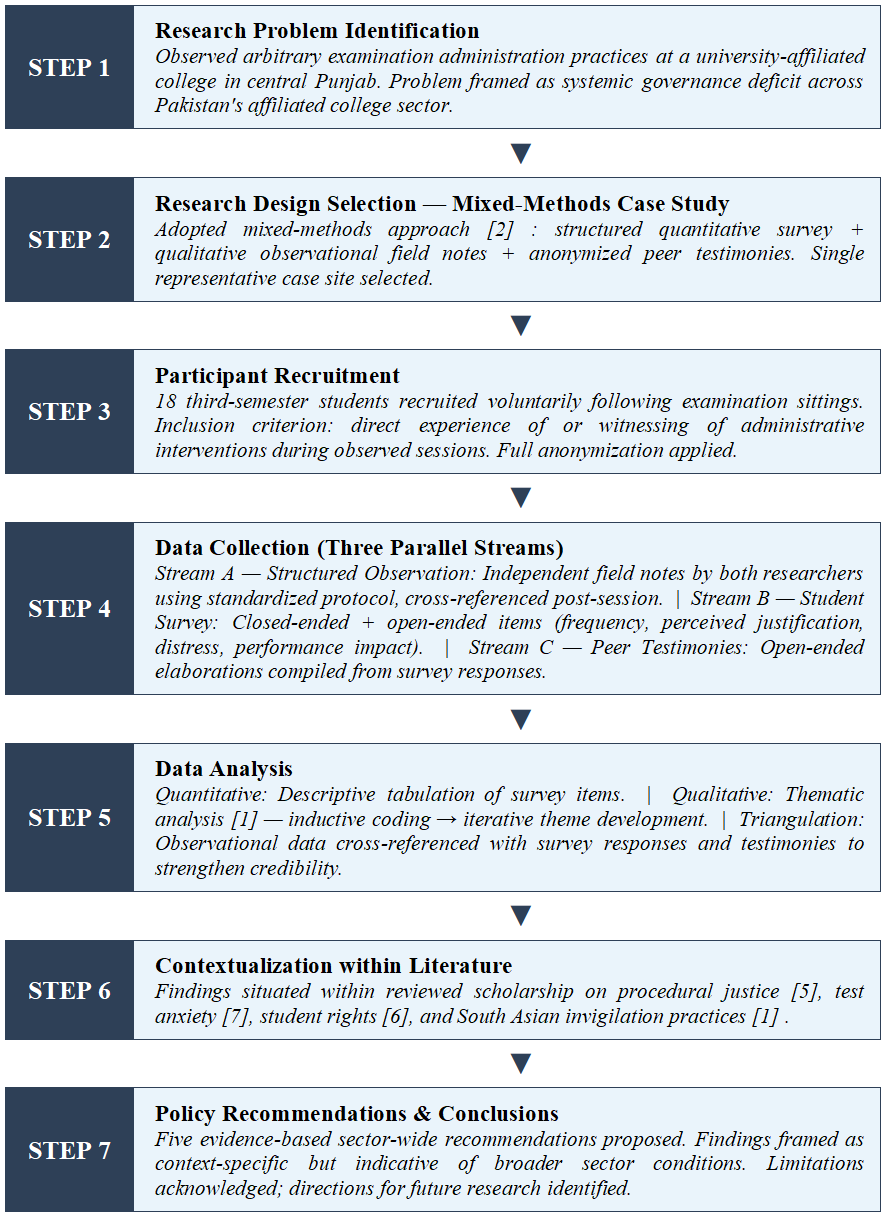
Graphical Abstract
Keywords
Data Availability Statement
Funding
Conflicts of Interest
AI Use Statement
Ethical Approval and Consent to Participate
References
- Suleman, Q., Gul, R., Ambrin, S., & Kamran, F. (2015). Factors contributing to examination malpractices at secondary school level in Kohat Division, Pakistan. Journal of Education and Learning, 9(2), 165-182.
[Google Scholar] - von der Embse, N., Jester, D., Roy, D., & Post, J. (2018). Test anxiety effects, predictors, and correlates: A 30-year meta-analytic review. Journal of Affective Disorders, 227, 483–493.
[CrossRef] [Google Scholar] - Tyler, T. R. (2006). Why people obey the law. Princeton University Press.
[CrossRef] [Google Scholar] - Główczewski, M., & Burdziej, S. (2023). (In)justice in academia: Procedural fairness, students’ academic identification, and perceived legitimacy of university authorities. Higher Education, 86(1), 163–184.
[CrossRef] [Google Scholar] - UNESCO. (2016). Education 2030: Incheon Declaration and Framework for Action for the implementation of Sustainable Development Goal 4: Ensure inclusive and equitable quality education and promote lifelong learning opportunities for all (ED-2016/WS/28). Retrieved from https://unesdoc.unesco.org/ark:/48223/pf0000245656
[Google Scholar] - Braun, V., & Clarke, V. (2006). Using thematic analysis in psychology. Qualitative Research in Psychology, 3(2), 77–101.
[CrossRef] [Google Scholar] - Creswell, J. W., & Plano Clark, V. L. (2018). Designing and conducting mixed methods research (3rd ed.). SAGE Publications.
[Google Scholar] - Tight, M. (2024). Challenging cheating in higher education: a review of research and practice. Assessment & Evaluation in Higher Education, 49(7), 911-923.
[CrossRef] [Google Scholar] - Yin, R. K. (2018). Case study research and applications: Design and methods (6th ed.). Sage Publications.
[Google Scholar]
Cite This Article
TY  - JOUR
AU  - Farooq, Muhammad Umar
AU  - Naeem, Aliza
PY  - 2026
DA  - 2026/04/25
TI  - Preventing Harassment and Ensuring Fairness in College Examinations: An Evidence-Based Case Study of Arbitrary Administrative Practices
JO  - Journal of Social Systems and Policy Analysis
T2  - Journal of Social Systems and Policy Analysis
JF  - Journal of Social Systems and Policy Analysis
VL  - 3
IS  - 2
SP  - 92
EP  - 99
DO  - 10.62762/JSSPA.2026.581783
UR  - https://www.icck.org/article/abs/jsspa.2026.581783
KW  - examination ethics
KW  - student rights
KW  - invigilation reform
KW  - procedural justice
KW  - Pakistan higher education
KW  - university-affiliated colleges
KW  - academic administration
AB  - Examination environments across Pakistan's university-affiliated college sector are designed to uphold fairness, integrity, and student dignity. However, systemic gaps in invigilation governance including absent standardized procedures, limited invigilator training, and inadequate accountability mechanisms allow arbitrary administrative practices to persist unchecked, harming student performance and psychological well-being. This mixed-methods study investigates repeated, unjustified search practices and documentation checks during formal examinations, documenting their ethical and procedural implications within Pakistan's broader examination governance framework. Data were gathered through structured observation, a student survey (n=18), and anonymized peer testimonies, analyzed thematically alongside existing literature. Findings confirm that arbitrary searches induce anxiety, erode institutional trust, and contravene procedural justice principles. Evidence-based recommendations include pre-examination verification protocols, standardized invigilator SOPs, and accessible grievance mechanisms to safeguard student dignity and strengthen sector-wide accountability.
SN  - 3068-5540
PB  - Institute of Central Computation and Knowledge
LA  - English
ER  -
@article{Farooq2026Preventing,
  author = {Muhammad Umar Farooq and Aliza Naeem},
  title = {Preventing Harassment and Ensuring Fairness in College Examinations: An Evidence-Based Case Study of Arbitrary Administrative Practices},
  journal = {Journal of Social Systems and Policy Analysis},
  year = {2026},
  volume = {3},
  number = {2},
  pages = {92-99},
  doi = {10.62762/JSSPA.2026.581783},
  url = {https://www.icck.org/article/abs/jsspa.2026.581783},
  abstract = {Examination environments across Pakistan's university-affiliated college sector are designed to uphold fairness, integrity, and student dignity. However, systemic gaps in invigilation governance including absent standardized procedures, limited invigilator training, and inadequate accountability mechanisms allow arbitrary administrative practices to persist unchecked, harming student performance and psychological well-being. This mixed-methods study investigates repeated, unjustified search practices and documentation checks during formal examinations, documenting their ethical and procedural implications within Pakistan's broader examination governance framework. Data were gathered through structured observation, a student survey (n=18), and anonymized peer testimonies, analyzed thematically alongside existing literature. Findings confirm that arbitrary searches induce anxiety, erode institutional trust, and contravene procedural justice principles. Evidence-based recommendations include pre-examination verification protocols, standardized invigilator SOPs, and accessible grievance mechanisms to safeguard student dignity and strengthen sector-wide accountability.},
  keywords = {examination ethics, student rights, invigilation reform, procedural justice, Pakistan higher education, university-affiliated colleges, academic administration},
  issn = {3068-5540},
  publisher = {Institute of Central Computation and Knowledge}
}
Article Metrics
Publisher's Note
ICCK stays neutral with regard to jurisdictional claims in published maps and institutional affiliations.
Rights and Permissions
 Copyright © 2026 by the Author(s). Published by Institute of Central Computation and Knowledge. This article is an open access article distributed under the terms and conditions of the Creative Commons Attribution (CC BY) license (https://creativecommons.org/licenses/by/4.0/), which permits use, sharing, adaptation, distribution and reproduction in any medium or format, as long as you give appropriate credit to the original author(s) and the source, provide a link to the Creative Commons licence, and indicate if changes were made.

Portico
