
Topic Modeling and Thematic Analysis of Agritourism Research: A Text Mining Approach




Article Information
Abstract
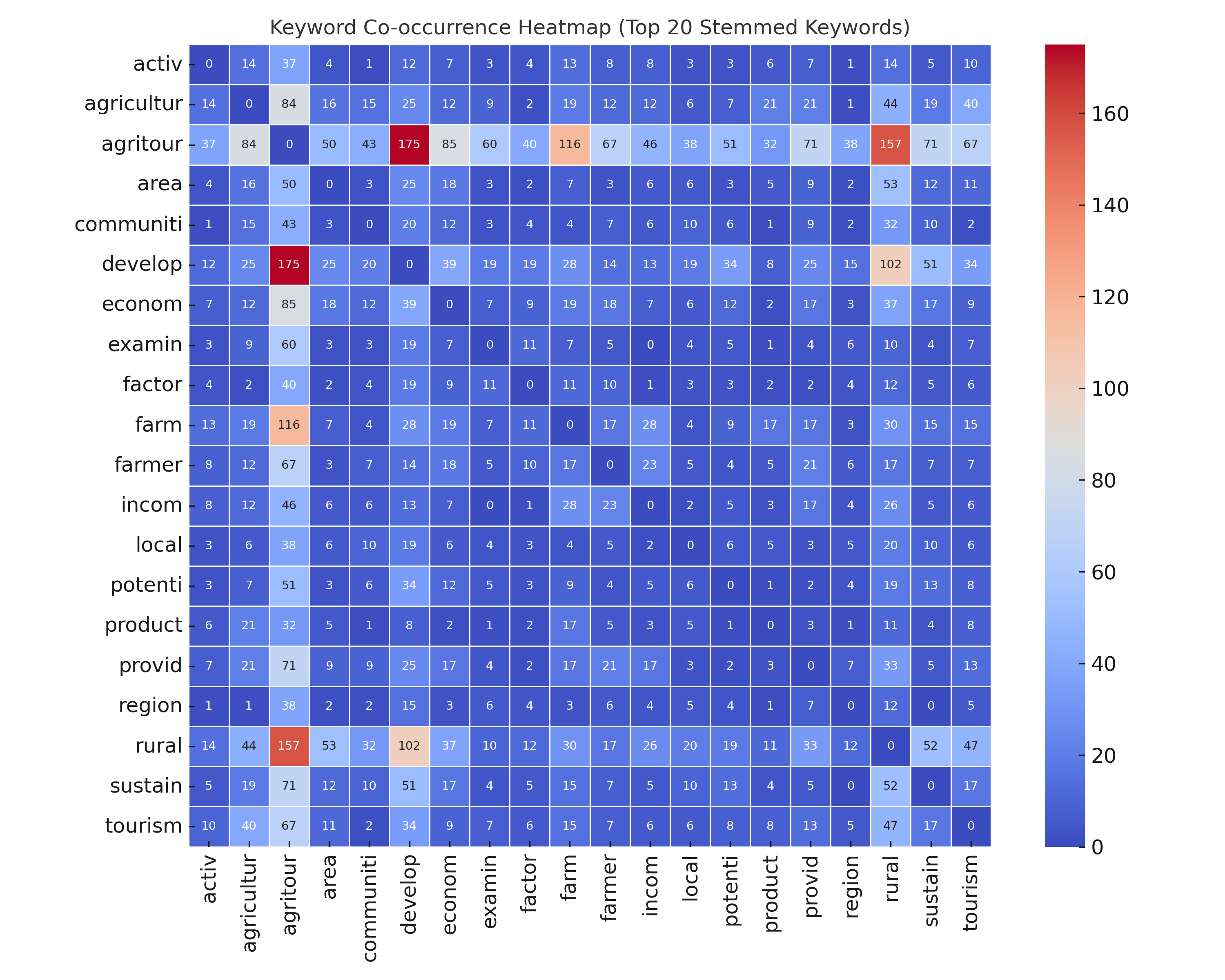
This study aims to explore the intellectual structure and thematic trends of agritourism research through advanced text mining and topic modeling techniques, addressing a significant gap by providing a quantitative synthesis of agritourism literature with a focus on how scholarly discourse has evolved across domains such as sustainability, rural development, and tourism marketing. A systematic review of 223 peer-reviewed journal articles published between 2000 and 2024 was conducted using the Scopus database, applying text mining techniques including preprocessing (tokenization, lemmatization, and stop word removal) followed by Latent Dirichlet Allocation (LDA) to extract latent topics, while bibliometric analysis complemented the findings by identifying citation patterns and prominent keywords. The analysis revealed five dominant themes: (1) Rural Development, (2) Agritourism Activities, (3) Sustainability and Environment, (4) Farm Management and Diversification, and (5) Policy and Governance, with findings showing a growing scholarly focus on sustainability, participatory development, and digital transformation in agritourism, and temporal trends indicating that post-2015 studies increasingly integrate policy and technological dimensions. This study contributes to the agritourism body of knowledge by applying text mining methods to synthesize a large volume of literature, uncovering thematic gaps and emerging research directions, offering practical guidance for academics and policymakers in aligning agritourism strategies with sustainable rural development, and proposing a conceptual model integrating technology, policy, and behavioral frameworks to better understand research trajectories.
Graphical Abstract
Keywords
Data Availability Statement
Funding
Conflicts of Interest
AI Use Statement
Ethical Approval and Consent to Participate
References
- Schilling, B. J., Attavanich, W., & Jin, Y. (2014). Does agritourism enhance farm profitability?. Journal of Agricultural and Resource Economics, 69-87.
[Google Scholar] - Ndhlovu, E., Dube, K., & Shereni, N. C. (2024). Tourism and hospitality for sustainable development. Tourism And Hospitality For Sustainable Development.
[CrossRef] [Google Scholar] - Junaidi, J., Zulgani, Z., Wahyudi, I., & Zevaya, F. (2024). Towards inclusive green growth: a holistic analysis of sustainable development goals in the agritourism sector of Jambi Province. Jurnal Perspektif Pembiayaan Dan Pembangunan Daerah, 12(2), 221-234.
[CrossRef] [Google Scholar] - Utama, I. G. B. R. (2023). Review studies of key elements of agrotourism management. Prosiding Seminar Nasional Forum Manajemen Indonesia, 1, 169–180.
[Google Scholar] - Wu, T. C. E., Chen, C. P., Hsu, A. Y. C., & Wall, G. (2024). Farm diversification through agritourism: innovation synergies. International Food and Agribusiness Management Review, 27(3), 509-525.
[CrossRef] [Google Scholar] - Carpio, C. E., Wohlgenant, M. K., & Boonsaeng, T. (2008). The demand for agritourism in the United States. Journal of Agricultural and Resource Economics, 33(2), 254–269.
[Google Scholar] - Liu, S. Y., Yen, C. Y., Tsai, K. N., & Lo, W. S. (2017). A conceptual framework for agri-food tourism as an eco-innovation strategy in small farms. Sustainability, 9(10), 1683.
[CrossRef] [Google Scholar] - Phillip, S., Hunter, C., & Blackstock, K. (2010). A typology for defining agritourism. Tourism Management, 31(6), 754–758.
[CrossRef] [Google Scholar] - Ramappa, K. B., Srivastava, R. C., Kumar, B., & Karjagi, R. (2022). Opportunities & challenges of agritourism. Indian Research Journal of Extension Education, 22(3), 78–84.
[CrossRef] [Google Scholar] - Wartecka-Ważyńska, A., & Piasecki, E. (2018). Educational aspects of agritourism business in Poland. Culture–Society–Education, 2(14), 231-243.
[Google Scholar] - Jeczmyk, A., Uglis, J., Graja-Zwolińska, S., Maćkowiak, M., Spychała, A., & Sikora, J. (2015). Research note: Economic benefits of agritourism development in Poland—An empirical study. Tourism Economics, 21(5), 1120-1126.
[CrossRef] [Google Scholar] - Khanal, A. R., & Mishra, A. K. (2014). Agritourism and off-farm work: Survival strategies for small farms. Agricultural Economics, 45(S1), 65–76.
[CrossRef] [Google Scholar] - Pal, S., & Murdia, M. (2018). Scope of Agrotourism in Maharashtra (with reference to challenges in development). Journal of Advance Research in Business Management and Accounting, 3(8), 2456-3544.
[Google Scholar] - Che, D., Veeck, A., & Veeck, G. (2005). Sustaining production and strengthening the agritourism product: Linkages among Michigan agritourism destinations. Agriculture and Human values, 22(2), 225-234.
[CrossRef] [Google Scholar] - Sullins, M., Moxon, D., & Thilmany McFadden, D. (2010). Developing effective marketing strategies for agritourism: Targeting visitor segments. Journal of Agribusiness, 28(2), 111–130.
[CrossRef] [Google Scholar] - Grillini, G., Sacchi, G., Chase, L., Taylor, J., Van Zyl, C. C., Van Der Merwe, P., ... & Fischer, C. (2022). Qualitative assessment of agritourism development support schemes in Italy, the USA and South Africa. Sustainability, 14(13), 7903.
[CrossRef] [Google Scholar] - Halim, M. F., Barbieri, C., Morais, D. B., Jakes, S., & Seekamp, E. (2020). Beyond Economic Earnings: The Holistic Meaning of Success for Women in Agritourism. Sustainability, 12(12), 4907.
[CrossRef] [Google Scholar] - Kaini, M. (2019). Agro-tourism in Nepal: A rural development perspective. Nepalese Journal of Development and Rural Studies, 16, 53–65.
[CrossRef] [Google Scholar] - Askarpour, M. H., Mohammadinejad, A., & Moghaddasi, R. (2020). Economics of agritourism development: An Iranian experience. Economic Journal of Emerging Markets, 12(1), 93-104. http://dx.doi.org/10.20885/ejem.vol12.iss1.art8
[Google Scholar] - Roberts, L., & Hall, D. (2001). Rural tourism and recreation: Principles to practice. CABI Publishing.
[Google Scholar] - Roslina, R., Nurmalina, R., Najib, M., & Asnawi, Y. H. (2021, May). Conceptual model of integrated agrotourism marketing. In Proceedings of the 1st International Conference on Sustainable Management and Innovation, ICoSMI 2020, 14-16 September 2020, Bogor, West Java, Indonesi. EAI.
[CrossRef] [Google Scholar] - Baby, J., Barbieri, C., & Knollenberg, W. (2024). Creative tourism: An umbrella for agrifood travel experiences?. Tourism and Hospitality, 5(4), 1363-1380.
[CrossRef] [Google Scholar] - Ciolac, R., Adamov, T., Popescu, G., Marin, D., & Bodnár, K. (2022). Agritourism-capitalization possibility of rural community resources. Acta Carolus Robertus, 12(Különszám), 3-11.
[CrossRef] [Google Scholar] - Fabry, N. (2011). L'agritourisme: enjeux socio-économiques et impacts touristiques. Juristourisme: le mensuel des acteurs du tourisme & des loisirs [Juris tourisme], 137(décembre), 20-22.
[Google Scholar] - Rumble, J. N., Stofer, K., & Manafian, H. (2018). Selecting the Right Type of Educational Experience for Your Agritourism Operation: AEC641/WC304, 5/2018. EDIS, 2018(3).
[CrossRef] [Google Scholar] - Sriyadi, B., Akhmadi, H., & Yekti, A. (2020). Impact of agrotourism development on increasing value added of agricultural products and farmers' income levels (A study in Karangtengah, Bantul, Yogyakarta). E3S Web of Conferences, 232, 02013.
[CrossRef] [Google Scholar] - Khamung, R. (2015). A study of cultural heritage and sustainable agriculture conservation as a means to develop rural farms as agritourism destinations. Humanities, Arts and Social Sciences Studies, 1-36.
[Google Scholar] - Velázquez Castro, J. A. (2018). Multifunctional agriculture: relevance for tourism in Mexico. Revista mexicana de ciencias agrícolas, 9(7), 1494-1507.
[CrossRef] [Google Scholar] - Miribung, G. (2019). Delineating the South Tyrolean law on agritourism: You cannot compare apples and oranges. In Destination und Lebensraum: Perspektiven touristischer Entwicklung (pp. 83–95). Springer.
[CrossRef] [Google Scholar] - Abubakar, H. D., Umar, M., & Bakale, M. A. (2022). Sentiment classification: Review text vectorization methods: Bag of Words, Tf-Idf, Word2vec and Doc2vec. Sule Lamido University Journal of Science & Technology, 4(1), 27–33.
[CrossRef] [Google Scholar] - Aggarwal, C. C. (2015). Mining text data. In Data mining: The textbook (pp. 429-455). Cham: Springer International Publishing.
[CrossRef] [Google Scholar] - Ait-Yahia Ghidouche, K., Nechoud, L., & Ghidouche, F. (2021). Achieving sustainable development goals through agritourism in Algeria. Worldwide Hospitality and Tourism Themes, 13(1), 63-80.
[CrossRef] [Google Scholar] - Tshekladze, M., & Sulaberidze, S. (2022). Possible Risks in Agritourism and Ways to Overcome Them (Based on The Example of The Guria Region). Three Seas Economic Journal, 3(4), 52-59.
[CrossRef] [Google Scholar] - Baby, J. (2022). Enhancing Missouri agritourism: a comprehensive evaluation of visitors' intrinsic motivation, environmental behavior, and satisfaction (Doctoral dissertation, University of Missouri--Columbia).
[Google Scholar] - Bagi, F. S., & Reeder, R. J. (2012). Factors affecting farmer participation in agritourism. Agricultural and Resource Economics Review, 41(2), 189-199.
[CrossRef] [Google Scholar] - Barbieri, C. (2013). Assessing the sustainability of agritourism in the US: A comparison between agritourism and other farm entrepreneurial ventures. Journal of sustainable tourism, 21(2), 252-270.
[CrossRef] [Google Scholar] - Barbieri, C., & Mshenga, P. M. (2008). The role of the firm and owner characteristics on the performance of agritourism farms. Sociologia Ruralis, 48(2), 166–183.
[CrossRef] [Google Scholar] - Bhatta, K., & Ohe, Y. (2020). A Review of Quantitative Studies in Agritourism: The Implications for Developing Countries. Tourism and Hospitality, 1(1), 23-40.
[CrossRef] [Google Scholar] - Blei, D. M., Ng, A. Y., & Jordan, M. I. (2003). Latent dirichlet allocation. Journal of machine Learning research, 3(Jan), 993-1022.
[Google Scholar] - Busby, G., & Rendle, S. (2000). The transition from tourism on farms to farm tourism. Tourism Management, 21(6), 635–642.
[CrossRef] [Google Scholar] - Barbieri, C. (2020). Agritourism research: A perspective article. Tourism Review, 75(1), 149-152.
[CrossRef] [Google Scholar] - Chenari, H. M., Emami, S. F., Agha, F. N. J., & Khodarahmi, R. (2024). Assessing the environmental capacity of the southern Caspian Sea for the development of agritourism with emphasis on rural areas of Iran. Journal of Agricultural Sciences – Sri Lanka, 19(2), 389–406.
[CrossRef] [Google Scholar] - Chowdhury, A., Bhattacharya, M., & Sharma, A. (2024). Examining the sustainable growth of agricultural tourism in the state of Maharashtra. PUSA Journal of Hospitality and Applied Sciences, 10(1), 50-55.
[CrossRef] [Google Scholar] - Feldman, R., & Sanger, J. (2007). The text mining handbook: Advanced approaches in analyzing unstructured data. Cambridge University Press.
[Google Scholar] - Flanigan, S., Blackstock, K., & Hunter, C. (2014). Agritourism from the perspective of providers and visitors: A typology-based study. Tourism Management, 40, 394–405.
[CrossRef] [Google Scholar] - Martinus, K., Boruff, B., & Picado, A. N. (2024). Authenticity, interaction, learning and location as curators of experiential agritourism. Journal of Rural Studies, 108, 103294.
[CrossRef] [Google Scholar] - Galluzzo, N. (2020). Agritourism growth and CAP subsidies in Romanian rural areas. Bulgarian Journal of Agricultural Science, 26(6), 1095–1099.
[Google Scholar] - Garrod, B., Wornell, R., & Youell, R. (2006). Reconceptualizing rural resources as countryside capital: The case of rural tourism. Journal of Rural Studies, 22(1), 117–128.
[CrossRef] [Google Scholar] - Gascón, J. (2023). Understanding Agritourism: A Chayanovian analysis. Annals of Tourism Research, 103, 103674.
[CrossRef] [Google Scholar] - Gascón, J. (2023). Understanding Agritourism: A Chayanovian analysis. Annals of Tourism Research, 103, 103674.
[CrossRef] [Google Scholar] - Giaccio, V., Mastronardi, L., Marino, D., Giannelli, A., & Scardera, A. (2018). Do rural policies impact on tourism development in Italy? A case study of agritourism. Sustainability, 10(8), 2938.
[CrossRef] [Google Scholar] - Hjalager, A. M. (1996). Agricultural diversification into tourism: Evidence of a European Community development programme. Tourism Management, 17(2), 103-111.
[CrossRef] [Google Scholar] - Jęczmyk, A., Uglis, J., & Steppa, R. (2021). Can animals be the key to the development of tourism: A case study of livestock in agritourism. Animals, 11(8), 2357.
[CrossRef] [Google Scholar] - Jelodar, H., Wang, Y., Yuan, C., Feng, X., Jiang, X., Li, Y., & Zhao, L. (2019). Latent Dirichlet allocation (LDA) and topic modeling: models, applications, a survey. Multimedia tools and applications, 78(11), 15169-15211.
[CrossRef] [Google Scholar] - Joo, H., Khanal, A. R., & Mishra, A. K. (2013). Farmers’ participation in agritourism: does it affect the bottom line?. Agricultural and Resource Economics Review, 42(3), 471-490.
[CrossRef] [Google Scholar] - Jurafsky, D., & Martin, J. H. (2026). Speech and language processing: An introduction to natural language processing, computational linguistics, and speech recognition with language models (3rd ed., online manuscript). Stanford University. Retrieved from https://web.stanford.edu/~jurafsky/slp3/
[Google Scholar] - Kipkorir, N., Twili, N. S., & Gogo, A. (2022). Effects of agritourism development on the local community in Kericho County, Kenya. Journal of Tourism, Culinary, and Entrepreneurship (JTCE), 2(1), 34-53.
[CrossRef] [Google Scholar] - Kizos, T., & Iosifides, T. (2007). The contradictions of agritourism development in Greece: Evidence from three case studies. South European Society and Politics, 12(1), 59–77.
[CrossRef] [Google Scholar] - Kolb, D. A. (2014). Experiential learning: Experience as the source of learning and development. FT press.
[Google Scholar] - Kuqi, B., Lajqi, D., & Osmanollaj, S. (2020). Agritourism model of family business development. Knowledge - International Journal, 43(1).
[Google Scholar] - Lak, A., & Khairabadi, O. (2022). Leveraging agritourism in rural areas in developing countries: The case of Iran. Frontiers in Sustainable Cities, 4, 863385.
[CrossRef] [Google Scholar] - Lane, B. (1994). What is rural tourism? Journal of Sustainable Tourism, 2(1-2), 7-21.
[CrossRef] [Google Scholar] - Rahimi, Z., & Homayounpour, M. M. (2023). The impact of preprocessing on word embedding quality: A comparative study. Language Resources and Evaluation, 57(1), 257-291.
[CrossRef] [Google Scholar] - Liang, A. R. D., Hsiao, T. Y., Chen, D. J., & Lin, J. H. (2021). Agritourism: Experience design, activities, and revisit intention. Tourism Review, 76(5), 1181-1196.
[CrossRef] [Google Scholar] - Pehin Dato Musa, S. F., & Chin, W. L. (2022). The role of farm-to-table activities in agritourism towards sustainable development. Tourism Review, 77(2), 659-671.
[CrossRef] [Google Scholar] - Marsat, J.-B., Menegazzi, P., Monin, C., Bonniot, A., & Bouchaud, M. (2013). Designing a regional policy of agrotourism – The case of Auvergne region (France). European Countryside, 5(4), 308–321.
[CrossRef] [Google Scholar] - McGehee, N. G., & Kim, K. (2004). Motivation for agri-tourism entrepreneurship. Journal of Travel Research, 43(2), 161–170.
[CrossRef] [Google Scholar] - Nickerson, N. P., Black, R. J., & McCool, S. F. (2001). Agritourism: Motivations behind farm/ranch business diversification. Journal of Travel Research, 40(1), 19–26.
[CrossRef] [Google Scholar] - Obeidat, B., & Hamadneh, A. (2022). Agritourism-A Sustainable Approach to the Development of Rural Settlements in Jordan: Al-Baqura Village as a Case Study. International Journal of Sustainable Development and Planning, 17(2), 669-676.
[CrossRef] [Google Scholar] - Ohe, Y. (2023). Exploring new opportunities for agritourism in the post-COVID-19 era. Agriculture, 13(6), 1181.
[CrossRef] [Google Scholar] - Ollenburg, C., & Buckley, R. (2007). Stated economic and social motivations of farm tourism operators. Journal of Travel Research, 45(4), 444-452.
[CrossRef] [Google Scholar] - Page, M. J., McKenzie, J. E., Bossuyt, P. M., Boutron, I., Hoffmann, T. C., Mulrow, C. D., ... & Moher, D. (2021). The PRISMA 2020 statement: an updated guideline for reporting systematic reviews. bmj, 372.
[CrossRef] [Google Scholar] - Porter, M. E. (2008). Competitive advantage: Creating and sustaining superior performance. simon and schuster.
[Google Scholar] - Putnam, R. D. (2000). Bowling alone: The collapse and revival of American community. Simon and schuster.
[CrossRef] [Google Scholar] - Roman, M., & Kawęcki, N. (2024). Agritourism in academic research: Literature review and cluster analysis. Turyzm, 34(1), 45–55.
[Google Scholar] - Lupi, C., Giaccio, V., Mastronardi, L., Giannelli, A., & Scardera, A. (2017). Exploring the features of agritourism and its contribution to rural development in Italy. Land use policy, 64, 383-390.
[CrossRef] [Google Scholar] - Sharpley, R., & Vass, A. (2006). Tourism, farming, and diversification: An attitudinal study. Tourism Management, 27(5), 1040–1052.
[CrossRef] [Google Scholar] - Srisomyong, N. (2010). Agritourism, rural development and related policy initiatives in Thailand. Sheffield Hallam University (United Kingdom).
[Google Scholar] - Tew, C., & Barbieri, C. (2012). The perceived benefits of agritourism: The provider’s perspective. Tourism Management, 33(1), 215–224.
[CrossRef] [Google Scholar] - Tugade, L. O. (2020). Re-creating farms into Agritourism: Cases of selected micro-entrepreneurs in the Philippines. African Journal of Hospitality, Tourism and Leisure, 9(1), 1-13.
[Google Scholar] - Yusuf, E. S., & Wulandari, S. (2023). Agritourism development: Designing an effective model for sustainable growth. In BIO Web of Conferences (Vol. 69, p. 04023). EDP Sciences.
[CrossRef] [Google Scholar] - Zvavahera, P., & Chigora, F. (2023). Agritourism: a source for socio-economic transformation in developing economies. Qeios, 1, 1-16.
[CrossRef] [Google Scholar]
Cite This Article
TY  - JOUR
AU  - Borimnejad, Hossein
AU  - Borimnejad, Vali
PY  - 2026
DA  - 2026/04/21
TI  - Topic Modeling and Thematic Analysis of Agritourism Research: A Text Mining Approach
JO  - Sustainable Analytics
T2  - Sustainable Analytics
JF  - Sustainable Analytics
VL  - 1
IS  - 1
SP  - 4
EP  - 18
DO  - 10.62762/SA.2025.621480
UR  - https://www.icck.org/article/abs/sa.2025.621480
KW  - agritourism
KW  - rural development
KW  - topic modeling
KW  - LDA
KW  - sustainable practices
AB  - This study aims to explore the intellectual structure and thematic trends of agritourism research through advanced text mining and topic modeling techniques, addressing a significant gap by providing a quantitative synthesis of agritourism literature with a focus on how scholarly discourse has evolved across domains such as sustainability, rural development, and tourism marketing. A systematic review of 223 peer-reviewed journal articles published between 2000 and 2024 was conducted using the Scopus database, applying text mining techniques including preprocessing (tokenization, lemmatization, and stop word removal) followed by Latent Dirichlet Allocation (LDA) to extract latent topics, while bibliometric analysis complemented the findings by identifying citation patterns and prominent keywords. The analysis revealed five dominant themes: (1) Rural Development, (2) Agritourism Activities, (3) Sustainability and Environment, (4) Farm Management and Diversification, and (5) Policy and Governance, with findings showing a growing scholarly focus on sustainability, participatory development, and digital transformation in agritourism, and temporal trends indicating that post-2015 studies increasingly integrate policy and technological dimensions. This study contributes to the agritourism body of knowledge by applying text mining methods to synthesize a large volume of literature, uncovering thematic gaps and emerging research directions, offering practical guidance for academics and policymakers in aligning agritourism strategies with sustainable rural development, and proposing a conceptual model integrating technology, policy, and behavioral frameworks to better understand research trajectories.
SN  - pending
PB  - Institute of Central Computation and Knowledge
LA  - English
ER  -
@article{Borimnejad2026Topic,
  author = {Hossein Borimnejad and Vali Borimnejad},
  title = {Topic Modeling and Thematic Analysis of Agritourism Research: A Text Mining Approach},
  journal = {Sustainable Analytics},
  year = {2026},
  volume = {1},
  number = {1},
  pages = {4-18},
  doi = {10.62762/SA.2025.621480},
  url = {https://www.icck.org/article/abs/sa.2025.621480},
  abstract = {This study aims to explore the intellectual structure and thematic trends of agritourism research through advanced text mining and topic modeling techniques, addressing a significant gap by providing a quantitative synthesis of agritourism literature with a focus on how scholarly discourse has evolved across domains such as sustainability, rural development, and tourism marketing. A systematic review of 223 peer-reviewed journal articles published between 2000 and 2024 was conducted using the Scopus database, applying text mining techniques including preprocessing (tokenization, lemmatization, and stop word removal) followed by Latent Dirichlet Allocation (LDA) to extract latent topics, while bibliometric analysis complemented the findings by identifying citation patterns and prominent keywords. The analysis revealed five dominant themes: (1) Rural Development, (2) Agritourism Activities, (3) Sustainability and Environment, (4) Farm Management and Diversification, and (5) Policy and Governance, with findings showing a growing scholarly focus on sustainability, participatory development, and digital transformation in agritourism, and temporal trends indicating that post-2015 studies increasingly integrate policy and technological dimensions. This study contributes to the agritourism body of knowledge by applying text mining methods to synthesize a large volume of literature, uncovering thematic gaps and emerging research directions, offering practical guidance for academics and policymakers in aligning agritourism strategies with sustainable rural development, and proposing a conceptual model integrating technology, policy, and behavioral frameworks to better understand research trajectories.},
  keywords = {agritourism, rural development, topic modeling, LDA, sustainable practices},
  issn = {pending},
  publisher = {Institute of Central Computation and Knowledge}
}
Article Metrics
Publisher's Note
ICCK stays neutral with regard to jurisdictional claims in published maps and institutional affiliations.
Rights and Permissions
 Copyright © 2026 by the Author(s). Published by Institute of Central Computation and Knowledge. This article is an open access article distributed under the terms and conditions of the Creative Commons Attribution (CC BY) license (https://creativecommons.org/licenses/by/4.0/), which permits use, sharing, adaptation, distribution and reproduction in any medium or format, as long as you give appropriate credit to the original author(s) and the source, provide a link to the Creative Commons licence, and indicate if changes were made.


Portico
