
-
CiteScore
-
Impact Factor
Volume 2, Issue 4, ICCK Transactions on Intelligent Systematics
Volume 2, Issue 4, 2025
Submit Manuscript Edit a Special Issue
Academic Editor
Xue-Bo Jin
Xue-Bo Jin
Beijing Technology and Business University, China
Article QR Code
Article QR Code
Scan the QR code for reading
Popular articles
ICCK Transactions on Intelligent Systematics, Volume 2, Issue 4, 2025: 248-258

Free to Read | Research Article | 24 November 2025
Enhanced Deepfake Detection Through Multi-Attention Mechanisms: A Comprehensive Framework for Synthetic Media Identification
1 Department of Computer Science, Graz University of Technology, Graz 8010, Austria
2 Department of AI and Software, Gachon University, Seongnam-si 13120, Republic of Korea
* Corresponding Author: Farhan Ali, [email protected]
Received: 28 May 2025, Accepted: 03 July 2025, Published: 24 November 2025  
Abstract
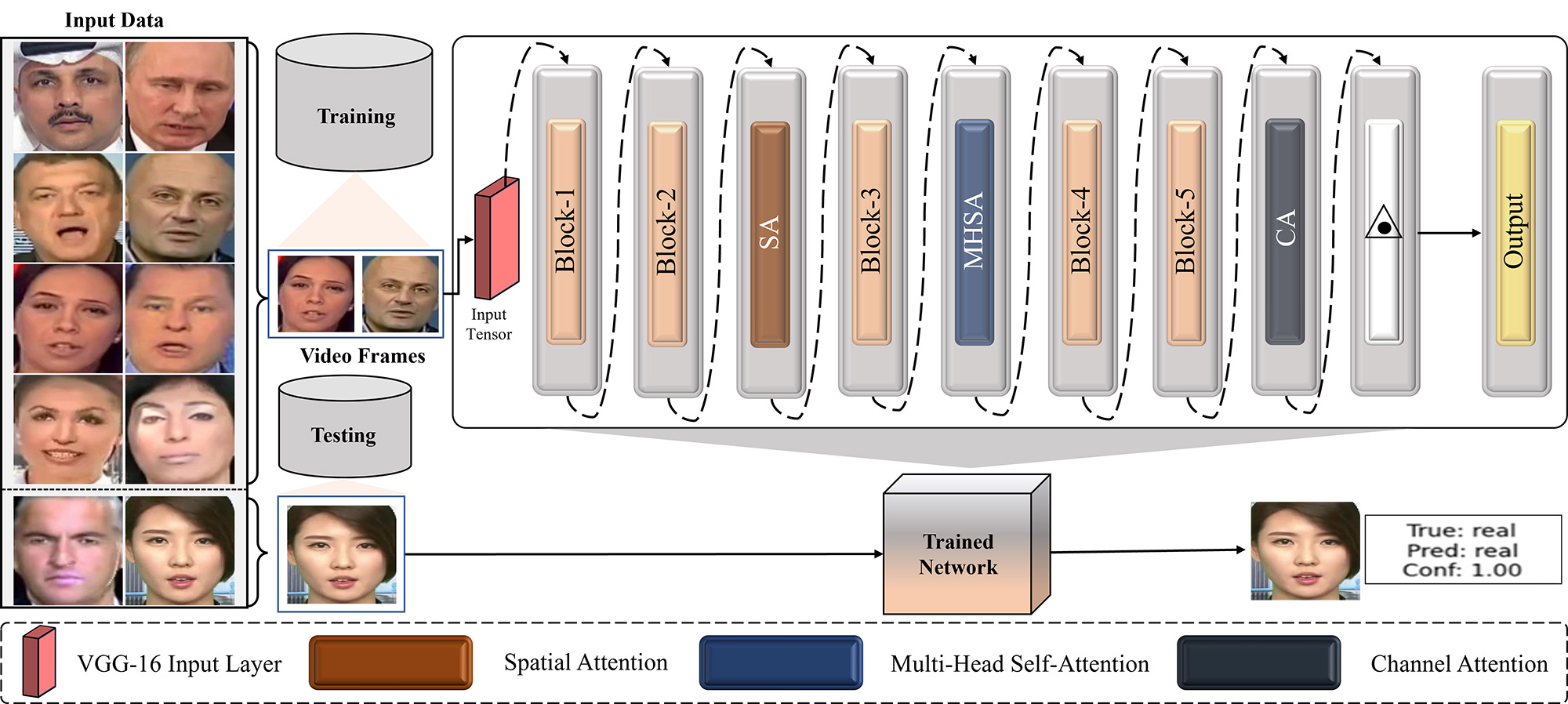
The proliferation of deepfake technology poses significant threats to digital media authenticity, necessitating robust detection systems to combat manipulated content. This paper presents a novel attention-based framework for deepfake detection that systematically integrates multiple complementary attention mechanisms to enhance discriminative feature learning. Our approach combines spatial attention, multi-head self-attention, and channel attention modules with a VGG-16 backbone to capture comprehensive representations across different feature spaces. The spatial attention mechanism focuses on discriminative facial regions, while multi-head self-attention captures long-range spatial dependencies and global contextual relationships. Channel attention further refines feature representations by emphasizing the most informative channels for detection. Extensive experiments on FaceForensics++ and Celeb-DF datasets demonstrate the effectiveness of our progressive attention integration strategy. The proposed framework achieves competitive performance with 92.67% accuracy and 99.30% Area Under the Curve (AUC) on FF++, while maintaining solid generalization capabilities with 82.35% accuracy and 82.7% AUC on the challenging Celeb-DF dataset. Comprehensive ablation studies validate the contribution of each attention component and justify key design choices, including the optimal 3×3 kernel size for spatial attention. Comparison with state-of-the-art methods demonstrates that our approach achieves competitive detection performance while maintaining architectural simplicity and computational efficiency. The modular design of our framework provides interpretability and flexibility for deployment across various computational environments, making it suitable for practical artificial media detection applications.

Graphical Abstract
Enhanced Deepfake Detection Through Multi-Attention Mechanisms: A Comprehensive Framework for Synthetic Media Identification

Keywords
deepfake detection
multi-head self-attention
synthetic media detection
facial manipulation detection

Data Availability Statement
Data will be made available on request.

Funding
This work was supported without any funding.

Conflicts of Interest
The authors declare no conflicts of interest.

Ethical Approval and Consent to Participate
Not applicable.

References
  1. Wu, C. K., Cheng, C.-T., Uwate, Y., Chen, G., Mumtaz, S., & Tsang, K. F. (2022). State-of-the-art and research opportunities for next-generation consumer electronics. IEEE Transactions on Consumer Electronics, 69(4), 937–948.
    [CrossRef]   [Google Scholar]
  2. Yamauchi, M., Ohsita, Y., Murata, M., Ueda, K., & Kato, Y. (2020). Anomaly detection in smart home operation from user behaviors and home conditions. IEEE Transactions on Consumer Electronics, 66(2), 183–192.
    [CrossRef]   [Google Scholar]
  3. Parashar, A., Rida, I., Parashar, A., & Aski, V. (2022). Protecting the privacy of face by De-Identification Pipeline Based on Deep Learning. In 2022 16th International Conference on Signal-Image Technology & Internet-Based Systems (SITIS) (pp. 409–416).
    [CrossRef]   [Google Scholar]
  4. Kaur, J., Sharma, K., & Singh, M. P. (2024). Exploring the Depth: Ethical Considerations, Privacy Concerns, and Security Measures in the Era of Deepfakes. In Navigating the World of Deepfake Technology (pp. 141-165). IGI Global.
    [CrossRef]   [Google Scholar]
  5. Zhang, G., Gao, M., Li, Q., Zhai, W., Zou, G., & Jeon, G. (2023). Disrupting deepfakes via union-saliency adversarial attack. IEEE Transactions on Consumer Electronics, 70(1), 2018–2026.
    [CrossRef]   [Google Scholar]
  6. Whittaker, L., Mulcahy, R., Letheren, K., Kietzmann, J., & Russell-Bennett, R. (2023). Mapping the deepfake landscape for innovation: A multidisciplinary systematic review and future research agenda. Technovation, 125, 102784.
    [CrossRef]   [Google Scholar]
  7. He, W., Fei, L., Zhao, S., Zhang, W., Teng, S., & Rida, I. (2023, December). Rrfae-net: Robust rgb-d facial age estimation network. In Chinese Conference on Biometric Recognition (pp. 119-128). Singapore: Springer Nature Singapore.
    [CrossRef]   [Google Scholar]
  8. Ding, F., Zhu, G., Alazab, M., Li, X., & Yu, K. (2020). Deep-learning-empowered digital forensics for edge consumer electronics in 5G HetNets. IEEE Consumer Electronics Magazine, 11(2), 42–50.
    [CrossRef]   [Google Scholar]
  9. Afchar, D., Nozick, V., Yamagishi, J., & Echizen, I. (2018, December). Mesonet: a compact facial video forgery detection network. In 2018 IEEE international workshop on information forensics and security (WIFS) (pp. 1-7). IEEE.
    [CrossRef]   [Google Scholar]
  10. Das, A., Das, S., & Dantcheva, A. (2021, December). Demystifying attention mechanisms for deepfake detection. In 2021 16th IEEE International Conference on Automatic Face and Gesture Recognition (FG 2021) (pp. 1-7). IEEE.
    [CrossRef]   [Google Scholar]
  11. Agarwal, S., & Farid, H. (2021, June). Detecting Deep-Fake Videos from Aural and Oral Dynamics. In 2021 IEEE/CVF Conference on Computer Vision and Pattern Recognition Workshops (CVPRW) (pp. 981-989). IEEE.
    [CrossRef]   [Google Scholar]
  12. Bonettini, N., Cannas, E. D., Mandelli, S., Bondi, L., Bestagini, P., & Tubaro, S. (2021, January). Video face manipulation detection through ensemble of cnns. In 2020 25th international conference on pattern recognition (ICPR) (pp. 5012-5019). IEEE.
    [CrossRef]   [Google Scholar]
  13. Lee, S., Tariq, S., Kim, J., & Woo, S. S. (2021, June). Tar: Generalized forensic framework to detect deepfakes using weakly supervised learning. In IFIP International conference on ICT systems security and privacy protection (pp. 351-366). Cham: Springer International Publishing.
    [CrossRef]   [Google Scholar]
  14. Wu, J., Qiu, Z., Zeng, Z., Xiao, R., Rida, I., & Zhang, S. (2024). Graph Autoencoder Anomaly Detection for E-commerce Application by Contextual Integrating Contrast With Reconstruction and Complementarity. IEEE Transactions on Consumer Electronics, 70(1), 1623–1630.
    [CrossRef]   [Google Scholar]
  15. Heidari, A., Jafari Navimipour, N., Dag, H., & Unal, M. (2024). Deepfake detection using deep learning methods: A systematic and comprehensive review. Wiley Interdisciplinary Reviews: Data Mining and Knowledge Discovery, 14(2), e1520.
    [CrossRef]   [Google Scholar]
  16. Yoon, J. H., Panizo-LLedot, A., Camacho, D., & Choi, C. (2024). Triple-modality interaction for deepfake detection on zero-shot identity. Information Fusion, 109, 102424.
    [CrossRef]   [Google Scholar]
  17. Ciftci, U. A., Demir, I., & Yin, L. (2020). Fakecatcher: Detection of synthetic portrait videos using biological signals. IEEE Transactions on Pattern Analysis and Machine Intelligence.
    [CrossRef]   [Google Scholar]
  18. Güera, D., & Delp, E. J. (2018, November). Deepfake video detection using recurrent neural networks. In 2018 15th IEEE international conference on advanced video and signal based surveillance (AVSS) (pp. 1-6). IEEE.
    [CrossRef]   [Google Scholar]
  19. Li, Y., & Lyu, S. (2018). Exposing deepfake videos by detecting face warping artifacts. arXiv preprint arXiv:1811.00656.
    [Google Scholar]
  20. Heo, Y. J., Choi, Y. J., Lee, Y. W., & Kim, B. G. (2021). Deepfake detection scheme based on vision transformer and distillation. arXiv preprint arXiv:2104.01353.
    [Google Scholar]
  21. Wang, J., Lei, J., Li, S., & Zhang, J. (2025). STA-3D: Combining Spatiotemporal Attention and 3D Convolutional Networks for Robust Deepfake Detection. Symmetry, 17(7), 1037.
    [CrossRef]   [Google Scholar]
  22. Chen, H. S., Rouhsedaghat, M., Ghani, H., Hu, S., You, S., & Kuo, C. C. J. (2021, July). DefakeHop: A Light-Weight High-Performance Deepfake Detector. In 2021 IEEE International Conference on Multimedia and Expo (ICME) (pp. 1-6). IEEE.
    [CrossRef]   [Google Scholar]
  23. Wodajo, D., & Atnafu, S. (2021). Deepfake video detection using convolutional vision transformer. arXiv preprint arXiv:2102.11126.
    [Google Scholar]
  24. Nguyen, T. T., Nguyen, Q. V. H., Nguyen, D. T., Nguyen, D. T., Huynh-The, T., Nahavandi, S., Nguyen, T. T., Pham, Q.-V., & Nguyen, C. M. (2022). Deep learning for deepfakes creation and detection: A survey. Computer Vision and Image Understanding, 223, 103525.
    [CrossRef]   [Google Scholar]
  25. Prajapati, P., & Pollett, C. (2022). MRI-GAN: A Generalized Approach to Detect DeepFakes using Perceptual Image Assessment. arXiv preprint arXiv:2203.00108.
    [Google Scholar]
  26. Song, W., Guo, S., Gao, M., Li, Q., Zhu, X., & Rida, I. (2025). Deepfake detection via Feature Refinement and Enhancement Network. Image and Vision Computing, 105663.
    [CrossRef]   [Google Scholar]
  27. Guan, W., Wang, W., Dong, J., & Peng, B. (2024). Improving generalization of deepfake detectors by imposing gradient regularization. IEEE Transactions on Information Forensics and Security, 19, 5345-5356.
    [CrossRef]   [Google Scholar]
  28. Mittal, T., Bhattacharya, U., Chandra, R., Bera, A., & Manocha, D. (2020). Emotions don't lie: An audio-visual deepfake detection method using affective cues. In Proceedings of the 28th ACM International Conference on Multimedia (pp. 2823–2832).
    [CrossRef]   [Google Scholar]
  29. Montserrat, D. M., Hao, H., Yarlagadda, S. K., Baireddy, S., Shao, R., Horváth, J., ... & Delp, E. J. (2020, June). Deepfakes Detection with Automatic Face Weighting. In 2020 IEEE/CVF Conference on Computer Vision and Pattern Recognition Workshops (CVPRW) (pp. 2851-2859). IEEE.
    [CrossRef]   [Google Scholar]
  30. De Lima, O., Franklin, S., Basu, S., Karwoski, B., & George, A. (2020). Deepfake detection using spatiotemporal convolutional networks. arXiv preprint arXiv:2006.14749.
    [Google Scholar]
  31. Rössler, A., Cozzolino, D., Verdoliva, L., Riess, C., Thies, J., & Niessner, M. (2019, October). FaceForensics++: Learning to Detect Manipulated Facial Images. In 2019 IEEE/CVF International Conference on Computer Vision (ICCV) (pp. 1-11). IEEE.
    [CrossRef]   [Google Scholar]
  32. Li, Y., Yang, X., Sun, P., Qi, H., & Lyu, S. (2020, June). Celeb-DF: A Large-Scale Challenging Dataset for DeepFake Forensics. In 2020 IEEE/CVF Conference on Computer Vision and Pattern Recognition (CVPR) (pp. 3204-3213). IEEE.
    [CrossRef]   [Google Scholar]
  33. Haliassos, A., Vougioukas, K., Petridis, S., & Pantic, M. (2021). Lips don't lie: A generalisable and robust approach to face forgery detection. In Proceedings of the IEEE/CVF Conference on Computer Vision and Pattern Recognition (pp. 5039–5049).
    [CrossRef]   [Google Scholar]
  34. Chen, S., Yao, T., Chen, Y., Ding, S., Li, J., & Ji, R. (2021, May). Local relation learning for face forgery detection. In Proceedings of the AAAI conference on artificial intelligence (Vol. 35, No. 2, pp. 1081-1088).
    [CrossRef]   [Google Scholar]
  35. Li, L., Bao, J., Zhang, T., Yang, H., Chen, D., Wen, F., & Guo, B. (2020, June). Face X-Ray for More General Face Forgery Detection. In 2020 IEEE/CVF Conference on Computer Vision and Pattern Recognition (CVPR) (pp. 5000-5009). IEEE.
    [CrossRef]   [Google Scholar]
  36. Sun, K., Yao, T., Chen, S., Ding, S., Li, J., & Ji, R. (2022, June). Dual contrastive learning for general face forgery detection. In Proceedings of the AAAI conference on artificial intelligence (Vol. 36, No. 2, pp. 2316-2324).
    [CrossRef]   [Google Scholar]
  37. Tan, M., & Le, Q. (2019, May). Efficientnet: Rethinking model scaling for convolutional neural networks. In International conference on machine learning (pp. 6105-6114). PMLR.
    [Google Scholar]
  38. Zhao, H., Wei, T., Zhou, W., Zhang, W., Chen, D., & Yu, N. (2021, June). Multi-attentional Deepfake Detection. In 2021 IEEE/CVF Conference on Computer Vision and Pattern Recognition (CVPR) (pp. 2185-2194). IEEE.
    [CrossRef]   [Google Scholar]
  39. Zhuang, W., Chu, Q., Tan, Z., Liu, Q., Yuan, H., Miao, C., ... & Yu, N. (2022, October). UIA-ViT: Unsupervised inconsistency-aware method based on vision transformer for face forgery detection. In European conference on computer vision (pp. 391-407). Cham: Springer Nature Switzerland.
    [CrossRef]   [Google Scholar]
  40. Wei, J., Wang, S., & Huang, Q. (2020, April). F³Net: fusion, feedback and focus for salient object detection. In Proceedings of the AAAI conference on artificial intelligence (Vol. 34, No. 07, pp. 12321-12328).
    [CrossRef]   [Google Scholar]
  41. Li, D., Yang, Y., Song, Y. Z., & Hospedales, T. (2018, April). Learning to generalize: Meta-learning for domain generalization. In Proceedings of the AAAI conference on artificial intelligence (Vol. 32, No. 1).
    [CrossRef]   [Google Scholar]
  42. Chollet, F. (2017, July). Xception: Deep Learning with Depthwise Separable Convolutions. In 2017 IEEE Conference on Computer Vision and Pattern Recognition (CVPR) (pp. 1800-1807). IEEE.
    [CrossRef]   [Google Scholar]
  43. Sun, K., Liu, H., Ye, Q., Gao, Y., Liu, J., Shao, L., & Ji, R. (2021, May). Domain general face forgery detection by learning to weight. In Proceedings of the AAAI conference on artificial intelligence (Vol. 35, No. 3, pp. 2638-2646).
    [CrossRef]   [Google Scholar]
  44. Usman, M. T., Khan, H., Singh, S. K., Lee, M. Y., & Koo, J. (2024). Efficient deepfake detection via layer-frozen assisted dual attention network for consumer imaging devices. IEEE Transactions on Consumer Electronics.
    [CrossRef]   [Google Scholar]

Cite This Article
APA Style
Ali, F., & Ghazanfar, Z. (2025). Enhanced Deepfake Detection Through Multi-Attention Mechanisms: A Comprehensive Framework for Synthetic Media Identification. ICCK Transactions on Intelligent Systematics, 2(4), 248–258. https://doi.org/10.62762/TIS.2025.756872
Export Citation
RIS Format
Compatible with EndNote, Zotero, Mendeley, and other reference managers
RIS format data for reference managers
TY  - JOUR
AU  - Ali, Farhan
AU  - Ghazanfar, Zainab
PY  - 2025
DA  - 2025/11/24
TI  - Enhanced Deepfake Detection Through Multi-Attention Mechanisms: A Comprehensive Framework for Synthetic Media Identification
JO  - ICCK Transactions on Intelligent Systematics
T2  - ICCK Transactions on Intelligent Systematics
JF  - ICCK Transactions on Intelligent Systematics
VL  - 2
IS  - 4
SP  - 248
EP  - 258
DO  - 10.62762/TIS.2025.756872
UR  - https://www.icck.org/article/abs/TIS.2025.756872
KW  - deepfake detection
KW  - multi-head self-attention
KW  - synthetic media detection
KW  - facial manipulation detection
AB  - The proliferation of deepfake technology poses significant threats to digital media authenticity, necessitating robust detection systems to combat manipulated content. This paper presents a novel attention-based framework for deepfake detection that systematically integrates multiple complementary attention mechanisms to enhance discriminative feature learning. Our approach combines spatial attention, multi-head self-attention, and channel attention modules with a VGG-16 backbone to capture comprehensive representations across different feature spaces. The spatial attention mechanism focuses on discriminative facial regions, while multi-head self-attention captures long-range spatial dependencies and global contextual relationships. Channel attention further refines feature representations by emphasizing the most informative channels for detection. Extensive experiments on FaceForensics++ and Celeb-DF datasets demonstrate the effectiveness of our progressive attention integration strategy. The proposed framework achieves competitive performance with 92.67% accuracy and 99.30% Area Under the Curve (AUC) on FF++, while maintaining solid generalization capabilities with 82.35% accuracy and 82.7% AUC on the challenging Celeb-DF dataset. Comprehensive ablation studies validate the contribution of each attention component and justify key design choices, including the optimal 3×3 kernel size for spatial attention. Comparison with state-of-the-art methods demonstrates that our approach achieves competitive detection performance while maintaining architectural simplicity and computational efficiency. The modular design of our framework provides interpretability and flexibility for deployment across various computational environments, making it suitable for practical artificial media detection applications.
SN  - 3068-5079
PB  - Institute of Central Computation and Knowledge
LA  - English
ER  - 
BibTeX Format
Compatible with LaTeX, BibTeX, and other reference managers
BibTeX format data for LaTeX and reference managers
@article{Ali2025Enhanced,
  author = {Farhan Ali and Zainab Ghazanfar},
  title = {Enhanced Deepfake Detection Through Multi-Attention Mechanisms: A Comprehensive Framework for Synthetic Media Identification},
  journal = {ICCK Transactions on Intelligent Systematics},
  year = {2025},
  volume = {2},
  number = {4},
  pages = {248-258},
  doi = {10.62762/TIS.2025.756872},
  url = {https://www.icck.org/article/abs/TIS.2025.756872},
  abstract = {The proliferation of deepfake technology poses significant threats to digital media authenticity, necessitating robust detection systems to combat manipulated content. This paper presents a novel attention-based framework for deepfake detection that systematically integrates multiple complementary attention mechanisms to enhance discriminative feature learning. Our approach combines spatial attention, multi-head self-attention, and channel attention modules with a VGG-16 backbone to capture comprehensive representations across different feature spaces. The spatial attention mechanism focuses on discriminative facial regions, while multi-head self-attention captures long-range spatial dependencies and global contextual relationships. Channel attention further refines feature representations by emphasizing the most informative channels for detection. Extensive experiments on FaceForensics++ and Celeb-DF datasets demonstrate the effectiveness of our progressive attention integration strategy. The proposed framework achieves competitive performance with 92.67\% accuracy and 99.30\% Area Under the Curve (AUC) on FF++, while maintaining solid generalization capabilities with 82.35\% accuracy and 82.7\% AUC on the challenging Celeb-DF dataset. Comprehensive ablation studies validate the contribution of each attention component and justify key design choices, including the optimal 3×3 kernel size for spatial attention. Comparison with state-of-the-art methods demonstrates that our approach achieves competitive detection performance while maintaining architectural simplicity and computational efficiency. The modular design of our framework provides interpretability and flexibility for deployment across various computational environments, making it suitable for practical artificial media detection applications.},
  keywords = {deepfake detection, multi-head self-attention, synthetic media detection, facial manipulation detection},
  issn = {3068-5079},
  publisher = {Institute of Central Computation and Knowledge}
}

Article Metrics
Citations:

Crossref

0

Scopus

0

Web of Science

0
Article Access Statistics:
Views: 234
PDF Downloads: 42

Publisher's Note
ICCK stays neutral with regard to jurisdictional claims in published maps and institutional affiliations.

Rights and Permissions
Institute of Central Computation and Knowledge (ICCK) or its licensor (e.g. a society or other partner) holds exclusive rights to this article under a publishing agreement with the author(s) or other rightsholder(s); author self-archiving of the accepted manuscript version of this article is solely governed by the terms of such publishing agreement and applicable law.
ICCK Transactions on Intelligent Systematics

ICCK Transactions on Intelligent Systematics

ISSN: 3068-5079 (Online) | ISSN: 3069-003X (Print)

Email: [email protected]

Portico

Portico

All published articles are preserved here permanently:
https://www.portico.org/publishers/icck/