

A Hybrid GASAPSO Algorithm for Traffic Signal Delay Minimization


Article Information
Abstract
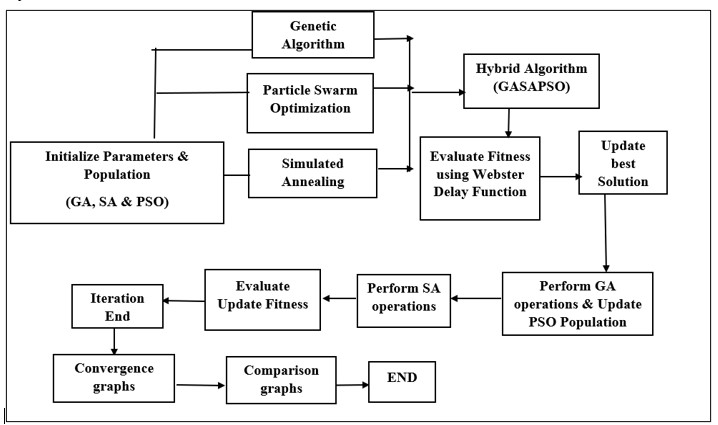
Traffic management is a crucial issue due to the massive increase in vehicles on the road. In order to improve traffic flow, reduce congestion, and ensure commuter safety at junctions, traffic light regulation is essential. This research aims to minimize delay and accident risk while maximizing vehicle throughput through intersections. In this paper, we introduced a new hybrid approach by combining various algorithms, which include a genetic algorithm (GA), Simulated Annealing (SA), and Particle Swarm Optimization (PSO) to reduce traffic delay at traffic lights. The Webster delay function has been used as a fitness function to evaluate the algorithmic performance. Our hybrid algorithm efficiently explores the solution space to pinpoint the ideal signal timings through extensive simulations and experiments, resulting in shorter vehicle wait times at traffic lights. Our proposed algorithm, GASAPSO, successfully reduced the traffic delay to 186.5 seconds at 250 iterations. Moreover, GASAPSO has shown the highest accuracy over other algorithms. PSO, GA, and SA work together to converge to superior solutions, increasing the overall effectiveness of the traffic control system. Finally, the performance of our proposed algorithm has been compared with the existing hybrid algorithms in the same context to validate our approach. The proposed algorithm has also been validated on real time traffic data for the Patiala City.
Graphical Abstract
Keywords
Data Availability Statement
Funding
Conflicts of Interest
AI Use Statement
Ethical Approval and Consent to Participate
References
- Wen, W. (2008). A dynamic and automatic traffic light control expert system for solving the road congestion problem. Expert systems with Applications, 34(4), 2370-2381.
[CrossRef] [Google Scholar] - Turky, A. M., Ahmad, M. S., Yusoff, M. Z. M., & Hammad, B. T. (2009, July). Using genetic algorithm for traffic light control system with a pedestrian crossing. In International Conference on Rough Sets and Knowledge Technology (pp. 512-519). Berlin, Heidelberg: Springer Berlin Heidelberg.
[CrossRef] [Google Scholar] - Slowik, A., & Kwasnicka, H. (2020). Evolutionary algorithms and their applications to engineering problems. Neural Computing and Applications, 32(16), 12363-12379.
[CrossRef] [Google Scholar] - Qadri, S. S. S. M., Gökçe, M. A., & Öner, E. (2020). State-of-art review of traffic signal control methods: challenges and opportunities. European transport research review, 12(1), 55.
[CrossRef] [Google Scholar] - Sofronova, E. (2021). Evolutionary computations for traffic signals optimization. Procedia Computer Science, 186, 802-811.
[CrossRef] [Google Scholar] - Wang, H., Hu, P., & Wang, H. (2021). A genetic timing scheduling model for urban traffic signal control. Information Sciences, 576, 475–483.
[CrossRef] [Google Scholar] - Shaikh, P. W., El-Abd, M., Khanafer, M., & Gao, K. (2020). A review on swarm intelligence and evolutionary algorithms for solving the traffic signal control problem. IEEE Transactions on Intelligent Transportation Systems, 23(1), 48–63.
[CrossRef] [Google Scholar] - Liu, W. L., Zhong, J., Liang, P., Guo, J., Zhao, H., & Zhang, J. (2024). Towards explainable traffic signal control for urban networks through genetic programming. Swarm and Evolutionary Computation, 88, 101588.
[CrossRef] [Google Scholar] - Dezani, H., Marranghello, N., & Damiani, F. (2014). Genetic algorithm-based traffic lights timing optimization and routes definition using petri net model of urban traffic flow. IFAC Proceedings Volumes, 47(3), 11326–11331.
[CrossRef] [Google Scholar] - Wijaya, I. G. P. S., Uchimura, K., & Koutaki, G. (2015). Traffic light signal parameters optimization using particle swarm optimization. In 2015 International Seminar on Intelligent Technology and Its Applications (ISITIA) (pp. 11–16). IEEE.
[CrossRef] [Google Scholar] - Zhao, Y., Fang, W., & Qing, C. (2016). A PSO based signal timing optimization approach of phase combination. In 2016 International Conference on Civil, Transportation and Environment (pp. 314–319). Atlantis Press.
[CrossRef] [Google Scholar] - Verma, A., Nagaraja, G., Anusha, C. S., & Mayakuntla, S. K. (2018). Traffic signal timing optimization for heterogeneous traffic conditions using modified Webster's delay model. Transportation in Developing Economies, 4(2), 13.
[CrossRef] [Google Scholar] - Zhao, H., Han, G., & Niu, X. (2020). The signal control optimization of road intersections with slow traffic based on improved PSO. Mobile Networks and Applications, 25(2), 623-631.
[CrossRef] [Google Scholar] - Cruz-Piris, L., Lopez-Carmona, M. A., & Marsa-Maestre, I. (2019). Automated optimization of intersections using a genetic algorithm. IEEE Access, 7, 15452-15468.
[CrossRef] [Google Scholar] - Ferrer, J., Lopez-Ibanez, M., & Alba, E. (2019). Reliable simulation-optimization of traffic lights in a real-world city. Applied Soft Computing, 78, 697-711.
[CrossRef] [Google Scholar] - Chen, Y., Qiao, F., Guo, L., & Liu, T. (2020, August). GAPSO-based traffic signal control in isolated intersection with multiple objectives. In International Symposium on Simulation and Process Modelling (pp. 263-275). Singapore: Springer Singapore.
[CrossRef] [Google Scholar] - Liang, X., Du, X., Wang, G., & Han, Z. (2019). A deep reinforcement learning network for traffic light cycle control. IEEE Transactions on Vehicular Technology, 68(2), 1243–1253.
[CrossRef] [Google Scholar] - Iskandarani, M. Z. (2020). Optimizing genetic algorithm performance for effective traffic lights control using balancing technique (GABT). International Journal of Advanced Computer Science and Applications, 11(3).
[CrossRef] [Google Scholar] - Bhattacharyya, R., Gupta, S., Marisha, Kumar, A., Mishra, D., & Gupta, M. (2026). A systematic review of evolutionary and swarm intelligence approaches for traffic signal control optimization. Artificial Intelligence Review.
[CrossRef] [Google Scholar] - Celtek, S. A., Durdu, A., & Ali, M. E. M. (2020). Real-time traffic signal control with swarm optimization methods. Measurement, 166, p.108206.
[CrossRef] [Google Scholar] - Liu, D., Yu, W., Baldi, S., Cao, J., & Huang, W. (2019). A switching-based adaptive dynamic programming method to optimal traffic signaling. IEEE Transactions on Systems, Man, and Cybernetics: Systems, 50(11), 4160–4170.
[CrossRef] [Google Scholar] - Dimitrov, S. (2020). Optimal control of traffic lights in urban area. In 2020 International Conference Automatics and Informatics (ICAI) (pp. 1–6). IEEE.
[CrossRef] [Google Scholar] - Tsai, C. W., Teng, T. C., Liao, J. T., & Chiang, M. C. (2021). An effective hybrid-heuristic algorithm for urban traffic light scheduling. Neural Computing and Applications, 33(24), 17535-17549.
[CrossRef] [Google Scholar] - Dell'Orco, M., Başkan, Ö., & Marinelli, M. (2013, November). Artificial bee colony-based algorithm for optimising traffic signal timings. In Soft Computing in Industrial Applications: Proceedings of the 17th Online World Conference on Soft Computing in Industrial Applications (pp. 327-337). Cham: Springer International Publishing.
[CrossRef] [Google Scholar] - Zhang, H., Yuan, H., Chen, Y., Yu, W., Wang, C., Wang, J., & Gao, Y. (2021). Traffic light optimization based on modified webster function. Journal of Advanced Transportation, 2021(1), 3328202.
[CrossRef] [Google Scholar] - Lin, H., Han, Y., Cai, W., & Jin, B. (2022). Traffic signal optimization based on fuzzy control and differential evolution algorithm. IEEE Transactions on Intelligent Transportation Systems, 24(8), 8555-8566.
[CrossRef] [Google Scholar] - Ranpura, P., Shukla, V., & Gujar, R. (2024). Estimation of vehicle control delay using artificial intelligence techniques for heterogeneous traffic conditions. Expert Systems with Applications, 246, 123206.
[CrossRef] [Google Scholar] - Zhang, Y., & Su, R. (2021). An optimization model and traffic light control scheme for heterogeneous traffic systems. Transportation research part C: emerging technologies, 124, 102911.
[CrossRef] [Google Scholar] - Dell'Orco, M., Baskan, O., & Marinelli, M. (2013). A Harmony Search Algorithm approach for optimizing traffic signal timings. PROMET-Traffic&Transportation, 25(4), 349-358.
[CrossRef] [Google Scholar] - Feng, B., Zheng, M., & Liu, Y. (2023). Optimization of signal timing for the contraflow left-turn lane at signalized intersections based on delay analysis. Sustainability, 15(8), 6477.
[CrossRef] [Google Scholar] - Liang, X., Guler, S. I., & Gayah, V. V. (2023). Decentralized arterial traffic signal optimization with connected vehicle information. Journal of Intelligent Transportation Systems, 27(2), 145-160.
[CrossRef] [Google Scholar] - Lee, J., Kim, J., & Park, B. (2011). A genetic algorithm-based procedure for determining optimal time-of-day break points for coordinated actuated traffic signal systems. KSCE Journal of Civil Engineering, 15(1), 197-203.
[CrossRef] [Google Scholar] - Jahangiri, A., Afandizadeh, S., & Kalantari, N. (2011). The optimization of traffic signal timing for emergency evacuation using the simulated annealing algorithm. Transport, 26(2), 133–140.
[CrossRef] [Google Scholar] - Hu, T. Y., & Chen, L. W. (2012). Traffic signal optimization with greedy randomized tabu search algorithm. Journal of transportation engineering, 138(8), 1040-1050.
[CrossRef] [Google Scholar] - Zhang, Z., Zhu, H., Zhang, W., Cai, Z., Zhu, L., & Li, Z. (2023). Multi-Objective Optimization of Traffic Signal Timing at Typical Junctions Based on Genetic Algorithms. Computer Systems Science & Engineering, 47(2).
[CrossRef] [Google Scholar] - Lee, J., Abdulhai, B., Shalaby, A., & Chung, E. H. (2005). Real-time optimization for adaptive traffic signal control using genetic algorithms. Journal of Intelligent Transportation Systems, 9(3), 111-122.
[CrossRef] [Google Scholar] - Mao, T., Mihăită, A. S., Chen, F., & Vu, H. L. (2021). Boosted genetic algorithm using machine learning for traffic control optimization. IEEE transactions on intelligent transportation systems, 23(7), 7112-7141.
[CrossRef] [Google Scholar] - Desmira, D., Abi Hamid, M., Bakar, N. A., Nurtanto, M., & Sunardi, S. (2022). A smart traffic light using a microcontroller based on the fuzzy logic. IAES International Journal of Artificial Intelligence, 11(3), p.809.
[CrossRef] [Google Scholar] - Liu, B., & Ding, Z. (2022). A distributed deep reinforcement learning method for traffic light control. Neurocomputing, 490, 390–399.
[CrossRef] [Google Scholar] - Li, Z., & Schonfeld, P. (2015). Hybrid simulated annealing and genetic algorithm for optimizing arterial signal timings under oversaturated traffic conditions. Journal of advanced transportation, 49(1), 153-170.
[CrossRef] [Google Scholar] - Tran, Q. H., Do, V. M., & Dinh, T. H. (2022). Traffic signal timing optimization for isolated urban intersections considering environmental problems and non-motorized vehicles by using constrained optimization solutions. Innovative Infrastructure Solutions, 7(5), 299.
[CrossRef] [Google Scholar] - Zhang, X., Fan, X., Yu, S., Shan, A., Fan, S., Xiao, Y., & Dang, F. (2022). Intersection signal timing optimization: A multi-objective evolutionary algorithm. Sustainability, 14(3), 1506.
[CrossRef] [Google Scholar] - Akopov, A. S., & Beklaryan, L. A. (2024). Traffic improvement in Manhattan road networks with the use of parallel hybrid biobjective genetic algorithm. IEEE Access, 12, 19532-19552.
[CrossRef] [Google Scholar] - Jian, L. (2020). Multi-objective optimisation of traffic signal control based on particle swarm optimisation. International Journal of Grid and Utility Computing, 11(4), 547-553.
[CrossRef] [Google Scholar]
Cited By (4)
-
Haiying Cao. Interpretable financial time series anomaly detection based on frequency domain features and enhanced sparse attention.
Applied Intelligence, 2026 , 56 (10).
[CrossRef] -
Yadan Ye. Emotion recognition in dance therapy driven by DanceEmoNet: a deep learning model based on facial expression and pose estimation.
Frontiers in Psychology, 2026 , 17 .
[CrossRef] -
Fan Xu, Wenjie Jiang. Artificial intelligence enabled behavior modeling and dual-task performance analysis of cloud-native software with fused multi-source heterogeneous data.
Scientific Reports, 2026 , 16 (1).
[CrossRef] -
Shubhani Aggarwal, Arzoo Miglani, Norah Saleh Alghamdi, Gaurav Dhiman. Resilient and decentralized demand-side management in smart grids using blockchain.
Scientific Reports, 2026 , 16 (1).
[CrossRef]
Cite This Article
TY  - JOUR
AU  - Garg, Tanya
AU  - Kaur, Gurjinder
PY  - 2026
DA  - 2026/04/06
TI  - A Hybrid GASAPSO Algorithm for Traffic Signal Delay Minimization
JO  - ICCK Transactions on Machine Intelligence
T2  - ICCK Transactions on Machine Intelligence
JF  - ICCK Transactions on Machine Intelligence
VL  - 2
IS  - 3
SP  - 144
EP  - 160
DO  - 10.62762/TMI.2025.542785
UR  - https://www.icck.org/article/abs/TMI.2025.542785
KW  - traffic management
KW  - traffic signal
KW  - Webster delay
KW  - GASAPSO
KW  - delay minimization
AB  - Traffic management is a crucial issue due to the massive increase in vehicles on the road. In order to improve traffic flow, reduce congestion, and ensure commuter safety at junctions, traffic light regulation is essential. This research aims to minimize delay and accident risk while maximizing vehicle throughput through intersections. In this paper, we introduced a new hybrid approach by combining various algorithms, which include a genetic algorithm (GA), Simulated Annealing (SA), and Particle Swarm Optimization (PSO) to reduce traffic delay at traffic lights. The Webster delay function has been used as a fitness function to evaluate the algorithmic performance. Our hybrid algorithm efficiently explores the solution space to pinpoint the ideal signal timings through extensive simulations and experiments, resulting in shorter vehicle wait times at traffic lights. Our proposed algorithm, GASAPSO, successfully reduced the traffic delay to 186.5 seconds at 250 iterations. Moreover, GASAPSO has shown the highest accuracy over other algorithms. PSO, GA, and SA work together to converge to superior solutions, increasing the overall effectiveness of the traffic control system. Finally, the performance of our proposed algorithm has been compared with the existing hybrid algorithms in the same context to validate our approach. The proposed algorithm has also been validated on real time traffic data for the Patiala City.
SN  - 3068-7403
PB  - Institute of Central Computation and Knowledge
LA  - English
ER  -
@article{Garg2026A,
  author = {Tanya Garg and Gurjinder Kaur},
  title = {A Hybrid GASAPSO Algorithm for Traffic Signal Delay Minimization},
  journal = {ICCK Transactions on Machine Intelligence},
  year = {2026},
  volume = {2},
  number = {3},
  pages = {144-160},
  doi = {10.62762/TMI.2025.542785},
  url = {https://www.icck.org/article/abs/TMI.2025.542785},
  abstract = {Traffic management is a crucial issue due to the massive increase in vehicles on the road. In order to improve traffic flow, reduce congestion, and ensure commuter safety at junctions, traffic light regulation is essential. This research aims to minimize delay and accident risk while maximizing vehicle throughput through intersections. In this paper, we introduced a new hybrid approach by combining various algorithms, which include a genetic algorithm (GA), Simulated Annealing (SA), and Particle Swarm Optimization (PSO) to reduce traffic delay at traffic lights. The Webster delay function has been used as a fitness function to evaluate the algorithmic performance. Our hybrid algorithm efficiently explores the solution space to pinpoint the ideal signal timings through extensive simulations and experiments, resulting in shorter vehicle wait times at traffic lights. Our proposed algorithm, GASAPSO, successfully reduced the traffic delay to 186.5 seconds at 250 iterations. Moreover, GASAPSO has shown the highest accuracy over other algorithms. PSO, GA, and SA work together to converge to superior solutions, increasing the overall effectiveness of the traffic control system. Finally, the performance of our proposed algorithm has been compared with the existing hybrid algorithms in the same context to validate our approach. The proposed algorithm has also been validated on real time traffic data for the Patiala City.},
  keywords = {traffic management, traffic signal, Webster delay, GASAPSO, delay minimization},
  issn = {3068-7403},
  publisher = {Institute of Central Computation and Knowledge}
}
Publisher's Note
ICCK stays neutral with regard to jurisdictional claims in published maps and institutional affiliations.
Rights and Permissions


Portico
