

An Intelligent Approach for Machine Downtime Prediction Using Ensembled Machine Learning Models



Article Information
Abstract
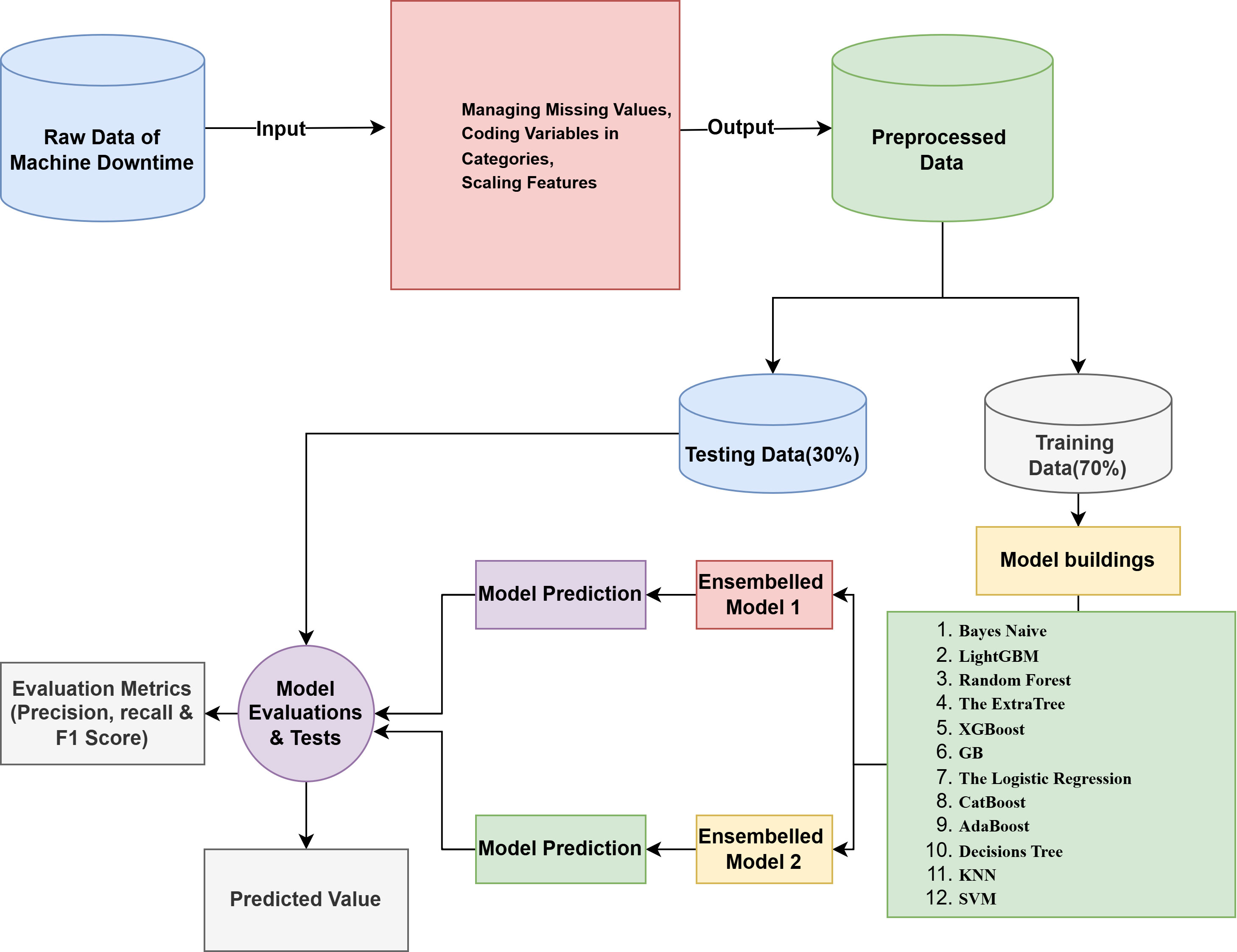
In industrial settings, unplanned machine downtime is a serious risk to profitability, operational effectiveness, and production. In order to predict machine breakdowns before they occur, this research offers a machine learning-based predictive maintenance framework that enables early prediction of machine downtime. The research is carried out using recorded data sets of industrial machines that operate according to various factors or reasons for downtime. Based on these values, prediction of downtime is possible. To guarantee data quality and consistency, several preprocessing techniques, such as imputation and normalization, were used on a dataset of 2,500 records and 16 features, ranging from hydraulic pressure and temperature to spindle vibration and torque. A variety of machine learning models, such as Random Forest, Support Vector Machines (SVM), LightGBM, XGBoost, and Gradient Boosting, were created and assessed. Although models such as SVM performed at a relatively moderate level, LightGBM and Gradient Boosting performed better than others in terms of prediction performance, with test accuracies surpassing 97%. The efficiency of machine learning in shifting from reactive to proactive maintenance is demonstrated by this work. Real-time data integration, the use of deep learning techniques, and cloud or edge platform deployment for wider industrial applicability are some future approaches to the early prediction of machine downtime.
Graphical Abstract
Keywords
Data Availability Statement
Funding
Conflicts of Interest
AI Use Statement
Ethical Approval and Consent to Participate
References
- Carvalho, T. P., Soares, F. A., Vita, R., Francisco, R. D. P., Basto, J. P., & Alcalá, S. G. (2019). A systematic literature review of machine learning methods applied to predictive maintenance. Computers & industrial engineering, 137, 106024.
[CrossRef] [Google Scholar] - Ahuja, A., & Gupta, M. (2024). Optimizing Predictive Maintenance with Machine Learning And Iot: A Business Strategy For Reducing Downtime And Operational Costs.
[CrossRef] [Google Scholar] - Sharma, D. B., Kodipalli, A., Rao, T., & BR, R. (2023, June). Machine predictive maintenance classification using machine learning. In 2023 International Conference on Computational Intelligence for Information, Security and Communication Applications (CIISCA) (pp. 308-313). IEEE.
[CrossRef] [Google Scholar] - Zonta, T., Da Costa, C. A., da Rosa Righi, R., De Lima, M. J., Da Trindade, E. S., & Li, G. P. (2020). Predictive maintenance in the Industry 4.0: A systematic literature review. Computers & industrial engineering, 150, 106889.
[CrossRef] [Google Scholar] - Pinciroli Vago, N. O., Forbicini, F., & Fraternali, P. (2024). Predicting machine failures from multivariate time series: An industrial case study. Machines, 12(6), 357.
[CrossRef] [Google Scholar] - Rivera-Gómez, H., Gharbi, A., Kenné, J. P., Montaño-Arango, O., & Corona-Armenta, J. R. (2020). Joint optimization of production and maintenance strategies considering a dynamic sampling strategy for a deteriorating system. Computers & industrial engineering, 140, 106273.
[CrossRef] [Google Scholar] - Leukel, J., González, J., & Riekert, M. (2021). Adoption of machine learning technology for failure prediction in industrial maintenance: A systematic review. Journal of Manufacturing Systems, 61, 87-96.
[CrossRef] [Google Scholar] - Fernandes, M., Corchado, J. M., & Marreiros, G. (2022). Machine learning techniques applied to mechanical fault diagnosis and fault prognosis in the context of real industrial manufacturing use-cases: a systematic literature review. Applied Intelligence, 52(12), 14246-14280.
[CrossRef] [Google Scholar] - Mohan, T. R., Roselyn, J. P., Uthra, R. A., Devaraj, D., & Umachandran, K. (2021). Intelligent machine learning based total productive maintenance approach for achieving zero downtime in industrial machinery. Computers and Industrial Engineering, 157, 107267.
[CrossRef] [Google Scholar] - Shahin, M., Chen, F. F., Hosseinzadeh, A., & Zand, N. (2023). Using machine learning and deep learning algorithms for downtime minimization in manufacturing systems: An early failure detection diagnostic service. The international journal of advanced manufacturing technology, 128(9), 3857-3883.
[CrossRef] [Google Scholar] - Surucu, O., Gadsden, S. A., & Yawney, J. (2023). Condition monitoring using machine learning: A review of theory, applications, and recent advances. Expert Systems with Applications, 221, 119738.
[CrossRef] [Google Scholar] - Achouch, M., Dimitrova, M., Ziane, K., Sattarpanah Karganroudi, S., Dhouib, R., Ibrahim, H., & Adda, M. (2022). On predictive maintenance in industry 4.0: Overview, models, and challenges. Applied sciences, 12(16), 8081.
[CrossRef] [Google Scholar] - Dalzochio, J., Kunst, R., Pignaton, E., Binotto, A., Sanyal, S., Favilla, J., & Barbosa, J. (2020). Machine learning and reasoning for predictive maintenance in Industry 4.0: Current status and challenges. Computers in industry, 123, 103298.
[CrossRef] [Google Scholar] - Nacchia, M., Fruggiero, F., Lambiase, A., & Bruton, K. (2021). A systematic mapping of the advancing use of machine learning techniques for predictive maintenance in the manufacturing sector. Applied Sciences, 11(6), 2546.
[CrossRef] [Google Scholar] - Çınar, Z. M., Abdussalam Nuhu, A., Zeeshan, Q., Korhan, O., Asmael, M., & Safaei, B. (2020). Machine learning in predictive maintenance towards sustainable smart manufacturing in industry 4.0. Sustainability, 12(19), 8211.
[CrossRef] [Google Scholar] - Hung, Y. H. (2022). Developing an improved ensemble learning approach for predictive maintenance in the textile manufacturing process. Sensors, 22(23), 9065.
[CrossRef] [Google Scholar] - Panda, C., & Singh, T. R. (2023). ML-based vehicle downtime reduction: A case of air compressor failure detection. Engineering Applications of Artificial Intelligence, 122, 106031.
[CrossRef] [Google Scholar] - Li, W., & Li, T. (2025). Comparison of deep learning models for predictive maintenance in industrial manufacturing systems using sensor data. Scientific Reports, 15(1), 23545.
[CrossRef] [Google Scholar] - Elkateb, S., Métwalli, A., Shendy, A., & Abu-Elanien, A. E. (2024). Machine learning and IoT–Based predictive maintenance approach for industrial applications. Alexandria Engineering Journal, 88, 298-309.
[CrossRef] [Google Scholar] - Leukel, J., González, J., & Riekert, M. (2023). Machine learning-based failure prediction in industrial maintenance: improving performance by sliding window selection. International Journal of Quality & Reliability Management, 40(6), 1449-1462.
[CrossRef] [Google Scholar] - Alshboul, O., Al Mamlook, R. E., Shehadeh, A., & Munir, T. (2024). Empirical exploration of predictive maintenance in concrete manufacturing: Harnessing machine learning for enhanced equipment reliability in construction project management. Computers & Industrial Engineering, 190, 110046.
[CrossRef] [Google Scholar] - Hector, I., & Panjanathan, R. (2024). Predictive maintenance in Industry 4.0: A survey of planning models and machine learning techniques. PeerJ Computer Science, 10, e2016.
[CrossRef] [Google Scholar] - Er-Ratby, M., Kobi, A., Sadraoui, Y., & Kadiri, M. S. (2025). The impact of predictive maintenance on the performance of industrial enterprises. SN Computer Science, 6(1), 73.
[CrossRef] [Google Scholar] - Basit, J. (2024). Predictive maintenance using deep learning: Enhancing reliability and reducing electrical system downtime. International Journal of Innovations in Science & Technology, 6(3), 1120-1136. https://ideas.repec.org/a/abq/ijist1/v6y2024i3p1120-1136.html
[Google Scholar] - Abdulkareem, A., Anyim, T., Popoola, O., Abubakar, J., & Ayoade, A. (2025). Prediction of induction motor faults using machine learning. Heliyon, 11(1)., e41493.
[CrossRef] [Google Scholar] - Koppula, M. (2025). Predictive Maintenance to Reduce Machine Downtime in Factories Using Machine Learning Algorithms. International Journal of Advanced Research in Computer Science, 16(2), 71-77. http://doi.org/10.26483/ijarcs.v16i2.7224
[Google Scholar] - Phongmoo, S., Suedumrong, C., Kuensaen, C., Sinthavalai, R., & Leksakul, K. (2025). Predictive maintenance in semiconductor manufacturing: Comparative analysis of machine learning models for downtime reduction. Computers & Industrial Engineering, 111211.
[CrossRef] [Google Scholar] - Ojeda, J. C. O., de Moraes, J. G. B., Filho, C. V. D. S., Pereira, M. D. S., Pereira, J. V. D. Q., Dias, I. C. P., ... & Goncalves, M. C. (2025). Application of a Predictive Model to Reduce Unplanned Downtime in Automotive Industry Production Processes: A Sustainability Perspective. Sustainability, 17(9), 3926.
[CrossRef] [Google Scholar] - Zeb, S., & Lodhi, S. K. (2025). AI for Predictive Maintenance: Reducing Downtime and Enhancing Efficiency. Enrichment Journal of Multidisciplinary Research and Development, 3(1), 135–150.
[CrossRef] [Google Scholar] - Aminzadeh, A., Sattarpanah Karganroudi, S., Majidi, S., Dabompre, C., Azaiez, K., Mitride, C., & S\'en\'echal, E. (2025). A machine learning implementation to predictive maintenance and monitoring of industrial compressors. Sensors, 25(4), 1006.
[CrossRef] [Google Scholar] - Kim, S. (2025). Artificial Intelligence in Predictive Maintenance for Industrial Equipment: Optimizing Efficiency and Reducing Downtime. Modern American Journal of Engineering, Technology, and Innovation, 1(1), 7–13. https://www.neliti.com/publications/670529/artificial-intelligence-in-predictive-maintenance-for-industrial-equipment-optim
[Google Scholar]
Cited By (3)
-
Shubhani Aggarwal, Arzoo Miglani, Norah Saleh Alghamdi, Gaurav Dhiman. Resilient and decentralized demand-side management in smart grids using blockchain.
Scientific Reports, 2026 , 16 (1).
[CrossRef] -
Zhaotong Yang, Madi Babaiasl, Fan Yang. A unified multitask cross-modal representation learning method for visual, tactile, and linguistic grasping.
Information Fusion, 2026 , 136 .
[CrossRef] -
Juan Mao, Chenghui Liu, Dichao Zhang, Yufei Yang, Yingwei Liang. Prompt-Power: A large language model-guided automated compliance auditing framework for power data.
Electric Power Systems Research, 2026 , 259 .
[CrossRef]
Cite This Article
TY  - JOUR
AU  - Arya, Suraj
AU  - Deepak
AU  - Ujjawal, Krishna Kumar
PY  - 2026
DA  - 2026/04/09
TI  - An Intelligent Approach for Machine Downtime Prediction Using Ensembled Machine Learning Models
JO  - ICCK Transactions on Machine Intelligence
T2  - ICCK Transactions on Machine Intelligence
JF  - ICCK Transactions on Machine Intelligence
VL  - 2
IS  - 3
SP  - 161
EP  - 171
DO  - 10.62762/TMI.2025.597909
UR  - https://www.icck.org/article/abs/TMI.2025.597909
KW  - machine downtime
KW  - machine learning
KW  - ensembled model
KW  - machine downtime predictor
AB  - In industrial settings, unplanned machine downtime is a serious risk to profitability, operational effectiveness, and production. In order to predict machine breakdowns before they occur, this research offers a machine learning-based predictive maintenance framework that enables early prediction of machine downtime. The research is carried out using recorded data sets of industrial machines that operate according to various factors or reasons for downtime. Based on these values, prediction of downtime is possible. To guarantee data quality and consistency, several preprocessing techniques, such as imputation and normalization, were used on a dataset of 2,500 records and 16 features, ranging from hydraulic pressure and temperature to spindle vibration and torque. A variety of machine learning models, such as Random Forest, Support Vector Machines (SVM), LightGBM, XGBoost, and Gradient Boosting, were created and assessed. Although models such as SVM performed at a relatively moderate level, LightGBM and Gradient Boosting performed better than others in terms of prediction performance, with test accuracies surpassing 97%. The efficiency of machine learning in shifting from reactive to proactive maintenance is demonstrated by this work. Real-time data integration, the use of deep learning techniques, and cloud or edge platform deployment for wider industrial applicability are some future approaches to the early prediction of machine downtime.
SN  - 3068-7403
PB  - Institute of Central Computation and Knowledge
LA  - English
ER  -
@article{Arya2026An,
  author = {Suraj Arya and Deepak and Krishna Kumar Ujjawal},
  title = {An Intelligent Approach for Machine Downtime Prediction Using Ensembled Machine Learning Models},
  journal = {ICCK Transactions on Machine Intelligence},
  year = {2026},
  volume = {2},
  number = {3},
  pages = {161-171},
  doi = {10.62762/TMI.2025.597909},
  url = {https://www.icck.org/article/abs/TMI.2025.597909},
  abstract = {In industrial settings, unplanned machine downtime is a serious risk to profitability, operational effectiveness, and production. In order to predict machine breakdowns before they occur, this research offers a machine learning-based predictive maintenance framework that enables early prediction of machine downtime. The research is carried out using recorded data sets of industrial machines that operate according to various factors or reasons for downtime. Based on these values, prediction of downtime is possible. To guarantee data quality and consistency, several preprocessing techniques, such as imputation and normalization, were used on a dataset of 2,500 records and 16 features, ranging from hydraulic pressure and temperature to spindle vibration and torque. A variety of machine learning models, such as Random Forest, Support Vector Machines (SVM), LightGBM, XGBoost, and Gradient Boosting, were created and assessed. Although models such as SVM performed at a relatively moderate level, LightGBM and Gradient Boosting performed better than others in terms of prediction performance, with test accuracies surpassing 97\%. The efficiency of machine learning in shifting from reactive to proactive maintenance is demonstrated by this work. Real-time data integration, the use of deep learning techniques, and cloud or edge platform deployment for wider industrial applicability are some future approaches to the early prediction of machine downtime.},
  keywords = {machine downtime, machine learning, ensembled model, machine downtime predictor},
  issn = {3068-7403},
  publisher = {Institute of Central Computation and Knowledge}
}
Publisher's Note
ICCK stays neutral with regard to jurisdictional claims in published maps and institutional affiliations.
Rights and Permissions


Portico
