

Predictive Analytics for Maternal Mortality in Bangladesh: An Interpretable ML Framework with Ensemble Methods




Article Information
Abstract
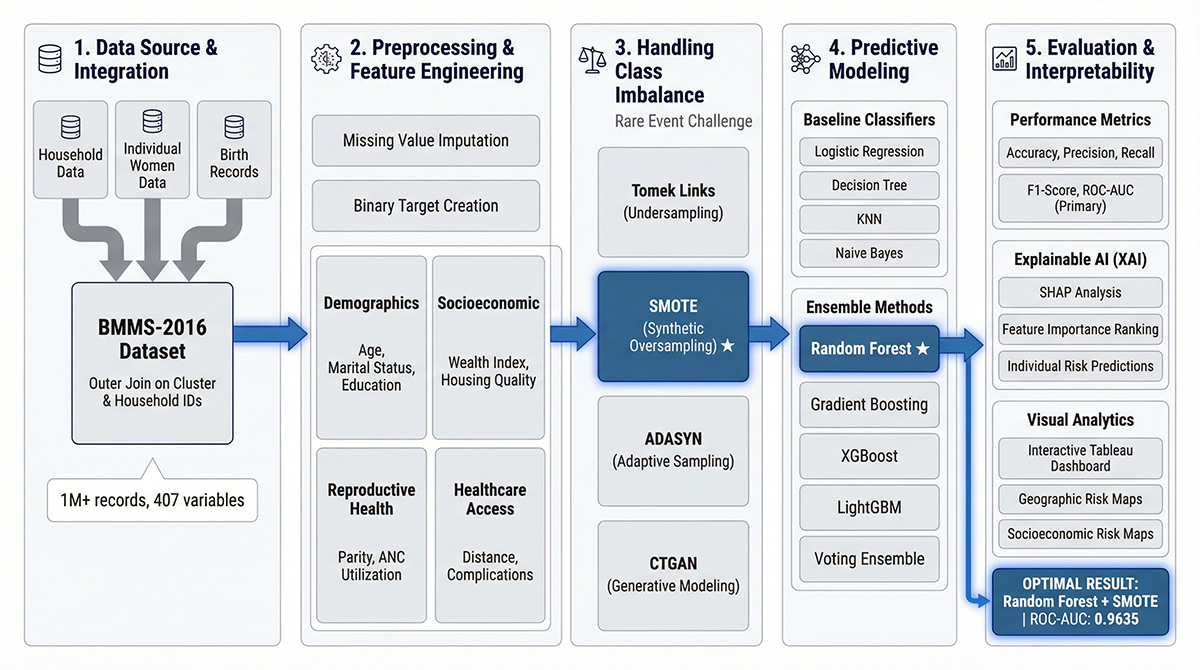
Maternal mortality in Bangladesh remains a critical public health challenge, with recent evidence indicating stagnation in mortality reduction despite expanded facility-based delivery and skilled birth attendance. Accurate identification of high-risk cases is essential to enable targeted intervention and resource allocation. This study develops an interpretable machine learning framework for maternal mortality prediction using the nationally representative Bangladesh Maternal Mortality Survey 2016 (BMMS-2016). A comprehensive data integration and feature engineering pipeline was implemented across demographic, socioeconomic, and maternal healthcare domains. Given the severe class imbalance inherent in maternal death outcomes, multiple resampling strategies---including Tomek Links undersampling, SMOTE, ADASYN, and CTGAN---were systematically evaluated in conjunction with diverse classifiers and ensemble methods. Among all configurations, Random Forest combined with SMOTE achieved the best overall performance (ROC-AUC: 0.9635; Accuracy: 0.9016; F1-score: 0.8928), demonstrating superior precision--recall balance suitable for rare-event prediction. Tree-based ensemble models consistently outperformed baseline classifiers. Model interpretability was ensured through SHAP analysis, revealing region type, maternal age, and administrative division as the most influential predictors and highlighting substantial geographic and demographic disparities. An interactive Tableau dashboard translates predictive insights into accessible visual analytics for policy and decision support. The findings underscore the importance of explicit imbalance handling and explainable artificial intelligence frameworks in maternal health risk modeling, offering a scalable and transparent approach for data-driven maternal mortality reduction strategies.
Graphical Abstract
Keywords
Data Availability Statement
Funding
Conflicts of Interest
AI Use Statement
Ethical Approval and Consent to Participate
References
- Taye, E. A., Woubet, E. Y., Hailie, G. Y., Arage, F. G., Zerihun, T. E., Zegeye, A. T., ... & Kassaw, A. T. (2025). Application of the random forest algorithm to predict skilled birth attendance and identify determinants among reproductive-age women in 27 Sub-Saharan African countries; machine learning analysis. BMC Public Health, 25(1), 901.
[CrossRef] [Google Scholar] - World Health Organization. (2023). Trends in maternal mortality 2000 to 2020: estimates by WHO, UNICEF, UNFPA, World Bank Group and UNDESA/Population Division. WHO Press, Geneva. Retrieved from https://www.who.int/publications/i/item/9789240068759
[Google Scholar] - Chawla, N. V., Bowyer, K. W., Hall, L. O., & Kegelmeyer, W. P. (2002). SMOTE: synthetic minority over-sampling technique. Journal of artificial intelligence research, 16, 321-357.
[CrossRef] [Google Scholar] - Rahman, A., & Alam, M. G. R. (2023). Explainable AI based maternal health risk prediction using machine learning and deep learning. In 2023 IEEE World AI IoT Congress (AIIoT) (pp. 0013-0018). IEEE.
[CrossRef] [Google Scholar] - Maheswari, B. U., Dixit, A., & Karn, A. K. (2024, April). Machine learning algorithm for maternal health risk classification with smote and explainable ai. In 2024 IEEE 9th International Conference for Convergence in Technology (I2CT) (pp. 1-6). IEEE.
[CrossRef] [Google Scholar] - Raza, A., Siddiqui, H. U. R., Munir, K., Almutairi, M., Rustam, F., & Ashraf, I. (2022). Ensemble learning-based feature engineering to analyze maternal health during pregnancy and health risk prediction. Plos one, 17(11), e0276525.
[CrossRef] [Google Scholar] - Sinambela, D. P., Rahmatullah, B., Lah, N. H. C., & Selamat, A. W. (2024). Machine learning approaches for predicting postpartum hemorrhage: a comprehensive systematic literature review. Indonesian Journal of Electrical Engineering and Computer Science, 34(3), 2087-2095.
[CrossRef] [Google Scholar] - Nuriadi, I., Fauzi, R., & Al Anshary, F. (2025, July). Health Risk Detection and Early Screening of Maternal Health in Pregnant Women Using a Stacking Machine Learning Models. In 2025 International Seminar on Intelligent Technology and Its Applications (ISITIA) (pp. 789-794). IEEE.
[CrossRef] [Google Scholar] - Salam, M. A., Islam, M. M., & Karim, M. R. (2025). Machine learning algorithms for predicting and identifying the influencing predictors of antenatal care visits among women in Bangladesh: Evidence from BDHS 2022 data. Plos one, 20(10), e0324226.
[CrossRef] [Google Scholar] - Kubahoniyesu, T., & Kabano, I. H. (2024). Predicting adverse pregnancy outcome in Rwanda using machine learning techniques. Plos one, 19(12), e0312447.
[CrossRef] [Google Scholar] - Inyang, U. G., Eyoh, I. J., Nwokoro, C. O., Osang, F. B., & Afolorunso, A. A. (2020). Comparative analytics of classifiers on resampled datasets for pregnancy outcome prediction. International Journal of Advanced Computer Science and Applications, 11(6), 493-503.
[CrossRef] [Google Scholar] - Khadidos, A. O., Saleem, F., Selvarajan, S., Ullah, Z., & Khadidos, A. O. (2024). Ensemble machine learning framework for predicting maternal health risk during pregnancy. Scientific Reports, 14(1), 21483.
[CrossRef] [Google Scholar] - Bogale, D. S., Abuhay, T. M., & Dejene, B. E. (2022). Predicting perinatal mortality based on maternal health status and health insurance service using homogeneous ensemble machine learning methods. BMC Medical Informatics and Decision Making, 22(1), 341.
[CrossRef] [Google Scholar] - He, H., Bai, Y., Garcia, E. A., & Li, S. (2008, June). ADASYN: Adaptive synthetic sampling approach for imbalanced learning. In 2008 IEEE international joint conference on neural networks (IEEE world congress on computational intelligence) (pp. 1322-1328). IEEE.
[CrossRef] [Google Scholar] - Mustamin, N. F., Buang, A., Aziz, F., & Nur, H. N. (2024). Ensemble techniques based risk classification for maternal health during pregnancy. Ilkom Jurnal Ilmiah, 16(2), 190-197.
[CrossRef] [Google Scholar] - Zoha, S., Alam, S., Sifat, I. K., Sultana, N., & Kibria, M. K. (2025). Identifying determinants and predicting cesarean section delivery among Bangladeshi women using machine learning: Insight from BDHS 2022 Data. PLOS Global Public Health, 5(11), e0005494.
[CrossRef] [Google Scholar] - Noor, S. T. A., Islam, R. B., Yeasar, S., & Siddique, S. (2025). Machine Learning-Based Prediction of Maternal Continuum of Care Completion: Evidence from Bangladesh Demographic and Health Survey 2022. Array, 100666.
[CrossRef] [Google Scholar] - Mamun, M., Hussain, M. I., Ali, M. S., Chowdhury, M. S. A., Chowdhury, S. H., & Hossain, M. M. (2025, July). An explainable ensemble learning framework with feature optimization for accurate maternal health risk prediction. In 2025 International conference on quantum photonics, artificial intelligence, and networking (QPAIN) (pp. 1-6). IEEE.
[CrossRef] [Google Scholar] - Bosschieter, T. M., Xu, Z., Lan, H., Lengerich, B. J., Nori, H., Sitcov, K., ... & Caruana, R. (2022). Using interpretable machine learning to predict maternal and fetal outcomes. arXiv preprint arXiv:2207.05322.
[CrossRef] [Google Scholar] - Nwokoro, C. O., Inyang, U. G., Eyoh, I. J., Umoh, U. A., Duke, O. A., Nwokoro, K. C., ... & Kingsley, J. U. (2023). Enhancing maternal outcome prediction using explainable artificial intelligence for women of childbearing age. Asian Journal of Science and Applied Technology, 12(2), 44-55.
[CrossRef] [Google Scholar] - Lundberg, S. M., & Lee, S. I. (2017). A unified approach to interpreting model predictions. Advances in neural information processing systems, 30.
[Google Scholar] - Ahsan, K. Z., Angeles, G., Curtis, S. L., Streatfield, P. K., Chakraborty, N., Rahman, M., & Jamil, K. (2024). Stagnation of maternal mortality decline in Bangladesh between 2010 and 2016 in spite of an increase in health services utilisation: Examining data from three large cross-sectional surveys. Journal of Global Health, 14, 04027.
[CrossRef] [Google Scholar] - Hossain, A. T., Siddique, A. B., Jabeen, S., Khan, S., Haider, M. M., Ameen, S., ... & Rahman, A. E. (2023). Maternal mortality in Bangladesh: Who, when, why, and where? A national survey-based analysis. Journal of Global Health, 13, 07002.
[CrossRef] [Google Scholar] - Dasgupta, D. P., Suman, S. M., Sultana, N., Sujon, M. S. H., Fatema, K., Toma, M. J., & Hossain, M. M. (2025). Comparative study on the factors influencing pre-eclampsia symptoms at different pregnancy stages in Bangladeshi women: urban vs. rural perspectives. BMC Pregnancy and Childbirth, 25(1), 450.
[CrossRef] [Google Scholar] - Breiman, L. (2001). Random forests. Machine Learning, 45(1), 5-32.
[CrossRef] [Google Scholar] - Chen, T., & Guestrin, C. (2016, August). Xgboost: A scalable tree boosting system. In Proceedings of the 22nd acm sigkdd international conference on knowledge discovery and data mining (pp. 785-794).
[CrossRef] [Google Scholar] - Patel, S. S. (2023). Explainable machine learning models to analyse maternal health. Data & Knowledge Engineering, 146, 102198.
[CrossRef] [Google Scholar] - Xu, L., Skoularidou, M., Cuesta-Infante, A., & Veeramachaneni, K. (2019). Modeling tabular data using conditional gan. Advances in neural information processing systems, 32.
[Google Scholar]
Cited By (2)
-
Zhongsheng Tang, Qiang Huang, Liangyi Yang, Jingbo Xiang, Xianfeng Ye. Adaptive pedestrian detection in resource-constrained dynamic crowds via hierarchical occlusion-aware reasoning.
Pattern Recognition, 2026 , 179 .
[CrossRef] -
Shubhani Aggarwal, Arzoo Miglani, Norah Saleh Alghamdi, Gaurav Dhiman. Resilient and decentralized demand-side management in smart grids using blockchain.
Scientific Reports, 2026 , 16 (1).
[CrossRef]
Cite This Article
TY  - JOUR
AU  - Mazumder, Partha Pratim
AU  - Hasan, Raza
AU  - Mahmood, Salman
AU  - Palaniappan, Sellappan
PY  - 2026
DA  - 2026/04/02
TI  - Predictive Analytics for Maternal Mortality in Bangladesh: An Interpretable ML Framework with Ensemble Methods
JO  - ICCK Transactions on Machine Intelligence
T2  - ICCK Transactions on Machine Intelligence
JF  - ICCK Transactions on Machine Intelligence
VL  - 2
IS  - 3
SP  - 127
EP  - 143
DO  - 10.62762/TMI.2026.182317
UR  - https://www.icck.org/article/abs/TMI.2026.182317
KW  - maternal mortality prediction
KW  - interpretable machine learning
KW  - class imbalance techniques
KW  - SMOTE
KW  - ADASYN
KW  - CTGAN
KW  - Tomek Links
KW  - ensemble learning
KW  - Random Forest
KW  - SHAP explainability
KW  - healthcare risk modeling
KW  - public health analytics
AB  - Maternal mortality in Bangladesh remains a critical public health challenge, with recent evidence indicating stagnation in mortality reduction despite expanded facility-based delivery and skilled birth attendance. Accurate identification of high-risk cases is essential to enable targeted intervention and resource allocation. This study develops an interpretable machine learning framework for maternal mortality prediction using the nationally representative Bangladesh Maternal Mortality Survey 2016 (BMMS-2016). A comprehensive data integration and feature engineering pipeline was implemented across demographic, socioeconomic, and maternal healthcare domains. Given the severe class imbalance inherent in maternal death outcomes, multiple resampling strategies---including Tomek Links undersampling, SMOTE, ADASYN, and CTGAN---were systematically evaluated in conjunction with diverse classifiers and ensemble methods. Among all configurations, Random Forest combined with SMOTE achieved the best overall performance (ROC-AUC: 0.9635; Accuracy: 0.9016; F1-score: 0.8928), demonstrating superior precision--recall balance suitable for rare-event prediction. Tree-based ensemble models consistently outperformed baseline classifiers. Model interpretability was ensured through SHAP analysis, revealing region type, maternal age, and administrative division as the most influential predictors and highlighting substantial geographic and demographic disparities. An interactive Tableau dashboard translates predictive insights into accessible visual analytics for policy and decision support. The findings underscore the importance of explicit imbalance handling and explainable artificial intelligence frameworks in maternal health risk modeling, offering a scalable and transparent approach for data-driven maternal mortality reduction strategies.
SN  - 3068-7403
PB  - Institute of Central Computation and Knowledge
LA  - English
ER  -
@article{Mazumder2026Predictive,
  author = {Partha Pratim Mazumder and Raza Hasan and Salman Mahmood and Sellappan Palaniappan},
  title = {Predictive Analytics for Maternal Mortality in Bangladesh: An Interpretable ML Framework with Ensemble Methods},
  journal = {ICCK Transactions on Machine Intelligence},
  year = {2026},
  volume = {2},
  number = {3},
  pages = {127-143},
  doi = {10.62762/TMI.2026.182317},
  url = {https://www.icck.org/article/abs/TMI.2026.182317},
  abstract = {Maternal mortality in Bangladesh remains a critical public health challenge, with recent evidence indicating stagnation in mortality reduction despite expanded facility-based delivery and skilled birth attendance. Accurate identification of high-risk cases is essential to enable targeted intervention and resource allocation. This study develops an interpretable machine learning framework for maternal mortality prediction using the nationally representative Bangladesh Maternal Mortality Survey 2016 (BMMS-2016). A comprehensive data integration and feature engineering pipeline was implemented across demographic, socioeconomic, and maternal healthcare domains. Given the severe class imbalance inherent in maternal death outcomes, multiple resampling strategies---including Tomek Links undersampling, SMOTE, ADASYN, and CTGAN---were systematically evaluated in conjunction with diverse classifiers and ensemble methods. Among all configurations, Random Forest combined with SMOTE achieved the best overall performance (ROC-AUC: 0.9635; Accuracy: 0.9016; F1-score: 0.8928), demonstrating superior precision--recall balance suitable for rare-event prediction. Tree-based ensemble models consistently outperformed baseline classifiers. Model interpretability was ensured through SHAP analysis, revealing region type, maternal age, and administrative division as the most influential predictors and highlighting substantial geographic and demographic disparities. An interactive Tableau dashboard translates predictive insights into accessible visual analytics for policy and decision support. The findings underscore the importance of explicit imbalance handling and explainable artificial intelligence frameworks in maternal health risk modeling, offering a scalable and transparent approach for data-driven maternal mortality reduction strategies.},
  keywords = {maternal mortality prediction, interpretable machine learning, class imbalance techniques, SMOTE, ADASYN, CTGAN, Tomek Links, ensemble learning, Random Forest, SHAP explainability, healthcare risk modeling, public health analytics},
  issn = {3068-7403},
  publisher = {Institute of Central Computation and Knowledge}
}
Publisher's Note
ICCK stays neutral with regard to jurisdictional claims in published maps and institutional affiliations.
Rights and Permissions


Portico
