-
CiteScore
-
Impact Factor
Volume 2, Issue 4, ICCK Transactions on Sensing, Communication, and Control
Volume 2, Issue 4, 2025
Submit Manuscript Edit a Special Issue
Article QR Code
Article QR Code
Scan the QR code for reading
Popular articles
ICCK Transactions on Sensing, Communication, and Control, Volume 2, Issue 4, 2025: 238-249

Free to Read | Research Article | 30 November 2025
RUL Prediction of the Injection Lance in Copper Top-Blown Smelting Using KPCA and TSO-Optimized LSSVM
1 Huize Smelting Branch, Yunnan Chihong Zinc and Germanium Co., Ltd., Huize 654200, China
2 Faculty of Mechanical and Electrical Engineering, Kunming University of Science and Technology, Kunming 650500, China
3 Yunnan Key Laboratory of Intelligent Control and Application, Kunming University of Science and Technology, Kunming 650500, China
* Corresponding Author: Chunxi Yang, [email protected]
Received: 28 October 2025, Accepted: 26 November 2025, Published: 30 November 2025  
Abstract
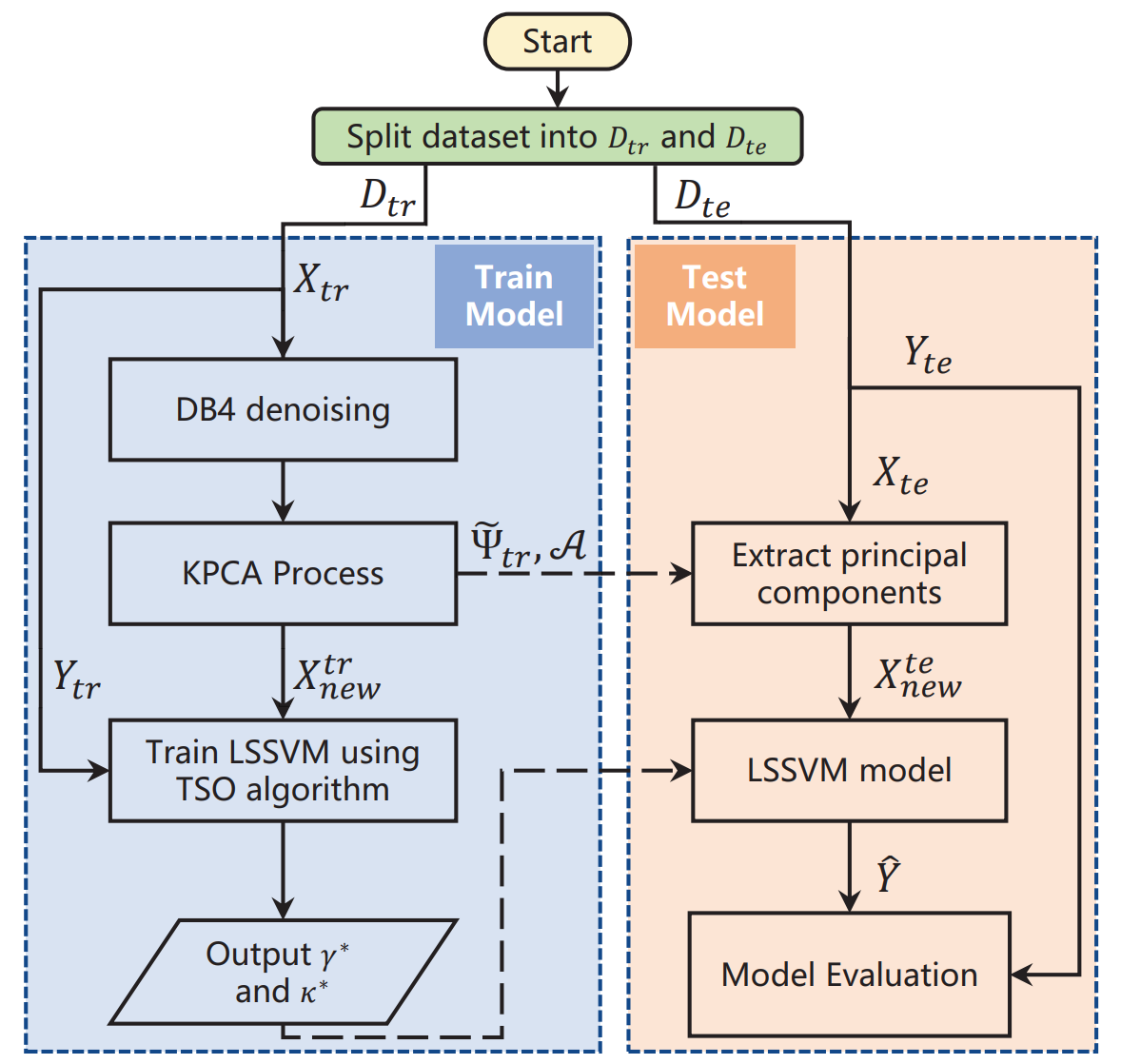
As the core component of the copper top-blown smelting, the service life of the injection lance critically affects production stability. To monitor the operating condition of the injection lance, a data-driven model is proposed to predict the Remaining Useful Life (RUL) or service life, namely, the DKT-LSSVM model. Firstly, to reduce noise interference, the Daubechies wavelet with four vanishing moments (DB4) denoising is used to process the raw data. Then, the Kernel Principal Component Analysis (KPCA) method is utilized to extract the principal components from the denoised data, which retains at least 90% information content (18 principal components are obtained). These principal components are used as inputs to a Least Square Support Vector Machine (LSSVM) model to predict the RUL of the injection lance, and a Tuna Swarm Optimization (TSO) algorithm is proposed to optimize the hyperparameters of the LSSVM. The results show that the proposed algorithm performs well in RUL prediction of the injection lance, with RMSE=1.2274 (day), MAE=0.6623 (day) and R$^2$=0.9308. Therefore, the proposed algorithm can provide effective RUL prediction for the injection lance, reduce its operational risks, and improve the stability and reliability of the copper top-blown smelting system.

Graphical Abstract
RUL Prediction of the Injection Lance in Copper Top-Blown Smelting Using KPCA and TSO-Optimized LSSVM

Keywords
injection lance
least square support vector machine (LSSVM)
tuna swarm optimization (TSO) algorithm
remaining useful life (RUL)

Data Availability Statement
Data will be made available on request.

Funding
This work was supported in part by the Yunnan Major Scientific and Technological Projects, China under Grant 202302AD080005; in part by the Yunnan Fundamental Research Projects under Grant 202301AT070401.

Conflicts of Interest
Qiang Peng is an employee of Huize Smelting Branch, Yunnan Chihong Zinc and Germanium Co., Ltd., Huize 654200, China. The authors declare no conflicts of interest.

Ethical Approval and Consent to Participate
Not applicable.

References
  1. Zhao, H. L., Yin, P., Zhang, L. F., & Wang, S. (2016). Water model experiments of multiphase mixing in the top-blown smelting process of copper concentrate. International Journal of Minerals, Metallurgy, and Materials, 23(12), 1369-1376.
    [CrossRef]   [Google Scholar]
  2. Floyd, J. M. (1996). The third decade of top submerged lance technology. In The Howard Worner International Symposium on Injection in Pyrometallurgy (pp. 417-429).
    [Google Scholar]
  3. Wan, Z., Yang, S., Kong, D., Li, D., Hu, J., & Wang, H. (2024). Numerical investigation of sinusoidal pulsating gas intake to intensify the gas-slag momentum transfer in the top-blown smelting furnace. International Journal of Minerals, Metallurgy and Materials, 31(2), 301-314.
    [CrossRef]   [Google Scholar]
  4. Zhao, H., Lu, T., Liu, F., Yin, P., & Wang, S. (2019). Computational fluid dynamics study on a top-blown smelting process with lance failure in an Isa furnace. JOM, 71(5), 1643-1649.
    [CrossRef]   [Google Scholar]
  5. Yu, B., Guo, H., & Shi, J. (2025). Remaining useful life prediction based on hybrid CNN-BiLSTM model with dual attention mechanism. International Journal of Electrical Power & Energy Systems, 172, 111152.
    [CrossRef]   [Google Scholar]
  6. Li, J., Liu, Y., & Li, Q. (2022). Intelligent fault diagnosis of rolling bearings under imbalanced data conditions using attention-based deep learning method. Measurement, 189, 110500.
    [CrossRef]   [Google Scholar]
  7. Jia, F., Lei, Y., Lin, J., Zhou, X., & Lu, N. (2016). Deep neural networks: A promising tool for fault characteristic mining and intelligent diagnosis of rotating machinery with massive data. Mechanical systems and signal processing, 72, 303-315.
    [CrossRef]   [Google Scholar]
  8. Chen, J., Huang, R., Chen, Z., Mao, W., & Li, W. (2023). Transfer learning algorithms for bearing remaining useful life prediction: A comprehensive review from an industrial application perspective. Mechanical Systems and Signal Processing, 193, 110239.
    [CrossRef]   [Google Scholar]
  9. Mathew, V., Toby, T., Singh, V., Rao, B. M., & Kumar, M. G. (2017, December). Prediction of Remaining Useful Lifetime (RUL) of turbofan engine using machine learning. In 2017 IEEE international conference on circuits and systems (ICCS) (pp. 306-311). IEEE.
    [CrossRef]   [Google Scholar]
  10. Mo, R., Zhou, H., Yin, H., & Si, X. (2025). A survey on few-shot learning for remaining useful life prediction. Reliability Engineering & System Safety, 110850.
    [CrossRef]   [Google Scholar]
  11. Song, Y., Gao, S., Li, Y., Jia, L., Li, Q., & Pang, F. (2020). Distributed attention-based temporal convolutional network for remaining useful life prediction. IEEE Internet of Things Journal, 8(12), 9594-9602.
    [CrossRef]   [Google Scholar]
  12. Zhang, X., Dong, Y., Wen, L., Lu, F., & Li, W. (2019, August). Remaining useful life estimation based on a new convolutional and recurrent neural network. In 2019 ieee 15th international conference on automation science and engineering (case) (pp. 317-322). IEEE.
    [CrossRef]   [Google Scholar]
  13. Zheng, S., Ristovski, K., Farahat, A., & Gupta, C. (2017, June). Long short-term memory network for remaining useful life estimation. In 2017 IEEE international conference on prognostics and health management (ICPHM) (pp. 88-95). IEEE.
    [CrossRef]   [Google Scholar]
  14. Zhang, Y., Xiong, R., He, H., & Pecht, M. G. (2018). Long short-term memory recurrent neural network for remaining useful life prediction of lithium-ion batteries. IEEE Transactions on Vehicular Technology, 67(7), 5695-5705.
    [CrossRef]   [Google Scholar]
  15. Wang, J., Wen, G., Yang, S., & Liu, Y. (2018, October). Remaining useful life estimation in prognostics using deep bidirectional LSTM neural network. In 2018 Prognostics and System Health Management Conference (PHM-Chongqing) (pp. 1037-1042). IEEE.
    [CrossRef]   [Google Scholar]
  16. Zhong, S. S., Fu, S., & Lin, L. (2019). A novel gas turbine fault diagnosis method based on transfer learning with CNN. Measurement, 137, 435-453.
    [CrossRef]   [Google Scholar]
  17. Zhang, K., Zhang, K., & Bao, R. (2023). Prediction of gas explosion pressures: A machine learning algorithm based on KPCA and an optimized LSSVM. Journal of Loss Prevention in the Process Industries, 83, 105082.
    [CrossRef]   [Google Scholar]
  18. Islam, M. M., Prosvirin, A. E., & Kim, J. M. (2021). Data-driven prognostic scheme for rolling-element bearings using a new health index and variants of least-square support vector machines. Mechanical Systems and Signal Processing, 160, 107853.
    [CrossRef]   [Google Scholar]
  19. Zhang, J., Hu, J., You, H., Jia, R., Wang, X., & Zhang, X. (2021). A remaining useful life prediction method of IGBT based on online status data. Microelectronics Reliability, 121, 114124.
    [CrossRef]   [Google Scholar]
  20. Huang, W., Liu, M., Zhang, C., Niu, T., Fu, Z., Ren, X., & Chin, C. S. (2024). Life prediction for proton exchange membrane fuel cell based on experimental results and combinatorial optimization algorithm. International Journal of Hydrogen Energy, 79, 364-376.
    [CrossRef]   [Google Scholar]
  21. Mallat, S. G. (2002). A theory for multiresolution signal decomposition: the wavelet representation. IEEE transactions on pattern analysis and machine intelligence, 11(7), 674-693.
    [CrossRef]   [Google Scholar]
  22. Liu, M., Yao, X., Zhang, J., Chen, W., Jing, X., & Wang, K. (2020). Multi-sensor data fusion for remaining useful life prediction of machining tools by IABC-BPNN in dry milling operations. Sensors, 20(17), 4657.
    [CrossRef]   [Google Scholar]
  23. Zhou, T., & Peng, Y. (2020). Kernel principal component analysis-based Gaussian process regression modelling for high-dimensional reliability analysis. Computers & Structures, 241, 106358.
    [CrossRef]   [Google Scholar]
  24. Suykens, J. A., & Vandewalle, J. (1999). Least squares support vector machine classifiers. Neural processing letters, 9(3), 293-300.
    [CrossRef]   [Google Scholar]
  25. Ansari, S., Safaei-Farouji, M., Atashrouz, S., Abedi, A., Hemmati-Sarapardeh, A., & Mohaddespour, A. (2022). Prediction of hydrogen solubility in aqueous solutions: Comparison of equations of state and advanced machine learning-metaheuristic approaches. International Journal of Hydrogen Energy, 47(89), 37724-37741.
    [CrossRef]   [Google Scholar]
  26. Tian, Z. (2020). Short-term wind speed prediction based on LMD and improved FA optimized combined kernel function LSSVM. Engineering Applications of Artificial Intelligence, 91, 103573.
    [CrossRef]   [Google Scholar]
  27. Xie, L., Han, T., Zhou, H., Zhang, Z. R., Han, B., & Tang, A. (2021). Tuna swarm optimization: a novel swarm‐based metaheuristic algorithm for global optimization. Computational intelligence and Neuroscience, 2021(1), 9210050.
    [CrossRef]   [Google Scholar]
  28. Zhang, T., Wang, Q., Shu, Y., Xiao, W., & Ma, W. (2023). Remaining useful life prediction for rolling bearings with a novel entropy-based health indicator and improved particle filter algorithm. IEEE Access, 11, 3062-3079.
    [CrossRef]   [Google Scholar]
  29. Liu, J., Song, Y., & Yu, X. (2024). Risk assessment study of hydrogen energy storage system based on KPCA-TSO-LSSVM. International Journal of Hydrogen Energy, 79, 931-942.
    [CrossRef]   [Google Scholar]
  30. Kong, D., Chen, Y., & Li, N. (2018). Gaussian process regression for tool wear prediction. Mechanical systems and signal processing, 104, 556-574.
    [CrossRef]   [Google Scholar]

Cite This Article
APA Style
Peng, Q., Li, G., Yang, C., Zhang, X., Na, J., & Li, M. (2025). RUL Prediction of the Injection Lance in Copper Top-Blown Smelting Using KPCA and TSO-Optimized LSSVM. ICCK Transactions on Sensing, Communication, and Control, 2(4), 238–249. https://doi.org/10.62762/TSCC.2025.978286
Export Citation
RIS Format
Compatible with EndNote, Zotero, Mendeley, and other reference managers
RIS format data for reference managers
TY  - JOUR
AU  - Peng, Qiang
AU  - Li, Gengen
AU  - Yang, Chunxi
AU  - Zhang, Xiufeng
AU  - Na, Jing
AU  - Li, Mou
PY  - 2025
DA  - 2025/11/30
TI  - RUL Prediction of the Injection Lance in Copper Top-Blown Smelting Using KPCA and TSO-Optimized LSSVM
JO  - ICCK Transactions on Sensing, Communication, and Control
T2  - ICCK Transactions on Sensing, Communication, and Control
JF  - ICCK Transactions on Sensing, Communication, and Control
VL  - 2
IS  - 4
SP  - 238
EP  - 249
DO  - 10.62762/TSCC.2025.978286
UR  - https://www.icck.org/article/abs/TSCC.2025.978286
KW  - injection lance
KW  - least square support vector machine (LSSVM)
KW  - tuna swarm optimization (TSO) algorithm
KW  - remaining useful life (RUL)
AB  - As the core component of the copper top-blown smelting, the service life of the injection lance critically affects production stability. To monitor the operating condition of the injection lance, a data-driven model is proposed to predict the Remaining Useful Life (RUL) or service life, namely, the DKT-LSSVM model. Firstly, to reduce noise interference, the Daubechies wavelet with four vanishing moments (DB4) denoising is used to process the raw data. Then, the Kernel Principal Component Analysis (KPCA) method is utilized to extract the principal components from the denoised data, which retains at least 90% information content (18 principal components are obtained). These principal components are used as inputs to a Least Square Support Vector Machine (LSSVM) model to predict the RUL of the injection lance, and a Tuna Swarm Optimization (TSO) algorithm is proposed to optimize the hyperparameters of the LSSVM. The results show that the proposed algorithm performs well in RUL prediction of the injection lance, with RMSE=1.2274 (day), MAE=0.6623 (day) and R$^2$=0.9308. Therefore, the proposed algorithm can provide effective RUL prediction for the injection lance, reduce its operational risks, and improve the stability and reliability of the copper top-blown smelting system.
SN  - 3068-9287
PB  - Institute of Central Computation and Knowledge
LA  - English
ER  - 
BibTeX Format
Compatible with LaTeX, BibTeX, and other reference managers
BibTeX format data for LaTeX and reference managers
@article{Peng2025RUL,
  author = {Qiang Peng and Gengen Li and Chunxi Yang and Xiufeng Zhang and Jing Na and Mou Li},
  title = {RUL Prediction of the Injection Lance in Copper Top-Blown Smelting Using KPCA and TSO-Optimized LSSVM},
  journal = {ICCK Transactions on Sensing, Communication, and Control},
  year = {2025},
  volume = {2},
  number = {4},
  pages = {238-249},
  doi = {10.62762/TSCC.2025.978286},
  url = {https://www.icck.org/article/abs/TSCC.2025.978286},
  abstract = {As the core component of the copper top-blown smelting, the service life of the injection lance critically affects production stability. To monitor the operating condition of the injection lance, a data-driven model is proposed to predict the Remaining Useful Life (RUL) or service life, namely, the DKT-LSSVM model. Firstly, to reduce noise interference, the Daubechies wavelet with four vanishing moments (DB4) denoising is used to process the raw data. Then, the Kernel Principal Component Analysis (KPCA) method is utilized to extract the principal components from the denoised data, which retains at least 90\% information content (18 principal components are obtained). These principal components are used as inputs to a Least Square Support Vector Machine (LSSVM) model to predict the RUL of the injection lance, and a Tuna Swarm Optimization (TSO) algorithm is proposed to optimize the hyperparameters of the LSSVM. The results show that the proposed algorithm performs well in RUL prediction of the injection lance, with RMSE=1.2274 (day), MAE=0.6623 (day) and R\$^2\$=0.9308. Therefore, the proposed algorithm can provide effective RUL prediction for the injection lance, reduce its operational risks, and improve the stability and reliability of the copper top-blown smelting system.},
  keywords = {injection lance, least square support vector machine (LSSVM), tuna swarm optimization (TSO) algorithm, remaining useful life (RUL)},
  issn = {3068-9287},
  publisher = {Institute of Central Computation and Knowledge}
}

Article Metrics
Citations:

Crossref

0

Scopus

0

Web of Science

0
Article Access Statistics:
Views: 145
PDF Downloads: 29

Publisher's Note
ICCK stays neutral with regard to jurisdictional claims in published maps and institutional affiliations.

Rights and Permissions
Institute of Central Computation and Knowledge (ICCK) or its licensor (e.g. a society or other partner) holds exclusive rights to this article under a publishing agreement with the author(s) or other rightsholder(s); author self-archiving of the accepted manuscript version of this article is solely governed by the terms of such publishing agreement and applicable law.
ICCK Transactions on Sensing, Communication, and Control

ICCK Transactions on Sensing, Communication, and Control

ISSN: 3068-9287 (Online) | ISSN: 3068-9279 (Print)

Email: [email protected]

Portico

Portico

All published articles are preserved here permanently:
https://www.portico.org/publishers/icck/