Volume 2, Issue 2


Volume 2, Issue 2 (December, 2026) – 5 articles
Citations: Crossref logo 0,   0   |   Viewed: 1444, Download: 479

Table of Contents

Open Access | Research Article | 20 September 2026
From the Formalism of the Delayed Mackey-Glass Equation and Its Application to Leukemia Growth
Journal of Numerical Simulations in Physics and Mathematics | Volume 2, Issue 2: 130-140, 2026 | DOI: 10.62762/JNSPM.2026.604346
Abstract
This study develops a mathematically explicit and computationally reproducible framework based on the delayed Mackey--Glass equation for leukemia-related population dynamics. The classical model is formulated from a population balance law, delayed maturation, and saturating nonlinear feedback, and is then extended by a stage-dependent treatment-control term. Parameters that are not identifiable from the available clinical information are taken from established mathematical and hematopoietic literature, while the treatment-control coefficients are constrained phenomenologically by the modeled burden states. A brief systematic literature search was used to characterize previous Mackey--Glass a... More >

Graphical Abstract
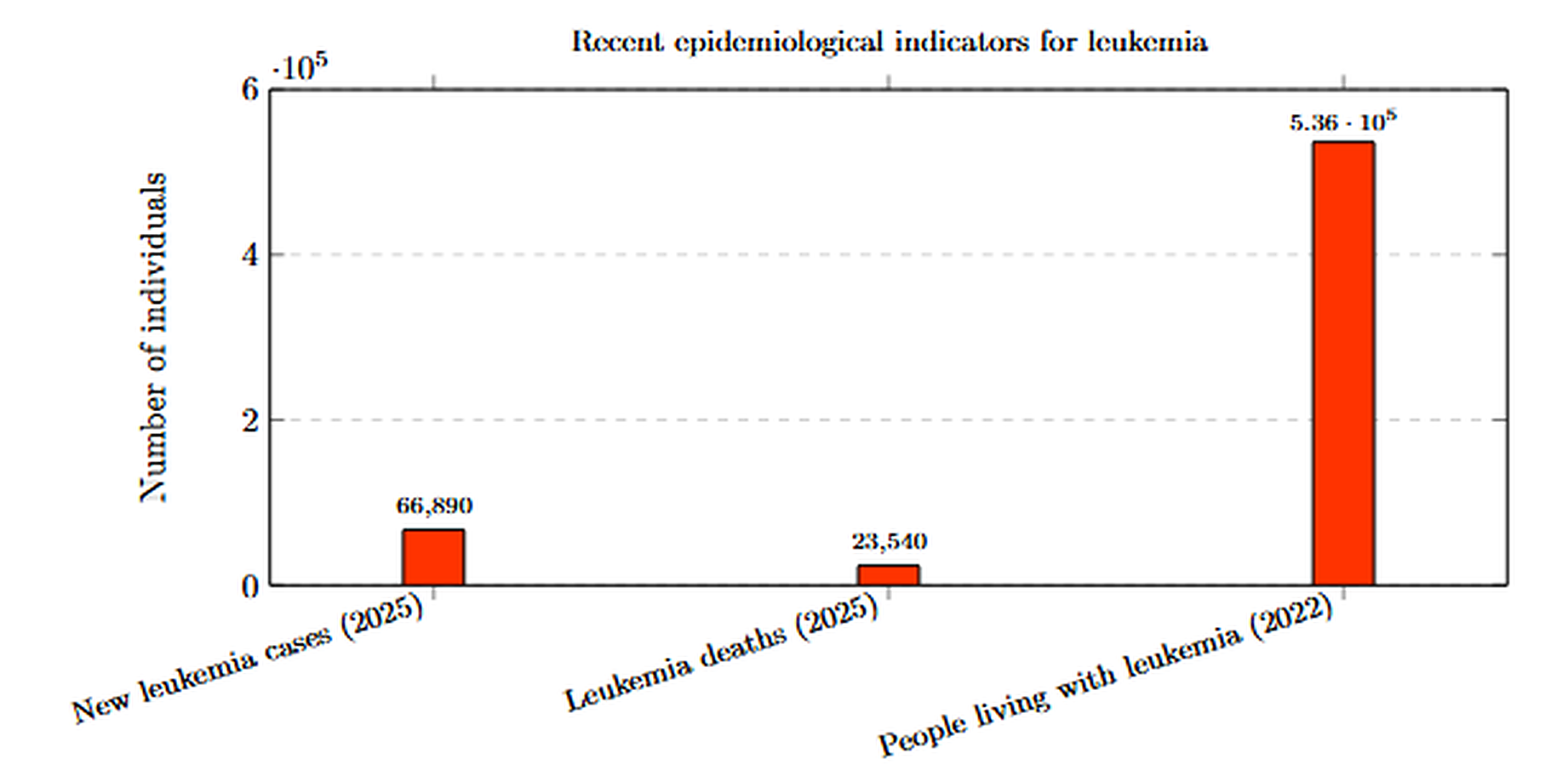
From the Formalism of the Delayed Mackey-Glass Equation and Its Application to Leukemia Growth
Open Access | Research Article | 19 September 2026
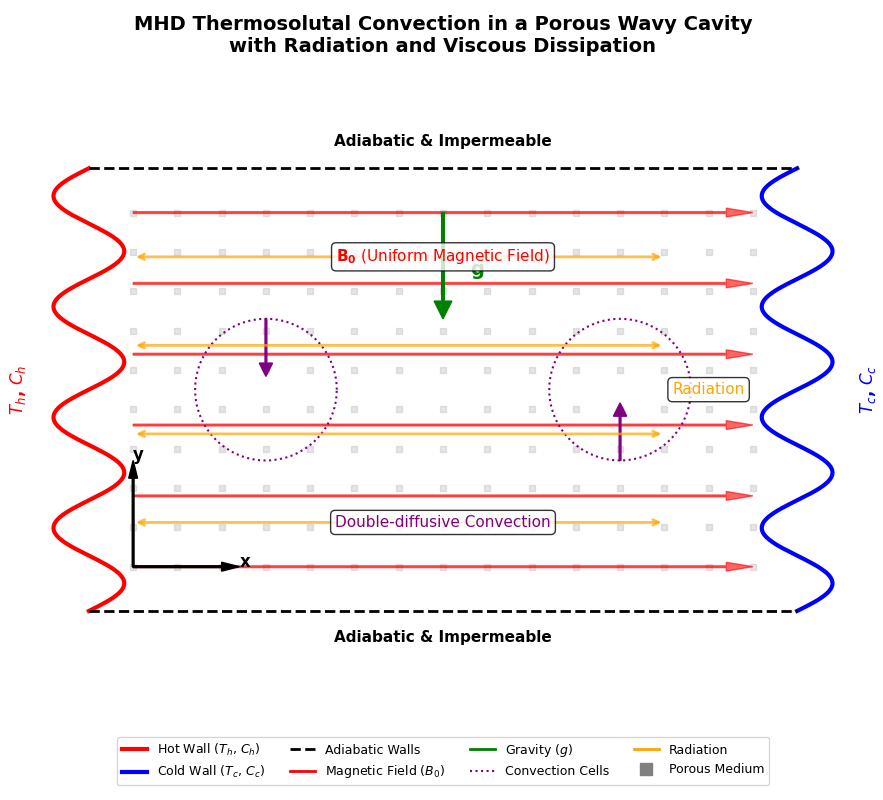
MHD Double-Diffusive Convection in a Darcy--Forchheimer Porous Wavy Cavity with Radiation and Viscous Dissipation: A Finite Element Study
Journal of Numerical Simulations in Physics and Mathematics | Volume 2, Issue 2: 117-129, 2026 | DOI: 10.62762/JNSPM.2026.403753
Abstract
This paper investigates the combined effects of magnetohydrodynamics (MHD), double-diffusive convection, radiative heat transfer, and viscous dissipation in a porous wavy cavity. The Darcy–Forchheimer model and Rosseland approximation are employed; the dimensionless governing equations are solved using the Galerkin finite element method with triangular elements. Key quantitative findings include: the Hartmann number suppresses convective transport, reducing average Nusselt and Sherwood numbers by up to 59% at $Ha=50$; the radiation parameter $N_1$ enhances heat transfer by 169% as $N_1$ varies from 0.01 to 10; viscous dissipation paradoxically reduces wall heat flux by 33% despite increasi... More >

Graphical Abstract
MHD Double-Diffusive Convection in a Darcy--Forchheimer Porous Wavy Cavity with Radiation and Viscous Dissipation: A Finite Element Study
Open Access | Research Article | 18 September 2026
The Integration of Stiff Systems of Ordinary Differential Equations Using a Time-Stepping Algorithm with Off-Step Points
Journal of Numerical Simulations in Physics and Mathematics | Volume 2, Issue 2: 104-116, 2026 | DOI: 10.62762/JNSPM.2026.264715
Abstract
Stiff systems of ordinary differential equations (ODEs) arise frequently in science, engineering, and applied mathematics, and their numerical solutions require methods with strong stability properties to avoid severe step-size restrictions. This motivates the development of efficient and stable numerical schemes tailored for such problems. In this paper, a fully implicit hybrid block method, termed the Two-Point Superclass Block Backward Differentiation Formula with Off-step Points (2SBBDFO), is proposed for solving stiff ODE systems. The method extends the classical two-point block BDF by incorporating a non-zero coefficient $\beta_{k-1}$, enabling the simultaneous computation of two grid-... More >

Graphical Abstract
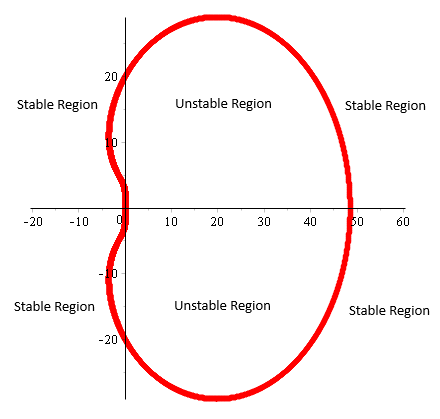
The Integration of Stiff Systems of Ordinary Differential Equations Using a Time-Stepping Algorithm with Off-Step Points
Open Access | Research Article | 17 September 2026
New Iteration Method (NIM) for Solving Fourth-Order Two-Point Nonlinear Boundary Value Problems
Journal of Numerical Simulations in Physics and Mathematics | Volume 2, Issue 2: 90-103, 2026 | DOI: 10.62762/JNSPM.2026.798641
Abstract
In this study, the New Iteration Method (NIM) is employed to obtain approximate analytical solutions of nonlinear fourth-order ordinary differential equations of the general form \[ \mathcal{L}(u) + \mathcal{N}(u) = g(x), \qquad x \in [a,b], \] subject to the two-point boundary conditions \[ \mathcal{B}_1(u)=0, \qquad \mathcal{B}_2(u)=0, \] where $\mathcal{L}$ denotes a linear differential operator, $\mathcal{N}$ represents a nonlinear operator, and $g(x)$ is a given continuous function. The NIM framework constructs a rapidly convergent iterative sequence $\{u_n\}_{n=0}^{\infty}$ whose limit approximates the exact solution. The convergence behavior and numerical performan... More >
Open Access | Research Article | 09 September 2026
Numerical Simulation of Stiff Systems of Ordinary Differential Equations Using a Block Extended Backward Differentiation Scheme with a Stability Control Parameter
Journal of Numerical Simulations in Physics and Mathematics | Volume 2, Issue 2: 69-89, 2026 | DOI: 10.62762/JNSPM.2026.422478
Abstract
Stiff systems of ordinary differential equations (ODEs) arise frequently in several areas of applied mathematics, science, and engineering, and their numerical integration requires methods with strong stability characteristics. In this paper, a block extended backward differentiation formula (BEBDF) with a stability control parameter is developed for the numerical solution of stiff systems of ODEs. The proposed method is constructed within the framework of block multistep methods, allowing the simultaneous computation of solution values at several grid points. A free parameter $\rho$ is incorporated into the formulation of the method to regulate and improve its stability behavior. The presen... More >

Graphical Abstract
Numerical Simulation of Stiff Systems of Ordinary Differential Equations Using a Block Extended Backward Differentiation Scheme with a Stability Control Parameter