An Evidence Fusion Approach for Rolling Bearing Fault Diagnosis Using PredVAR-Extracted Latent Variables




Article Information
Abstract
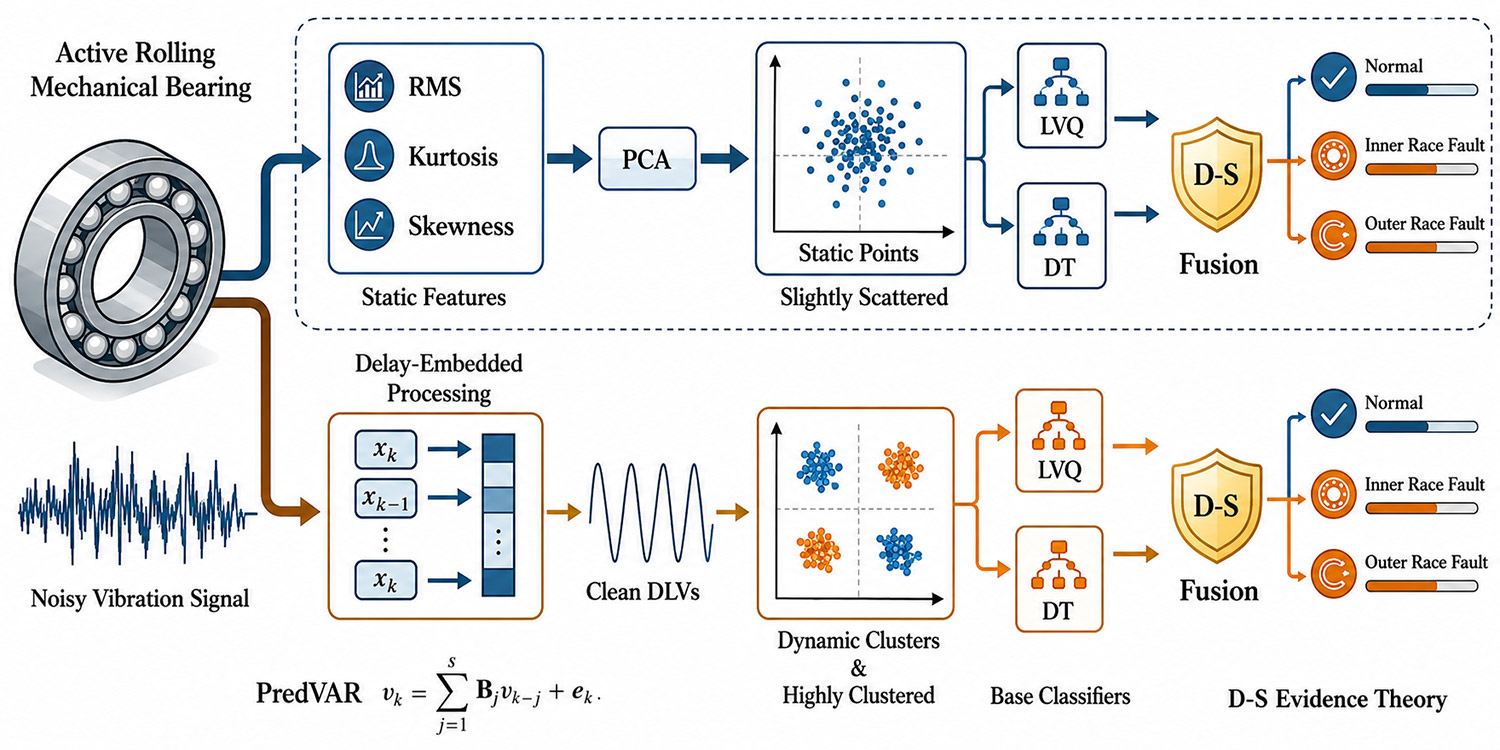
Conventional data-driven fault diagnosis for rolling-element bearings often uses static dimensionality-reduction methods, such as principal component analysis (PCA). Such methods may preserve load-related static variation and produce inconsistent evidence when several classifiers are fused. This paper proposes a dynamic feature extraction and evidence fusion method based on the probabilistic reduced-dimensional vector autoregressive (PredVAR) model proposed in [Mo and Qin, 2025, Automatica]. The raw vibration signal is first reconstructed by delay embedding, and PredVAR is then used to extract predictable dynamic latent variables (DLVs). The extracted DLVs are converted into compact dynamic feature vectors for learning vector quantization (LVQ) and decision tree (DT) classifiers, whose outputs are combined by Dempster-Shafer (D-S) evidence theory. Experiments on a mixed-load CWRU bearing dataset show that the proposed PredVAR + D-S framework achieves an average accuracy of 99.91% with a standard deviation of 0.0014 under the main 20-run protocol. The D-S conflict coefficient is reduced from 0.0195 to 0.0056 compared with PCA-based features, indicating more consistent classifier evidence. The proposed method can be positioned as a compact and interpretable dynamic-fusion approach. In a limited-label setting with 50 labeled windows per class, PredVAR + D-S obtains the highest mean accuracy among the compared methods, suggesting an advantage when labeled fault data are scarce.
Graphical Abstract
Keywords
Data Availability Statement
Funding
Conflicts of Interest
AI Use Statement
Ethical Approval and Consent to Participate
References
- Peng, B., Bi, Y., Xue, B., Zhang, M., & Wan, S. (2022). A survey on fault diagnosis of rolling bearings. Algorithms, 15(10), 347.
[CrossRef] [Google Scholar] - Zhao, J., Wang, W., Huang, J., & Ma, X. (2025). A comprehensive review of deep learning-based fault diagnosis approaches for rolling bearings: Advancements and challenges. AIP Advances, 15(2).
[CrossRef] [Google Scholar] - Lei, L., Li, W., Zhang, S., Wu, C., & Yu, H. (2025). Research progress on data-driven industrial fault diagnosis methods. Sensors, 25(9), 2952.
[CrossRef] [Google Scholar] - Jaber, A. A. (2024). Diagnosis of bearing faults using temporal vibration signals: a comparative study of machine learning models with feature selection techniques. Journal of Failure Analysis and Prevention, 24(2), 752-768.
[CrossRef] [Google Scholar] - Hua, L., Wu, X., Liu, T., & Li, S. (2022). The methodology of modified frequency band envelope kurtosis for bearing fault diagnosis. IEEE Transactions on Industrial Informatics, 19(3), 2856-2865.
[CrossRef] [Google Scholar] - Prieto-Moreno, A., Llanes-Santiago, O., & García-Moreno, E. (2015). Principal components selection for dimensionality reduction using discriminant information applied to fault diagnosis. Journal of Process Control, 33, 14-24.
[CrossRef] [Google Scholar] - Brito, L. C., Susto, G. A., Brito, J. N., & Duarte, M. A. V. (2021). Fault detection of bearing: An unsupervised machine learning approach exploiting feature extraction and dimensionality reduction. Informatics, 8(4), 85.
[CrossRef] [Google Scholar] - Wen, X., & Xu, Z. (2021). Wind turbine fault diagnosis based on ReliefF-PCA and DNN. Expert Systems with Applications, 178, 115016.
[CrossRef] [Google Scholar] - Yao, X., Li, S., & Hu, J. (2017). Improving rolling bearing fault diagnosis by DS evidence theory based fusion model. Journal of Sensors, 2017(1), 6737295.
[CrossRef] [Google Scholar] - Kohonen, T. (1995). Learning vector quantization. In Self-Organizing Maps (pp. 245-261). Springer.
[CrossRef] [Google Scholar] - Nova, D., & Estévez, P. A. (2014). A review of learning vector quantization classifiers. Neural Computing and Applications, 25(3), 511-524.
[CrossRef] [Google Scholar] - Quinlan, J. R. (2014). C4.5: Programs for Machine Learning. Elsevier. https://dl.acm.org/doi/abs/10.5555/583200
[Google Scholar] - Suthaharan, S. (2016). Decision tree learning. In Machine Learning Models and Algorithms for Big Data Classification (pp. 237-269). Springer.
[CrossRef] [Google Scholar] - Zhen, D., Guo, J., Xu, Y., Zhang, H., & Gu, F. (2019). A novel fault detection method for rolling bearings based on non-stationary vibration signature analysis. Sensors, 19(18), 3994.
[CrossRef] [Google Scholar] - Gong, T., Yang, J., Liu, S., & Liu, H. (2022). Non-stationary feature extraction by the stochastic response of coupled oscillators and its application in bearing fault diagnosis under variable speed condition. Nonlinear Dynamics, 108(4), 3839-3857.
[CrossRef] [Google Scholar] - Kasim, N. A., Mohamed, M. G., & Nuawi, M. Z. (2022). Non-Stationary vibratory signatures bearing fault detection using alternative novel kurtosis-based statistical analysis. Journal of Applied Science and Process Engineering, 9(1), 1139-1148.
[CrossRef] [Google Scholar] - Mo, Y., & Qin, S. J. (2025). Probabilistic reduced-dimensional vector autoregressive modeling with oblique projections. Automatica, 180, 112476.
[CrossRef] [Google Scholar] - Dong, Y., & Qin, S. J. (2018). A novel dynamic PCA algorithm for dynamic data modeling and process monitoring. Journal of Process Control, 67, 1-11.
[CrossRef] [Google Scholar] - Yuan, R., Lv, Y., Lu, Z., Li, S., & Li, H. (2023). Robust fault diagnosis of rolling bearing via phase space reconstruction of intrinsic mode functions and neural network under various operating conditions. Structural Health Monitoring, 22(2), 846-864.
[CrossRef] [Google Scholar] - Zhang, Z., Liu, B., Liu, Y., & Zhang, H. (2022). Fault feature-extraction method of aviation bearing based on maximum correlation R\'{enyi Entropy and Phase-Space Reconstruction Technology. Entropy, 24(10), 1459.
[CrossRef] [Google Scholar] - Xiao, F., Wen, J., Pedrycz, W., & Aritsugi, M. (2024). Complex evidence theory for multisource data fusion. Chinese Journal of Information Fusion, 1(2), 134-159.
[CrossRef] [Google Scholar] - Murphy, C. K. (2000). Combining belief functions when evidence conflicts. Decision support systems, 29(1), 1-9.
[CrossRef] [Google Scholar] - Li, W., Han, D., Dezert, J., & Yang, Y. (2024). Basic belief assignment determination based on radial basis function network. Chinese Journal of Information Fusion, 1(3), 175-182.
[CrossRef] [Google Scholar] - Wen, G., Lei, Z., Chen, X., & Huang, X. (2024). DS evidence theory and its application for fault diagnosis of machinery. In New Generation Artificial Intelligence-Driven Diagnosis and Maintenance Techniques: Advanced Machine Learning Models, Methods and Applications (pp. 325-341). Singapore: Springer Nature Singapore.
[CrossRef] [Google Scholar] - Li, L., Zhang, X., Wang, P., Chen, C., Ma, T., & Gao, S. (2025). A bearing fault diagnosis method for multi-sensors using cloud model and Dempster–Shafer evidence fusion. Applied Sciences, 15(21), 11302.
[CrossRef] [Google Scholar] - Case Western Reserve University Bearing Data Center. (2024). Bearing Data Center: Seeded Fault Test Data. Case Western Reserve University. Accessed May 18, 2026. https://engineering.case.edu/bearingdatacenter
[Google Scholar] - Liang, P., Wang, W., Yuan, X., Liu, S., Zhang, L., & Cheng, Y. (2022). Intelligent fault diagnosis of rolling bearing based on wavelet transform and improved ResNet under noisy labels and environment. Engineering Applications of Artificial Intelligence, 115, 105269.
[CrossRef] [Google Scholar] - Ni, Q., Ji, J. C., Halkon, B., Feng, K., & Nandi, A. K. (2023). Physics-Informed Residual Network (PIResNet) for rolling element bearing fault diagnostics. Mechanical Systems and Signal Processing, 200, 110544.
[CrossRef] [Google Scholar] - Hou, S., Lian, A., & Chu, Y. (2023). Bearing fault diagnosis method using the joint feature extraction of Transformer and ResNet. Measurement Science and Technology, 34(7), 075108.
[CrossRef] [Google Scholar] - Zhong, H., Lv, Y., Yuan, R., & Yang, D. (2022). Bearing fault diagnosis using transfer learning and self-attention ensemble lightweight convolutional neural network. Neurocomputing, 501, 765-777.
[CrossRef] [Google Scholar]
Cite This Article
TY  - JOUR
AU  - Zhu, Zhongxi
AU  - Lv, Weijun
AU  - Mo, Yanfang
PY  - 2026
DA  - 2026/11/17
TI  - An Evidence Fusion Approach for Rolling Bearing Fault Diagnosis Using PredVAR-Extracted Latent Variables
JO  - Chinese Journal of Information Fusion
T2  - Chinese Journal of Information Fusion
JF  - Chinese Journal of Information Fusion
VL  - 3
IS  - 4
SP  - 238
EP  - 250
DO  - 10.62762/CJIF.2026.701879
UR  - https://www.icck.org/article/abs/cjif.2026.701879
KW  - fault diagnosis
KW  - dynamic latent variable
KW  - PredVAR
KW  - Dempster-Shafer evidence theory
KW  - information fusion
AB  - Conventional data-driven fault diagnosis for rolling-element bearings often uses static dimensionality-reduction methods, such as principal component analysis (PCA). Such methods may preserve load-related static variation and produce inconsistent evidence when several classifiers are fused. This paper proposes a dynamic feature extraction and evidence fusion method based on the probabilistic reduced-dimensional vector autoregressive (PredVAR) model proposed in [Mo and Qin, 2025, Automatica]. The raw vibration signal is first reconstructed by delay embedding, and PredVAR is then used to extract predictable dynamic latent variables (DLVs). The extracted DLVs are converted into compact dynamic feature vectors for learning vector quantization (LVQ) and decision tree (DT) classifiers, whose outputs are combined by Dempster-Shafer (D-S) evidence theory. Experiments on a mixed-load CWRU bearing dataset show that the proposed PredVAR + D-S framework achieves an average accuracy of 99.91% with a standard deviation of 0.0014 under the main 20-run protocol. The D-S conflict coefficient is reduced from 0.0195 to 0.0056 compared with PCA-based features, indicating more consistent classifier evidence. The proposed method can be positioned as a compact and interpretable dynamic-fusion approach. In a limited-label setting with 50 labeled windows per class, PredVAR + D-S obtains the highest mean accuracy among the compared methods, suggesting an advantage when labeled fault data are scarce.
SN  - 2998-3371
PB  - Institute of Central Computation and Knowledge
LA  - English
ER  -
@article{Zhu2026An,
  author = {Zhongxi Zhu and Weijun Lv and Yanfang Mo},
  title = {An Evidence Fusion Approach for Rolling Bearing Fault Diagnosis Using PredVAR-Extracted Latent Variables},
  journal = {Chinese Journal of Information Fusion},
  year = {2026},
  volume = {3},
  number = {4},
  pages = {238-250},
  doi = {10.62762/CJIF.2026.701879},
  url = {https://www.icck.org/article/abs/cjif.2026.701879},
  abstract = {Conventional data-driven fault diagnosis for rolling-element bearings often uses static dimensionality-reduction methods, such as principal component analysis (PCA). Such methods may preserve load-related static variation and produce inconsistent evidence when several classifiers are fused. This paper proposes a dynamic feature extraction and evidence fusion method based on the probabilistic reduced-dimensional vector autoregressive (PredVAR) model proposed in [Mo and Qin, 2025, Automatica]. The raw vibration signal is first reconstructed by delay embedding, and PredVAR is then used to extract predictable dynamic latent variables (DLVs). The extracted DLVs are converted into compact dynamic feature vectors for learning vector quantization (LVQ) and decision tree (DT) classifiers, whose outputs are combined by Dempster-Shafer (D-S) evidence theory. Experiments on a mixed-load CWRU bearing dataset show that the proposed PredVAR + D-S framework achieves an average accuracy of 99.91\% with a standard deviation of 0.0014 under the main 20-run protocol. The D-S conflict coefficient is reduced from 0.0195 to 0.0056 compared with PCA-based features, indicating more consistent classifier evidence. The proposed method can be positioned as a compact and interpretable dynamic-fusion approach. In a limited-label setting with 50 labeled windows per class, PredVAR + D-S obtains the highest mean accuracy among the compared methods, suggesting an advantage when labeled fault data are scarce.},
  keywords = {fault diagnosis, dynamic latent variable, PredVAR, Dempster-Shafer evidence theory, information fusion},
  issn = {2998-3371},
  publisher = {Institute of Central Computation and Knowledge}
}
Article Metrics
Publisher's Note
ICCK stays neutral with regard to jurisdictional claims in published maps and institutional affiliations.
Rights and Permissions
 Copyright © 2026 by the Author(s). Published by Institute of Central Computation and Knowledge. This article is an open access article distributed under the terms and conditions of the Creative Commons Attribution (CC BY) license (https://creativecommons.org/licenses/by/4.0/), which permits use, sharing, adaptation, distribution and reproduction in any medium or format, as long as you give appropriate credit to the original author(s) and the source, provide a link to the Creative Commons licence, and indicate if changes were made.


Portico