
DA-DISTA-Net: Degradation-Aware Unfolding Network for Closely-Spaced Infrared Small Target Unmixing





Article Information
Abstract
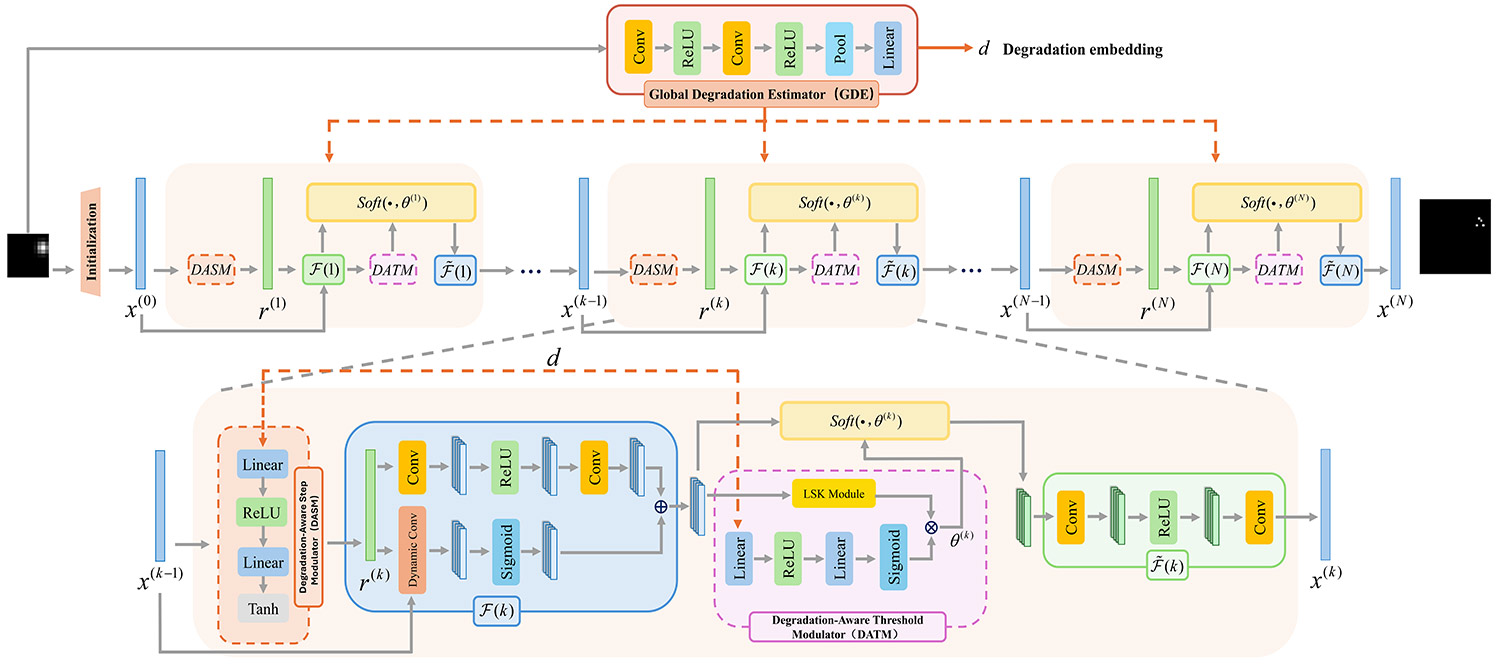
Deep unfolding networks for closely-spaced infrared small target (CSIST) unmixing are usually trained and tested with a single, known point spread function (PSF). When the PSF at test time differs from the training PSF, their accuracy drops noticeably. We treat unmixing under an unknown PSF as an information fusion problem: the low-resolution observation contains both the target configuration and cues about the blur that produced it, and the second kind of information can be used to steer the reconstruction. Based on this idea, we propose DA-DISTA-Net, a degradation-aware unfolding network. A lightweight Global Degradation Estimator (GDE) maps the low-resolution input to a compact degradation embedding once, before unfolding starts. At every stage, the embedding drives a Degradation-Aware Step Modulator (DASM) and a Degradation-Aware Threshold Modulator (DATM), which adjust the gradient step size and the soft-thresholding level, respectively. No PSF labels are needed. For evaluation, we re-render the images of CSIST-100K from their original annotations with a PSF standard deviation $\sigma$ drawn uniformly from $[0.2, 0.9]$ pixels for each image. On this random-degradation test set, DA-DISTA-Net reaches a mean average precision (mAP) of 43.29%, which is 0.78 percentage points higher than the strongest baseline, at the cost of a 3.2% increase in parameters.
Graphical Abstract
Keywords
Data Availability Statement
Funding
Conflicts of Interest
AI Use Statement
Ethical Approval and Consent to Participate
References
- Daubechies, I., Defrise, M., & De Mol, C. (2004). An iterative thresholding algorithm for linear inverse problems with a sparsity constraint. Communications on Pure and Applied Mathematics, 57(11), 1413-1457.
[CrossRef] [Google Scholar] - Beck, A., & Teboulle, M. (2009). A fast iterative shrinkage-thresholding algorithm for linear inverse problems. SIAM Journal on Imaging Sciences, 2(1), 183-202.
[CrossRef] [Google Scholar] - Zhang, J., & Ghanem, B. (2018, June). ISTA-Net: Interpretable optimization-inspired deep network for image compressive sensing. In 2018 IEEE/CVF Conference on Computer Vision and Pattern Recognition (pp. 1828-1837). IEEE.
[CrossRef] [Google Scholar] - Han, S., Yang, S., Li, Y., Zhang, X., Li, X., Yang, J., ... & Dai, Y. (2025, October). DISTA-Net: Dynamic closely-spaced infrared small target unmixing. In 2025 IEEE/CVF International Conference on Computer Vision (ICCV) (pp. 14655-14664). IEEE.
[CrossRef] [Google Scholar] - Zhang, K., Van Gool, L., & Timofte, R. (2020). Deep unfolding network for image super-resolution. In Proceedings of the IEEE/CVF Conference on Computer Vision and Pattern Recognition (pp. 3217-3226).
[CrossRef] [Google Scholar] - Cai, Y., Lin, J., Wang, H., Yuan, X., Ding, H., Zhang, Y., ... & Gool, L. V. (2022). Degradation-aware unfolding half-shuffle transformer for spectral compressive imaging. Advances in Neural Information Processing Systems, 35, 37749-37761.
[CrossRef] [Google Scholar] - Li, B., Xiao, C., Wang, L., Wang, Y., Lin, Z., Li, M., ... & Guo, Y. (2023). Dense nested attention network for infrared small target detection. IEEE Transactions on Image Processing, 32, 1745-1758.
[CrossRef] [Google Scholar] - Yuan, S., Qin, H., Yan, X., Akhtar, N., & Mian, A. (2024). SCTransNet: Spatial-channel cross transformer network for infrared small target detection. IEEE Transactions on Geoscience and Remote Sensing, 62, 1-15.
[CrossRef] [Google Scholar] - Borgerding, M., Schniter, P., & Rangan, S. (2017). AMP-inspired deep networks for sparse linear inverse problems. IEEE Transactions on Signal Processing, 65(16), 4293-4308.
[CrossRef] [Google Scholar] - Gregor, K., & LeCun, Y. (2010, June). Learning fast approximations of sparse coding. In Proceedings of the 27th international conference on international conference on machine learning (pp. 399-406). https://mlanthology.org/icml/2010/gregor2010icml-learning
[Google Scholar] - Li, Y., Hou, Q., Zheng, Z., Cheng, M. M., Yang, J., & Li, X. (2023, October). Large selective kernel network for remote sensing object detection. In Proceedings of the IEEE/CVF International Conference on Computer Vision (ICCV). IEEE.
[CrossRef] [Google Scholar] - You, D., Xie, J., & Zhang, J. (2021). ISTA-Net++: Flexible deep unfolding network for compressive sensing. In Proceedings of the 2021 IEEE International Conference on Multimedia and Expo (pp. 1-6).
[CrossRef] [Google Scholar] - Chen, X., Liu, J., Wang, Z., & Yin, W. (2018). Theoretical linear convergence of unfolded ISTA and its practical weights and thresholds. Advances in Neural Information Processing Systems, 31. https://proceedings.neurips.cc/paper/2018/hash/cf8c9be2a4508a24ae92c9d3d379131d-Abstract.html
[Google Scholar] - Liu, J., Chen, X., Wang, Z., & Yin, W. (2019). ALISTA: Analytic weights are as good as learned weights in LISTA. In International Conference on Learning Representations. https://mlanthology.org/iclr/2019/liu2019iclr-alista
[Google Scholar] - Zheng, Z., Dai, W., Xue, D., Li, C., Zou, J., & Xiong, H. (2023). Hybrid ISTA: Unfolding ISTA with convergence guarantees using free-form deep neural networks. IEEE Transactions on Pattern Analysis and Machine Intelligence, 45(3), 3226-3244.
[CrossRef] [Google Scholar] - Wang, L., Wang, Y., Dong, X., Xu, Q., Yang, J., An, W., & Guo, Y. (2021, June). Unsupervised degradation representation learning for blind super-resolution. In 2021 IEEE/CVF Conference on Computer Vision and Pattern Recognition (CVPR) (pp. 10581–10590). IEEE.
[CrossRef] [Google Scholar] - Xia, B., Zhang, Y., Wang, Y., Tian, Y., Yang, W., Timofte, R., & Van Gool, L. (2022). Knowledge distillation based degradation estimation for blind super-resolution. arXiv preprint arXiv:2211.16928.
[CrossRef] [Google Scholar] - Kingma, D. P., & Ba, J. (2014). Adam: A method for stochastic optimization. arXiv preprint arXiv:1412.6980.
[CrossRef] [Google Scholar] - Zhang, Y., Li, K., Li, K., Wang, L., Zhong, B., & Fu, Y. (2018). Image super-resolution using very deep residual channel attention networks. In Proceedings of the European Conference on Computer Vision (pp. 286-301).
[CrossRef] [Google Scholar] - Zhang, Y., Tian, Y., Kong, Y., Zhong, B., & Fu, Y. (2018, June). Residual dense network for image super-resolution. In 2018 IEEE/CVF conference on computer vision and pattern recognition (pp. 2472-2481). IEEE.
[CrossRef] [Google Scholar] - Li, Z., Yang, J., Liu, Z., Yang, X., Jeon, G., & Wu, W. (2019, June). Feedback network for image super-resolution. In 2019 IEEE/CVF Conference on Computer Vision and Pattern Recognition (CVPR) (pp. 3867–3876). IEEE.
[CrossRef] [Google Scholar] - Xiang, J., Dong, Y., & Yang, Y. (2021). FISTA-Net: Learning a fast iterative shrinkage thresholding network for inverse problems in imaging. IEEE Transactions on Medical Imaging, 40(5), 1329-1339.
[CrossRef] [Google Scholar] - Van der Maaten, L., & Hinton, G. (2008). Visualizing data using t-SNE. Journal of Machine Learning Research, 9, 2579–2605. https://www.jmlr.org/papers/volume9/vandermaaten08a/vandermaaten08a.pdf?fbcl
[Google Scholar]
Cite This Article
TY  - JOUR
AU  - Yang, Wenjun
AU  - Chen, Yaxiu
AU  - Wang, Yang
AU  - Lv, Bo
AU  - Yang, Jungang
AU  - Zou, Jiangwei
PY  - 2026
DA  - 2026/11/19
TI  - DA-DISTA-Net: Degradation-Aware Unfolding Network for Closely-Spaced Infrared Small Target Unmixing
JO  - Chinese Journal of Information Fusion
T2  - Chinese Journal of Information Fusion
JF  - Chinese Journal of Information Fusion
VL  - 3
IS  - 4
SP  - 251
EP  - 261
DO  - 10.62762/CJIF.2026.903328
UR  - https://www.icck.org/article/abs/cjif.2026.903328
KW  - infrared small target detection
KW  - closely-spaced target unmixing
KW  - deep unfolding network
KW  - sparse reconstruction
KW  - degradation-aware inference
KW  - information fusion
AB  - Deep unfolding networks for closely-spaced infrared small target (CSIST) unmixing are usually trained and tested with a single, known point spread function (PSF). When the PSF at test time differs from the training PSF, their accuracy drops noticeably. We treat unmixing under an unknown PSF as an information fusion problem: the low-resolution observation contains both the target configuration and cues about the blur that produced it, and the second kind of information can be used to steer the reconstruction. Based on this idea, we propose DA-DISTA-Net, a degradation-aware unfolding network. A lightweight Global Degradation Estimator (GDE) maps the low-resolution input to a compact degradation embedding once, before unfolding starts. At every stage, the embedding drives a Degradation-Aware Step Modulator (DASM) and a Degradation-Aware Threshold Modulator (DATM), which adjust the gradient step size and the soft-thresholding level, respectively. No PSF labels are needed. For evaluation, we re-render the images of CSIST-100K from their original annotations with a PSF standard deviation $\sigma$ drawn uniformly from $[0.2, 0.9]$ pixels for each image. On this random-degradation test set, DA-DISTA-Net reaches a mean average precision (mAP) of 43.29%, which is 0.78 percentage points higher than the strongest baseline, at the cost of a 3.2% increase in parameters.
SN  - 2998-3371
PB  - Institute of Central Computation and Knowledge
LA  - English
ER  -
@article{Yang2026DADISTANet,
  author = {Wenjun Yang and Yaxiu Chen and Yang Wang and Bo Lv and Jungang Yang and Jiangwei Zou},
  title = {DA-DISTA-Net: Degradation-Aware Unfolding Network for Closely-Spaced Infrared Small Target Unmixing},
  journal = {Chinese Journal of Information Fusion},
  year = {2026},
  volume = {3},
  number = {4},
  pages = {251-261},
  doi = {10.62762/CJIF.2026.903328},
  url = {https://www.icck.org/article/abs/cjif.2026.903328},
  abstract = {Deep unfolding networks for closely-spaced infrared small target (CSIST) unmixing are usually trained and tested with a single, known point spread function (PSF). When the PSF at test time differs from the training PSF, their accuracy drops noticeably. We treat unmixing under an unknown PSF as an information fusion problem: the low-resolution observation contains both the target configuration and cues about the blur that produced it, and the second kind of information can be used to steer the reconstruction. Based on this idea, we propose DA-DISTA-Net, a degradation-aware unfolding network. A lightweight Global Degradation Estimator (GDE) maps the low-resolution input to a compact degradation embedding once, before unfolding starts. At every stage, the embedding drives a Degradation-Aware Step Modulator (DASM) and a Degradation-Aware Threshold Modulator (DATM), which adjust the gradient step size and the soft-thresholding level, respectively. No PSF labels are needed. For evaluation, we re-render the images of CSIST-100K from their original annotations with a PSF standard deviation \$\sigma\$ drawn uniformly from \$[0.2, 0.9]\$ pixels for each image. On this random-degradation test set, DA-DISTA-Net reaches a mean average precision (mAP) of 43.29\%, which is 0.78 percentage points higher than the strongest baseline, at the cost of a 3.2\% increase in parameters.},
  keywords = {infrared small target detection, closely-spaced target unmixing, deep unfolding network, sparse reconstruction, degradation-aware inference, information fusion},
  issn = {2998-3371},
  publisher = {Institute of Central Computation and Knowledge}
}
Article Metrics
Publisher's Note
ICCK stays neutral with regard to jurisdictional claims in published maps and institutional affiliations.
Rights and Permissions
 Copyright © 2026 by the Author(s). Published by Institute of Central Computation and Knowledge. This article is an open access article distributed under the terms and conditions of the Creative Commons Attribution (CC BY) license (https://creativecommons.org/licenses/by/4.0/), which permits use, sharing, adaptation, distribution and reproduction in any medium or format, as long as you give appropriate credit to the original author(s) and the source, provide a link to the Creative Commons licence, and indicate if changes were made.


Portico
