

DETER: A Clinical Deterioration Prediction Algorithm to Improve Patient Care with Devices-Based Telemetry and Generative AI


Article Information
Abstract
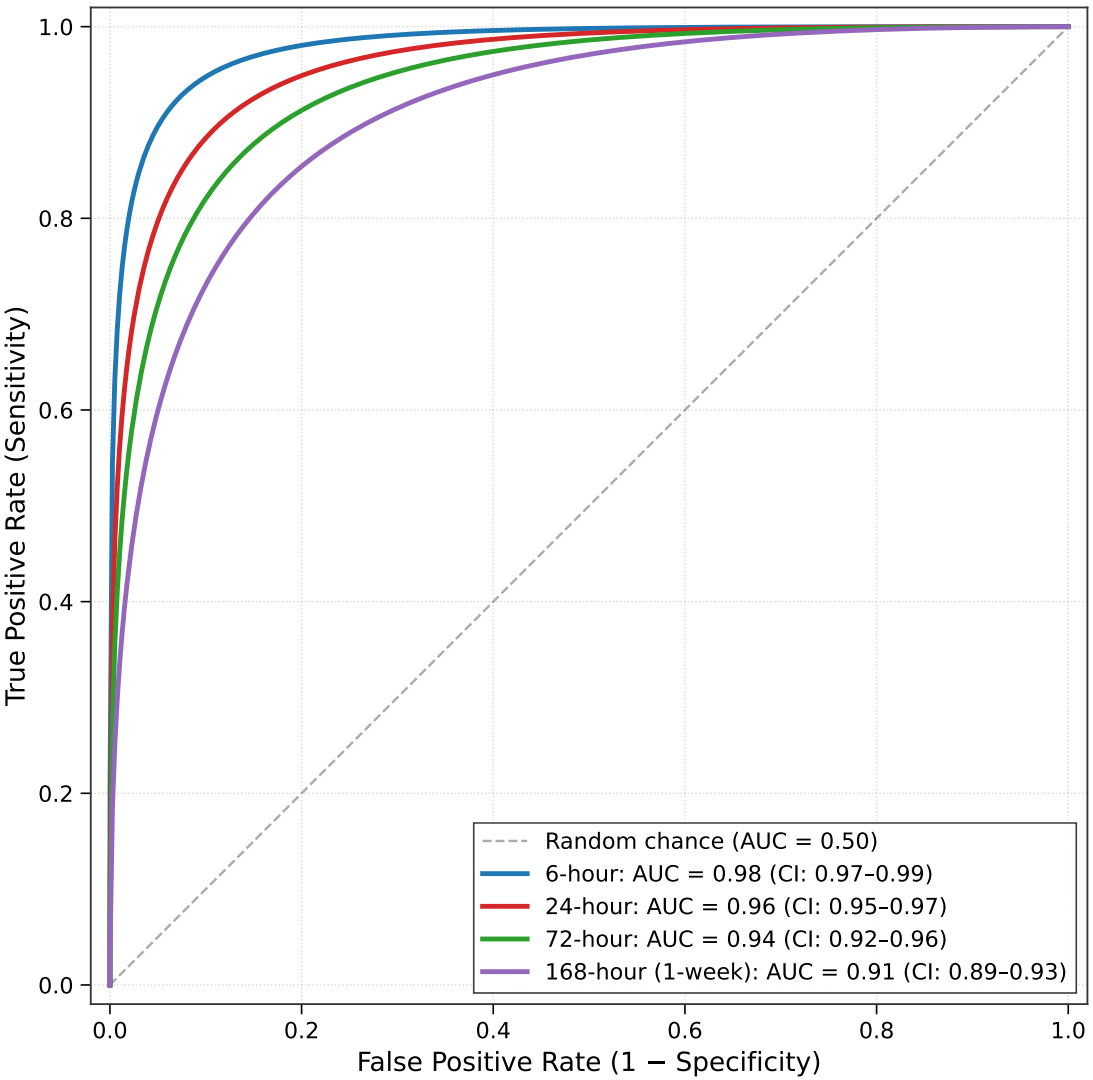
Traditional Early Warning Systems (EWS) relying on intermittent vital signs and aggregate scoring often miss subtle pre-deterioration changes. Recent advances in continuous telemetry and artificial intelligence present opportunities for enhanced detection. We propose DETER, a novel algorithm integrating continuous vital sign telemetry with Retrieval-Augmented Generation (RAG)-enhanced generative AI. The system processes real-time physiological data (ECG, SpO2, blood pressure, temperature, respiratory rate, heart rate variability) alongside electronic medical records and clinical assessments. Developed and validated on 94 patients (74% aged >65 years) from the Cardio-Thoracic Clinic of University Hospital of Patras, with synthetic data augmentation generated from the MIMIC-IV-ED cohort, the Transformer-based architecture achieves 96.5% accuracy with Area Under the Curve (AUC) of 0.98 (6h) and 0.96 (24h). DETER outperforms traditional EWS by providing risk stratification with lead times of days to weeks, not hours, and generates continuously updated, personalized deterioration risk scores for proactive intervention and optimized resource allocation. The integration of continuous telemetry with RAG-enhanced generative AI moves monitoring from reactive to predictive and from population-level to personalised. By forecasting physiological trajectories with lead time in days rather than hours, DETER can enable earlier intervention, reduce preventable deterioration, and support both acute and ambulatory care. Prospective validation is warranted to confirm real-world impact and feasibility in diverse healthcare environments.
Graphical Abstract
Keywords
Data Availability Statement
Funding
Conflicts of Interest
AI Use Statement
Ethical Approval and Consent to Participate
References
- Alam, N., Hobbelink, E. L., van Tienhoven, A. J., van de Ven, P. M., Jansma, E. P., & Nanayakkara, P. W. (2014). The impact of the use of the Early Warning Score (EWS) on patient outcomes: a systematic review. Resuscitation, 85(5), 587-594.
[CrossRef] [Google Scholar] - Koyner, J. L., Carey, K. A., Edelson, D. P., & Churpek, M. M. (2018). The development of a machine learning inpatient acute kidney injury prediction model. Critical care medicine, 46(7), 1070-1077.
[CrossRef] [Google Scholar] - Shimabukuro, D. W., Barton, C. W., Feldman, M. D., Mataraso, S. J., & Das, R. (2017). Effect of a machine learning-based severe sepsis prediction algorithm on patient survival and hospital length of stay: a randomised clinical trial. BMJ open respiratory research, 4(1), e000234.
[CrossRef] [Google Scholar] - Wellner, B., Grand, J., Canzone, E., Coarr, M., Brady, P. W., Simmons, J., ... & Sylvester, P. (2017). Predicting unplanned transfers to the intensive care unit: a machine learning approach leveraging diverse clinical elements. JMIR medical informatics, 5(4), e45.
[CrossRef] [Google Scholar] - Desautels, T., Calvert, J., Hoffman, J., Jay, M., Kerem, Y., Shieh, L., ... & Das, R. (2016). Prediction of sepsis in the intensive care unit with minimal electronic health record data: a machine learning approach. JMIR medical informatics, 4(3), e5909.
[CrossRef] [Google Scholar] - Reyna, M. A., Josef, C., Seyedi, S., Jeter, R., Shashikumar, S. P., Westover, M. B., ... & Clifford, G. D. (2019, September). Early prediction of sepsis from clinical data: the physionet/computing in cardiology challenge 2019. In 2019 Computing in Cardiology (CinC) (pp. Page-1). IEEE.
[CrossRef] [Google Scholar] - Goff, D. C., Lloyd-Jones, D. M., Bennett, G., Coady, S., D'agostino, R. B., Gibbons, R., ... & Wilson, P. W. (2014). 2013 ACC/AHA guideline on the assessment of cardiovascular risk: a report of the American College of Cardiology/American Heart Association Task Force on Practice Guidelines. Journal of the American College of Cardiology, 63(25 Part B), 2935-2959.
[CrossRef] [Google Scholar] - Boubiche, D. E., Boubiche, S., & Chehri, A. (2025). Revolutionizing patient care with medical iot and generative ai. IEEE Internet of Things Magazine, 9(1), 80-87.
[CrossRef] [Google Scholar] - Churpek, M. M., Yuen, T. C., Winslow, C., Meltzer, D. O., Kattan, M. W., & Edelson, D. P. (2016). Multicenter comparison of machine learning methods and conventional regression for predicting clinical deterioration on the wards. Critical care medicine, 44(2), 368-374.
[CrossRef] [Google Scholar] - Ghassemi, M., Oakden-Rayner, L., & Beam, A. L. (2021). The false hope of current approaches to explainable artificial intelligence in health care. The lancet digital health, 3(11), e745-e750.
[CrossRef] [Google Scholar] - Dey, D., Slomka, P. J., Leeson, P., Comaniciu, D., Shrestha, S., Sengupta, P. P., & Marwick, T. H. (2019). Artificial intelligence in cardiovascular imaging: JACC state-of-the-art review. Journal of the American College of Cardiology, 73(11), 1317-1335.
[CrossRef] [Google Scholar] - Attia, Z. I., Kapa, S., Lopez-Jimenez, F., McKie, P. M., Ladewig, D. J., Satam, G., ... & Friedman, P. A. (2019). Screening for cardiac contractile dysfunction using an artificial intelligence–enabled electrocardiogram. Nature medicine, 25(1), 70-74.
[CrossRef] [Google Scholar] - Levin, S., Toerper, M., Hamrock, E., Hinson, J. S., Barnes, S., Gardner, H., ... & Kelen, G. (2018). Machine-learning-based electronic triage more accurately differentiates patients with respect to clinical outcomes compared with the emergency severity index. Annals of emergency medicine, 71(5), 565-574.
[CrossRef] [Google Scholar] - Barr, A. A., Quan, J., Guo, E., & Sezgin, E. (2025). Large language models generating synthetic clinical datasets: a feasibility and comparative analysis with real-world perioperative data. Frontiers in artificial intelligence, 8, 1533508.
[CrossRef] [Google Scholar] - Thirunavukarasu, A. J., Ting, D. S. J., Elangovan, K., Gutierrez, L., Tan, T. F., & Ting, D. S. W. (2023). Large language models in medicine. Nature medicine, 29(8), 1930-1940.
[CrossRef] [Google Scholar] - Moor, M., Banerjee, O., Abad, Z. S. H., Krumholz, H. M., Leskovec, J., Topol, E. J., & Rajpurkar, P. (2023). Foundation models for generalist medical artificial intelligence. Nature, 616(7956), 259-265.
[CrossRef] [Google Scholar] - Rajpurkar, P., Chen, E., Banerjee, O., & Topol, E. J. (2022). AI in health and medicine. Nature medicine, 28(1), 31-38.
[CrossRef] [Google Scholar] - Lewis, P., Perez, E., Piktus, A., Petroni, F., Karpukhin, V., Goyal, N., ... & Kiela, D. (2020). Retrieval-augmented generation for knowledge-intensive nlp tasks. Advances in neural information processing systems, 33, 9459-9474.
[Google Scholar] - Guu, K., Lee, K., Tung, Z., Pasupat, P., & Chang, M. (2020, November). Retrieval augmented language model pre-training. In International conference on machine learning (pp. 3929-3938). PMLR.
[Google Scholar] - Borgeaud, S., Mensch, A., Hoffmann, J., Cai, T., Rutherford, E., Millican, K., ... & Sifre, L. (2022, June). Improving language models by retrieving from trillions of tokens. In International conference on machine learning (pp. 2206-2240). PMLR.
[Google Scholar] - Izacard, G., & Grave, E. (2021, April). Leveraging passage retrieval with generative models for open domain question answering. In Proceedings of the 16th conference of the european chapter of the association for computational linguistics: main volume (pp. 874-880).
[CrossRef] [Google Scholar] - Shuster, K., Poff, S., Chen, M., Kiela, D., & Weston, J. (2021, November). Retrieval augmentation reduces hallucination in conversation. In Findings of the Association for Computational Linguistics: EMNLP 2021 (pp. 3784-3803).
[CrossRef] [Google Scholar] - Ram, O., Levine, Y., Dalmedigos, I., Muhlgay, D., Shashua, A., Leyton-Brown, K., & Shoham, Y. (2023). In-context retrieval-augmented language models. Transactions of the Association for Computational Linguistics, 11, 1316-1331.
[CrossRef] [Google Scholar] - Peng, B., Galley, M., He, P., Cheng, H., Xie, Y., Hu, Y., ... & Gao, J. (2023). Check your facts and try again: Improving large language models with external knowledge and automated feedback. arXiv preprint arXiv:2302.12813.
[CrossRef] [Google Scholar] - Singhal, K., Azizi, S., Tu, T., Mahdavi, S. S., Wei, J., Chung, H. W., ... & Natarajan, V. (2023). Large language models encode clinical knowledge. Nature, 620(7972), 172-180.
[CrossRef] [Google Scholar] - Vaswani, A., Shazeer, N., Parmar, N., Uszkoreit, J., Jones, L., Gomez, A. N., ... & Polosukhin, I. (2017). Attention is all you need. Advances in neural information processing systems, 30.
[Google Scholar] - Wen, Q., Zhou, T., Zhang, C., Chen, W., Ma, Z., Yan, J., & Sun, L. (2023, August). Transformers in time series: a survey. In Proceedings of the Thirty-Second International Joint Conference on Artificial Intelligence (pp. 6778-6786).
[CrossRef] [Google Scholar] - Zhou, H., Zhang, S., Peng, J., Zhang, S., Li, J., Xiong, H., & Zhang, W. (2021, May). Informer: Beyond efficient transformer for long sequence time-series forecasting. In Proceedings of the AAAI conference on artificial intelligence (Vol. 35, No. 12, pp. 11106-11115).
[CrossRef] [Google Scholar] - CAREPOI. (n.d.). CAREPOI® — Continuous Vital Signs Telemetry Platform. Retrieved from https://www.carepoi.com
[Google Scholar] - Mirza, M., & Osindero, S. (2014). Conditional generative adversarial nets. arXiv preprint arXiv:1411.1784.
[CrossRef] [Google Scholar] - Gulrajani, I., Ahmed, F., Arjovsky, M., Dumoulin, V., & Courville, A. (2017). Improved training of Wasserstein GANs. Advances in Neural Information Processing Systems, 30, 5767–5777.
[Google Scholar] - Krstajic, D., Buturovic, L. J., Leahy, D. E., & Thomas, S. (2014). Cross-validation pitfalls when selecting and assessing regression and classification models. Journal of cheminformatics, 6(1), 10.
[CrossRef] [Google Scholar] - Lundberg, S. M., & Lee, S. I. (2017). A unified approach to interpreting model predictions. Advances in neural information processing systems, 30.
[Google Scholar] - Lundberg, S. M., Erion, G., Chen, H., DeGrave, A., Prutkin, J. M., Nair, B., ... & Lee, S. I. (2020). From local explanations to global understanding with explainable AI for trees. Nature machine intelligence, 2(1), 56-67.
[CrossRef] [Google Scholar] - Thayer, J. F., Åhs, F., Fredrikson, M., Sollers III, J. J., & Wager, T. D. (2012). A meta-analysis of heart rate variability and neuroimaging studies: implications for heart rate variability as a marker of stress and health. Neuroscience & Biobehavioral Reviews, 36(2), 747-756.
[CrossRef] [Google Scholar] - Rothwell, P. M., Howard, S. C., Dolan, E., O'Brien, E., Dobson, J. E., Dahlöf, B., ... & Poulter, N. R. (2010). Prognostic significance of visit-to-visit variability, maximum systolic blood pressure, and episodic hypertension. The Lancet, 375(9718), 895-905.
[CrossRef] [Google Scholar] - Kraut, J. A., & Madias, N. E. (2014). Lactic acidosis. New England Journal of Medicine, 371(24), 2309-2319.
[CrossRef] [Google Scholar]
Cite This Article
TY  - JOUR
AU  - Pylarinou, Charalampia
AU  - Gortzis, Lefteris
AU  - Koletsis, Efstratios
AU  - Leivaditis, Vasileios
AU  - Mavrilas, Dimosthenis
PY  - 2026
DA  - 2026/08/11
TI  - DETER: A Clinical Deterioration Prediction Algorithm to Improve Patient Care with Devices-Based Telemetry and Generative AI
JO  - Journal of Computational Intelligence in Biomedicine
T2  - Journal of Computational Intelligence in Biomedicine
JF  - Journal of Computational Intelligence in Biomedicine
VL  - 1
IS  - 1
SP  - 24
EP  - 43
DO  - 10.62762/JCIB.2025.132871
UR  - https://www.icck.org/article/abs/JCIB.2025.132871
KW  - Generative AI
KW  - clinical deterioration
KW  - machine learning
KW  - remote patient monitoring
AB  - Traditional Early Warning Systems (EWS) relying on intermittent vital signs and aggregate scoring often miss subtle pre-deterioration changes. Recent advances in continuous telemetry and artificial intelligence present opportunities for enhanced detection. We propose DETER, a novel algorithm integrating continuous vital sign telemetry with Retrieval-Augmented Generation (RAG)-enhanced generative AI. The system processes real-time physiological data (ECG, SpO2, blood pressure, temperature, respiratory rate, heart rate variability) alongside electronic medical records and clinical assessments. Developed and validated on 94 patients (74% aged >65 years) from the Cardio-Thoracic Clinic of University Hospital of Patras, with synthetic data augmentation generated from the MIMIC-IV-ED cohort, the Transformer-based architecture achieves 96.5% accuracy with Area Under the Curve (AUC) of 0.98 (6h) and 0.96 (24h). DETER outperforms traditional EWS by providing risk stratification with lead times of days to weeks, not hours, and generates continuously updated, personalized deterioration risk scores for proactive intervention and optimized resource allocation. The integration of continuous telemetry with RAG-enhanced generative AI moves monitoring from reactive to predictive and from population-level to personalised. By forecasting physiological trajectories with lead time in days rather than hours, DETER can enable earlier intervention, reduce preventable deterioration, and support both acute and ambulatory care. Prospective validation is warranted to confirm real-world impact and feasibility in diverse healthcare environments.
SN  - request pending
PB  - Institute of Central Computation and Knowledge
LA  - English
ER  -
@article{Pylarinou2026DETER,
  author = {Charalampia Pylarinou and Lefteris Gortzis and Efstratios Koletsis and Vasileios Leivaditis and Dimosthenis Mavrilas},
  title = {DETER: A Clinical Deterioration Prediction Algorithm to Improve Patient Care with Devices-Based Telemetry and Generative AI},
  journal = {Journal of Computational Intelligence in Biomedicine},
  year = {2026},
  volume = {1},
  number = {1},
  pages = {24-43},
  doi = {10.62762/JCIB.2025.132871},
  url = {https://www.icck.org/article/abs/JCIB.2025.132871},
  abstract = {Traditional Early Warning Systems (EWS) relying on intermittent vital signs and aggregate scoring often miss subtle pre-deterioration changes. Recent advances in continuous telemetry and artificial intelligence present opportunities for enhanced detection. We propose DETER, a novel algorithm integrating continuous vital sign telemetry with Retrieval-Augmented Generation (RAG)-enhanced generative AI. The system processes real-time physiological data (ECG, SpO2, blood pressure, temperature, respiratory rate, heart rate variability) alongside electronic medical records and clinical assessments. Developed and validated on 94 patients (74\% aged >65 years) from the Cardio-Thoracic Clinic of University Hospital of Patras, with synthetic data augmentation generated from the MIMIC-IV-ED cohort, the Transformer-based architecture achieves 96.5\% accuracy with Area Under the Curve (AUC) of 0.98 (6h) and 0.96 (24h). DETER outperforms traditional EWS by providing risk stratification with lead times of days to weeks, not hours, and generates continuously updated, personalized deterioration risk scores for proactive intervention and optimized resource allocation. The integration of continuous telemetry with RAG-enhanced generative AI moves monitoring from reactive to predictive and from population-level to personalised. By forecasting physiological trajectories with lead time in days rather than hours, DETER can enable earlier intervention, reduce preventable deterioration, and support both acute and ambulatory care. Prospective validation is warranted to confirm real-world impact and feasibility in diverse healthcare environments.},
  keywords = {Generative AI, clinical deterioration, machine learning, remote patient monitoring},
  issn = {request pending},
  publisher = {Institute of Central Computation and Knowledge}
}
Article Metrics
Publisher's Note
ICCK stays neutral with regard to jurisdictional claims in published maps and institutional affiliations.
Rights and Permissions
 Copyright © 2026 by the Author(s). Published by Institute of Central Computation and Knowledge. This article is an open access article distributed under the terms and conditions of the Creative Commons Attribution (CC BY) license (https://creativecommons.org/licenses/by/4.0/), which permits use, sharing, adaptation, distribution and reproduction in any medium or format, as long as you give appropriate credit to the original author(s) and the source, provide a link to the Creative Commons licence, and indicate if changes were made.


Portico
