

Mechanics-Based Drill Bit Design for Soil Sampling in Resource Exploration




Article Information
Abstract
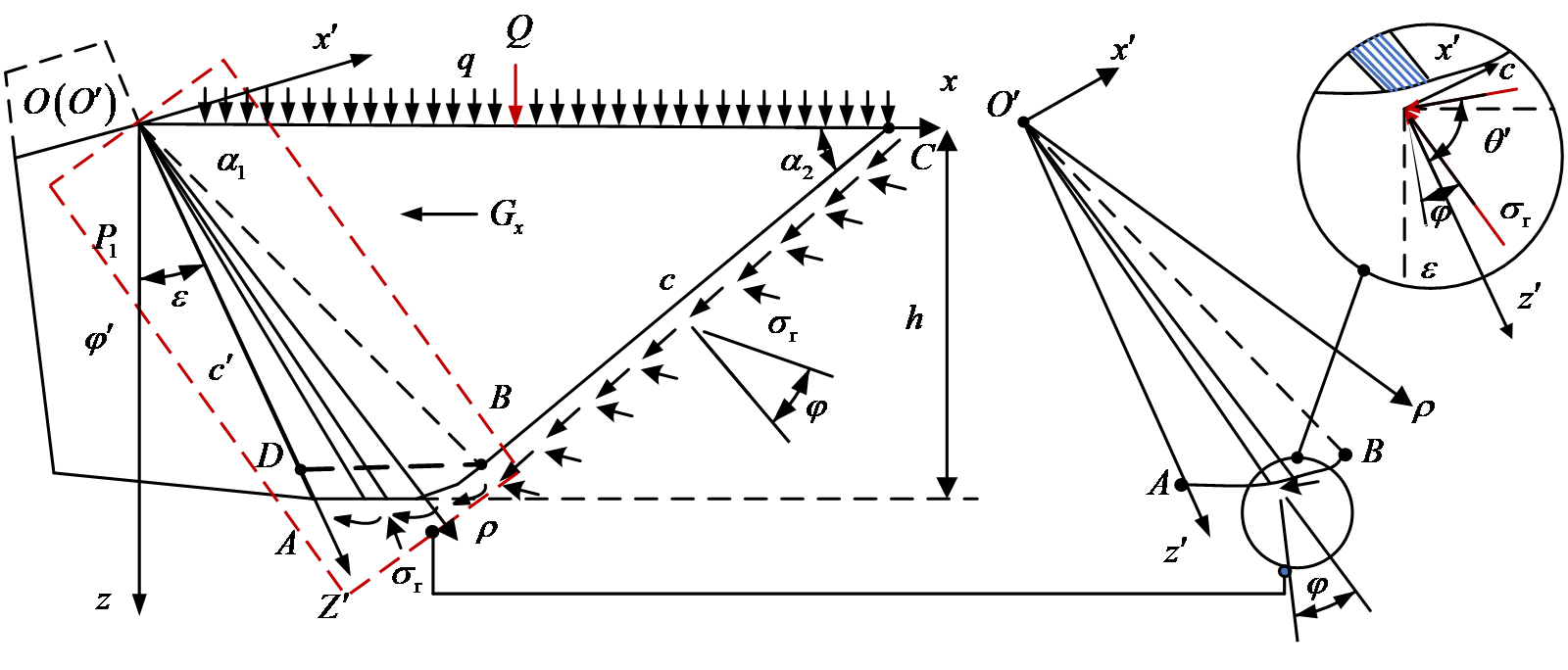
To meet the requirements for automated sampling of silty clay and loam in mineral exploration, a soil-sampling drill bit was designed, and its structural parameters, soil-cutting mechanism, and drilling performance were investigated. Based on the characteristics of helical soil conveying, the helix angle of the flight was set to $14^\circ$, giving a pitch of approximately 35 mm. Building on the McKyes-Ali model, the soil failure surface was represented as a composite surface consisting of a planar surface and a logarithmic spiral surface, and the cutting zone was divided into a central failure zone and two lateral failure zones. The calculated total cutting resistance of the drill bit was lowest at a rake angle of $18^\circ$, while the lateral resistance accounted for 30%--40% of the total cutting load. A coupled RecurDyn-EDEM model of the drill bit-soil interaction was then established using the Hertz-Mindlin with JKRV2 contact model. Thirteen numerical tests were conducted to investigate the effects of rotational speed and feed speed on thrust force and torque. Both thrust force and torque increased markedly with increasing feed speed. Increasing the rotational speed appropriately while limiting the feed speed reduced the drilling load. Field sampling tests in silty clay were then carried out at depths of 5--30 cm. Twelve sampling operations were completed, of which eleven yielded samples weighing at least 200 g.
Graphical Abstract
Keywords
Data Availability Statement
Funding
Conflicts of Interest
AI Use Statement
Ethical Approval and Consent to Participate
References
- Norby, J., Wang, S., Wang, H., Deng, S., Jones, N., Mishra, A., ... & Lowry, G. V. (2024). Path to autonomous soil sampling and analysis by ground-based robots. Journal of Environmental Management, 360, 121130.
[CrossRef] [Google Scholar] - Harper, H. J. (1931). An improved soil sampling tube. Soil Science, 32(1), 65-70.
[CrossRef] [Google Scholar] - Groenewoud, H. van. (1960). Methods and samplers for obtaining undisturbed soil samples in the forest. Soil Science, 90(5), 272-274.
[CrossRef] [Google Scholar] - Walker, M. E., Stansell, J. R., & Shannon, J. E. (1976). Precision soil sampler. Agronomy Journal, 68(2), 431-432.
[CrossRef] [Google Scholar] - Karahashi, M., Morimoto, K., Goto, T., & Fujii, Y. (1987). Development of a new soil-core sampler. Japan Agricultural Research Quarterly, 21(1), 28-35. https://www.jircas.go.jp/sites/default/files/publication/jarq/21-1-028-035_0.pdf
[Google Scholar] - McGrath, D., & Skotnikov, A. (1996). Possibility of different soil sampling techniques with automated soil sampler. Communications in Soil Science and Plant Analysis, 27(5-8), 1779-1794.
[CrossRef] [Google Scholar] - Burrage, R. H., Vibert, R. O., & MacLeod, M. N. (1963). Note on a power-operated soil sampler for field wireworm studies. Canadian Journal of Plant Science, 43(2), 242-243.
[CrossRef] [Google Scholar] - Hubers, E. (2002). U.S. Patent No. 6,363,803. Washington, DC: U.S. Patent and Trademark Office. https://patents.google.com/patent/US6363803B1/en
[Google Scholar] - Sibley, K. J., Adsett, J. F., & Struik, P. C. (2008). An on-the-go soil sampler for an automated soil nitrate mapping system. Transactions of the ASABE, 51(6), 1895-1904.
[CrossRef] [Google Scholar] - Fiechter, T. (2020). U.S. Patent No. 10,801,927. Washington, DC: U.S. Patent and Trademark Office. https://patents.google.com/patent/US10801927B2/en
[Google Scholar] - Baarstad, L. L., Rickman, R. W., Wilkins, D., & Morita, S. (1993). A hydraulic soil sampler providing minimum field plot disruption. Agronomy Journal, 85(1), 178-181.
[CrossRef] [Google Scholar] - Kornecki, T. S., Prior, S. A., Runion, G. B., Rogers, H. H., & Erbach, D. C. (2008). Hydraulic core extraction: cutting device for soil–root studies. Communications in Soil Science and Plant Analysis, 39(7-8), 1080-1089.
[CrossRef] [Google Scholar] - Yildirim, S., Birrell, S. J., & Hummel, J. W. (2006). Laboratory evaluation of an electro-pneumatic sampling method for real-time soil sensing. Transactions of the ASABE, 49(4), 845-850.
[CrossRef] [Google Scholar] - Shen, X., Yuan, D., Wu, J., Qiu, T., Chen, X., Jin, D., & Wu, J. (2025). A novel three-dimensional mechanical model for rotary cutting in soil considering wear status and its experimental verification. Acta Geotechnica, 20(4), 1661-1679.
[CrossRef] [Google Scholar] - ISO 18400-102:2017. Soil quality--Sampling--Part 102: Selection and application of sampling techniques. International Organization for Standardization, Geneva. Retrieved from https://www.iso.org/standard/62843.html
[Google Scholar] - Clayton, C. R. I., Siddique, A., & Hopper, R. J. (1998). Effects of sampler design on tube sampling disturbance—numerical and analytical investigations. Géotechnique, 48(6), 847-867. http://doi.org/10.1680/geot.1998.48.6.847
[Google Scholar] - Fu, L., Wang, K., Hu, B., & Xo, N. V. (2021). Conveying performance of drilling tool of auger miner at different strike angles based on discrete element method. Powder Technology, 378, 202-215.
[CrossRef] [Google Scholar] - McKyes, E., & Ali, O. S. (1977). The cutting of soil by narrow blades. Journal of Terramechanics, 14(2), 43-58.
[CrossRef] [Google Scholar] - Godwin, R. J., & Spoor, G. (1977). Soil failure with narrow tines. Journal of Agricultural Engineering Research, 22(3), 213-228.
[CrossRef] [Google Scholar] - Mak, J., Chen, Y., & Sadek, M. A. (2012). Determining parameters of a discrete element model for soil-tool interaction. Soil and Tillage Research, 118, 117-122.
[CrossRef] [Google Scholar] - Ucgul, M., Fielke, J. M., & Saunders, C. (2014). Three-dimensional discrete element modelling of tillage: Determination of a suitable contact model and parameters for a cohesionless soil. Biosystems Engineering, 121, 105-117.
[CrossRef] [Google Scholar] - Johnson, K. L., Kendall, K., & Roberts, A. D. (1971). Surface energy and the contact of elastic solids. Proceedings of the Royal Society of London. A, 324(1558), 301-313.
[CrossRef] [Google Scholar] - Roessler, T., & Katterfeld, A. (2019). DEM parameter calibration of cohesive bulk materials using a simple angle of repose test. Particuology, 45, 105-115.
[CrossRef] [Google Scholar]
Cite This Article
TY  - JOUR
AU  - Chen, Ziming
AU  - Zhang, Hongyuan
AU  - Hou, Hongfei
AU  - Han, Wang
AU  - Zhang, Pan
AU  - Wang, Wushuai
AU  - Zhao, Chen
AU  - Li, Qirui
PY  - 2026
DA  - 2026/11/27
TI  - Mechanics-Based Drill Bit Design for Soil Sampling in Resource Exploration
JO  - Journal of Energy and Resources
T2  - Journal of Energy and Resources
JF  - Journal of Energy and Resources
VL  - 1
IS  - 1
SP  - 5
EP  - 19
DO  - 10.62762/JER.2026.773413
UR  - https://www.icck.org/article/abs/jer.2026.773413
KW  - soil-sampling drill bit
KW  - soil sampling
KW  - three-dimensional cutting model
KW  - coupled simulation
AB  - To meet the requirements for automated sampling of silty clay and loam in mineral exploration, a soil-sampling drill bit was designed, and its structural parameters, soil-cutting mechanism, and drilling performance were investigated. Based on the characteristics of helical soil conveying, the helix angle of the flight was set to $14^\circ$, giving a pitch of approximately 35 mm. Building on the McKyes-Ali model, the soil failure surface was represented as a composite surface consisting of a planar surface and a logarithmic spiral surface, and the cutting zone was divided into a central failure zone and two lateral failure zones. The calculated total cutting resistance of the drill bit was lowest at a rake angle of $18^\circ$, while the lateral resistance accounted for 30%--40% of the total cutting load. A coupled RecurDyn-EDEM model of the drill bit-soil interaction was then established using the Hertz-Mindlin with JKRV2 contact model. Thirteen numerical tests were conducted to investigate the effects of rotational speed and feed speed on thrust force and torque. Both thrust force and torque increased markedly with increasing feed speed. Increasing the rotational speed appropriately while limiting the feed speed reduced the drilling load. Field sampling tests in silty clay were then carried out at depths of 5--30 cm. Twelve sampling operations were completed, of which eleven yielded samples weighing at least 200 g.
SN  - pending
PB  - Institute of Central Computation and Knowledge
LA  - English
ER  -
@article{Chen2026MechanicsB,
  author = {Ziming Chen and Hongyuan Zhang and Hongfei Hou and Wang Han and Pan Zhang and Wushuai Wang and Chen Zhao and Qirui Li},
  title = {Mechanics-Based Drill Bit Design for Soil Sampling in Resource Exploration},
  journal = {Journal of Energy and Resources},
  year = {2026},
  volume = {1},
  number = {1},
  pages = {5-19},
  doi = {10.62762/JER.2026.773413},
  url = {https://www.icck.org/article/abs/jer.2026.773413},
  abstract = {To meet the requirements for automated sampling of silty clay and loam in mineral exploration, a soil-sampling drill bit was designed, and its structural parameters, soil-cutting mechanism, and drilling performance were investigated. Based on the characteristics of helical soil conveying, the helix angle of the flight was set to \$14^\circ\$, giving a pitch of approximately 35 mm. Building on the McKyes-Ali model, the soil failure surface was represented as a composite surface consisting of a planar surface and a logarithmic spiral surface, and the cutting zone was divided into a central failure zone and two lateral failure zones. The calculated total cutting resistance of the drill bit was lowest at a rake angle of \$18^\circ\$, while the lateral resistance accounted for 30\%--40\% of the total cutting load. A coupled RecurDyn-EDEM model of the drill bit-soil interaction was then established using the Hertz-Mindlin with JKRV2 contact model. Thirteen numerical tests were conducted to investigate the effects of rotational speed and feed speed on thrust force and torque. Both thrust force and torque increased markedly with increasing feed speed. Increasing the rotational speed appropriately while limiting the feed speed reduced the drilling load. Field sampling tests in silty clay were then carried out at depths of 5--30 cm. Twelve sampling operations were completed, of which eleven yielded samples weighing at least 200 g.},
  keywords = {soil-sampling drill bit, soil sampling, three-dimensional cutting model, coupled simulation},
  issn = {pending},
  publisher = {Institute of Central Computation and Knowledge}
}
Article Metrics
Publisher's Note
ICCK stays neutral with regard to jurisdictional claims in published maps and institutional affiliations.
Rights and Permissions
 Copyright © 2026 by the Author(s). Published by Institute of Central Computation and Knowledge. This article is an open access article distributed under the terms and conditions of the Creative Commons Attribution (CC BY) license (https://creativecommons.org/licenses/by/4.0/), which permits use, sharing, adaptation, distribution and reproduction in any medium or format, as long as you give appropriate credit to the original author(s) and the source, provide a link to the Creative Commons licence, and indicate if changes were made.

