
A Chaotic-Adaptive Grey Wolf Optimizer for Sizing Grid-Connected Solar-Wind-Battery Microgrids with EV Fast Charging under Rule-Based Dispatch



Article Information
Abstract
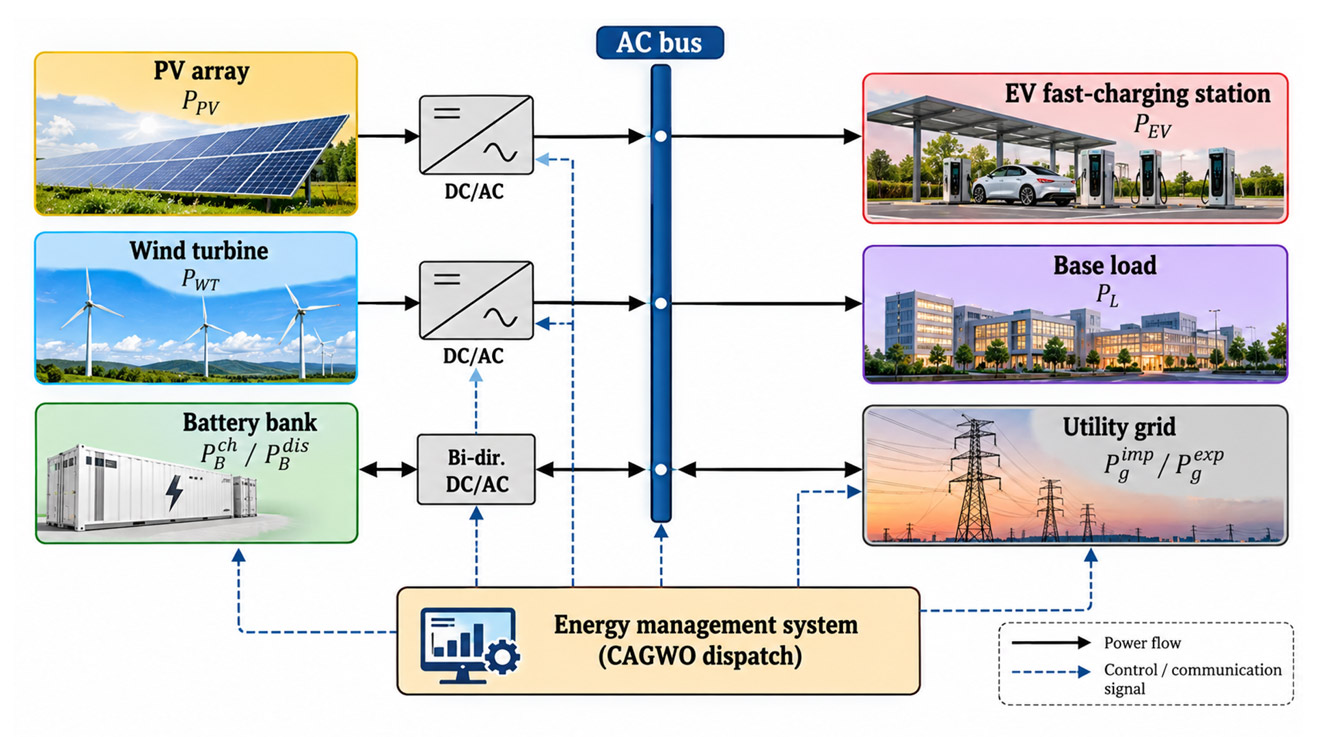
Fast electric vehicle (EV) charging adds a steep, intermittent load to microgrids built on variable solar and wind generation, and sizing such a microgrid is a non-convex problem. This paper proposes a Chaotic-Adaptive Grey Wolf Optimizer (CAGWO), which modifies the standard Grey Wolf Optimizer (GWO) in two ways: a tent-map chaotic initialization for more even initial coverage, and a nonlinear adaptive convergence factor that extends early exploration. CAGWO sizes the PV, wind, battery, and converter capacities of a grid-connected microgrid supplying an EV fast-charging station. A year-long hourly simulation under a degradation-aware rule-based dispatch evaluates each candidate design, and the objective minimizes net present cost (NPC) under reliability and renewable-fraction limits. For a coastal site in Bangladesh, CAGWO, GWO, particle swarm optimization (PSO), and the whale optimization algorithm (WOA) reach the same design: 1.12~MW PV, 0.49~MW wind, an NPC of US$4.17 million, and a levelized cost of energy of US$0.126/kWh. CAGWO does not lower the final cost relative to GWO (Wilcoxon $p = 0.29$). Its advantage lies in convergence: a lower mean NPC at small iteration budgets and a run-to-run standard deviation of US$17, against more than US$56{,}000 for GA and WOA. On 30-dimensional benchmarks, CAGWO improves on GWO on all five functions (significant on four), while WOA attains the lowest mean on four of five. The advantage over GWO shrinks to two significant functions at 4 dimensions, and an ablation traces it to the adaptive convergence factor alone. The design rests on one weather year and one EV-demand realization, and scenario-based sizing is left for future work.
Graphical Abstract
Keywords
Data Availability Statement
Funding
Conflicts of Interest
AI Use Statement
Ethical Approval and Consent to Participate
References
- International Energy Agency. (2024). Renewables 2024: Analysis and forecast to 2030. IEA, Paris. Retrieved from https://www.iea.org/reports/renewables-2024
[Google Scholar] - International Energy Agency. (2025). Global EV Outlook 2025. IEA, Paris. Retrieved from https://www.iea.org/reports/global-ev-outlook-2025
[Google Scholar] - Ishraque, M. F., Shezan, S. A., Ali, M. M., & Rashid, M. M. (2021). Optimization of load dispatch strategies for an islanded microgrid connected with renewable energy sources. Applied Energy, 292, 116879.
[CrossRef] [Google Scholar] - Ul Hassan, S., Yousif, M., Nawaz Khan, S., Kazmi, S. A. A., & Imran, K. (2023). A decision-centric approach for techno-economic optimization and environmental assessment of standalone and grid-integrated renewable-powered electric vehicle charging stations under multiple planning horizons. Energy Conversion and Management, 294, 117571.
[CrossRef] [Google Scholar] - Alharbi, A. M., Ali, Z. M., & Zaki Diab, A. A. (2025). Comparative techno-economic optimization of microgrid configurations using hybrid battery--hydrogen storage: NEOM case study, Saudi Arabia. PLOS ONE, 20(9), e0326050.
[CrossRef] [Google Scholar] - Mirjalili, S., Mirjalili, S. M., & Lewis, A. (2014). Grey wolf optimizer. Advances in Engineering Software, 69, 46-61.
[CrossRef] [Google Scholar] - El-Fergany, A. A., & Hasanien, H. M. (2015). Single and multi-objective optimal power flow using grey wolf optimizer and differential evolution algorithms. Electric Power Components and Systems, 43(13), 1548-1559.
[CrossRef] [Google Scholar] - Aeggegn, D. B., Nyakoe, G. N., & Wekesa, C. (2024). Optimal sizing of grid connected multi-microgrid system using grey wolf optimization. Results in Engineering, 23, 102421.
[CrossRef] [Google Scholar] - Faris, H., Aljarah, I., Al-Betar, M. A., & Mirjalili, S. (2018). Grey wolf optimizer: a review of recent variants and applications. Neural Computing and Applications, 30(2), 413-435.
[CrossRef] [Google Scholar] - Sharma, S., Bhattacharjee, S., & Bhattacharya, A. (2016). Grey wolf optimisation for optimal sizing of battery energy storage device to minimise operation cost of microgrid. IET Generation, Transmission & Distribution, 10(3), 625-637.
[CrossRef] [Google Scholar] - Güven, A. F., Hassan, M. H., & Kamel, S. (2025). Optimization of a hybrid microgrid for a small hotel using renewable energy and EV charging with a quadratic interpolation beluga whale algorithm. Neural Computing and Applications, 37(5), 3973-4008.
[CrossRef] [Google Scholar] - Mittal, N., Singh, U., & Sohi, B. S. (2016). Modified grey wolf optimizer for global engineering optimization. Applied Computational Intelligence and Soft Computing, 2016(1), 7950348.
[CrossRef] [Google Scholar] - Kohli, M., & Arora, S. (2018). Chaotic grey wolf optimization algorithm for constrained optimization problems. Journal of Computational Design and Engineering, 5(4), 458-472.
[CrossRef] [Google Scholar] - Hou, Y., Gao, H., Wang, Z., & Du, C. (2022). Improved grey wolf optimization algorithm and application. Sensors, 22(10), 3810.
[CrossRef] [Google Scholar] - Xu, B., Oudalov, A., Ulbig, A., Andersson, G., & Kirschen, D. S. (2018). Modeling of lithium-ion battery degradation for cell life assessment. IEEE Transactions on Smart Grid, 9(2), 1131-1140.
[CrossRef] [Google Scholar] - Fallahifar, R., & Kalantar, M. (2023). Optimal planning of lithium ion battery energy storage for microgrid applications: Considering capacity degradation. Journal of Energy Storage, 57, 106103.
[CrossRef] [Google Scholar] - Yang, H., Zhou, W., Lu, L., & Fang, Z. (2008). Optimal sizing method for stand-alone hybrid solar–wind system with LPSP technology by using genetic algorithm. Solar Energy, 82(4), 354-367.
[CrossRef] [Google Scholar] - Lee, Z. J., Li, T., & Low, S. H. (2019, June). ACN-data: Analysis and applications of an open EV charging dataset. In Proceedings of the Tenth ACM International Conference on Future Energy Systems (pp. 139-149).
[CrossRef] [Google Scholar] - Kumar, J., Suryakiran, B. V., Verma, A., & Bhatti, T. S. (2019). Analysis of techno-economic viability with demand response strategy of a grid-connected microgrid model for enhanced rural electrification in Uttar Pradesh state, India. Energy, 178, 176-185.
[CrossRef] [Google Scholar] - Bangladesh Energy Regulatory Commission. (2026). Retail electricity tariff order, effective from the June 2026 billing month. BERC, Dhaka. Retrieved from https://berc.org.bd
[Google Scholar] - Kennedy, J., & Eberhart, R. (1995, November). Particle swarm optimization. In Proceedings of ICNN'95 - International Conference on Neural Networks (Vol. 4, pp. 1942-1948). IEEE.
[CrossRef] [Google Scholar] - Holland, J. H. (1975). Adaptation in natural and artificial systems. University of Michigan Press. https://archive.org/details/adaptationinnatu0000holl/mode/2up
[Google Scholar] - Deb, K., & Agrawal, R. B. (1995). Simulated binary crossover for continuous search space. Complex Systems, 9(2), 115-148. https://www.complex-systems.com/abstracts/v09_i02_a02/
[Google Scholar] - Mirjalili, S., & Lewis, A. (2016). The whale optimization algorithm. Advances in Engineering Software, 95, 51-67.
[CrossRef] [Google Scholar] - Power Division, Ministry of Power, Energy and Mineral Resources. (2025). The renewable energy policy 2025. Government of the People's Republic of Bangladesh. Retrieved from https://objectstorage.ap-dcc-gazipur-1.oraclecloud15.com/n/axvjbnqprylg/b/V2Ministry/o/office-egcb/2026/5/0893ede8-5a55-4ce8-b575-c64468561b47.pdf
[Google Scholar]
Cite This Article
TY  - JOUR
AU  - Hasan, Md. Nimul
PY  - 2026
DA  - 2026/11/23
TI  - A Chaotic-Adaptive Grey Wolf Optimizer for Sizing Grid-Connected Solar-Wind-Battery Microgrids with EV Fast Charging under Rule-Based Dispatch
JO  - Journal of Intelligent and Sustainable Energy Systems
T2  - Journal of Intelligent and Sustainable Energy Systems
JF  - Journal of Intelligent and Sustainable Energy Systems
VL  - 1
IS  - 1
SP  - 1
EP  - 17
DO  - 10.62762/JISES.2026.737627
UR  - https://www.icck.org/article/abs/jises.2026.737627
KW  - Grey Wolf Optimizer
KW  - chaotic map
KW  - adaptive convergence factor
KW  - microgrid sizing
KW  - electric vehicle fast charging
KW  - rule-based dispatch
KW  - levelized cost of energy
AB  - Fast electric vehicle (EV) charging adds a steep, intermittent load to microgrids built on variable solar and wind generation, and sizing such a microgrid is a non-convex problem. This paper proposes a Chaotic-Adaptive Grey Wolf Optimizer (CAGWO), which modifies the standard Grey Wolf Optimizer (GWO) in two ways: a tent-map chaotic initialization for more even initial coverage, and a nonlinear adaptive convergence factor that extends early exploration. CAGWO sizes the PV, wind, battery, and converter capacities of a grid-connected microgrid supplying an EV fast-charging station. A year-long hourly simulation under a degradation-aware rule-based dispatch evaluates each candidate design, and the objective minimizes net present cost (NPC) under reliability and renewable-fraction limits. For a coastal site in Bangladesh, CAGWO, GWO, particle swarm optimization (PSO), and the whale optimization algorithm (WOA) reach the same design: 1.12~MW PV, 0.49~MW wind, an NPC of US$4.17 million, and a levelized cost of energy of US$0.126/kWh. CAGWO does not lower the final cost relative to GWO (Wilcoxon $p = 0.29$). Its advantage lies in convergence: a lower mean NPC at small iteration budgets and a run-to-run standard deviation of US$17, against more than US$56{,}000 for GA and WOA. On 30-dimensional benchmarks, CAGWO improves on GWO on all five functions (significant on four), while WOA attains the lowest mean on four of five. The advantage over GWO shrinks to two significant functions at 4 dimensions, and an ablation traces it to the adaptive convergence factor alone. The design rests on one weather year and one EV-demand realization, and scenario-based sizing is left for future work.
SN  - 5 Articles Required
PB  - Institute of Central Computation and Knowledge
LA  - English
ER  -
@article{Hasan2026A,
  author = {Md. Nimul Hasan},
  title = {A Chaotic-Adaptive Grey Wolf Optimizer for Sizing Grid-Connected Solar-Wind-Battery Microgrids with EV Fast Charging under Rule-Based Dispatch},
  journal = {Journal of Intelligent and Sustainable Energy Systems},
  year = {2026},
  volume = {1},
  number = {1},
  pages = {1-17},
  doi = {10.62762/JISES.2026.737627},
  url = {https://www.icck.org/article/abs/jises.2026.737627},
  abstract = {Fast electric vehicle (EV) charging adds a steep, intermittent load to microgrids built on variable solar and wind generation, and sizing such a microgrid is a non-convex problem. This paper proposes a Chaotic-Adaptive Grey Wolf Optimizer (CAGWO), which modifies the standard Grey Wolf Optimizer (GWO) in two ways: a tent-map chaotic initialization for more even initial coverage, and a nonlinear adaptive convergence factor that extends early exploration. CAGWO sizes the PV, wind, battery, and converter capacities of a grid-connected microgrid supplying an EV fast-charging station. A year-long hourly simulation under a degradation-aware rule-based dispatch evaluates each candidate design, and the objective minimizes net present cost (NPC) under reliability and renewable-fraction limits. For a coastal site in Bangladesh, CAGWO, GWO, particle swarm optimization (PSO), and the whale optimization algorithm (WOA) reach the same design: 1.12~MW PV, 0.49~MW wind, an NPC of US\$4.17 million, and a levelized cost of energy of US\$0.126/kWh. CAGWO does not lower the final cost relative to GWO (Wilcoxon \$p = 0.29\$). Its advantage lies in convergence: a lower mean NPC at small iteration budgets and a run-to-run standard deviation of US\$17, against more than US\$56{,}000 for GA and WOA. On 30-dimensional benchmarks, CAGWO improves on GWO on all five functions (significant on four), while WOA attains the lowest mean on four of five. The advantage over GWO shrinks to two significant functions at 4 dimensions, and an ablation traces it to the adaptive convergence factor alone. The design rests on one weather year and one EV-demand realization, and scenario-based sizing is left for future work.},
  keywords = {Grey Wolf Optimizer, chaotic map, adaptive convergence factor, microgrid sizing, electric vehicle fast charging, rule-based dispatch, levelized cost of energy},
  issn = {5 Articles Required},
  publisher = {Institute of Central Computation and Knowledge}
}
Article Metrics
Publisher's Note
ICCK stays neutral with regard to jurisdictional claims in published maps and institutional affiliations.
Rights and Permissions
 Copyright © 2026 by the Author(s). Published by Institute of Central Computation and Knowledge. This article is an open access article distributed under the terms and conditions of the Creative Commons Attribution (CC BY) license (https://creativecommons.org/licenses/by/4.0/), which permits use, sharing, adaptation, distribution and reproduction in any medium or format, as long as you give appropriate credit to the original author(s) and the source, provide a link to the Creative Commons licence, and indicate if changes were made.


Portico
