

A Modified IRS Channel Model for MIMO Optical Wireless Communications with Geometric Constraints and Alignment Errors




Article Information
Abstract
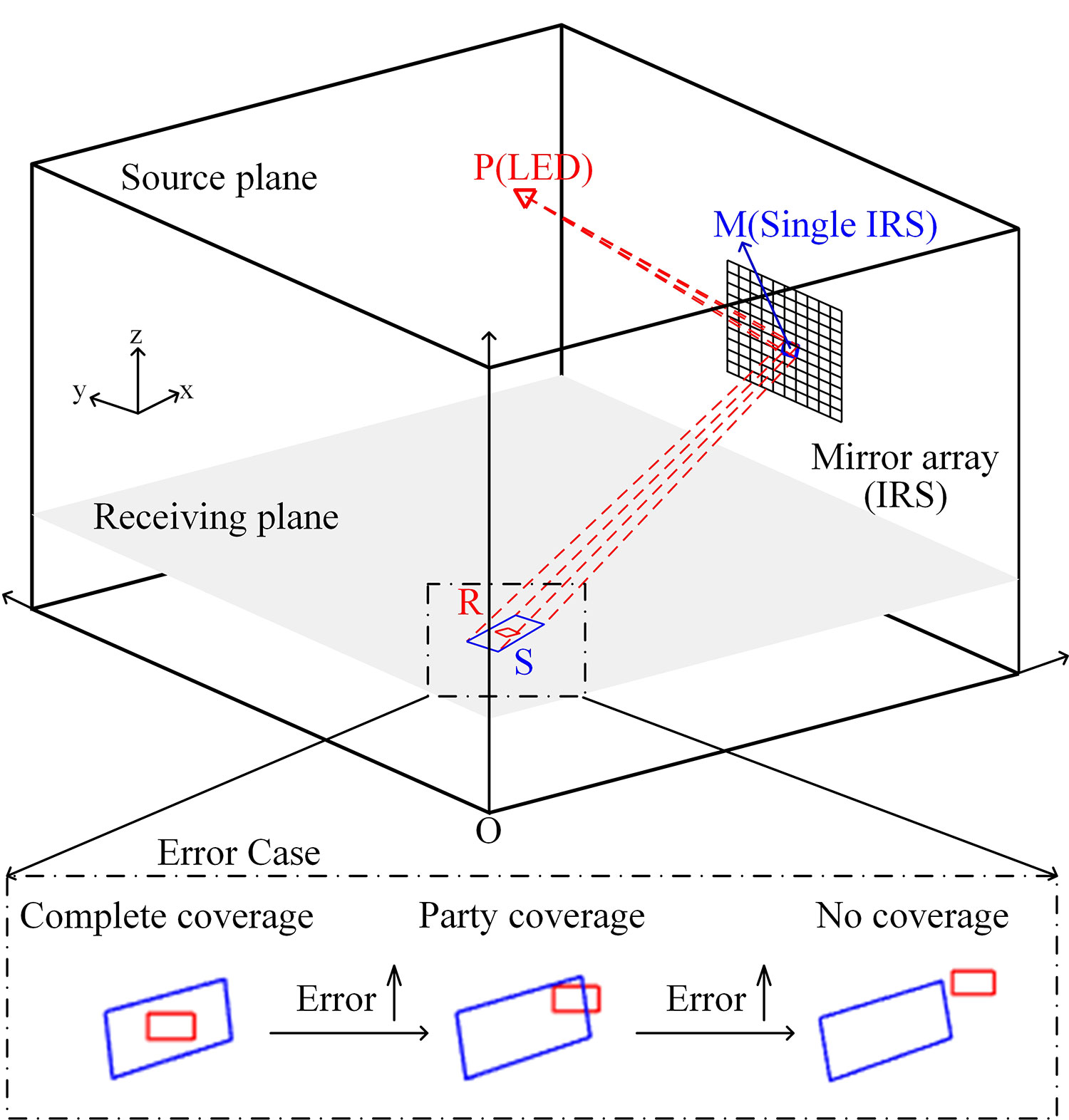
Optical wireless communication (OWC) has emerged as a promising technology for high-speed indoor wireless access. Recently, mirror-based intelligent reflecting surface (IRS) has been introduced to OWC to enhance communication performance. However, traditional radio frequency IRS channel models fail to adapt optical features of OWC, and existing ideal optical models neglect some physical imperfections, leading to inaccurate performance evaluations in real-world deployments. To address this problem, this paper proposes a modified and more realistic IRS channel model. Distinct from ideal IRS channel, the proposed model employs a differential summation method to mathematically incorporate both geometric size constraints and random rotation angle errors of the IRS, thereby computing a more realistic IRS channel gain. Utilizing this modified channel model, we systematically evaluate and compare the relative communication performance under both single-input single-output (SISO) and multiple-input multiple-output (MIMO) systems. Simulation results demonstrate that IRS size variations and IRS rotation angle errors cause non-negligible negative impacts on MIMO-OWC systems, specifically leading to a loss in received optical power and a significant increase in inter-channel interference (ICI), thereby degrading overall system stability. In conclusion, the proposed modified channel model successfully demonstrates the realistic impacts and challenges of deploying IRS in practical OWC applications especially in MIMO setups. By capturing these results, this work provides a critical foundation and guidelines for the physical layout, hardware specifications, and robust beamforming design of future IRS-aided OWC systems.
Graphical Abstract
Keywords
Data Availability Statement
Funding
Conflicts of Interest
AI Use Statement
Ethical Approval and Consent to Participate
References
- Katz, M., & Ahmed, I. (2020). Opportunities and challenges for visible light communications in 6G. 2020 2nd 6G wireless summit (6G SUMMIT), 1-5.
[CrossRef] [Google Scholar] - Komine, T., & Nakagawa, M. (2004). Fundamental analysis for visible-light communication system using LED lights. IEEE transactions on Consumer Electronics, 50(1), 100-107.
[CrossRef] [Google Scholar] - Wu, Q., & Zhang, R. (2019). Intelligent reflecting surface enhanced wireless network via joint active and passive beamforming. IEEE transactions on wireless communications, 18(11), 5394-5409.
[CrossRef] [Google Scholar] - Abdelhady, A. M., Salem, A. K. S., Amin, O., Shihada, B., & Alouini, M. S. (2020). Visible light communications via intelligent reflecting surfaces: Metasurfaces vs mirror arrays. IEEE Open Journal of the Communications Society, 2, 1-20.
[CrossRef] [Google Scholar] - Zhao, Y., Zeng, Z., Cao, H., & Chen, C. (2025). Enhanced transmitter designs for indoor MIMO-VLC systems. Optics Communications, 575, 131279.
[CrossRef] [Google Scholar] - Chen, C., Zhong, X., Fu, S., Jian, X., Liu, M., Yang, H., ... & Fu, H. Y. (2021). OFDM-based generalized optical MIMO. Journal of Lightwave Technology, 39(19), 6063-6075.
[CrossRef] [Google Scholar] - Zhong, X., Chen, C., Wen, W., Liu, M., Fu, H. Y., & Haas, H. (2024). Optimization of surface configuration in IRS-aided MIMO-VLC: A BER minimization approach. IEEE Photonics Journal, 16(3), 1-12.
[CrossRef] [Google Scholar] - Kahn, J. M., & Barry, J. R. (1997). Wireless infrared communications. Proceedings of the IEEE, 85(2), 265-298.
[CrossRef] [Google Scholar] - Abdelhady, A. M., Amin, O., Salem, A. K. S., Alouini, M. S., & Shihada, B. (2022). Channel characterization of IRS-based visible light communication systems. IEEE Transactions on Communications, 70(3), 1913-1926.
[CrossRef] [Google Scholar] - Sun, S., Wang, T., Yang, F., Song, J., & Han, Z. (2021). Intelligent reflecting surface-aided visible light communications: Potentials and challenges. IEEE Vehicular Technology Magazine, 17(1), 47-56.
[CrossRef] [Google Scholar] - Najafi, M., Schmauss, B., & Schober, R. (2021). Intelligent reflecting surfaces for free space optical communication systems. IEEE transactions on communications, 69(9), 6134-6151.
[CrossRef] [Google Scholar] - Wu, Q., Zhang, J., Zhang, Y., Xin, G., & Guo, J. (2022). Configuring reconfigurable intelligent surface for parallel MIMO visible light communications with asymptotic capacity maximization. Applied Sciences, 13(1), 563.
[CrossRef] [Google Scholar] - Sun, S., Mei, W., Yang, F., An, N., Song, J., & Zhang, R. (2023). Optical intelligent reflecting surface assisted MIMO VLC: Channel modeling and capacity characterization. IEEE Transactions on Wireless Communications, 23(3), 2125-2139.
[CrossRef] [Google Scholar] - Sun, S., Yang, F., Song, J., & Zhang, R. (2023). Intelligent reflecting surface for MIMO VLC: Joint design of surface configuration and transceiver signal processing. IEEE Transactions on Wireless Communications, 22(9), 5785-5799.
[CrossRef] [Google Scholar] - Greiner, G., & Hormann, K. (1998). Efficient clipping of arbitrary polygons. ACM Transactions on Graphics (TOG), 17(2), 71-83.
[CrossRef] [Google Scholar] - Toussaint, G. T. (1984). A new linear algorithm for triangulating monotone polygons. Pattern Recognition Letters, 2(3), 155-158.
[CrossRef] [Google Scholar] - Chen, C., Zhong, W. D., & Wu, D. (2016, June). Indoor OFDM visible light communications employing adaptive digital pre-frequency domain equalization. In 2016 Conference on Lasers and Electro-Optics (CLEO) (pp. 1-2). IEEE. https://ieeexplore.ieee.org/abstract/document/7787995
[Google Scholar] - Chen, C., Zhong, W. D., & Wu, D. (2017). On the coverage of multiple-input multiple-output visible light communications. Journal of Optical Communications and Networking, 9(9), D31-D41.
[CrossRef] [Google Scholar] - Chiani, M., Dardari, D., & Simon, M. K. (2003). New exponential bounds and approximations for the computation of error probability in fading channels. IEEE Transactions on Wireless Communications, 2(4), 840-845.
[CrossRef] [Google Scholar]
Cite This Article
TY  - JOUR
AU  - Zhong, Xin
AU  - Zeng, Zhihong
AU  - Chen, Chen
PY  - 2026
DA  - 2026/08/08
TI  - A Modified IRS Channel Model for MIMO Optical Wireless Communications with Geometric Constraints and Alignment Errors
JO  - Optical Wireless Communication
T2  - Optical Wireless Communication
JF  - Optical Wireless Communication
VL  - 1
IS  - 1
SP  - 30
EP  - 43
DO  - 10.62762/OWC.2026.926601
UR  - https://www.icck.org/article/abs/OWC.2026.926601
KW  - optical wireless communication
KW  - multiple-input multiple-output
KW  - intelligent reflecting surface
KW  - inter-channel interference
AB  - Optical wireless communication (OWC) has emerged as a promising technology for high-speed indoor wireless access. Recently, mirror-based intelligent reflecting surface (IRS) has been introduced to OWC to enhance communication performance. However, traditional radio frequency IRS channel models fail to adapt optical features of OWC, and existing ideal optical models neglect some physical imperfections, leading to inaccurate performance evaluations in real-world deployments. To address this problem, this paper proposes a modified and more realistic IRS channel model. Distinct from ideal IRS channel, the proposed model employs a differential summation method to mathematically incorporate both geometric size constraints and random rotation angle errors of the IRS, thereby computing a more realistic IRS channel gain. Utilizing this modified channel model, we systematically evaluate and compare the relative communication performance under both single-input single-output (SISO) and multiple-input multiple-output (MIMO) systems. Simulation results demonstrate that IRS size variations and IRS rotation angle errors cause non-negligible negative impacts on MIMO-OWC systems, specifically leading to a loss in received optical power and a significant increase in inter-channel interference (ICI), thereby degrading overall system stability. In conclusion, the proposed modified channel model successfully demonstrates the realistic impacts and challenges of deploying IRS in practical OWC applications especially in MIMO setups. By capturing these results, this work provides a critical foundation and guidelines for the physical layout, hardware specifications, and robust beamforming design of future IRS-aided OWC systems.
SN  - 5 Articles Required
PB  - Institute of Central Computation and Knowledge
LA  - English
ER  -
@article{Zhong2026A,
  author = {Xin Zhong and Zhihong Zeng and Chen Chen},
  title = {A Modified IRS Channel Model for MIMO Optical Wireless Communications with Geometric Constraints and Alignment Errors},
  journal = {Optical Wireless Communication},
  year = {2026},
  volume = {1},
  number = {1},
  pages = {30-43},
  doi = {10.62762/OWC.2026.926601},
  url = {https://www.icck.org/article/abs/OWC.2026.926601},
  abstract = {Optical wireless communication (OWC) has emerged as a promising technology for high-speed indoor wireless access. Recently, mirror-based intelligent reflecting surface (IRS) has been introduced to OWC to enhance communication performance. However, traditional radio frequency IRS channel models fail to adapt optical features of OWC, and existing ideal optical models neglect some physical imperfections, leading to inaccurate performance evaluations in real-world deployments. To address this problem, this paper proposes a modified and more realistic IRS channel model. Distinct from ideal IRS channel, the proposed model employs a differential summation method to mathematically incorporate both geometric size constraints and random rotation angle errors of the IRS, thereby computing a more realistic IRS channel gain. Utilizing this modified channel model, we systematically evaluate and compare the relative communication performance under both single-input single-output (SISO) and multiple-input multiple-output (MIMO) systems. Simulation results demonstrate that IRS size variations and IRS rotation angle errors cause non-negligible negative impacts on MIMO-OWC systems, specifically leading to a loss in received optical power and a significant increase in inter-channel interference (ICI), thereby degrading overall system stability. In conclusion, the proposed modified channel model successfully demonstrates the realistic impacts and challenges of deploying IRS in practical OWC applications especially in MIMO setups. By capturing these results, this work provides a critical foundation and guidelines for the physical layout, hardware specifications, and robust beamforming design of future IRS-aided OWC systems.},
  keywords = {optical wireless communication, multiple-input multiple-output, intelligent reflecting surface, inter-channel interference},
  issn = {5 Articles Required},
  publisher = {Institute of Central Computation and Knowledge}
}
Article Metrics
Publisher's Note
ICCK stays neutral with regard to jurisdictional claims in published maps and institutional affiliations.
Rights and Permissions
 Copyright © 2026 by the Author(s). Published by Institute of Central Computation and Knowledge. This article is an open access article distributed under the terms and conditions of the Creative Commons Attribution (CC BY) license (https://creativecommons.org/licenses/by/4.0/), which permits use, sharing, adaptation, distribution and reproduction in any medium or format, as long as you give appropriate credit to the original author(s) and the source, provide a link to the Creative Commons licence, and indicate if changes were made.


Portico
