

Application of Region Growing Algorithm in Hartmann Wavefront Reconstruction



Article Information
Abstract
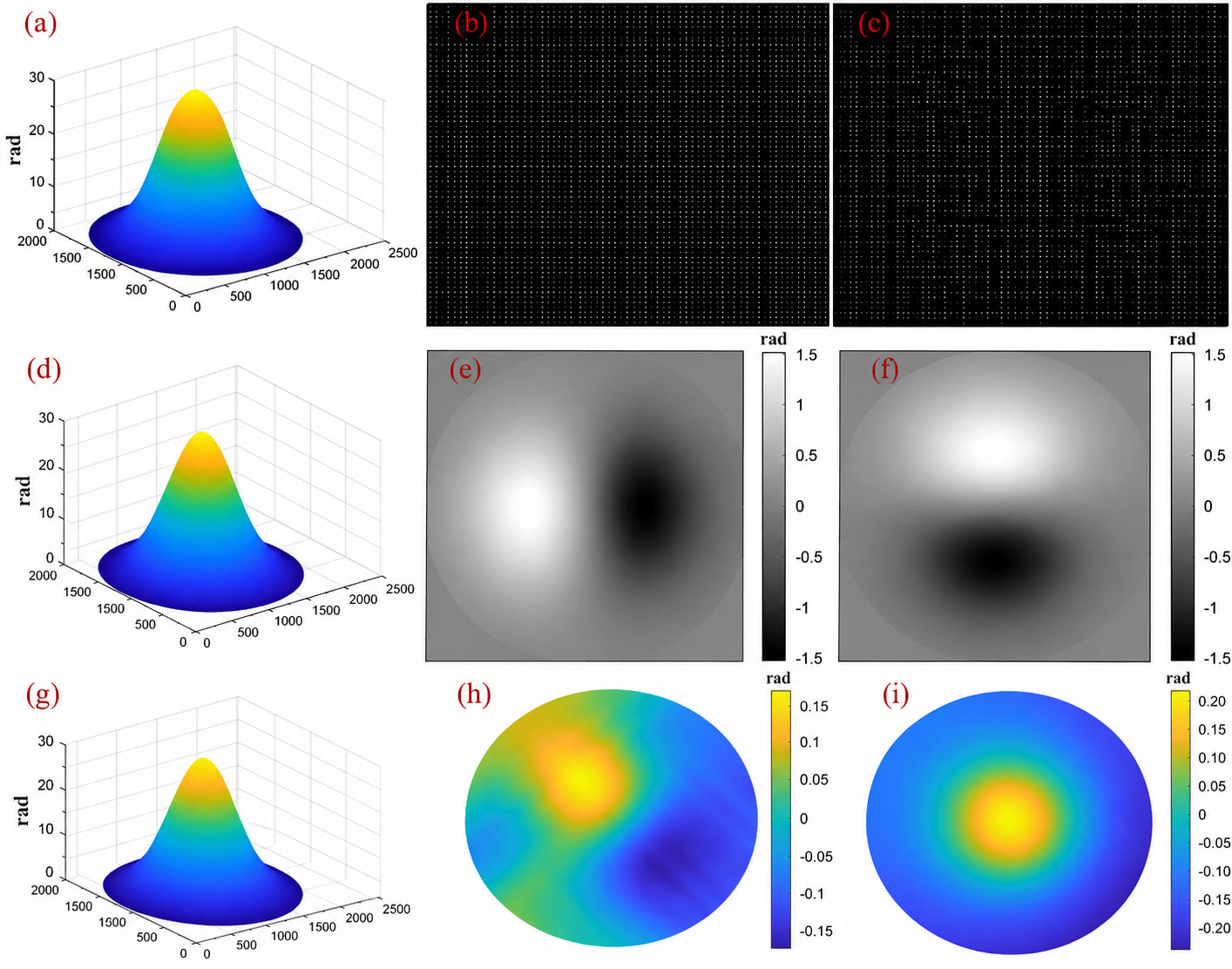
The Shack-Hartmann wavefront sensor measures wavefront slopes by analyzing the displacement of focal spots formed by a microlens array. Based on these slope measurements, wavefront reconstruction can be achieved by solving the difference equations that relate slope to phase. A wavefront reconstruction algorithm based on the region-growing method is proposed. Numerical simulations are conducted to compare its performance with the Southwell method for reconstructing various simulated wavefronts. The noise resistance of the algorithms was analyzed by introducing additive white Gaussian noise, and experimental results further validated the effectiveness of the proposed method. The findings indicate that the region-growing-based reconstruction algorithm achieves a lower Root-Mean-Square (RMS) error value compared to the Southwell method, with a computational time reduced to less than 2% of that required by the Southwell method. Moreover, under high-noise conditions, the proposed algorithm maintains superior accuracy and demonstrates strong robustness. It efficiently processes wavefront slope data, providing both theoretical and experimental support for enhancing wavefront reconstruction speed in adaptive optical systems.
Graphical Abstract
Keywords
Data Availability Statement
Funding
Conflicts of Interest
AI Use Statement
Ethical Approval and Consent to Participate
References
- Xizheng, K., Jiali, W., & Shangjun, Y. (2021). Research progress and prospect of atmospheric turbulence for wireless optical communication. Chinese journal of radio science, 36(3), 323-339. http://dx.doi.org/10.12265/j.cjors.2020116
[Google Scholar] - Wenhan, J. (2018). Overview of adaptive optics development. Opto-Electronic Engineering, 45(3), 170489-1.
[CrossRef] [Google Scholar] - Platt, B. C., & Shack, R. (2001). History and principles of Shack-Hartmann wavefront sensing. Journal of refractive surgery, 17(5), S573-S577.
[CrossRef] [Google Scholar] - Li, G., Li, Y., Liu, K., Ma, X., & Wang, H. (2013). Improving wavefront reconstruction accuracy by using integration equations with higher-order truncation errors in the Southwell geometry. Journal of the Optical Society of America A, 30(7), 1448-1459.
[CrossRef] [Google Scholar] - Poyneer, L. A., Gavel, D. T., & Brase, J. M. (2002). Fast wave-front reconstruction in large adaptive optics systems with use of the Fourier transform. Journal of the Optical Society of America A, 19(10), 2100-2111.
[CrossRef] [Google Scholar] - Dai, G. M. (1996). Modal wave-front reconstruction with Zernike polynomials and Karhunen–Loève functions. Journal of the Optical Society of America A, 13(6), 1218-1225.
[CrossRef] [Google Scholar] - Liang, J., Williams, D. R., & Miller, D. T. (1997). Supernormal vision and high-resolution retinal imaging through adaptive optics. Journal of the Optical Society of America A, 14(11), 2884-2892.
[CrossRef] [Google Scholar] - Duan, H. F., Yang, Z. P., & Wang, S. Q. (2002). Model wavefront reconstruction of Shack-Hartmann sensor on arbitrary area and wavefront expression by Zernike polynomials. Chinese Journal of Lasers, 29(6), 517-520. https://www.opticsjournal.net/Articles/OJ327ae222f01aec44/Abstract
[Google Scholar] - Jingyuan, L., Xiwen, L., Chenghu, K., & Xizheng, K. (2024). Surface characterization using Zernike polynomials. Opto-Electronic Engineering, 51(11), 240163-1.
[CrossRef] [Google Scholar] - Hudgin, R. H. (1977). Wave-front reconstruction for compensated imaging. Journal of the Optical Society of America, 67(3), 375-378.
[CrossRef] [Google Scholar] - Fried, D. L. (1977). Least-square fitting a wave-front distortion estimate to an array of phase-difference measurements. Journal of the Optical Society of America, 67(3), 370-375.
[CrossRef] [Google Scholar] - Southwell, W. H. (1980). Wave-front estimation from wave-front slope measurements. Journal of the Optical Society of America, 70(8), 998-1006.
[CrossRef] [Google Scholar] - Hao, C., Ling, W., Ende, L., Yi, H., Jinsheng, Y., Xiqi, L., ... & Yudong, Z. (2021). A B-spline based fast wavefront reconstruction algorithm. Opto-Electronic Engineering, 48(2), 200160-1.
[CrossRef] [Google Scholar] - Poyneer, L. A., & Véran, J. P. (2005). Optimal modal Fourier-transform wavefront control. Journal of the Optical Society of America A, 22(8), 1515-1526.
[CrossRef] [Google Scholar] - Guan, H., Zhao, W., Yang, K., Zhao, C., Wang, S., Liu, S., ... & Yang, P. (2025). Improving wavefront reconstruction performance with a binary phase hybrid Shack-Hartmann wavefront sensor. Optics Express, 33(5), 9756-9774.
[CrossRef] [Google Scholar] - Pathak, B., & Boruah, B. R. (2014). Improved wavefront reconstruction algorithm for Shack–Hartmann type wavefront sensors. Journal of Optics, 16(5), 055403.
[CrossRef] [Google Scholar]
Cite This Article
TY  - JOUR
AU  - Li, Xiwen
AU  - Liang, Jingyuan
AU  - Ke, Xizheng
PY  - 2026
DA  - 2026/08/15
TI  - Application of Region Growing Algorithm in Hartmann Wavefront Reconstruction
JO  - Optical Wireless Communication
T2  - Optical Wireless Communication
JF  - Optical Wireless Communication
VL  - 1
IS  - 1
SP  - 44
EP  - 59
DO  - 10.62762/OWC.2026.960227
UR  - https://www.icck.org/article/abs/OWC.2026.960227
KW  - adaptive optics
KW  - wavefront reconstruction
KW  - region growing algorithm
KW  - shack-hartmann wavefront sensor
AB  - The Shack-Hartmann wavefront sensor measures wavefront slopes by analyzing the displacement of focal spots formed by a microlens array. Based on these slope measurements, wavefront reconstruction can be achieved by solving the difference equations that relate slope to phase. A wavefront reconstruction algorithm based on the region-growing method is proposed. Numerical simulations are conducted to compare its performance with the Southwell method for reconstructing various simulated wavefronts. The noise resistance of the algorithms was analyzed by introducing additive white Gaussian noise, and experimental results further validated the effectiveness of the proposed method. The findings indicate that the region-growing-based reconstruction algorithm achieves a lower Root-Mean-Square (RMS) error value compared to the Southwell method, with a computational time reduced to less than 2% of that required by the Southwell method. Moreover, under high-noise conditions, the proposed algorithm maintains superior accuracy and demonstrates strong robustness. It efficiently processes wavefront slope data, providing both theoretical and experimental support for enhancing wavefront reconstruction speed in adaptive optical systems.
SN  - 5 Articles Required
PB  - Institute of Central Computation and Knowledge
LA  - English
ER  -
@article{Li2026Applicatio,
  author = {Xiwen Li and Jingyuan Liang and Xizheng Ke},
  title = {Application of Region Growing Algorithm in Hartmann Wavefront Reconstruction},
  journal = {Optical Wireless Communication},
  year = {2026},
  volume = {1},
  number = {1},
  pages = {44-59},
  doi = {10.62762/OWC.2026.960227},
  url = {https://www.icck.org/article/abs/OWC.2026.960227},
  abstract = {The Shack-Hartmann wavefront sensor measures wavefront slopes by analyzing the displacement of focal spots formed by a microlens array. Based on these slope measurements, wavefront reconstruction can be achieved by solving the difference equations that relate slope to phase. A wavefront reconstruction algorithm based on the region-growing method is proposed. Numerical simulations are conducted to compare its performance with the Southwell method for reconstructing various simulated wavefronts. The noise resistance of the algorithms was analyzed by introducing additive white Gaussian noise, and experimental results further validated the effectiveness of the proposed method. The findings indicate that the region-growing-based reconstruction algorithm achieves a lower Root-Mean-Square (RMS) error value compared to the Southwell method, with a computational time reduced to less than 2\% of that required by the Southwell method. Moreover, under high-noise conditions, the proposed algorithm maintains superior accuracy and demonstrates strong robustness. It efficiently processes wavefront slope data, providing both theoretical and experimental support for enhancing wavefront reconstruction speed in adaptive optical systems.},
  keywords = {adaptive optics, wavefront reconstruction, region growing algorithm, shack-hartmann wavefront sensor},
  issn = {5 Articles Required},
  publisher = {Institute of Central Computation and Knowledge}
}
Article Metrics
Publisher's Note
ICCK stays neutral with regard to jurisdictional claims in published maps and institutional affiliations.
Rights and Permissions
 Copyright © 2026 by the Author(s). Published by Institute of Central Computation and Knowledge. This article is an open access article distributed under the terms and conditions of the Creative Commons Attribution (CC BY) license (https://creativecommons.org/licenses/by/4.0/), which permits use, sharing, adaptation, distribution and reproduction in any medium or format, as long as you give appropriate credit to the original author(s) and the source, provide a link to the Creative Commons licence, and indicate if changes were made.


Portico
