


The Pseudo-Second-Order Model in Adsorption Kinetics: Why a Good Fit Does Not Prove a Two-Site Chemisorption Mechanism



Article Information
Abstract
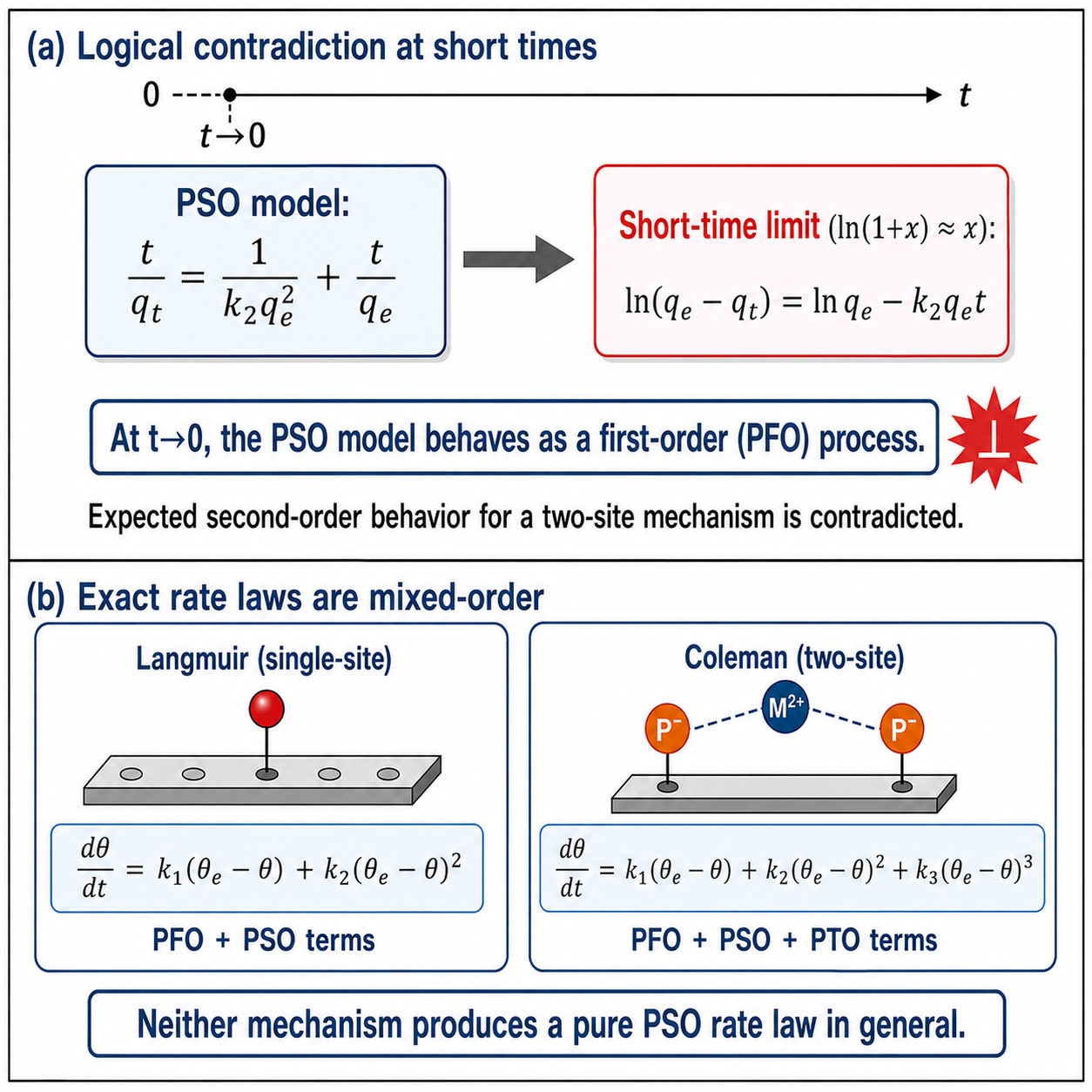
The pseudo-second-order (PSO) model, popularized by Ho and McKay's work on divalent metal sorption onto peat, is routinely misinterpreted as proof of a two-site chemisorption mechanism. This article provides a rigorous, multi-faceted refutation of that inference. It demonstrates that a PSO fit offers no mechanistic proof through three converging lines of evidence. First, the PSO rate law is mathematically non-unique: it emerges as a limiting case from Langmuir kinetics, intraparticle diffusion, and statistical rate theory. Most critically, the two-site Coleman mechanism itself yields a mixed-order rate equation in which pure PSO appears only under restrictive conditions; a formal reductio ad absurdum further reveals that interpreting PSO as a two-site signature contradicts its own short-time behavior. Second, the linearized fitting method suffers from spurious correlation and statistical bias. Third, the independent-site collision required by the mechanism is physically implausible for solid adsorbents. The routine practice of inferring a chemisorption pathway from a PSO fit must be replaced by independent experimental validation.
Graphical Abstract
Keywords
Data Availability Statement
Funding
Conflicts of Interest
AI Use Statement
Ethical Approval and Consent to Participate
References
- Ho, Y. S., & McKay, G. (2000). The kinetics of sorption of divalent metal ions onto sphagnum moss peat. Water Research, 34(3), 735-742.
[CrossRef] [Google Scholar] - Blanchard, G., Maunaye, M., & Martin, G. (1984). Removal of heavy metals from waters by means of natural zeolites. Water Research, 18(12), 1501-1507.
[CrossRef] [Google Scholar] - Coleman, N. T., McClung, A. C., & Moore, D. P. (1956). Formation constants for Cu(II)-peat complexes. Science, 123(3191), 330-331.
[CrossRef] [Google Scholar] - Azizian, S. (2004). Kinetic models of sorption: A theoretical analysis. Journal of Colloid and Interface Science, 276(1), 47-52.
[CrossRef] [Google Scholar] - Plazinski, W., Dziuba, J., & Rudzinski, W. (2013). Modeling of sorption kinetics: The pseudo-second order equation and the sorbate intraparticle diffusivity. Adsorption, 19(5), 1055-1064.
[CrossRef] [Google Scholar] - Rudzinski, W., & Plazinski, W. (2006). Kinetics of solute adsorption at solid/solution interfaces: A theoretical development of the empirical pseudo-first and pseudo-second order kinetic rate equations, based on applying the statistical rate theory of interfacial transport. The Journal of Physical Chemistry B, 110(33), 16514-16525.
[CrossRef] [Google Scholar] - Rudzinski, W., & Plazinski, W. (2007). Studies of the kinetics of solute adsorption at solid/solution interfaces: on the possibility of distinguishing between the diffusional and the surface reaction kinetic models by studying the pseudo-first-order kinetics. The Journal of Physical Chemistry C, 111(41), 15100-15110.
[CrossRef] [Google Scholar] - Hubbe, M. A., Azizian, S., & Douven, S. (2019). Implications of apparent pseudo-second-order adsorption kinetics onto cellulosic materials: A review. BioResources, 14(3), 7582-7626.
[CrossRef] [Google Scholar] - Tran, H. N. (2022). Is it possible to draw conclusions (adsorption is chemisorption) based on fitting between kinetic models (pseudo-second-order or Elovich) and experimental data of time-dependent adsorption in solid-liquid phases? Recent Innovations in Chemical Engineering, 15(4), 228-230.
[CrossRef] [Google Scholar] - Marczewski, A. W. (2010). Application of mixed order rate equations to adsorption of methylene blue on mesoporous carbons. Applied Surface Science, 256(17), 5145-5152.
[CrossRef] [Google Scholar] - Zhang, J. (2019). Physical insights into kinetic models of adsorption. Separation and Purification Technology, 229, 115832.
[CrossRef] [Google Scholar] - Ezzati, R., Ezzati, S., & Azizi, M. (2024). Exact solution of the Langmuir rate equation: New insights into pseudo-first-order and pseudo-second-order kinetics models for adsorption. Vacuum, 220, 112790.
[CrossRef] [Google Scholar] - Ezzati, R. (2025). A new insight into the pseudo-second-order model and the physical meaning of its rate constant in adsorption. Journal of Dispersion Science and Technology, 46(2), 222-229.
[CrossRef] [Google Scholar] - Hu, Q., Wang, Q., Feng, C., Zhang, Z., Lei, Z., & Shimizu, K. (2018). Insights into mathematical characteristics of adsorption models and physical meaning of corresponding parameters. Journal of Molecular Liquids, 254, 20-25.
[CrossRef] [Google Scholar] - Simonin, J. P. (2016). On the comparison of pseudo-first order and pseudo-second order rate laws in the modeling of adsorption kinetics. Chemical Engineering Journal, 300, 254-263.
[CrossRef] [Google Scholar] - Xiao, Y., Azaiez, J., & Hill, J. M. (2018). Erroneous application of pseudo-second-order adsorption kinetics model: Ignored assumptions and spurious correlations. Industrial & Engineering Chemistry Research, 57(7), 2705-2709.
[CrossRef] [Google Scholar] - Bujdák, J. (2020). Adsorption kinetics models in clay systems. The critical analysis of pseudo-second order mechanism. Applied Clay Science, 191, 105630.
[CrossRef] [Google Scholar] - Tran, H. N., You, S. J., Hosseini-Bandegharaei, A., & Chao, H. P. (2017). Mistakes and inconsistencies regarding adsorption of contaminants from aqueous solutions: a critical review. Water research, 120, 88-116.
[CrossRef] [Google Scholar] - Plazinski, W. (2010). Statistical rate theory approach to description of the pH-dependent kinetics of metal ion adsorption. The Journal of Physical Chemistry C, 114(21), 9952-9954.
[CrossRef] [Google Scholar]
Cite This Article
TY  - JOUR
AU  - Ezzati, Rohollah
AU  - Azizi, Maryam
PY  - 2026
DA  - 2026/09/28
TI  - The Pseudo-Second-Order Model in Adsorption Kinetics: Why a Good Fit Does Not Prove a Two-Site Chemisorption Mechanism
JO  - Environmental Adsorption Research
T2  - Environmental Adsorption Research
JF  - Environmental Adsorption Research
VL  - 1
IS  - 1
SP  - 4
EP  - 14
DO  - 10.62762/EAR.2026.643297
UR  - https://www.icck.org/article/abs/EAR.2026.643297
KW  - pseudo-second-order model
KW  - adsorption kinetics
KW  - chemisorption mechanism
KW  - Langmuir kinetics
KW  - intraparticle diffusion
KW  - statistical rate theory
AB  - The pseudo-second-order (PSO) model, popularized by Ho and McKay's work on divalent metal sorption onto peat, is routinely misinterpreted as proof of a two-site chemisorption mechanism. This article provides a rigorous, multi-faceted refutation of that inference. It demonstrates that a PSO fit offers no mechanistic proof through three converging lines of evidence. First, the PSO rate law is mathematically non-unique: it emerges as a limiting case from Langmuir kinetics, intraparticle diffusion, and statistical rate theory. Most critically, the two-site Coleman mechanism itself yields a mixed-order rate equation in which pure PSO appears only under restrictive conditions; a formal reductio ad absurdum further reveals that interpreting PSO as a two-site signature contradicts its own short-time behavior. Second, the linearized fitting method suffers from spurious correlation and statistical bias. Third, the independent-site collision required by the mechanism is physically implausible for solid adsorbents. The routine practice of inferring a chemisorption pathway from a PSO fit must be replaced by independent experimental validation.
SN  - pending
PB  - Institute of Central Computation and Knowledge
LA  - English
ER  -
@article{Ezzati2026The,
  author = {Rohollah Ezzati and Maryam Azizi},
  title = {The Pseudo-Second-Order Model in Adsorption Kinetics: Why a Good Fit Does Not Prove a Two-Site Chemisorption Mechanism},
  journal = {Environmental Adsorption Research},
  year = {2026},
  volume = {1},
  number = {1},
  pages = {4-14},
  doi = {10.62762/EAR.2026.643297},
  url = {https://www.icck.org/article/abs/EAR.2026.643297},
  abstract = {The pseudo-second-order (PSO) model, popularized by Ho and McKay's work on divalent metal sorption onto peat, is routinely misinterpreted as proof of a two-site chemisorption mechanism. This article provides a rigorous, multi-faceted refutation of that inference. It demonstrates that a PSO fit offers no mechanistic proof through three converging lines of evidence. First, the PSO rate law is mathematically non-unique: it emerges as a limiting case from Langmuir kinetics, intraparticle diffusion, and statistical rate theory. Most critically, the two-site Coleman mechanism itself yields a mixed-order rate equation in which pure PSO appears only under restrictive conditions; a formal reductio ad absurdum further reveals that interpreting PSO as a two-site signature contradicts its own short-time behavior. Second, the linearized fitting method suffers from spurious correlation and statistical bias. Third, the independent-site collision required by the mechanism is physically implausible for solid adsorbents. The routine practice of inferring a chemisorption pathway from a PSO fit must be replaced by independent experimental validation.},
  keywords = {pseudo-second-order model, adsorption kinetics, chemisorption mechanism, Langmuir kinetics, intraparticle diffusion, statistical rate theory},
  issn = {pending},
  publisher = {Institute of Central Computation and Knowledge}
}
Article Metrics
Publisher's Note
ICCK stays neutral with regard to jurisdictional claims in published maps and institutional affiliations.
Rights and Permissions
 Copyright © 2026 by the Author(s). Published by Institute of Central Computation and Knowledge. This article is an open access article distributed under the terms and conditions of the Creative Commons Attribution (CC BY) license (https://creativecommons.org/licenses/by/4.0/), which permits use, sharing, adaptation, distribution and reproduction in any medium or format, as long as you give appropriate credit to the original author(s) and the source, provide a link to the Creative Commons licence, and indicate if changes were made.

