

Beyond the Blue Dot: Mars as the Next Step in Human Civilization and Public Readiness for Multiplanetary Migration


Article Information
Abstract
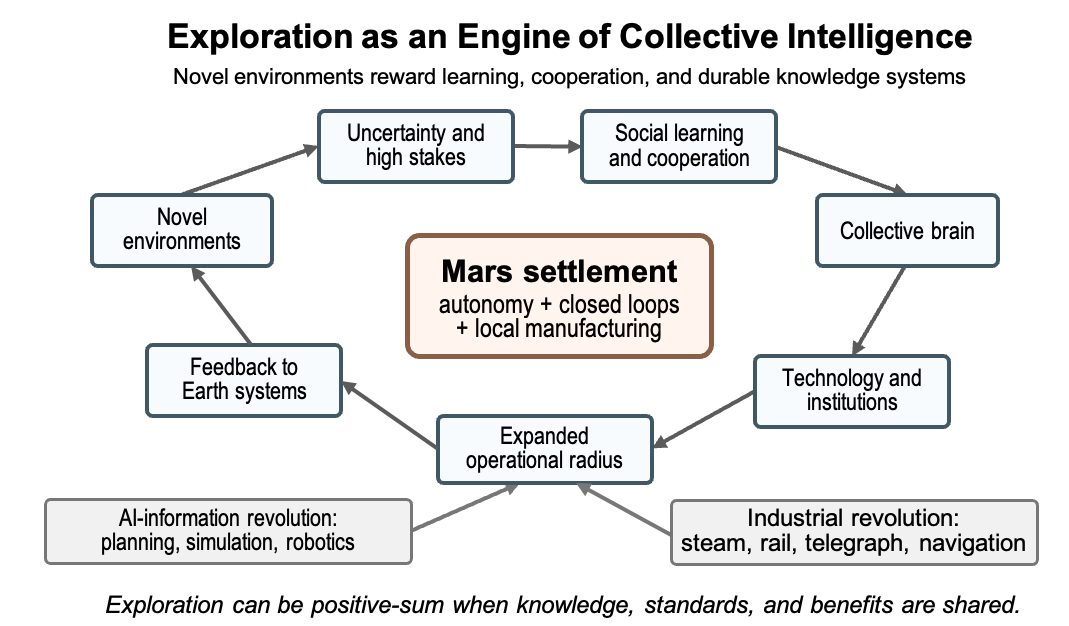
Human history is marked by migration, exploration, and adaptation. This article argues that permanent settlement on Mars should be understood not as an escape from Earth, but as a long-horizon extension of evolutionary and civilizational strategies for resilience, innovation, and continuity. We pair a conceptual synthesis of literature on human dispersal, cultural evolution, technological revolutions, existential risk, space resources, and governance with an exploratory online survey of 519 respondents in China examining attitudes toward Mars migration over a 200-year horizon. The survey is used as a hypothesis-generating case study illustrating how questions of feasibility, fairness, and social legitimacy may condition public readiness for multiplanetary futures. We propose a historical framework in which successive technological revolutions expand the operational radius of civilization: the first great migration made Homo sapiens a multicontinental species, industrial-era infrastructure enabled durable transoceanic societies, and AI-enabled autonomy may prepare human systems for interplanetary distances. A single-planet civilization remains exposed to correlated risks, while off-world settlement could create scientific, economic, institutional, and resilience-related benefits if pursued responsibly. Survey results indicate cautious optimism: 66.5% of respondents believe a first Martian base is likely within 200 years, and 61.1% expect net positive effects. However, concerns about fairness and inequality are substantial; many believe Mars migration could widen gaps between rich and poor and marginalize those remaining on Earth. We argue that the legitimacy of Mars settlement depends not only on technical feasibility, but also on transparent governance, equitable access, planetary protection, and continuing stewardship of Earth. Mars should be framed as a cooperative, ethically governed project of long-term human development, not as conquest or abandonment.
Graphical Abstract
Keywords
Data Availability Statement
Funding
Conflicts of Interest
AI Use Statement
Ethical Approval and Consent to Participate
References
- Stringer, C. (2016). The origin and evolution of Homo sapiens. Philosophical Transactions of the Royal Society B: Biological Sciences, 371(1698), 20150237.
[CrossRef] [Google Scholar] - Hublin, J. J., Ben-Ncer, A., Bailey, S. E., Freidline, S. E., Neubauer, S., Skinner, M. M., ... & Gunz, P. (2017). New fossils from Jebel Irhoud, Morocco and the pan-African origin of Homo sapiens. Nature, 546(7657), 289-292.
[CrossRef] [Google Scholar] - Mellars, P. (2006). Why did modern human populations disperse from Africa ca. 60,000 years ago? A new model. Proceedings of the National Academy of Sciences, 103(25), 9381-9386.
[CrossRef] [Google Scholar] - Diamond, J., & Smil, V. (2005). COLLAPSE: How Societies Choose to Fail or Succeed. International Journal, 60(3), 886. http://www.doi.org/10.2307/40204082
[Google Scholar] - Rockström, J., Steffen, W., Noone, K., Persson, Å., Chapin III, F. S., Lambin, E. F., ... & Foley, J. A. (2009). A safe operating space for humanity. Nature, 461(7263), 472-475.
[CrossRef] [Google Scholar] - Steffen, W., Richardson, K., Rockström, J., Cornell, S. E., Fetzer, I., Bennett, E. M., ... & Sörlin, S. (2015). Planetary boundaries: Guiding human development on a changing planet. Science, 347(6223), 1259855.
[CrossRef] [Google Scholar] - Mokyr, J. (1990). The Lever of Riches: Technological Creativity and Economic Progress. Oxford University Press.
[Google Scholar] - Pomeranz, K. (2000). The Great Divergence: China, Europe, and the Making of the Modern World Economy. Princeton University Press.
[CrossRef] [Google Scholar] - Russell, S. J., Norvig, P., Canny, J. F., Malik, J. M., & Edwards, D. D. (1995). Artificial intelligence: a modern approach (Vol. 2, No. 9). Englewood Cliffs, NJ: Prentice hall.
[Google Scholar] - NASA. (2026c). Artificial intelligence for life in space. Retrieved from https://www.nasa.gov/ames/space-biosciences/research-branch/artificial-intelligence-for-life-in-space/
[Google Scholar] - NASA. (2026d). NASA's Perseverance rover completes first AI-planned drive on Mars. Retrieved from https://www.jpl.nasa.gov/news/nasas-perseverance-rover-completes-first-ai-planned-drive-on-mars/
[Google Scholar] - Carr, M. H., & Head III, J. W. (2010). Geologic history of Mars. Earth and Planetary Science Letters, 294(3-4), 185-203.
[CrossRef] [Google Scholar] - Morgan, G. A., Putzig, N. E., Perry, M. R., Sizemore, H. G., Bramson, A. M., Petersen, E. I., ... & Campbell, B. A. (2021). Availability of subsurface water-ice resources in the northern mid-latitudes of Mars. Nature Astronomy, 5(3), 230-236.
[CrossRef] [Google Scholar] - Hazen, R. M., Downs, R. T., Morrison, S. M., Tutolo, B. M., Blake, D. F., Bristow, T. F., Chipera, S. J., McSween, H. Y., Ming, D. W., Morris, R. V., Rampe, E. B., Thorpe, M. T., Treiman, A. H., Tu, V. M., & Vaniman, D. T. (2023). On the diversity and formation modes of Martian minerals. Journal of Geophysical Research: Planets, 128(9), e2023JE007865.
[CrossRef] [Google Scholar] - National Academies of Sciences, Engineering, and Medicine. (2026). A Science Strategy for the Human Exploration of Mars. The National Academies Press.
[CrossRef] [Google Scholar] - Bostrom, N. (2013). Existential risk prevention as global priority. Global policy, 4(1), 15-31.
[CrossRef] [Google Scholar] - Ord, T. (2020). The Precipice: Existential Risk and the Future of Humanity. Grand Central Publishing.
[Google Scholar] - Cann, R. L., Stoneking, M., & Wilson, A. C. (1987). Mitochondrial DNA and human evolution. Nature, 325(6099), 31-36.
[CrossRef] [Google Scholar] - Prugnolle, F., Manica, A., & Balloux, F. (2005). Geography predicts neutral genetic diversity of human populations. Current Biology, 15(5), R159-R160.
[CrossRef] [Google Scholar] - Ramachandran, S., Deshpande, O., Roseman, C. C., Rosenberg, N. A., Feldman, M. W., & Cavalli-Sforza, L. L. (2005). Support from the relationship of genetic and geographic distance in human populations for a serial founder effect originating in Africa. Proceedings of the National Academy of Sciences, 102(44), 15942-15947.
[CrossRef] [Google Scholar] - Purvis, A., Gittleman, J. L., Cowlishaw, G., & Mace, G. M. (2000). Predicting extinction risk in declining species. Proceedings of the Royal Society B, 267, 1947-1952.
[CrossRef] [Google Scholar] - Foerster, V., Asrat, A., Bronk Ramsey, C., Brown, E. T., Chapot, M. S., Deino, A., Duesing, W., Grove, M., Hahn, A., Junginger, A., Kaboth-Bahr, S., Lane, C. S., Opitz, S., Noren, A., Roberts, H. M., Stockhecke, M., Tiedemann, R., Vidal, C. M., Vogelsang, R., \ldots\ & Trauth, M. H. (2022). Pleistocene climate variability in eastern Africa influenced hominin evolution. Nature Geoscience, 15(10), 805-811.
[CrossRef] [Google Scholar] - Jacobson, A. P., Riggio, J., M. Tait, A., & EM Baillie, J. (2019). Global areas of low human impact ('Low Impact Areas') and fragmentation of the natural world. Scientific Reports, 9(1), 14179.
[CrossRef] [Google Scholar] - Dundas, C. M., McEwen, A. S., Chojnacki, M., Milazzo, M. P., Byrne, S., McElwaine, J. N., & Urso, A. (2017). Granular flows at recurring slope lineae on Mars indicate a limited role for liquid water. Nature Geoscience, 10(12), 903-907.
[CrossRef] [Google Scholar] - Moses, R. W., & Bushnell, D. M. (2016). Frontier In-Situ Resource Utilization for Enabling Sustained Human Presence on Mars (NASA/TM-2016-219182). NASA Langley Research Center. https://ntrs.nasa.gov/citations/20160005963
[Google Scholar] - Beyin, A. (2011). Upper Pleistocene human dispersals out of Africa: a review of the current state of the debate. International journal of evolutionary biology, 2011(1), 615094.
[CrossRef] [Google Scholar] - López, S., Van Dorp, L., & Hellenthal, G. (2015). Human dispersal out of Africa: a lasting debate. Evolutionary Bioinformatics, 11, EBO-S33489.
[CrossRef] [Google Scholar] - Jokela, M., Elovainio, M., Kivim\"{aki, M., & Keltikangas-J\"{arvinen, L. (2009). Personality predicts migration within and between U.S.\ states. Journal of Research in Personality, 43(1), 79-83.
[CrossRef] [Google Scholar] - Roca Paz, R., & Uebelmesser, S. (2021). Risk attitudes and migration decisions. Journal of Regional Science, 61(3), 649-684.
[CrossRef] [Google Scholar] - Boyd, R., Richerson, P. J., & Henrich, J. (2011). The cultural niche: Why social learning is essential for human adaptation. Proceedings of the National Academy of Sciences, 108(supplement\_2), 10918-10925.
[CrossRef] [Google Scholar] - Muthukrishna, M., Doebeli, M., Chudek, M., & Henrich, J. (2018). The cultural brain hypothesis: How culture drives brain expansion, sociality, and life history. PLOS Computational Biology, 14(11), e1006504.
[CrossRef] [Google Scholar] - Dunbar, R. I. (1998). The social brain hypothesis. Evolutionary Anthropology: Issues, News, and Reviews: Issues, News, and Reviews, 6(5), 178-190.
[CrossRef] [Google Scholar] - Muthukrishna, M., & Henrich, J. (2016). Innovation in the collective brain. Philosophical Transactions of the Royal Society B, 371(1690), 20150192.
[CrossRef] [Google Scholar] - UNESCO. (n.d.). The UNESCO Silk Roads Programme. Retrieved May 5, 2026, from https://en.unesco.org/silkroad/about-silk-roads
[Google Scholar] - Fernandez-Velasco, P., & Spiers, H. J. (2024). Wayfinding across ocean and tundra: What traditional cultures teach us about navigation. Trends in Cognitive Sciences, 28(1), 56-71.
[CrossRef] [Google Scholar] - Mesoudi, A., & Thornton, A. (2018). What is cumulative cultural evolution?. Proceedings of the Royal Society B: Biological Sciences, 285(1880), 20180712.
[CrossRef] [Google Scholar] - Henrich, J. (2004). Demography and cultural evolution: How adaptive cultural processes can produce maladaptive losses - the Tasmanian case. American Antiquity, 69(2), 197-214.
[CrossRef] [Google Scholar] - Powell, A., Shennan, S., & Thomas, M. G. (2009). Late Pleistocene demography and the appearance of modern human behavior. Science, 324(5932), 1298-1301.
[CrossRef] [Google Scholar] - Bettencourt, L. M. A., Lobo, J., Helbing, D., Kuhnert, C., & West, G. B. (2007). Growth, innovation, scaling, and the pace of life in cities. Proceedings of the National Academy of Sciences, 104(17), 7301-7306.
[CrossRef] [Google Scholar] - NASA. (2024). Hazard: Distance from Earth. Retrieved from https://www.nasa.gov/hrp/hazard-distance-from-earth/
[Google Scholar] - Jakosky, B. M., & Edwards, C. S. (2018). Inventory of CO$_2$ available for terraforming Mars. Nature Astronomy, 2(8), 634-639.
[CrossRef] [Google Scholar] - NASA. (2009). Human Health and Performance Risks of Space Exploration Missions (NASA SP-2009-3405). Lyndon B. Johnson Space Center.
[Google Scholar] - Chapman, C. R., & Morrison, D. (1994). Impacts on the Earth by asteroids and comets: assessing the hazard. Nature, 367(6458), 33-40.
[CrossRef] [Google Scholar] - Sparks, R. S. J., Self, S., Grattan, J., Oppenheimer, C., Pyle, D. M., & Rymer, H. (2005). Super-eruptions: Global effects and future threats. Report of a Geological Society of London Working Group. The Geological Society. https://scispace.com/pdf/super-eruptions-global-effects-and-future-threats-3nxnmwd49y.pdf
[Google Scholar] - SIPRI. (2026). Trends in World Military Expenditure, 2025. Stockholm International Peace Research Institute.
[CrossRef] [Google Scholar] - OECD. (2023). The Space Economy in Figures: Responding to Global Challenges. OECD Publishing.
[CrossRef] [Google Scholar] - SIPRI. (2025). Rebalancing Military Spending Towards Achieving Sustainable Development. Stockholm International Peace Research Institute.
[CrossRef] [Google Scholar] - Kennedy, P. (1987). The Rise and Fall of the Great Powers: Economic Change and Military Conflict from 1500 to 2000. Random House.
[Google Scholar] - Nye, J. (2017). Soft power: the origins and political progress of a concept. Palgrave communications, 3(1), 17008.
[CrossRef] [Google Scholar] - NASA. (2023a). International Space Station cooperation. Retrieved from https://www.nasa.gov/international-space-station/space-station-international-cooperation/
[Google Scholar] - NASA. (2025c). NASA releases its Spinoff 2025 publication. Retrieved from https://www.nasa.gov/newsletters/aerospace-frontiers/nasa-releases-its-spinoff-2025-publication/
[Google Scholar] - Fernandez-Armesto, F. (2006). Pathfinders: A Global History of Exploration. Oxford University Press.
[Google Scholar] - Crosby Jr, A. W. (2003). The Columbian exchange: biological and cultural consequences of 1492. Bloomsbury Publishing USA.
[Google Scholar] - NASA. (2022). Dawn of the space age. Retrieved from https://www.nasa.gov/history/dawn-of-the-space-age/
[Google Scholar] - Smithsonian National Air and Space Museum. (n.d.). Apollo 11: The Moon landing. Retrieved May 5, 2026, from https://airandspace.si.edu/explore/stories/apollo-11-moon-landing
[Google Scholar] - NASA. (2026b). Moon to Mars architecture: Strategy and objectives. Retrieved from https://www.nasa.gov/moontomarsarchitecture-strategyandobjectives/
[Google Scholar] - Kessler, P., Prater, T., Nickens, T., & Harris, D. (2022, March). Artemis deep space habitation: Enabling a sustained human presence on the moon and beyond. In 2022 IEEE aerospace conference (AERO) (pp. 01-12). IEEE.
[CrossRef] [Google Scholar] - United Nations. (1967). Treaty on Principles Governing the Activities of States in the Exploration and Use of Outer Space, including the Moon and Other Celestial Bodies. Retrieved May 5, 2026, from https://access.heinonline.com/HOL/LandingPage?handle=hein.crasl/nairspl0037&div=6
[Google Scholar] - NASA. (2026a). The Artemis Accords. Retrieved from https://www.nasa.gov/artemis-accords/
[Google Scholar] - International Space Exploration Coordination Group. (2013). Benefits Stemming from Space Exploration. NASA. https://www.nasa.gov/wp-content/uploads/2015/01/benefits-stemming-from-space-exploration-2013-tagged.pdf?emrc=ca90d1
[Google Scholar] - NASA. (2023b). International Space Station benefits for humanity. Retrieved from https://www.nasa.gov/international-space-station/space-station-research-and-technology/benefits-for-humanity/
[Google Scholar] - NASA. (2025a). Fiscal year 2026 budget request. Retrieved from https://www.nasa.gov/fy-2026-budget-request/
[Google Scholar] - NASA. (2026e). Fiscal Year 2027 Budget Estimates. Retrieved from https://www.nasa.gov/wp-content/uploads/2026/04/fiscal-year-2027-full-budget-request.pdf
[Google Scholar] - NASA. (2025b). Commercial Crew Program essentials. Retrieved from https://www.nasa.gov/humans-in-space/commercial-space/commercial-crew-program/commercial-crew-program-essentials/
[Google Scholar] - NASA. (n.d.). Communications Services Project. Retrieved May 5, 2026, from https://www.nasa.gov/communicating-with-missions/communications-services-project/
[Google Scholar] - Crawford, I. A. (2016). The long-term scientific benefits of a space economy. Space Policy, 37, 58-61.
[CrossRef] [Google Scholar] - Carstensen, L. L., Isaacowitz, D. M., & Charles, S. T. (1999). Taking time seriously: A theory of socioemotional selectivity. American Psychologist, 54(3), 165-181.
[CrossRef] [Google Scholar] - Coustenis, A. (2020). COSPAR Policy on Planetary Protection. Space Research Today, 208, 10-22.
[CrossRef] [Google Scholar] - Rummel, J. D., Beaty, D. W., Jones, M. A., Bakermans, C., Barlow, N. G., Boston, P. J., ... & Wray, J. J. (2014). A new analysis of Mars "special regions": findings of the second MEPAG Special Regions Science Analysis Group (SR-SAG2). Astrobiology, 14(11), 887–968.
[CrossRef] [Google Scholar] - National Research Council. (2006). Preventing the Forward Contamination of Mars. The National Academies Press.
[CrossRef] [Google Scholar] - Impey, C. (2015). Beyond: Our Future in Space. W. W. Norton & Company.
[Google Scholar]
Cite This Article
TY  - JOUR
AU  - Xie, Xinyan
AU  - Han, Feng
PY  - 2026
DA  - 2026/09/15
TI  - Beyond the Blue Dot: Mars as the Next Step in Human Civilization and Public Readiness for Multiplanetary Migration
JO  - Journal of Humanity's Future in the Cosmos
T2  - Journal of Humanity's Future in the Cosmos
JF  - Journal of Humanity's Future in the Cosmos
VL  - 1
IS  - 1
SP  - 15
EP  - 38
DO  - 10.62762/JHFC.2026.638761
UR  - https://www.icck.org/article/abs/JHFC.2026.638761
KW  - Mars settlement
KW  - public attitudes
KW  - human migration
KW  - space governance
KW  - planetary protection
KW  - multiplanetary civilization
AB  - Human history is marked by migration, exploration, and adaptation. This article argues that permanent settlement on Mars should be understood not as an escape from Earth, but as a long-horizon extension of evolutionary and civilizational strategies for resilience, innovation, and continuity. We pair a conceptual synthesis of literature on human dispersal, cultural evolution, technological revolutions, existential risk, space resources, and governance with an exploratory online survey of 519 respondents in China examining attitudes toward Mars migration over a 200-year horizon. The survey is used as a hypothesis-generating case study illustrating how questions of feasibility, fairness, and social legitimacy may condition public readiness for multiplanetary futures. We propose a historical framework in which successive technological revolutions expand the operational radius of civilization: the first great migration made Homo sapiens a multicontinental species, industrial-era infrastructure enabled durable transoceanic societies, and AI-enabled autonomy may prepare human systems for interplanetary distances. A single-planet civilization remains exposed to correlated risks, while off-world settlement could create scientific, economic, institutional, and resilience-related benefits if pursued responsibly. Survey results indicate cautious optimism: 66.5% of respondents believe a first Martian base is likely within 200 years, and 61.1% expect net positive effects. However, concerns about fairness and inequality are substantial; many believe Mars migration could widen gaps between rich and poor and marginalize those remaining on Earth. We argue that the legitimacy of Mars settlement depends not only on technical feasibility, but also on transparent governance, equitable access, planetary protection, and continuing stewardship of Earth. Mars should be framed as a cooperative, ethically governed project of long-term human development, not as conquest or abandonment.
SN  - pending
PB  - Institute of Central Computation and Knowledge
LA  - English
ER  -
@article{Xie2026Beyond,
  author = {Xinyan Xie and Feng Han},
  title = {Beyond the Blue Dot: Mars as the Next Step in Human Civilization and Public Readiness for Multiplanetary Migration},
  journal = {Journal of Humanity's Future in the Cosmos},
  year = {2026},
  volume = {1},
  number = {1},
  pages = {15-38},
  doi = {10.62762/JHFC.2026.638761},
  url = {https://www.icck.org/article/abs/JHFC.2026.638761},
  abstract = {Human history is marked by migration, exploration, and adaptation. This article argues that permanent settlement on Mars should be understood not as an escape from Earth, but as a long-horizon extension of evolutionary and civilizational strategies for resilience, innovation, and continuity. We pair a conceptual synthesis of literature on human dispersal, cultural evolution, technological revolutions, existential risk, space resources, and governance with an exploratory online survey of 519 respondents in China examining attitudes toward Mars migration over a 200-year horizon. The survey is used as a hypothesis-generating case study illustrating how questions of feasibility, fairness, and social legitimacy may condition public readiness for multiplanetary futures. We propose a historical framework in which successive technological revolutions expand the operational radius of civilization: the first great migration made Homo sapiens a multicontinental species, industrial-era infrastructure enabled durable transoceanic societies, and AI-enabled autonomy may prepare human systems for interplanetary distances. A single-planet civilization remains exposed to correlated risks, while off-world settlement could create scientific, economic, institutional, and resilience-related benefits if pursued responsibly. Survey results indicate cautious optimism: 66.5\% of respondents believe a first Martian base is likely within 200 years, and 61.1\% expect net positive effects. However, concerns about fairness and inequality are substantial; many believe Mars migration could widen gaps between rich and poor and marginalize those remaining on Earth. We argue that the legitimacy of Mars settlement depends not only on technical feasibility, but also on transparent governance, equitable access, planetary protection, and continuing stewardship of Earth. Mars should be framed as a cooperative, ethically governed project of long-term human development, not as conquest or abandonment.},
  keywords = {Mars settlement, public attitudes, human migration, space governance, planetary protection, multiplanetary civilization},
  issn = {pending},
  publisher = {Institute of Central Computation and Knowledge}
}
Article Metrics
Publisher's Note
ICCK stays neutral with regard to jurisdictional claims in published maps and institutional affiliations.
Rights and Permissions
 Copyright © 2026 by the Author(s). Published by Institute of Central Computation and Knowledge. This article is an open access article distributed under the terms and conditions of the Creative Commons Attribution (CC BY) license (https://creativecommons.org/licenses/by/4.0/), which permits use, sharing, adaptation, distribution and reproduction in any medium or format, as long as you give appropriate credit to the original author(s) and the source, provide a link to the Creative Commons licence, and indicate if changes were made.


Portico
