

Secret Holonomy and Public Geometry in Mixed-State Quantum Information



Article Information
Abstract
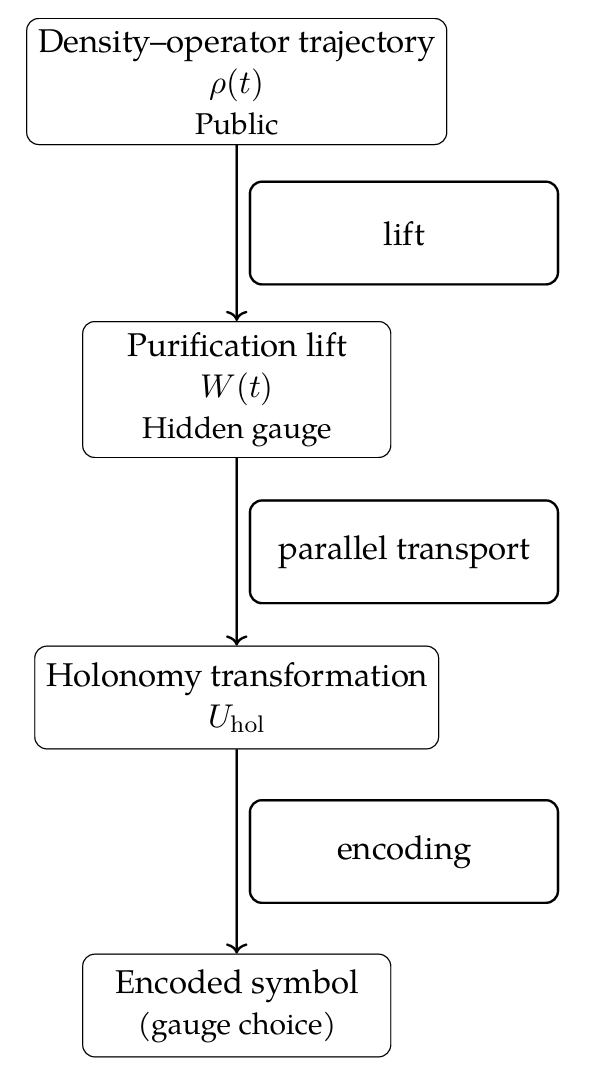
Mixed quantum states exhibit a rich geometric structure from the information geometry of density operators and their purifications. Parallel transport via the Uhlmann connection induces holonomy transformations along closed trajectories of density operators. Although extensively studied in quantum physics, their potential as information-theoretic resources in quantum cryptography remains largely unexplored. This work investigates whether holonomy in the purification bundle can serve as a secrecy resource for mixed-state quantum systems. The key observation is that while a density-operator trajectory describes only the base manifold, the lifted trajectory depends on an additional unitary gauge freedom associated with purification amplitudes. Consequently, distinct lifted trajectories from different gauge choices may generate different holonomy transformations even when the observable density evolution remains identical. We formalize this by proving that holonomy from a closed density-operator trajectory cannot be uniquely reconstructed from base-space observations. Specifically, the observable trajectory determines holonomy only up to conjugacy in the unitary group. This reveals a structural separation between publicly observable geometric information—namely the density-operator trajectory equipped with Bures quantum information geometry—and hidden bundle-level transformations arising from purification gauge choices. Based on this property, we introduce a minimal geometric encoding primitive where classical symbols correspond to gauge transformations in the purification bundle while the observable density trajectory remains unchanged. We further formalize a base-space-restricted adversarial model, define a distinguishability advantage for message recovery, and analyze potential attacks including tomographic, geometric, and algebraic reconstruction attempts. Explicit single-qubit and multi-qubit examples illustrate how Abelian and non-Abelian holonomy arise in low-dimensional mixed-state systems. These results identify holonomy as a geometric information carrier in mixed-state quantum information and provide structural foundations for future holonomy-based quantum cryptographic protocols.
Graphical Abstract
Keywords
Data Availability Statement
Funding
Conflicts of Interest
AI Use Statement
Ethical Approval and Consent to Participate
References
- Di Cairano, L. (2025). Secret Entanglement, Public Geometry. Quantum Cryptography from a Geometric Perspective. arXiv preprint arXiv:2511.22984.
[CrossRef] [Google Scholar] - Uhlmann, A. (1986). Parallel transport and “quantum holonomy” along density operators. Reports on Mathematical Physics, 24(2), 229-240.
[CrossRef] [Google Scholar] - Nielsen, M. A., & Chuang, I. L. (2010). Quantum computation and quantum information. Cambridge university press.
[Google Scholar] - Sjöqvist, E. (2015). Geometric phases in quantum information. International Journal of Quantum Chemistry, 115(19), 1311-1326.
[CrossRef] [Google Scholar] - El MORSALANI, M. (2024). Quantum and Post-Quantum Cryptography: Principles, Protocols, and Challenges [Preprint]. ResearchGate. https://www.researchgate.net/publication/385041521_Quantum_and_Post-Quantum_Cryptography_Principles_Protocols_and_Challenges
[Google Scholar] - Berry, M. V. (1984). Quantal phase factors accompanying adiabatic changes. Proceedings of the Royal Society of London. A. Mathematical and Physical Sciences, 392(1802), 45-57.
[CrossRef] [Google Scholar] - Aharonov, Y., & Anandan, J. (1987). Phase change during a cyclic quantum evolution. Physical Review Letters, 58(16), 1593.
[CrossRef] [Google Scholar] - Tong, D. M., Sjöqvist, E., Kwek, L. C., & Oh, C. H. (2004). Kinematic approach to the mixed state geometric phase in nonunitary evolution. Physical review letters, 93(8), 080405.
[CrossRef] [Google Scholar] - Sjöqvist, E., Pati, A. K., Ekert, A., Anandan, J. S., Ericsson, M., Oi, D. K., & Vedral, V. (2000). Geometric phases for mixed states in interferometry. Physical Review Letters, 85(14), 2845.
[CrossRef] [Google Scholar] - Andersson, O. (2019). Holonomy in quantum information geometry. arXiv preprint arXiv:1910.08140.
[CrossRef] [Google Scholar] - Petz, D. (1996). Monotone metrics on matrix spaces. Linear algebra and its applications, 244, 81-96.
[CrossRef] [Google Scholar] - Dittmann, J. (1999). The scalar curvature of the Bures metric on the space of density matrices. Journal of Geometry and Physics, 31(1), 16-24.
[CrossRef] [Google Scholar] - Braunstein, S. L., & Caves, C. M. (1994). Statistical distance and the geometry of quantum states. Physical Review Letters, 72(22), 3439.
[CrossRef] [Google Scholar] - Helstrom, C. W. (1969). Quantum detection and estimation theory. Journal of statistical physics, 1(2), 231-252.
[CrossRef] [Google Scholar] - Amari, S. I., & Nagaoka, H. (2000). Methods of information geometry (Vol. 191). American Mathematical Soc.
[Google Scholar] - Uhlmann, A. (1991). A gauge field governing parallel transport along mixed states. letters in mathematical physics, 21(3), 229-236.
[CrossRef] [Google Scholar] - Vedral, V., & Plenio, M. B. (1998). Entanglement measures and purification procedures. Physical Review A, 57(3), 1619.
[CrossRef] [Google Scholar] - Bures, D. (1969). An extension of Kakutani’s theorem on infinite product measures to the tensor product of semifinite $W^\ast$-algebras. Transactions of the American Mathematical Society, 135, 199–212.
[CrossRef] [Google Scholar] - Goldreich, O. (2004). Foundations of cryptography, volume 2. Cambridge: Cambridge university press.
[Google Scholar] - Katz, J., & Lindell, Y. (2007). Introduction to modern cryptography: principles and protocols. Chapman and hall/CRC.
[CrossRef] [Google Scholar]
Cite This Article
TY  - JOUR
AU  - Morsalani, Mohamed El
PY  - 2026
DA  - 2026/05/17
TI  - Secret Holonomy and Public Geometry in Mixed-State Quantum Information
JO  - Journal of Quantum Cryptography
T2  - Journal of Quantum Cryptography
JF  - Journal of Quantum Cryptography
VL  - 1
IS  - 1
SP  - 35
EP  - 54
DO  - 10.62762/JQC.2026.133798
UR  - https://www.icck.org/article/abs/JQC.2026.133798
KW  - mixed-state quantum cryptography
KW  - uhlmann holonomy
KW  - quantum information geometry
KW  - bures geometry
KW  - purification bundle
KW  - geometric secrecy
AB  - Mixed quantum states exhibit a rich geometric structure from the information geometry of density operators and their purifications. Parallel transport via the Uhlmann connection induces holonomy transformations along closed trajectories of density operators. Although extensively studied in quantum physics, their potential as information-theoretic resources in quantum cryptography remains largely unexplored. This work investigates whether holonomy in the purification bundle can serve as a secrecy resource for mixed-state quantum systems. The key observation is that while a density-operator trajectory describes only the base manifold, the lifted trajectory depends on an additional unitary gauge freedom associated with purification amplitudes. Consequently, distinct lifted trajectories from different gauge choices may generate different holonomy transformations even when the observable density evolution remains identical. We formalize this by proving that holonomy from a closed density-operator trajectory cannot be uniquely reconstructed from base-space observations. Specifically, the observable trajectory determines holonomy only up to conjugacy in the unitary group. This reveals a structural separation between publicly observable geometric information—namely the density-operator trajectory equipped with Bures quantum information geometry—and hidden bundle-level transformations arising from purification gauge choices. Based on this property, we introduce a minimal geometric encoding primitive where classical symbols correspond to gauge transformations in the purification bundle while the observable density trajectory remains unchanged. We further formalize a base-space-restricted adversarial model, define a distinguishability advantage for message recovery, and analyze potential attacks including tomographic, geometric, and algebraic reconstruction attempts. Explicit single-qubit and multi-qubit examples illustrate how Abelian and non-Abelian holonomy arise in low-dimensional mixed-state systems. These results identify holonomy as a geometric information carrier in mixed-state quantum information and provide structural foundations for future holonomy-based quantum cryptographic protocols.
SN  - request pending
PB  - Institute of Central Computation and Knowledge
LA  - English
ER  -
@article{Morsalani2026Secret,
  author = {Mohamed El Morsalani},
  title = {Secret Holonomy and Public Geometry in Mixed-State Quantum Information},
  journal = {Journal of Quantum Cryptography},
  year = {2026},
  volume = {1},
  number = {1},
  pages = {35-54},
  doi = {10.62762/JQC.2026.133798},
  url = {https://www.icck.org/article/abs/JQC.2026.133798},
  abstract = {Mixed quantum states exhibit a rich geometric structure from the information geometry of density operators and their purifications. Parallel transport via the Uhlmann connection induces holonomy transformations along closed trajectories of density operators. Although extensively studied in quantum physics, their potential as information-theoretic resources in quantum cryptography remains largely unexplored. This work investigates whether holonomy in the purification bundle can serve as a secrecy resource for mixed-state quantum systems. The key observation is that while a density-operator trajectory describes only the base manifold, the lifted trajectory depends on an additional unitary gauge freedom associated with purification amplitudes. Consequently, distinct lifted trajectories from different gauge choices may generate different holonomy transformations even when the observable density evolution remains identical. We formalize this by proving that holonomy from a closed density-operator trajectory cannot be uniquely reconstructed from base-space observations. Specifically, the observable trajectory determines holonomy only up to conjugacy in the unitary group. This reveals a structural separation between publicly observable geometric information—namely the density-operator trajectory equipped with Bures quantum information geometry—and hidden bundle-level transformations arising from purification gauge choices. Based on this property, we introduce a minimal geometric encoding primitive where classical symbols correspond to gauge transformations in the purification bundle while the observable density trajectory remains unchanged. We further formalize a base-space-restricted adversarial model, define a distinguishability advantage for message recovery, and analyze potential attacks including tomographic, geometric, and algebraic reconstruction attempts. Explicit single-qubit and multi-qubit examples illustrate how Abelian and non-Abelian holonomy arise in low-dimensional mixed-state systems. These results identify holonomy as a geometric information carrier in mixed-state quantum information and provide structural foundations for future holonomy-based quantum cryptographic protocols.},
  keywords = {mixed-state quantum cryptography, uhlmann holonomy, quantum information geometry, bures geometry, purification bundle, geometric secrecy},
  issn = {request pending},
  publisher = {Institute of Central Computation and Knowledge}
}
Article Metrics
Publisher's Note
ICCK stays neutral with regard to jurisdictional claims in published maps and institutional affiliations.
Rights and Permissions
 Copyright © 2026 by the Author(s). Published by Institute of Central Computation and Knowledge. This article is an open access article distributed under the terms and conditions of the Creative Commons Attribution (CC BY) license (https://creativecommons.org/licenses/by/4.0/), which permits use, sharing, adaptation, distribution and reproduction in any medium or format, as long as you give appropriate credit to the original author(s) and the source, provide a link to the Creative Commons licence, and indicate if changes were made.


Portico
