

Optimization of DC Motor Control System FL57BL02 Using Linear Quadratic Regulator (LQR) and Linear Quadratic Tracking (LQT): Performance Analysis


Article Information
Abstract
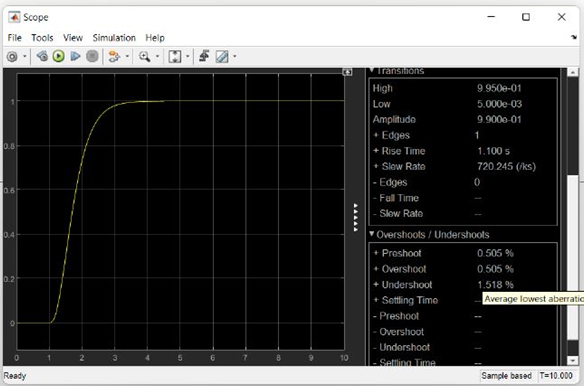
Optimization is a critical approach in decision-making processes aimed at enhancing both safety and operational efficiency in industrial systems. This research focuses on the implementation of the Linear Quadratic Regulator (LQR) and Linear Quadratic Tracking (LQT) control strategies to optimize the FL57BL02 DC motor control system, widely used in industrial automation, particularly in high-risk applications such as conveyors and robotic systems. The LQR method is employed to enhance system stability by minimizing output deviations and ensuring optimal control performance under varying load conditions. Meanwhile, LQT is utilized to improve trajectory tracking accuracy, ensuring that the system follows the desired reference with minimal error. Through comprehensive simulation and experimental validation, this study demonstrates that the integration of LQR and LQT control strategies reduces output deviation and transient response errors by up to 25% compared to conventional PID-based controllers. Furthermore, the implementation of these advanced control techniques contributes significantly to Occupational Safety and Health (OHS) compliance by mitigating mechanical vibrations and reducing noise levels both of which are crucial risk factors in industrial environments. By stabilizing system performance, this research presents a novel engineering solution that enhances machine reliability, minimizes downtime, and mitigates the potential for workplace hazards. This study offers an important contribution to the field of automatic control systems by demonstrating how advanced optimal control strategies can be leveraged to enhance industrial safety, improve energy efficiency, and pave the way for the development of more sophisticated OHS-compliant automation technologies in future industrial applications.
Graphical Abstract
Keywords
Data Availability Statement
Funding
Conflicts of Interest
Ethical Approval and Consent to Participate
References
- Alabi, T. M., Aghimien, E. I., Agbajor, F. D., Yang, Z., Lu, L., Adeoye, A. R., & Gopaluni, B. (2022). A review on the integrated optimization techniques and machine learning approaches for modeling, prediction, and decision making on integrated energy systems. Renewable Energy, 194, 822-849.
[CrossRef] [Google Scholar] - Carpanzano, E., & Knüttel, D. (2022). Advances in artificial intelligence methods applications in industrial control systems: Towards cognitive self-optimizing manufacturing systems. Applied sciences, 12(21), 10962.
[CrossRef] [Google Scholar] - Nugraha, A. T., & Febrianti, C. Implementasi Sensor Flowmeter pada Auxiliary Engine Kapal Berbasis Outseal PLC.
[Google Scholar] - Mei, L., & Wang, Q. (2021). Structural optimization in civil engineering: a literature review. Buildings, 11(2), 66.
[CrossRef] [Google Scholar] - Elechi, P., Ekolama, S. M., Okowa, E., & Kukuchuku, S. (2025). A review of emerging technologies in wireless communication systems. Innovation and Emerging Technologies, 12, 2550005.
[CrossRef] [Google Scholar] - Bhat, A. P., Dhoble, S. J., & Rewatkar, K. G. (2021). Multiple-Input Multiple-Output Antenna Design and Applications. In Microstrip Antenna Design for Wireless Applications (pp. 99-144). CRC Press.
[Google Scholar] - Elalaouy, O., El Ghzaoui, M., & Foshi, J. (2024). Enhancing antenna performance: A comprehensive review of metamaterial utilization. Materials Science and Engineering: B, 304, 117382.
[CrossRef] [Google Scholar] - Baran, H., Bayezit, I., & Jambak, A. I. (2024). Advanced UAV system utilization of LQR and ESC techniques for flight control. Aerospace Systems, 1-18.
[CrossRef] [Google Scholar] - Abdullah, M., Amin, A. A., Iqbal, S., & Mahmood-ul-Hasan, K. (2021). Swing up and stabilization control of rotary inverted pendulum based on energy balance, fuzzy logic, and LQR controllers. Measurement and Control, 54(9-10), 1356-1370.
[CrossRef] [Google Scholar] - Khosravi, M., Azarinfar, H., & Sabzevari, K. (2024). Design of infinite horizon LQR controller for discrete delay systems in satellite orbit control: A predictive controller and reduction method approach. Heliyon, 10(2).
[CrossRef] [Google Scholar] - Hong-yang, X., Ming, Y., Jing-Jing, L., Xi, H., & Wei, X. (2025). LQT-based Energy-Efficient Control for Intelligent Vehicles Optimized by Adaptive Genetic Algorithm. IEEE Access, 13, 96800-96812.
[CrossRef] [Google Scholar] - Mao, W., Zhao, Z., Chang, Z., Min, G., & Gao, W. (2021). Energy-efficient industrial internet of things: Overview and open issues. IEEE transactions on industrial informatics, 17(11), 7225-7237.
[CrossRef] [Google Scholar] - Book, G., Traue, A., Balakrishna, P., Brosch, A., Schenke, M., Hanke, S., ... & Wallscheid, O. (2021). Transferring online reinforcement learning for electric motor control from simulation to real-world experiments. IEEE Open Journal of Power Electronics, 2, 187-201.
[CrossRef] [Google Scholar] - Jalili, N., & Candelino, N. W. (2023). Dynamic systems and control engineering. Cambridge University Press.
[Google Scholar] - Dani, S., Sonawane, D., Ingole, D., & Patil, S. (2017, April). Performance evaluation of PID, LQR and MPC for DC motor speed control. In 2017 2nd international conference for convergence in technology (I2CT) (pp. 348-354). IEEE.
[CrossRef] [Google Scholar] - Rohman, Y. F., & Nugraha, A. T. (2024, November). DC Motor Analysis 42D29Y401 for System Optimization through LQR and LQT Approaches. In Conference of Electrical, Marine and Its Application (Vol. 3, No. 1, pp. 1-11). http://inergyc.ppns.ac.id/journal/index.php/celrina/article/view/178
[Google Scholar] - Eviningsih, R. P., Efendi, M. Z., Windarko, N. A., Nugraha, A. T., Prasetya, F. D., & Abdilla, M. R. D. (2024). MPPT Algorithm Based on Zebra Optimization Algorithm for Solar Panels System with Partial Shading Conditions. Indonesian Journal of Electronics, Electromedical Engineering, and Medical Informatics, 6(4), 206-218.
[CrossRef] [Google Scholar] - Sharma, A., Chaudhary, S., & Parnianifard, A. (2025). Introduction to Advances in Optical and Wireless Communication. Optical and Wireless Communications: Applications of Machine Learning and Artificial Intelligence, 1.
[Google Scholar] - Pambudi, D. S. A., Angga, A. T. N., Utomo, A. P., Ahmad, M. M., Tiwana, M. Z. A., & Ravi, A. M. (2021). Main Engine Water Cooling Failure Monitoring and Detection on Ships using Interface Modbus Communication. Applied Technology and Computing Science Journal, 4(2), 91-101.
[CrossRef] [Google Scholar] - Faj’riyah, A. N. (2022). RANCANG BANGUN PROTOTIPE PROTEKSI MOTOR TERHADAP OVERHEAT SERTA MONITORING ARUS DAN TEGANGAN BERBASIS ARDUINO UNO PADA PT. X (Doctoral dissertation, Politeknik Perkapalan Negeri Surabaya). http://repository.ppns.ac.id/id/eprint/4572
[Google Scholar]
Cite This Article
TY  - JOUR
AU  - Rohman, Yulian Fatkur
AU  - Nugraha, Anggara Trisna
AU  - Sobhita, Rama Arya
PY  - 2025
DA  - 2025/07/28
TI  - Optimization of DC Motor Control System FL57BL02 Using Linear Quadratic Regulator (LQR) and Linear Quadratic Tracking (LQT): Performance Analysis
JO  - ICCK Transactions on Power Electronics and Industrial Systems
T2  - ICCK Transactions on Power Electronics and Industrial Systems
JF  - ICCK Transactions on Power Electronics and Industrial Systems
VL  - 1
IS  - 1
SP  - 15
EP  - 22
DO  - 10.62762/TPEIS.2025.356246
UR  - https://www.icck.org/article/abs/TPEIS.2025.356246
KW  - DC motor control
KW  - linear quadratic regulator (LQR)
KW  - linear quadratic tracking (LQT)
KW  - optimization
KW  - engineering application
AB  - Optimization is a critical approach in decision-making processes aimed at enhancing both safety and operational efficiency in industrial systems. This research focuses on the implementation of the Linear Quadratic Regulator (LQR) and Linear Quadratic Tracking (LQT) control strategies to optimize the FL57BL02 DC motor control system, widely used in industrial automation, particularly in high-risk applications such as conveyors and robotic systems. The LQR method is employed to enhance system stability by minimizing output deviations and ensuring optimal control performance under varying load conditions. Meanwhile, LQT is utilized to improve trajectory tracking accuracy, ensuring that the system follows the desired reference with minimal error. Through comprehensive simulation and experimental validation, this study demonstrates that the integration of LQR and LQT control strategies reduces output deviation and transient response errors by up to 25% compared to conventional PID-based controllers. Furthermore, the implementation of these advanced control techniques contributes significantly to Occupational Safety and Health (OHS) compliance by mitigating mechanical vibrations and reducing noise levels both of which are crucial risk factors in industrial environments. By stabilizing system performance, this research presents a novel engineering solution that enhances machine reliability, minimizes downtime, and mitigates the potential for workplace hazards. This study offers an important contribution to the field of automatic control systems by demonstrating how advanced optimal control strategies can be leveraged to enhance industrial safety, improve energy efficiency, and pave the way for the development of more sophisticated OHS-compliant automation technologies in future industrial applications.
SN  - request pending
PB  - Institute of Central Computation and Knowledge
LA  - English
ER  -
@article{Rohman2025Optimizati,
  author = {Yulian Fatkur Rohman and Anggara Trisna Nugraha and Rama Arya Sobhita},
  title = {Optimization of DC Motor Control System FL57BL02 Using Linear Quadratic Regulator (LQR) and Linear Quadratic Tracking (LQT): Performance Analysis},
  journal = {ICCK Transactions on Power Electronics and Industrial Systems},
  year = {2025},
  volume = {1},
  number = {1},
  pages = {15-22},
  doi = {10.62762/TPEIS.2025.356246},
  url = {https://www.icck.org/article/abs/TPEIS.2025.356246},
  abstract = {Optimization is a critical approach in decision-making processes aimed at enhancing both safety and operational efficiency in industrial systems. This research focuses on the implementation of the Linear Quadratic Regulator (LQR) and Linear Quadratic Tracking (LQT) control strategies to optimize the FL57BL02 DC motor control system, widely used in industrial automation, particularly in high-risk applications such as conveyors and robotic systems. The LQR method is employed to enhance system stability by minimizing output deviations and ensuring optimal control performance under varying load conditions. Meanwhile, LQT is utilized to improve trajectory tracking accuracy, ensuring that the system follows the desired reference with minimal error. Through comprehensive simulation and experimental validation, this study demonstrates that the integration of LQR and LQT control strategies reduces output deviation and transient response errors by up to 25\% compared to conventional PID-based controllers. Furthermore, the implementation of these advanced control techniques contributes significantly to Occupational Safety and Health (OHS) compliance by mitigating mechanical vibrations and reducing noise levels both of which are crucial risk factors in industrial environments. By stabilizing system performance, this research presents a novel engineering solution that enhances machine reliability, minimizes downtime, and mitigates the potential for workplace hazards. This study offers an important contribution to the field of automatic control systems by demonstrating how advanced optimal control strategies can be leveraged to enhance industrial safety, improve energy efficiency, and pave the way for the development of more sophisticated OHS-compliant automation technologies in future industrial applications.},
  keywords = {DC motor control, linear quadratic regulator (LQR), linear quadratic tracking (LQT), optimization, engineering application},
  issn = {request pending},
  publisher = {Institute of Central Computation and Knowledge}
}
Article Metrics
Publisher's Note
ICCK stays neutral with regard to jurisdictional claims in published maps and institutional affiliations.
Rights and Permissions


Portico
