

The Ecological Ripple: Investigating Cu and Zn Transfer across Trophic Levels from Fish to Birds in River Kalpani, Pakistan



Article Information
Abstract
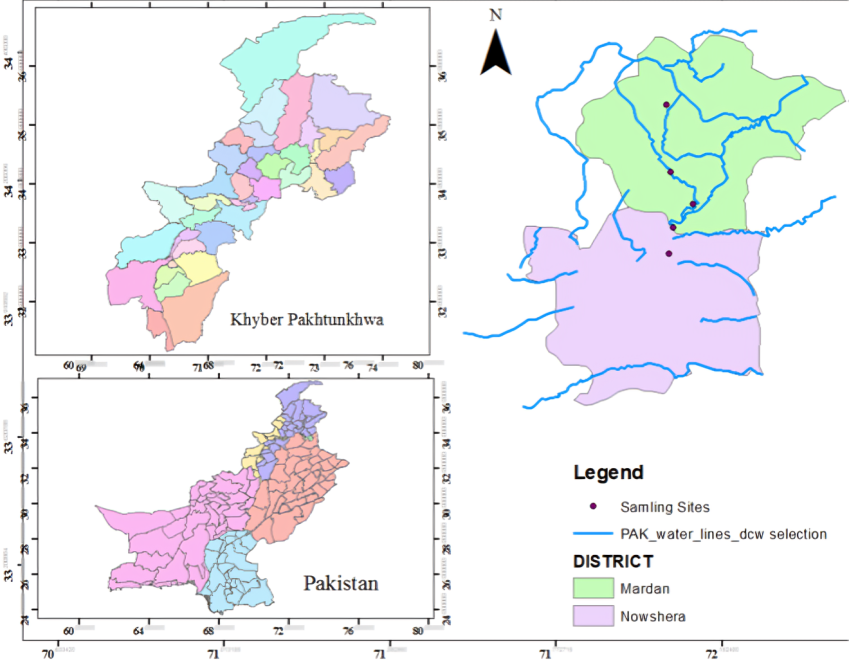
This study investigated the distribution and trophic transfer of copper (Cu) and zinc (Zn) from two freshwater fish species (Channa punctatus and Mastacembelus armatus) to the piscivorous bird Halcyon smyrnensis in River Kalpani, Pakistan. Samples collected from five sites between December 2017 and March 2018 included 64 fish and 15 kingfishers. Target tissues (fish: liver, gill, intestine, muscle; bird: feathers, liver, heart, intestine, muscle, bone, skin) were digested with nitric-perchloric acid and analyzed by flame atomic absorption spectrophotometry; results were expressed as mg kg$^{-1}$ (wet weight for soft tissues, dry weight for feathers and bones) and evaluated using one-way ANOVA ($p<0.05$). In both fish species, Cu and Zn concentrations generally followed the order: liver $>$ gill $>$ muscle $>$ skin, with liver Cu ranging from 2.43 to 18.2 mg/kg ww and Zn from 2.46 to 33.33 mg/kg ww. In kingfishers, metals predominantly accumulated in feathers and liver (feather Zn up to 42.5 mg kg$^{-1}$ dw), and mean concentrations were mostly higher in bird than fish tissues, suggesting trophic transfer. No consistent upstream--downstream gradient was observed, and all values remained below avian toxicity thresholds. These findings confirm tissue-specific accumulation and trophic transfer of essential metals, with no acute toxicity but elevated levels in higher trophic levels warranting continued monitoring. Kingfishers thus show promise as bioindicators of metal contamination in freshwater ecosystems.
Graphical Abstract
Keywords
Data Availability Statement
Funding
Conflicts of Interest
AI Use Statement
Ethical Approval and Consent to Participate
References
- Ali, H., Khan, E., & Ilahi, I. (2019). Environmental chemistry and ecotoxicology of hazardous heavy metals: environmental persistence, toxicity, and bioaccumulation. Journal of Chemistry, 2019(1), 6730305.
[CrossRef] [Google Scholar] - Reinecke, A. J., Snyman, R. G., & Nel, J. A. J. (2003). Uptake and distribution of lead (Pb) and cadmium (Cd) in the freshwater crab, Potamonautes perlatus (Crustacea) in the Eerste River, South Africa. Water, Air, and Soil Pollution, 145(1), 395-408.
[CrossRef] [Google Scholar] - Wepener, V., Van Vuren, J. H. J., & Du Preez, H. H. (2001). Uptake and distribution of a copper, iron and zinc mixture in gill, liver and plasma of a freshwater teleost, Tilapia sparrmanii. Water SA, 27(1), 99-108.
[CrossRef] [Google Scholar] - Ullah, K., Hashmi, M. Z., & Malik, R. N. (2014). Heavy-metal levels in feathers of cattle egret and their surrounding environment: a case of the Punjab Province, Pakistan. Archives of Environmental Contamination and Toxicology, 66(1), 139-153.
[CrossRef] [Google Scholar] - Kotze, P., Du Preez, H. H., & Van Vuren, J. H. J. (1999). Bioaccumulation of copper and zinc in Oreochromis mossambicus and Clarias gariepinus from the Olifants River, Mpumalanga, South Africa. Water SA, 25(1), 99-110. https://hero.epa.gov/reference/5439675/
[Google Scholar] - Ali, H., Ali, W., Ullah, K., Akbar, F., Ahrar, S., Ullah, I., Ahmad, I., Ahmad, A., Ilahi, I., & Sajad, M. A. (2017). Bioaccumulation of Cu and Zn in Schizothorax plagiostomus and Mastacembelus armatus from River Swat, River Panjkora and River Barandu in Malakand Division, Pakistan. Pakistan Journal of Zoology, 49(5), 1555-1561. http://dx.doi.org/10.17582/journal.pjz/2017.49.5.1555.1561
[Google Scholar] - Yousafzai, A. M., & Shakoori, A. R. (2007). Heavy metal bioaccumulation in the muscles of Mahaseer, Tor putitora, as an evidence of heavy metal pollution in River Kabul, Pakistan. Pakistan Journal of Zoology, 39(1), 1-8. https://zsp.com.pk/pdf3/69-76%20(1).pdf
[Google Scholar] - Kris-Etherton, P. M., Harris, W. S., & Appel, L. J. (2002). Fish consumption, fish oil, omega-3 fatty acids, and cardiovascular disease. Circulation, 106(21), 2747-2757.
[CrossRef] [Google Scholar] - Yousafzai, A. M., & Shakoori, A. R. (2008). Heavy metal accumulation in the gills of an endangered South Asian fresh water fish as an indicator of aquatic pollution. Pakistan Journal of Zoology, 40(6), 423-430. https://www.zsp.com.pk/pdf40/423-430\%20(40-6)\%20WP-73.pdf
[Google Scholar] - Bearhop, S., Waldron, S., Thompson, D., & Furness, R. (2000). Bioamplification of mercury in great skua Catharacta skua chicks: the influence of trophic status as determined by stable isotope signatures of blood and feathers. Marine Pollution Bulletin, 40(2), 181-185.
[CrossRef] [Google Scholar] - Horai, S., Watanabe, I., Takada, H., Iwamizu, Y., Hayashi, T., Tanabe, S., & Kuno, K. (2007). Trace element accumulations in 13 avian species collected from the Kanto area, Japan. Science of the Total Environment, 373(2-3), 512-525.
[CrossRef] [Google Scholar] - Dauwe, T., Bervoets, L., Blust, R., Pinxten, R., & Eens, M. (2000). Can excrement and feathers of nestling songbirds be used as biomonitors for heavy metal pollution? Archives of Environmental Contamination and Toxicology, 39(4), 541-546.
[CrossRef] [Google Scholar] - Burger, J. (1993). Metals in avian feathers: Bioindicators of environmental pollution. Reviews in Environmental Toxicology, 5, 203-311.
[Google Scholar] - Furness, R. W. (1993). Birds as monitors of pollutants. In Birds as monitors of environmental change (pp. 86-143). Dordrecht: Springer Netherlands.
[CrossRef] [Google Scholar] - Baron, L. A., Ashwood, T. L., Sample, B. E., & Welsh, C. (1997). Monitoring bioaccumulation of contaminants in the belted kingfisher (Ceryle alcyon). Environmental Monitoring and Assessment, 47(2), 153-165.
[CrossRef] [Google Scholar] - Ali, H., & Khan, E. (2019). Trophic transfer, bioaccumulation, and biomagnification of non-essential hazardous heavy metals and metalloids in food chains/webs---Concepts and implications for wildlife and human health. Human and Ecological Risk Assessment: An International Journal, 25(6), 1353-1376.
[CrossRef] [Google Scholar] - Yujun, Y. I., Zhaoyin, W., Guoan, Y. U., & Xuehua, D. U. A. N. (2008). Sediment pollution and its effect on fish through food chain in the Yangtze River. International Journal of Sediment Research, 23(4), 338-347.
[CrossRef] [Google Scholar] - Rosseland, B. O., Teien, H. C., Basnet, S., Borgstrøm, R., & Sharma, C. M. (2017). Trace elements and organochlorine pollutants in selected fish species from Lake Phewa, Nepal. Toxicological & Environmental Chemistry, 99(3), 390-401.
[CrossRef] [Google Scholar] - Javed, M., & Usmani, N. (2016). Accumulation of heavy metals and human health risk assessment via the consumption of freshwater fish Mastacembelus armatus inhabiting thermal power plant effluent loaded canal. SpringerPlus, 5(1), 776.
[CrossRef] [Google Scholar] - Zamani-Ahmadmahmoodi, R., Esmaili-Sari, A., Ghasempouri, S. M., & Savabieasfahani, M. (2009). Mercury levels in selected tissues of three kingfisher species; Ceryle rudis, Alcedo atthis, and Halcyon smyrnensis, from Shadegan Marshes of Iran. Ecotoxicology, 18(3), 319-324.
[CrossRef] [Google Scholar] - Muralidharan, S., Jayakumar, R., & Vishnu, G. (2004). Heavy metals in feathers of six species of birds in the District Nilgiris, India. Bulletin of Environmental Contamination and Toxicology, 73(2), 285-291.
[CrossRef] [Google Scholar] - Bravo, A., Colina, M., Azuero, S., & Salas, R. (2005). Heavy metal levels in plasma and fecal material samples of the black vulture (Coragyps atratus). Revista Científica, 15(4), 319-325. https://agris.fao.org/search/en/providers/125654/records/68879c157fd4d06c32a97512
[Google Scholar] - Carpenter, J. W., Andrews, G. A., & Beyer, W. N. (2004). Zinc toxicosis in a free-flying trumpeter swan (Cygnus buccinator). Journal of Wildlife Diseases, 40(4), 769-774.
[CrossRef] [Google Scholar] - Lebedeva, N. V. (1997). Accumulation of heavy metals by birds in the southwest of Russia. Russian Journal of Ecology, 28(1), 41-46.
[Google Scholar]
Cite This Article
TY  - JOUR
AU  - Ahmad, Sohail
AU  - Ilyas, Muhammad
AU  - Gul, Saira
AU  - Khan, Muhammad Qayash
PY  - 2026
DA  - 2026/07/07
TI  - The Ecological Ripple: Investigating Cu and Zn Transfer across Trophic Levels from Fish to Birds in River Kalpani, Pakistan
JO  - ICCK Journal of Intelligent Biotechnology
T2  - ICCK Journal of Intelligent Biotechnology
JF  - ICCK Journal of Intelligent Biotechnology
VL  - 1
IS  - 1
SP  - 1
EP  - 8
DO  - 10.62762/JIB.2026.964990
UR  - https://www.icck.org/article/abs/JIB.2026.964990
KW  - Copper (Cu)
KW  - Zinc (Zn)
KW  - heavy metals
KW  - trophic transfer
KW  - bioaccumulation
KW  - aquatic biomonitoring
KW  - piscivorous bird
KW  - bioindicator
AB  - This study investigated the distribution and trophic transfer of copper (Cu) and zinc (Zn) from two freshwater fish species (Channa punctatus and Mastacembelus armatus) to the piscivorous bird Halcyon smyrnensis in River Kalpani, Pakistan. Samples collected from five sites between December 2017 and March 2018 included 64 fish and 15 kingfishers. Target tissues (fish: liver, gill, intestine, muscle; bird: feathers, liver, heart, intestine, muscle, bone, skin) were digested with nitric-perchloric acid and analyzed by flame atomic absorption spectrophotometry; results were expressed as mg kg$^{-1}$ (wet weight for soft tissues, dry weight for feathers and bones) and evaluated using one-way ANOVA ($p$ gill $>$ muscle $>$ skin, with liver Cu ranging from 2.43 to 18.2 mg/kg ww and Zn from 2.46 to 33.33 mg/kg ww. In kingfishers, metals predominantly accumulated in feathers and liver (feather Zn up to 42.5 mg kg$^{-1}$ dw), and mean concentrations were mostly higher in bird than fish tissues, suggesting trophic transfer. No consistent upstream--downstream gradient was observed, and all values remained below avian toxicity thresholds. These findings confirm tissue-specific accumulation and trophic transfer of essential metals, with no acute toxicity but elevated levels in higher trophic levels warranting continued monitoring. Kingfishers thus show promise as bioindicators of metal contamination in freshwater ecosystems.
SN  - 5 Articles Required
PB  - Institute of Central Computation and Knowledge
LA  - English
ER  -
@article{Ahmad2026The,
  author = {Sohail Ahmad and Muhammad Ilyas and Saira Gul and Muhammad Qayash Khan},
  title = {The Ecological Ripple: Investigating Cu and Zn Transfer across Trophic Levels from Fish to Birds in River Kalpani, Pakistan},
  journal = {ICCK Journal of Intelligent Biotechnology},
  year = {2026},
  volume = {1},
  number = {1},
  pages = {1-8},
  doi = {10.62762/JIB.2026.964990},
  url = {https://www.icck.org/article/abs/JIB.2026.964990},
  abstract = {This study investigated the distribution and trophic transfer of copper (Cu) and zinc (Zn) from two freshwater fish species (Channa punctatus and Mastacembelus armatus) to the piscivorous bird Halcyon smyrnensis in River Kalpani, Pakistan. Samples collected from five sites between December 2017 and March 2018 included 64 fish and 15 kingfishers. Target tissues (fish: liver, gill, intestine, muscle; bird: feathers, liver, heart, intestine, muscle, bone, skin) were digested with nitric-perchloric acid and analyzed by flame atomic absorption spectrophotometry; results were expressed as mg kg\$^{-1}\$ (wet weight for soft tissues, dry weight for feathers and bones) and evaluated using one-way ANOVA (\$p\$ gill \$>\$ muscle \$>\$ skin, with liver Cu ranging from 2.43 to 18.2 mg/kg ww and Zn from 2.46 to 33.33 mg/kg ww. In kingfishers, metals predominantly accumulated in feathers and liver (feather Zn up to 42.5 mg kg\$^{-1}\$ dw), and mean concentrations were mostly higher in bird than fish tissues, suggesting trophic transfer. No consistent upstream--downstream gradient was observed, and all values remained below avian toxicity thresholds. These findings confirm tissue-specific accumulation and trophic transfer of essential metals, with no acute toxicity but elevated levels in higher trophic levels warranting continued monitoring. Kingfishers thus show promise as bioindicators of metal contamination in freshwater ecosystems.},
  keywords = {Copper (Cu), Zinc (Zn), heavy metals, trophic transfer, bioaccumulation, aquatic biomonitoring, piscivorous bird, bioindicator},
  issn = {5 Articles Required},
  publisher = {Institute of Central Computation and Knowledge}
}
Article Metrics
Publisher's Note
ICCK stays neutral with regard to jurisdictional claims in published maps and institutional affiliations.
Rights and Permissions
 Copyright © 2026 by the Author(s). Published by Institute of Central Computation and Knowledge. This article is an open access article distributed under the terms and conditions of the Creative Commons Attribution (CC BY) license (https://creativecommons.org/licenses/by/4.0/), which permits use, sharing, adaptation, distribution and reproduction in any medium or format, as long as you give appropriate credit to the original author(s) and the source, provide a link to the Creative Commons licence, and indicate if changes were made.


Portico
