
A Hybrid CNN-LSTM Deep Learning Framework for Demand Response Management in Grid-Connected Renewable Energy Microgrids





Article Information
Abstract
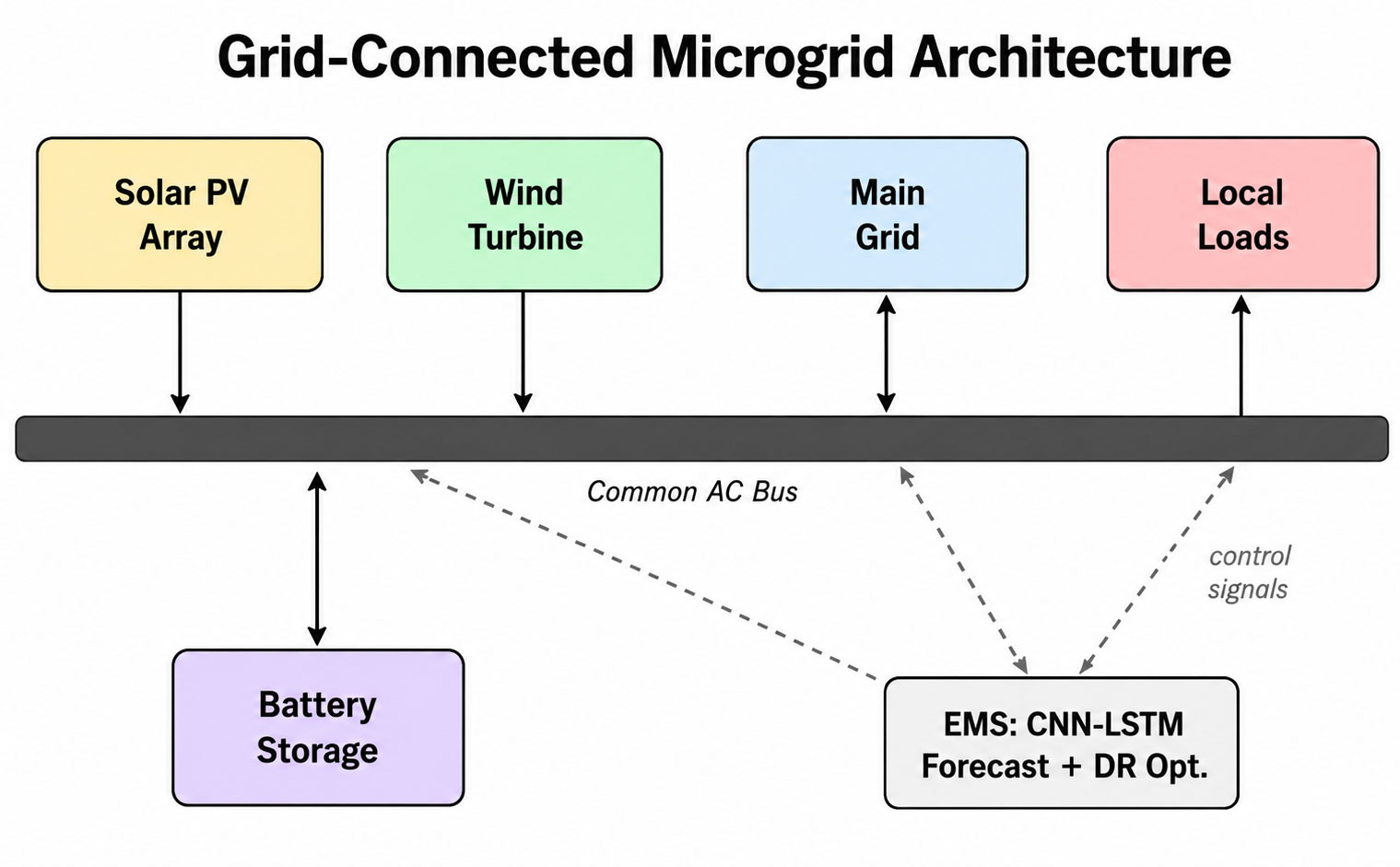
Grid-connected microgrids integrating solar photovoltaic and wind generation face a persistent mismatch between intermittent supply and local demand, raising operating cost and increasing reliance on grid imports during peak periods. Demand response (DR) mitigates this mismatch by reshaping load, but its effectiveness depends on accurate forecasting of load and renewable generation. This paper proposes a hybrid CNN-LSTM deep learning framework for DR management in a grid-connected microgrid comprising solar photovoltaic, wind, and battery storage. Convolutional layers extract local temporal features, long short-term memory layers model long-range daily dependencies, and the resulting forecasts drive a mixed-integer DR optimization layer that schedules flexible loads and battery dispatch to minimize operating cost. The framework is evaluated on one year of hourly HOMER Pro data for a residential community in Mirpur, Dhaka (2024), with the DR layer assessed on 24-hour scheduling days and benchmarked against standalone CNN, LSTM, and GRU models, as well as no-DR and rule-based DR strategies. The proposed model lowers load mean absolute percentage error to 4.8%, versus 7.0% for the next-best baseline. The DR layer reduces daily operating cost by 28.8% relative to no-DR and by 15.9% relative to rule-based DR, lowers the peak-to-average ratio from 1.62 to 1.24, and raises renewable utilization to 76.8%. Sensitivity analyses indicate gains across flexible load share, battery capacity, and forecast horizon, and illustrative seasonal days show similar behavior. Isolating the share of gains due to forecast accuracy remains future work.
Graphical Abstract
Keywords
Data Availability Statement
Funding
Conflicts of Interest
AI Use Statement
Ethical Approval and Consent to Participate
References
- Babu, K. V. S. M., Chakraborty, P., & Pal, M. (2025). Demand response optimization MILP framework for microgrids with DERs. arXiv preprint arXiv:2502.08764.
[CrossRef] [Google Scholar] - Shirzadi, N., Nasiri, F., El-Bayeh, C., & Eicker, U. (2022). Optimal dispatching of renewable energy-based urban microgrids using a deep learning approach for electrical load and wind power forecasting. International Journal of Energy Research, 46(3), 3173-3188.
[CrossRef] [Google Scholar] - Aslam, S., Herodotou, H., Mohsin, S. M., Javaid, N., Ashraf, N., & Aslam, S. (2021). A survey on deep learning methods for power load and renewable energy forecasting in smart microgrids. Renewable and Sustainable Energy Reviews, 144, 110992.
[CrossRef] [Google Scholar] - Hasanat, S. M., Younis, R., Alahmari, S., Ejaz, M. T., Haris, M., Yousaf, H., ... & Ullah, Z. (2024). Enhancing load forecasting accuracy in smart grids: a novel parallel multichannel network approach using 1D CNN and Bi‐LSTM models. International Journal of Energy Research, 2024(1), 2403847.
[CrossRef] [Google Scholar] - Zhang, S., Chen, R., Cao, J., & Tan, J. (2023). A CNN and LSTM-based multi-task learning architecture for short and medium-term electricity load forecasting. Electric Power Systems Research, 222, 109507.
[CrossRef] [Google Scholar] - Meng, Q., He, Y., Hussain, S., Lu, J., & Guerrero, J. M. (2025). Day-ahead economic dispatch of wind-integrated microgrids using coordinated energy storage and hybrid demand response strategies. Scientific Reports, 15(1), 26579.
[CrossRef] [Google Scholar] - Sang, J., Sun, H., & Kou, L. (2022). Deep reinforcement learning microgrid optimization strategy considering priority flexible demand side. Sensors, 22(6), 2256.
[CrossRef] [Google Scholar] - Wen, X., Liao, J., Niu, Q., Shen, N., & Bao, Y. (2024). Deep learning-driven hybrid model for short-term load forecasting and smart grid information management. Scientific Reports, 14(1), 13720.
[CrossRef] [Google Scholar] - Singh, A. R., Kumar, R. S., Bajaj, M., Khadse, C. B., & Zaitsev, I. (2024). Machine learning-based energy management and power forecasting in grid-connected microgrids with multiple distributed energy sources. Scientific Reports, 14(1), 19207.
[CrossRef] [Google Scholar] - Hasanat, S. M., Haris, M., Ullah, K., Shah, S. Z., Abid, U., & Ullah, Z. (2025). Hybrid CNN-LSTM model with soft attention mechanism for short-term load forecasting in smart grid. Engineering Reports, 7(5), e70163.
[CrossRef] [Google Scholar] - Shawon, S. M., Haider, S. N., Barua, A., Austin, S., Adan, I. A., Hossain, M. S., & Zubair, H. T. (2025). Hybrid CNN-LSTM model for urban energy load forecasting with IGA-XAI for smart grids: Peak and off-peak variability insights. Results in Engineering, 28, 107245.
[CrossRef] [Google Scholar] - Gharehveran, S. S., Shirini, K., Khavar, S. C., Mousavi, S. H., & Abdolahi, A. (2024). Deep learning-based demand response for short-term operation of renewable-based microgrids. The Journal of Supercomputing, 80(18), 26002-26035.
[CrossRef] [Google Scholar] - Singh, A. R., Dey, B., Bajaj, M., Kadiwala, S., Kumar, R. S., Dutta, S., & Zaitsev, I. (2025). Advanced microgrid optimization using price-elastic demand response and greedy rat swarm optimization for economic and environmental efficiency. Scientific Reports, 15(1), 2261.
[CrossRef] [Google Scholar] - Ahmad, S., Shafiullah, M., Ahmed, C. B., & Alowaifeer, M. (2023). A review of microgrid energy management and control strategies. IEEE Access, 11, 21729-21757.
[CrossRef] [Google Scholar] - Aziz, A., Khan, W., Yousaf, M. Z., Abdullah, M., Khan, R. S., Farooq, U., & Shabaz, M. (2025). Integrated energy scheduling for grid-connected microgrids using battery degradation-aware optimization and coordinated control strategies. Scientific Reports, 15(1), 44033.
[CrossRef] [Google Scholar] - Kim, T. Y., & Cho, S. B. (2019). Predicting residential energy consumption using CNN-LSTM neural networks. Energy, 182, 72-81.
[CrossRef] [Google Scholar] - Kingma, D. P., & Ba, J. (2014). Adam: A method for stochastic optimization. arXiv preprint arXiv:1412.6980.
[CrossRef] [Google Scholar]
Cite This Article
TY  - JOUR
AU  - Habib, Md. Ahsan
AU  - Arik, Md. Sadik Hassan
AU  - Sabiruzzaman, Md.
AU  - Hasan, Md. Nimul
PY  - 2026
DA  - 2026/11/28
TI  - A Hybrid CNN-LSTM Deep Learning Framework for Demand Response Management in Grid-Connected Renewable Energy Microgrids
JO  - Journal of Intelligent and Sustainable Energy Systems
T2  - Journal of Intelligent and Sustainable Energy Systems
JF  - Journal of Intelligent and Sustainable Energy Systems
VL  - 1
IS  - 1
SP  - 18
EP  - 32
DO  - 10.62762/JISES.2026.848280
UR  - https://www.icck.org/article/abs/jises.2026.848280
KW  - demand response
KW  - deep learning
KW  - CNN-LSTM
KW  - microgrid
KW  - renewable energy
KW  - load forecasting
AB  - Grid-connected microgrids integrating solar photovoltaic and wind generation face a persistent mismatch between intermittent supply and local demand, raising operating cost and increasing reliance on grid imports during peak periods. Demand response (DR) mitigates this mismatch by reshaping load, but its effectiveness depends on accurate forecasting of load and renewable generation. This paper proposes a hybrid CNN-LSTM deep learning framework for DR management in a grid-connected microgrid comprising solar photovoltaic, wind, and battery storage. Convolutional layers extract local temporal features, long short-term memory layers model long-range daily dependencies, and the resulting forecasts drive a mixed-integer DR optimization layer that schedules flexible loads and battery dispatch to minimize operating cost. The framework is evaluated on one year of hourly HOMER Pro data for a residential community in Mirpur, Dhaka (2024), with the DR layer assessed on 24-hour scheduling days and benchmarked against standalone CNN, LSTM, and GRU models, as well as no-DR and rule-based DR strategies. The proposed model lowers load mean absolute percentage error to 4.8%, versus 7.0% for the next-best baseline. The DR layer reduces daily operating cost by 28.8% relative to no-DR and by 15.9% relative to rule-based DR, lowers the peak-to-average ratio from 1.62 to 1.24, and raises renewable utilization to 76.8%. Sensitivity analyses indicate gains across flexible load share, battery capacity, and forecast horizon, and illustrative seasonal days show similar behavior. Isolating the share of gains due to forecast accuracy remains future work.
SN  - 5 Articles Required
PB  - Institute of Central Computation and Knowledge
LA  - English
ER  -
@article{Habib2026A,
  author = {Md. Ahsan Habib and Md. Sadik Hassan Arik and Md. Sabiruzzaman and Md. Nimul Hasan},
  title = {A Hybrid CNN-LSTM Deep Learning Framework for Demand Response Management in Grid-Connected Renewable Energy Microgrids},
  journal = {Journal of Intelligent and Sustainable Energy Systems},
  year = {2026},
  volume = {1},
  number = {1},
  pages = {18-32},
  doi = {10.62762/JISES.2026.848280},
  url = {https://www.icck.org/article/abs/jises.2026.848280},
  abstract = {Grid-connected microgrids integrating solar photovoltaic and wind generation face a persistent mismatch between intermittent supply and local demand, raising operating cost and increasing reliance on grid imports during peak periods. Demand response (DR) mitigates this mismatch by reshaping load, but its effectiveness depends on accurate forecasting of load and renewable generation. This paper proposes a hybrid CNN-LSTM deep learning framework for DR management in a grid-connected microgrid comprising solar photovoltaic, wind, and battery storage. Convolutional layers extract local temporal features, long short-term memory layers model long-range daily dependencies, and the resulting forecasts drive a mixed-integer DR optimization layer that schedules flexible loads and battery dispatch to minimize operating cost. The framework is evaluated on one year of hourly HOMER Pro data for a residential community in Mirpur, Dhaka (2024), with the DR layer assessed on 24-hour scheduling days and benchmarked against standalone CNN, LSTM, and GRU models, as well as no-DR and rule-based DR strategies. The proposed model lowers load mean absolute percentage error to 4.8\%, versus 7.0\% for the next-best baseline. The DR layer reduces daily operating cost by 28.8\% relative to no-DR and by 15.9\% relative to rule-based DR, lowers the peak-to-average ratio from 1.62 to 1.24, and raises renewable utilization to 76.8\%. Sensitivity analyses indicate gains across flexible load share, battery capacity, and forecast horizon, and illustrative seasonal days show similar behavior. Isolating the share of gains due to forecast accuracy remains future work.},
  keywords = {demand response, deep learning, CNN-LSTM, microgrid, renewable energy, load forecasting},
  issn = {5 Articles Required},
  publisher = {Institute of Central Computation and Knowledge}
}
Article Metrics
Publisher's Note
ICCK stays neutral with regard to jurisdictional claims in published maps and institutional affiliations.
Rights and Permissions
 Copyright © 2026 by the Author(s). Published by Institute of Central Computation and Knowledge. This article is an open access article distributed under the terms and conditions of the Creative Commons Attribution (CC BY) license (https://creativecommons.org/licenses/by/4.0/), which permits use, sharing, adaptation, distribution and reproduction in any medium or format, as long as you give appropriate credit to the original author(s) and the source, provide a link to the Creative Commons licence, and indicate if changes were made.


Portico
