

Investigation on the Mechanism of Laser-Assisted Machining of Surface-Nitrided TC4 Titanium Alloy


Article Information
Abstract
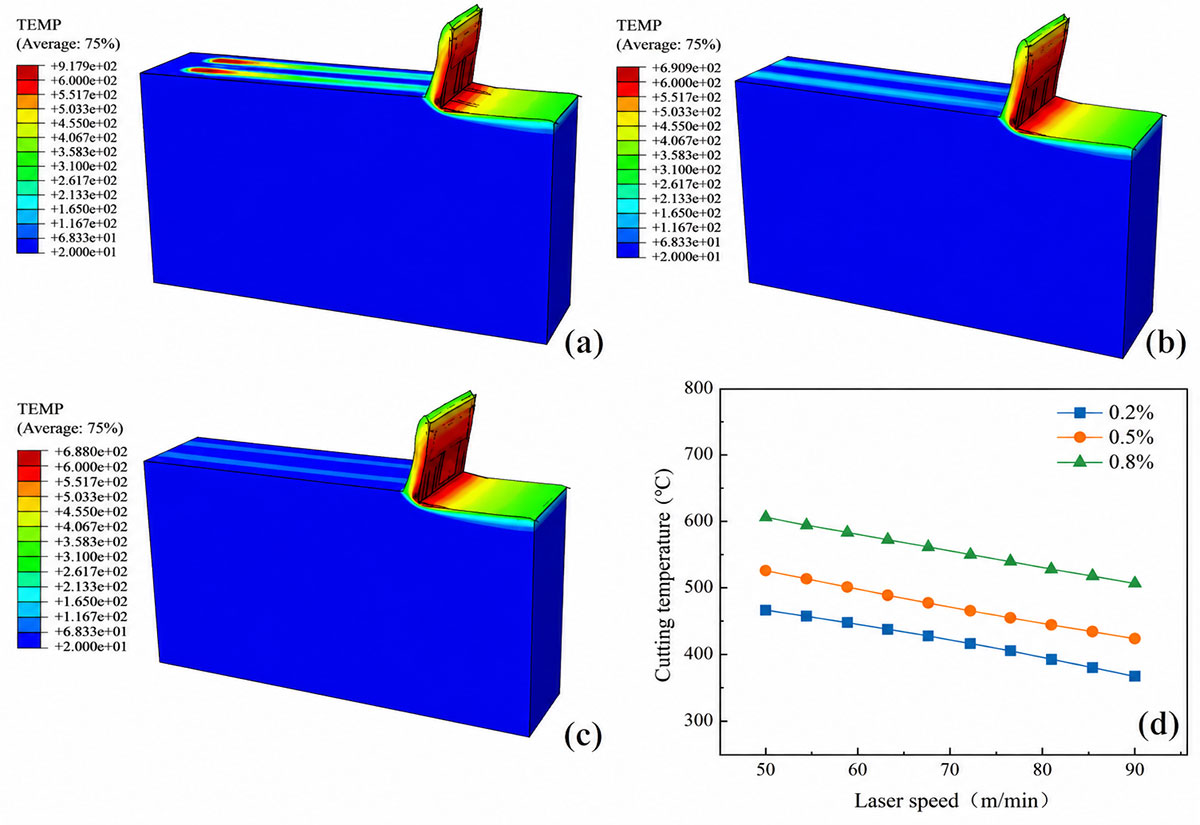
The present study systematically investigates the effects of surface nitriding treatment on the laser-assisted machining behavior of TC4 titanium alloy. Numerical simulations were conducted using the ABAQUS finite element platform to elucidate the influence of nitriding on cutting force, cutting temperature, and residual stress evolution. A three-factor, three-level orthogonal experimental design was established, considering nitriding concentration (0.2%-0.8%), laser power (500-1500 W), and laser scanning speed (50-90 m/min), to examine the coupled effects of these parameters. The results reveal that an increase in laser scanning speed leads to a reduction in both cutting force and cutting temperature, whereas higher laser power results in their escalation. Furthermore, elevated nitriding concentration intensifies the sensitivity of cutting force and temperature to laser parameters. Residual compressive stress increases with higher nitriding concentration and laser power, while the influence of laser scanning speed remains comparatively minor. This work provides a theoretical foundation for the optimization of laser-assisted machining parameters for TC4 titanium alloy, contributing to enhanced surface integrity and improved machinability, and offering guidance for its broader application in advanced manufacturing sectors.
Graphical Abstract
Keywords
Data Availability Statement
Funding
Conflicts of Interest
AI Use Statement
Ethical Approval and Consent to Participate
References
- Lü, Q., Chai, Y., Yang, L., Liu, X., Li, G., & Xiang, D. (2023). Experimental study on cutting force and surface integrity of TC4 titanium alloy with longitudinal ultrasonic-assisted milling. Coatings, 13(10), 1725.
[CrossRef] [Google Scholar] - Zha, X., Qin, H., Yuan, Z., Xi, L., Zhang, T., & Jiang, F. (2024). Effect of cutting feed rate on machining performance and surface integrity in cutting process of Ti-6Al-4V alloy. The International Journal of Advanced Manufacturing Technology, 131(5), 2791--2809.
[CrossRef] [Google Scholar] - Kalantari, O., Jafarian, F., & Fallah, M. M. (2021). Comparative investigation of surface integrity in laser assisted and conventional machining of Ti-6Al-4 V alloy. Journal of Manufacturing Processes, 62, 90--98.
[CrossRef] [Google Scholar] - Kalantari, O., Fallah, M. M., Jafarian, F., & Hamzeloo, S. R. (2021). Surface integrity in laser-assisted machining of Ti6Al4V. Proceedings of the Institution of Mechanical Engineers, Part C: Journal of Mechanical Engineering Science, 235(20), 5009--5016.
[CrossRef] [Google Scholar] - Li, Q., Wu, Z., Ji, B., Zhang, S., & Tu, R. (2025). Cutting performance of tin/tisin coated tool during turning of Ti6Al4V titanium alloy. Journal of Materials Engineering and Performance, 34(11), 9374--9387.
[CrossRef] [Google Scholar] - He, T., Tang, Y., Wu, H., Liu, Y., & Chen, J. (2024, June). Research and analysis of TC4 titanium alloy cutting based on crystal plasticity theory. In Journal of Physics: Conference Series (Vol. 2785, No. 1, p. 012131). IOP Publishing.
[CrossRef] [Google Scholar] - Takesue, S., Kikuchi, S., Misaka, Y., Morita, T., & Komotori, J. (2020). Rapid nitriding mechanism of titanium alloy by gas blow induction heating. Surface and Coatings Technology, 399, 126160.
[CrossRef] [Google Scholar] - Fujita, K., Ijiri, M., Inoue, Y., & Kikuchi, S. (2021). Rapid nitriding of titanium alloy with fine grains at room temperature. Advanced Materials, 33(20), 2008298.
[CrossRef] [Google Scholar] - Tarnowski, M., Borowski, T., Skrzypek, S., Kulikowski, K., & Wierzchoń, T. (2021). Shaping the structure and properties of titanium and Ti6Al7Nb titanium alloy in low-temperature plasma nitriding processes. Journal of Alloys and Compounds, 864, 158896.
[CrossRef] [Google Scholar] - Zong, X., Wang, H., Tang, H., Cheng, X., Tian, X., & Ran, X. (2023). Microstructure evolution and mass transfer behavior during multi-pass laser surface nitriding process on titanium alloy. Surface and Coatings Technology, 466, 129565.
[CrossRef] [Google Scholar] - Zhang, L., Shao, M., Zhang, Z., Yi, X., Yan, J., Zhou, Z., ... & Li, Y. (2023). Corrosion behavior of nitrided layer of Ti6Al4V titanium alloy by hollow cathodic plasma source nitriding. Materials, 16(8), 2961.
[CrossRef] [Google Scholar] - Ongtrakulkij, G., Kajornchaiyakul, J., Kondoh, K., & Khantachawana, A. (2022). Investigation of microstructure, residual stress, and hardness of Ti-6Al-4V after plasma nitriding process with different times and temperatures. Coatings, 12(12), 1932.
[CrossRef] [Google Scholar] - Li, Y., Liang, X., Cao, Z., Zhang, H., Lang, M., Xie, C., ... & He, W. (2025). Enhancement of wear resistance in TC6 titanium alloy through a combined treatment of laser shock peening and nitrogen ion implantation at 300° C. Journal of Materials Research and Technology, 36, 203--216.
[CrossRef] [Google Scholar] - Liu, F. H., & Pang, M. (2024). Effect of laser scanning velocity on the microstructure and wear resistance of laser nitride h-BN self-lubricating. Materials Today Communications, 39, 108601.
[CrossRef] [Google Scholar] - Xu, B., Zhang, J., Liu, X., Liu, H., & Zhao, W. (2023). Fully coupled thermomechanical simulation of laser-assisted machining Ti6Al4V reveals the mechanism of morphological evolution during serrated chip formation. Journal of Materials Processing Technology, 315, 117925.
[CrossRef] [Google Scholar] - Zhang, Z., Chai, Y., Yang, M., & He, G. (2024). Enhancing mechanism of TC4 high-cycle fatigue performance by the introduction of hard nitride mono-and multilayer coatings. International Journal of Fatigue, 182, 108219.
[CrossRef] [Google Scholar] - Gu, Y., Duan, X., Xu, Y., Shi, Y., Zhu, M., Feng, X., ... & Korzhyk, V. (2024). Preparation of ultra-thick, crack-free, titanium nitride coatings using a full-domain power-modulated laser. Journal of Manufacturing Processes, 113, 346--359.
[CrossRef] [Google Scholar] - Yang, Y. L., Zhao, G. J., Zhang, D., & Liu, C. S. (2006). Improving the surface property of TC4 alloy by laser nitriding and its mechanism. Acta metallurgica sinica (English letters), 19(2), 151--156.
[CrossRef] [Google Scholar] - Yang, Y., Cao, S., Zhang, S., Xu, C., & Qin, G. (2017). Microstructure and wear resistance of Ti--Cu--N composite coating prepared via laser cladding/laser nitriding technology on Ti--6Al--4V alloy. Applied Physics A, 123(7), 474.
[CrossRef] [Google Scholar] - Peng, Z., Zhang, X., Liu, L., Xu, G., Wang, G., & Zhao, M. (2023). Effect of high-speed ultrasonic vibration cutting on the microstructure, surface integrity, and wear behavior of titanium alloy. Journal of materials research and technology, 24, 3870--3888.
[CrossRef] [Google Scholar] - Kong, X., Hu, G., Hou, N., Liu, N., & Wang, M. (2023). Numerical and experimental investigations on the laser assisted machining of the TC6 titanium alloy. Journal of Manufacturing Processes, 96, 68--79.
[CrossRef] [Google Scholar] - Khajehzadeh, M., & Razfar, M. R. (2020). Process parameters influence on laser-assisted machining-induced residual stresses. Materials and Manufacturing Processes, 35(15), 1680--1689.
[CrossRef] [Google Scholar] - Rashid, R. R., Sun, S., Wang, G., & Dargusch, M. S. (2012). An investigation of cutting forces and cutting temperatures during laser-assisted machining of the Ti--6Cr--5Mo--5V--4Al beta titanium alloy. International Journal of Machine Tools and Manufacture, 63, 58--69.
[CrossRef] [Google Scholar] - Gupta, M. K., Niesłony, P., Korkmaz, M. E., Kuntoğlu, M., Królczyk, G. M., Günay, M., & Sarikaya, M. (2023). Comparison of tool wear, surface morphology, specific cutting energy and cutting temperature in machining of titanium alloys under hybrid and green cooling strategies. International Journal of Precision Engineering and Manufacturing-Green Technology, 10(6), 1393--1406.
[CrossRef] [Google Scholar] - Ribeiro-Carvalho, S., Horovistiz, A., & Davim, J. P. (2021). Material model assessment in Ti6Al4V machining simulations with FEM. Proceedings of the Institution of Mechanical Engineers, Part C: Journal of Mechanical Engineering Science, 235(21), 5500--5510.
[CrossRef] [Google Scholar] - Qian, X., & Duan, X. (2019). Constitutive model and cutting simulation of titanium alloy Ti6Al4V after heat treatment. Materials, 12(24), 4145.
[CrossRef] [Google Scholar] - Divse, V., Bhandarkar, A., Nayak, J., Thomas, V., & Marla, D. (2024). A FEM-based coupled thermo-mechanical model of laser-assisted machining of Ti6Al4V---a focus on chip morphology. The International Journal of Advanced Manufacturing Technology, 134(5), 2587--2605.
[CrossRef] [Google Scholar] - Yang, J., Sun, S., Brandt, M., & Yan, W. (2010). Experimental investigation and 3D finite element prediction of the heat affected zone during laser assisted machining of Ti6Al4V alloy. Journal of Materials Processing Technology, 210(15), 2215--2222.
[CrossRef] [Google Scholar] - Pfefferkorn, F. E., Lei, S., Jeon, Y., & Haddad, G. (2009). A metric for defining the energy efficiency of thermally assisted machining. International Journal of Machine Tools and Manufacture, 49(5), 357--365.
[CrossRef] [Google Scholar] - Dargusch, M. S., Sivarupan, T., Bermingham, M., Rashid, R. A. R., Palanisamy, S., & Sun, S. (2021). Challenges in laser-assisted milling of titanium alloys. International Journal of Extreme Manufacturing, 3(1), 015001.
[CrossRef] [Google Scholar]
Cite This Article
TY  - JOUR
AU  - Zhang, Ying
AU  - Zhao, Zhimin
AU  - Wang, Kedong
PY  - 2026
DA  - 2026/09/03
TI  - Investigation on the Mechanism of Laser-Assisted Machining of Surface-Nitrided TC4 Titanium Alloy
JO  - Journal of Materials Durability and Engineering
T2  - Journal of Materials Durability and Engineering
JF  - Journal of Materials Durability and Engineering
VL  - 1
IS  - 1
SP  - 52
EP  - 68
DO  - 10.62762/JMDE.2026.886891
UR  - https://www.icck.org/article/abs/JMDE.2026.886891
KW  - TC4 titanium alloy
KW  - surface nitriding
KW  - laser-assisted machining
KW  - residual compressive stress
KW  - finite element simulation
AB  - The present study systematically investigates the effects of surface nitriding treatment on the laser-assisted machining behavior of TC4 titanium alloy. Numerical simulations were conducted using the ABAQUS finite element platform to elucidate the influence of nitriding on cutting force, cutting temperature, and residual stress evolution. A three-factor, three-level orthogonal experimental design was established, considering nitriding concentration (0.2%-0.8%), laser power (500-1500 W), and laser scanning speed (50-90 m/min), to examine the coupled effects of these parameters. The results reveal that an increase in laser scanning speed leads to a reduction in both cutting force and cutting temperature, whereas higher laser power results in their escalation. Furthermore, elevated nitriding concentration intensifies the sensitivity of cutting force and temperature to laser parameters. Residual compressive stress increases with higher nitriding concentration and laser power, while the influence of laser scanning speed remains comparatively minor. This work provides a theoretical foundation for the optimization of laser-assisted machining parameters for TC4 titanium alloy, contributing to enhanced surface integrity and improved machinability, and offering guidance for its broader application in advanced manufacturing sectors.
SN  - pending
PB  - Institute of Central Computation and Knowledge
LA  - English
ER  -
@article{Zhang2026Investigat,
  author = {Ying Zhang and Zhimin Zhao and Kedong Wang},
  title = {Investigation on the Mechanism of Laser-Assisted Machining of Surface-Nitrided TC4 Titanium Alloy},
  journal = {Journal of Materials Durability and Engineering},
  year = {2026},
  volume = {1},
  number = {1},
  pages = {52-68},
  doi = {10.62762/JMDE.2026.886891},
  url = {https://www.icck.org/article/abs/JMDE.2026.886891},
  abstract = {The present study systematically investigates the effects of surface nitriding treatment on the laser-assisted machining behavior of TC4 titanium alloy. Numerical simulations were conducted using the ABAQUS finite element platform to elucidate the influence of nitriding on cutting force, cutting temperature, and residual stress evolution. A three-factor, three-level orthogonal experimental design was established, considering nitriding concentration (0.2\%-0.8\%), laser power (500-1500 W), and laser scanning speed (50-90 m/min), to examine the coupled effects of these parameters. The results reveal that an increase in laser scanning speed leads to a reduction in both cutting force and cutting temperature, whereas higher laser power results in their escalation. Furthermore, elevated nitriding concentration intensifies the sensitivity of cutting force and temperature to laser parameters. Residual compressive stress increases with higher nitriding concentration and laser power, while the influence of laser scanning speed remains comparatively minor. This work provides a theoretical foundation for the optimization of laser-assisted machining parameters for TC4 titanium alloy, contributing to enhanced surface integrity and improved machinability, and offering guidance for its broader application in advanced manufacturing sectors.},
  keywords = {TC4 titanium alloy, surface nitriding, laser-assisted machining, residual compressive stress, finite element simulation},
  issn = {pending},
  publisher = {Institute of Central Computation and Knowledge}
}
Article Metrics
Publisher's Note
ICCK stays neutral with regard to jurisdictional claims in published maps and institutional affiliations.
Rights and Permissions
 Copyright © 2026 by the Author(s). Published by Institute of Central Computation and Knowledge. This article is an open access article distributed under the terms and conditions of the Creative Commons Attribution (CC BY) license (https://creativecommons.org/licenses/by/4.0/), which permits use, sharing, adaptation, distribution and reproduction in any medium or format, as long as you give appropriate credit to the original author(s) and the source, provide a link to the Creative Commons licence, and indicate if changes were made.


Portico
