


Effect of Silver Nanoparticle Incorporation into an Epoxy Resin-Based Endodontic Sealer on Dentinal Tubule Penetration: An In Vitro Scanning Electron Microscopy Study


Article Information
Abstract
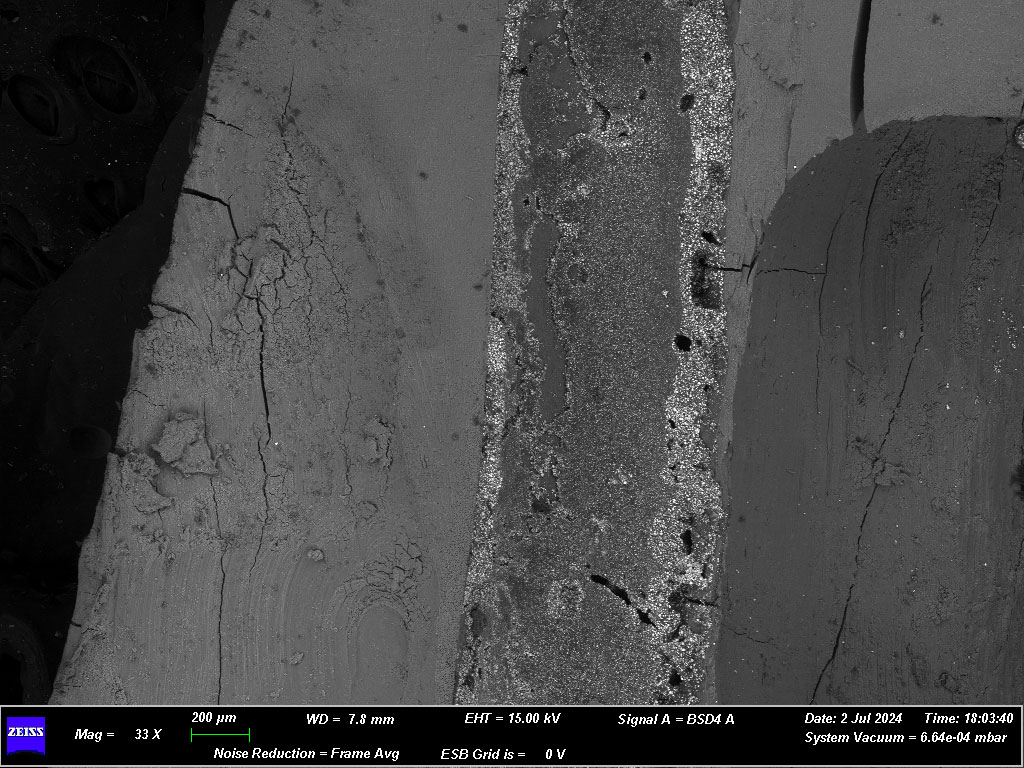
The long-term success of root canal treatment relies on effective chemomechanical disinfection and the ability of endodontic sealers to penetrate dentinal tubules, thereby improving the seal and limiting residual bacterial colonization. Silver nanoparticles (AgNPs) have attracted attention for their broad-spectrum antimicrobial activity; however, their influence on the dentinal tubule penetration of epoxy resin-based sealers remains incompletely understood. This study aimed to evaluate the effect of incorporating silver nanoparticles into an epoxy resin-based endodontic sealer on dentinal tubule penetration using scanning electron microscopy (SEM). Extracted human single-rooted teeth were instrumented, irrigated, and randomly allocated into a control group obturated with a conventional epoxy resin-based sealer and an experimental group obturated with the same sealer modified with silver nanoparticles. After setting, specimens were longitudinally sectioned and examined by SEM. The experimental sealer showed satisfactory adaptation and effective penetration comparable to the control group. Incorporating silver nanoparticles appears to preserve dentinal tubule penetration while potentially providing additional antimicrobial advantages, suggesting that modified sealers represent a promising strategy for enhancing endodontic disinfection without compromising sealing performance.
Graphical Abstract
Keywords
Data Availability Statement
Funding
Conflicts of Interest
AI Use Statement
Ethical Approval and Consent to Participate
References
- Mehta, D., Coleman, A., & Lessani, M. (2025). Success and failure of endodontic treatment: predictability, complications, challenges and maintenance. British Dental Journal, 238(7), 527-535.
[CrossRef] [Google Scholar] - Gomes, B. P., Aveiro, E., & Kishen, A. (2023). Irrigants and irrigation activation systems in Endodontics. Brazilian dental journal, 34, 1-33.
[CrossRef] [Google Scholar] - Neelakantan, P., Romero, M., Vera, J., Daood, U., Khan, A. U., Yan, A., & Cheung, G. S. P. (2017). Biofilms in endodontics—current status and future directions. International journal of molecular sciences, 18(8), 1748.
[CrossRef] [Google Scholar] - Yang, S., Meng, X., Zhen, Y., Baima, Q., Wang, Y., Jiang, X., & Xu, Z. (2024). Strategies and mechanisms targeting Enterococcus faecalis biofilms associated with endodontic infections: A comprehensive review. Frontiers in Cellular and Infection Microbiology, 14, 1433313.
[CrossRef] [Google Scholar] - Komabayashi, T., Colmenar, D., Cvach, N., Bhat, A., Primus, C., & Imai, Y. (2020). Comprehensive review of current endodontic sealers. Dental Materials Journal, 39(5), 703--720.
[CrossRef] [Google Scholar] - Pirani, C., & Camilleri, J. (2023). Effectiveness of root canal filling materials and techniques for treatment of apical periodontitis: A systematic review. International Endodontic Journal, 56, 436-454.
[CrossRef] [Google Scholar] - Azizi, H., Hadad, A., Levy, D. H., Ben Itzhak, J., Kim, H. C., & Solomonov, M. (2024). Epoxy vs. calcium silicate-based root canal sealers for different clinical scenarios: a narrative review. Dentistry Journal, 12(4), 85.
[CrossRef] [Google Scholar] - Ivkovi\'c, U., Moreno-Rabi\'e, C., Mignon, A., EzEldeen, M., & Jacobs, R. (2025). Multifunctional nanoparticles in endodontics: Applications, challenges, and future directions. Discover Nano, 20(1), 130.
[CrossRef] [Google Scholar] - Almutairi, B., & Alkhudhairy, F. (2025). Nanoparticles modified bioceramic sealers on solubility, antimicrobial efficacy, pushout bond strength and marginal adaptation at apical-third of canal dentin. PeerJ, 13, e18840. http://dx.doi.org/10.7717/peerj.18840
[Google Scholar] - Karataş, H., Eker, F., Akdaşçi, E., Bechelany, M., & Karav, S. (2026). Silver nanoparticles in antibacterial research: mechanisms, applications, and emerging perspectives. International journal of molecular sciences, 27(2), 927.
[CrossRef] [Google Scholar] - Afkhami, F., Chen, Y., Walsh, L. J., Peters, O. A., & Xu, C. (2024). Application of nanomaterials in endodontics. BME Frontiers, 5, 0043.
[CrossRef] [Google Scholar] - Bukhary, S., Alkahtany, S., Almohaimede, A., Alkhayatt, N., Alsulaiman, S., & Alohali, S. (2024). The impact of silver nanoparticles on dentinal tubule penetration of endodontic bioceramic sealer. Applied Sciences, 14(24), 11639.
[CrossRef] [Google Scholar] - Donnermeyer, D., Schmidt, S., Rohrbach, A., Berlandi, J., B\"urklein, S., & Sch\"afer, E. (2021). Debunking the concept of dentinal tubule penetration of endodontic sealers: Sealer staining with Rhodamine B fluorescent dye is an inadequate method. Materials (Basel), 14(12), 3211.
[CrossRef] [Google Scholar] - Schmidt, S., Sch\"afer, E., B\"urklein, S., Rohrbach, A., & Donnermeyer, D. (2021). Minimal dentinal tubule penetration of endodontic sealers in warm vertical compaction by direct detection via SEM analysis. Journal of Clinical Medicine, 10(19), 4440.
[CrossRef] [Google Scholar] - Gulabivala, K., & Ng, Y. L. (2023). Factors that affect the outcomes of root canal treatment and retreatment---A reframing of the principles. International Endodontic Journal, 56(Suppl. 2), 82--115.
[CrossRef] [Google Scholar] - Gazzaneo, I., Amoroso-Silva, P., Pacheco-Yanes, J., Alves, F. R. F., Marceliano-Alves, M., Olivares, P., Meto, A., Mdala, I., Siqueira, J. F., Jr., & R\^o\c{cas, I. N. (2021). Disinfecting and shaping type I C-shaped root canals: A correlative micro-computed tomographic and molecular microbiology study. Journal of Endodontics, 47(4), 621--630.
[CrossRef] [Google Scholar] - Wong, J., Manoil, D., N\"asman, P., Belibasakis, G. N., & Neelakantan, P. (2021). Microbiological aspects of root canal infections and disinfection strategies: An update review on the current knowledge and challenges. Frontiers in Oral Health, 2, 672887.
[CrossRef] [Google Scholar] - Błaszczyk-Pośpiech, A., Struzik, N., Szymonowicz, M., Sareło, P., Wiśniewska-Wrona, M., Wiśniewska, K., ... & Wawrzyńska, M. (2025). Endodontic sealers and innovations to enhance their properties: a current review. Materials, 18(18), 4259.
[CrossRef] [Google Scholar] - Maharti, I. D., Larasputri, I., Herdianto, N., Margono, A., Tasomara, R., & Rosseti, R. (2025). A comparative analysis of adhesion abilities between AH Plus Bioceramic, Ceraseal and AH Plus on root canal dentine surfaces. Journal of Conservative Dentistry and Endodontics, 28(9), 881--885.
[CrossRef] [Google Scholar] - Iqbal, K., Alhomrany, R., Berman, L. H., & Chogle, S. (2023). Enhancement of antimicrobial effect of endodontic sealers using nanoparticles: A systematic review. Journal of Endodontics, 49(10), 1238-1248.
[CrossRef] [Google Scholar] - Afkhami, F., Forghan, P., Gutmann, J. L., & Kishen, A. (2023). Silver nanoparticles and their therapeutic applications in endodontics: A narrative review. Pharmaceutics, 15(3), 715.
[CrossRef] [Google Scholar] - Hassan, N., Riad, M., Ibrahim, S. H., Mahmoud, K., Abulnoor, B. A., & Hassan, R. (2024). Antibacterial and cytotoxicity characteristics of experimental epoxy-based endodontic sealer loaded with silver gold nanoparticles: In vitro study. BDJ Open, 10(1), 81.
[CrossRef] [Google Scholar] - Nagdi, A. H., Mokhless, N. A., & Aboelseoud, M. R. (2025). Evaluation of the tubular penetration of two different types of nanoparticle root canal sealers over apically separated files: A scanning electron microscopic study (in vitro study). BMC Oral Health, 25(1), 887.
[CrossRef] [Google Scholar] - Santamaria, N., Bascones, J., Gallego-Garcia, C., & Gancedo-Caravia, L. (2026). Dentinal tubule penetration of an endodontic sealer in the apical third of root canals after different final irrigation techniques. Journal of Clinical Medicine, 15(3), 930.
[CrossRef] [Google Scholar]
Cite This Article
TY  - JOUR
AU  - Paoletti, Daniele
AU  - Caucci, Martina
AU  - Muscariello, Carmine
AU  - Esposito, Rosa
AU  - Cavarra, Francesco
AU  - Lorusso, Mauro
AU  - Ciavarella, Domenico
AU  - Tepedino, Michele
PY  - 2026
DA  - 2026/09/18
TI  - Effect of Silver Nanoparticle Incorporation into an Epoxy Resin-Based Endodontic Sealer on Dentinal Tubule Penetration: An In Vitro Scanning Electron Microscopy Study
JO  - Journal of Oral and Dental Approaches
T2  - Journal of Oral and Dental Approaches
JF  - Journal of Oral and Dental Approaches
VL  - 1
IS  - 1
SP  - 4
EP  - 12
DO  - 10.62762/JODA.2026.359949
UR  - https://www.icck.org/article/abs/JODA.2026.359949
KW  - silver nanoparticles
KW  - endodontic sealer
KW  - dentinal tubule penetration
KW  - epoxy resin-based sealer
KW  - root canal obturation
KW  - scanning electron microscopy
KW  - endodontics
KW  - nanotechnology
AB  - The long-term success of root canal treatment relies on effective chemomechanical disinfection and the ability of endodontic sealers to penetrate dentinal tubules, thereby improving the seal and limiting residual bacterial colonization. Silver nanoparticles (AgNPs) have attracted attention for their broad-spectrum antimicrobial activity; however, their influence on the dentinal tubule penetration of epoxy resin-based sealers remains incompletely understood. This study aimed to evaluate the effect of incorporating silver nanoparticles into an epoxy resin-based endodontic sealer on dentinal tubule penetration using scanning electron microscopy (SEM). Extracted human single-rooted teeth were instrumented, irrigated, and randomly allocated into a control group obturated with a conventional epoxy resin-based sealer and an experimental group obturated with the same sealer modified with silver nanoparticles. After setting, specimens were longitudinally sectioned and examined by SEM. The experimental sealer showed satisfactory adaptation and effective penetration comparable to the control group. Incorporating silver nanoparticles appears to preserve dentinal tubule penetration while potentially providing additional antimicrobial advantages, suggesting that modified sealers represent a promising strategy for enhancing endodontic disinfection without compromising sealing performance.
SN  - pending
PB  - Institute of Central Computation and Knowledge
LA  - English
ER  -
@article{Paoletti2026Effect,
  author = {Daniele Paoletti and Martina Caucci and Carmine Muscariello and Rosa Esposito and Francesco Cavarra and Mauro Lorusso and Domenico Ciavarella and Michele Tepedino},
  title = {Effect of Silver Nanoparticle Incorporation into an Epoxy Resin-Based Endodontic Sealer on Dentinal Tubule Penetration: An In Vitro Scanning Electron Microscopy Study},
  journal = {Journal of Oral and Dental Approaches},
  year = {2026},
  volume = {1},
  number = {1},
  pages = {4-12},
  doi = {10.62762/JODA.2026.359949},
  url = {https://www.icck.org/article/abs/JODA.2026.359949},
  abstract = {The long-term success of root canal treatment relies on effective chemomechanical disinfection and the ability of endodontic sealers to penetrate dentinal tubules, thereby improving the seal and limiting residual bacterial colonization. Silver nanoparticles (AgNPs) have attracted attention for their broad-spectrum antimicrobial activity; however, their influence on the dentinal tubule penetration of epoxy resin-based sealers remains incompletely understood. This study aimed to evaluate the effect of incorporating silver nanoparticles into an epoxy resin-based endodontic sealer on dentinal tubule penetration using scanning electron microscopy (SEM). Extracted human single-rooted teeth were instrumented, irrigated, and randomly allocated into a control group obturated with a conventional epoxy resin-based sealer and an experimental group obturated with the same sealer modified with silver nanoparticles. After setting, specimens were longitudinally sectioned and examined by SEM. The experimental sealer showed satisfactory adaptation and effective penetration comparable to the control group. Incorporating silver nanoparticles appears to preserve dentinal tubule penetration while potentially providing additional antimicrobial advantages, suggesting that modified sealers represent a promising strategy for enhancing endodontic disinfection without compromising sealing performance.},
  keywords = {silver nanoparticles, endodontic sealer, dentinal tubule penetration, epoxy resin-based sealer, root canal obturation, scanning electron microscopy, endodontics, nanotechnology},
  issn = {pending},
  publisher = {Institute of Central Computation and Knowledge}
}
Article Metrics
Publisher's Note
ICCK stays neutral with regard to jurisdictional claims in published maps and institutional affiliations.
Rights and Permissions
 Copyright © 2026 by the Author(s). Published by Institute of Central Computation and Knowledge. This article is an open access article distributed under the terms and conditions of the Creative Commons Attribution (CC BY) license (https://creativecommons.org/licenses/by/4.0/), which permits use, sharing, adaptation, distribution and reproduction in any medium or format, as long as you give appropriate credit to the original author(s) and the source, provide a link to the Creative Commons licence, and indicate if changes were made.

