

GeoFACT: Geospatial Few-Shot Adaptive and Compatible Training Framework for Remote Sensing Images Classification




Article Information
Abstract
Remote Sensing (RS) data streams necessitate classification models capable of assimilating novel information without the computational burden of retraining from scratch. Although Few-Shot Incremental Learning (FSIL) offers a promising paradigm for adaptation using limited samples, existing methodologies often falter due to the high inter-class similarity and complex background clutter inherent in aerial imagery. To address these challenges, we introduce a novel framework, Geospatial Few-Shot Adaptive Compatible Training, designed to mitigate catastrophic forgetting in dynamic environments. This method ensures forward compatibility by strategically allocating embedding space for future categories via virtual prototypes, while simultaneously maintaining backward compatibility through knowledge distillation and selective network freezing. The proposed framework was rigorously evaluated on the AID and NWPU-RESIS45 benchmark datasets to assess its ability to balance plasticity for new tasks with stability for previously learned classes. Experimental analysis using accuracy, loss, and F1-score metrics demonstrates the robustness of the approach, achieving a base-session accuracy of 96.62% on the AID dataset and 96.74% on the NWPU-RESISC45 dataset. These results confirm that the proposed model effectively addresses the limitations of current state-of-the-art techniques, offering a scalable solution for RS classification, Catastrophic Forgetting, Forward Compatibility, and Few-Shot Incremental Learning.
Graphical Abstract
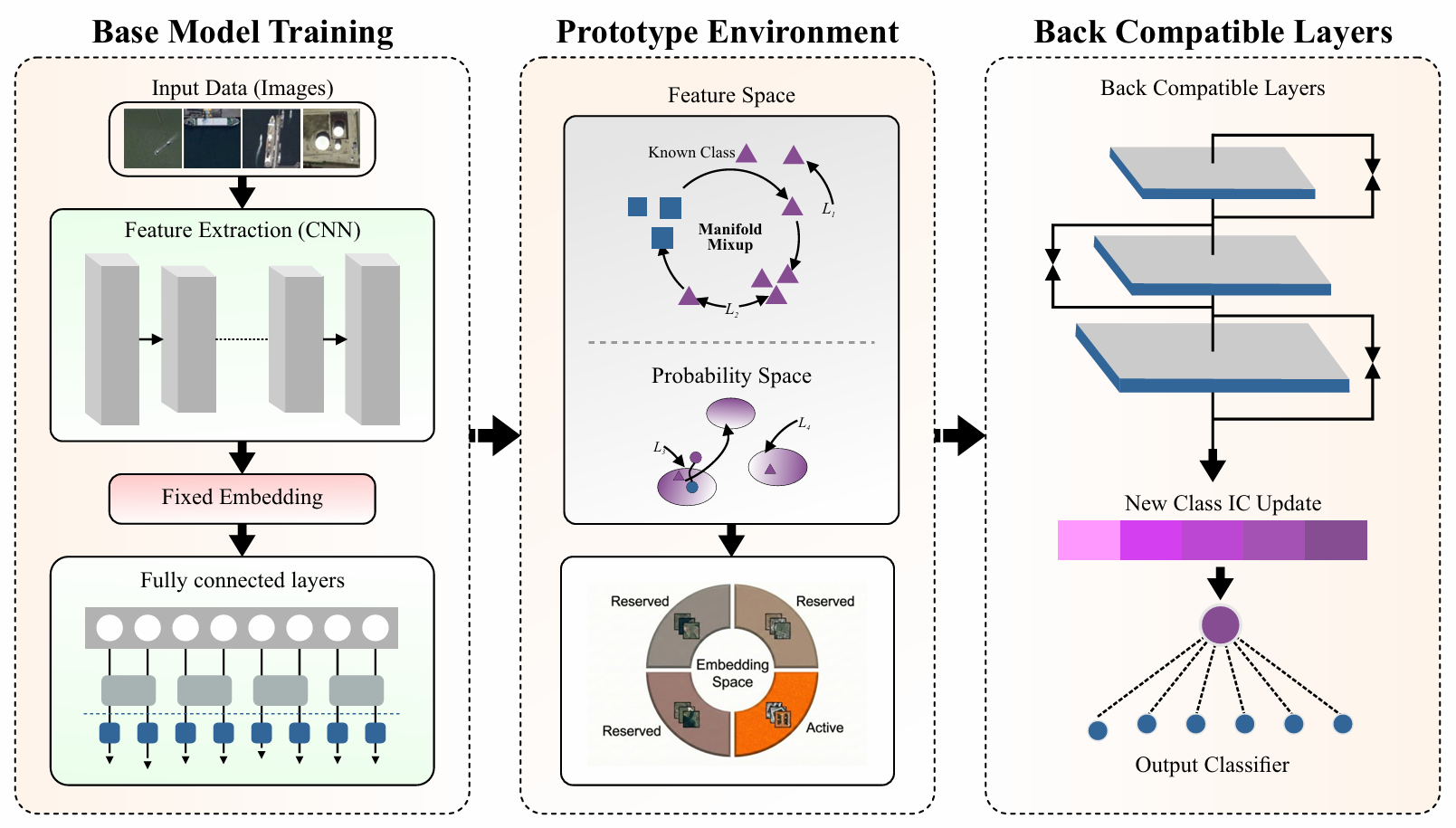
Keywords
Data Availability Statement
Funding
Conflicts of Interest
AI Use Statement
Ethical Approval and Consent to Participate
References
- Cheng, G., Xie, X., Han, J., Guo, L., & Xia, G. S. (2020). Remote sensing image scene classification meets deep learning: Challenges, methods, benchmarks, and opportunities. IEEE Journal of Selected Topics in Applied Earth Observations and Remote Sensing, 13, 3735-3756.
[CrossRef] [Google Scholar] - Zhu, X. X., Tuia, D., Mou, L., Xia, G. S., Zhang, L., Xu, F., & Fraundorfer, F. (2017). Deep learning in remote sensing: A comprehensive review and list of resources. IEEE geoscience and remote sensing magazine, 5(4), 8-36.
[CrossRef] [Google Scholar] - Ma, L., Liu, Y., Zhang, X., Ye, Y., Yin, G., & Johnson, B. A. (2019). Deep learning in remote sensing applications: A meta-analysis and review. ISPRS journal of photogrammetry and remote sensing, 152, 166-177.
[CrossRef] [Google Scholar] - Parisi, G. I., Kemker, R., Part, J. L., Kanan, C., & Wermter, S. (2019). Continual lifelong learning with neural networks: A review. Neural networks, 113, 54-71.
[CrossRef] [Google Scholar] - Gepperth, A., & Hammer, B. (2016). Incremental learning algorithms and applications. In European symposium on artificial neural networks (ESANN).
[Google Scholar] - De Lange, M., Aljundi, R., Masana, M., Parisot, S., Jia, X., Leonardis, A., ... & Tuytelaars, T. (2021). A continual learning survey: Defying forgetting in classification tasks. IEEE transactions on pattern analysis and machine intelligence, 44(7), 3366-3385.
[CrossRef] [Google Scholar] - Lopez-Paz, D., & Ranzato, M. A. (2017). Gradient episodic memory for continual learning. Advances in neural information processing systems, 30.
[Google Scholar] - Li, Z., & Hoiem, D. (2017). Learning without forgetting. IEEE transactions on pattern analysis and machine intelligence, 40(12), 2935-2947.
[CrossRef] [Google Scholar] - Zhou, D. W., Sun, H. L., Ning, J., Ye, H. J., & Zhan, D. C. (2024, August). Continual learning with pre-trained models: a survey. In Proceedings of the Thirty-Third International Joint Conference on Artificial Intelligence (pp. 8363-8371).
[CrossRef] [Google Scholar] - Thrun, S. (1998). Lifelong learning algorithms. In Learning to learn (pp. 181-209). Boston, MA: Springer US.
[CrossRef] [Google Scholar] - Masana, M., Liu, X., Twardowski, B., Menta, M., Bagdanov, A. D., & Van De Weijer, J. (2022). Class-incremental learning: survey and performance evaluation on image classification. IEEE Transactions on Pattern Analysis and Machine Intelligence, 45(5), 5513-5533.
[CrossRef] [Google Scholar] - Ye, Z., Zhang, Y., Zhang, J., Li, W., & Bai, L. (2024). A multiscale incremental learning network for remote sensing scene classification. IEEE transactions on geoscience and remote sensing, 62, 1-15.
[CrossRef] [Google Scholar] - Song, J., Jia, H., & Xu, F. (2023, July). Class-incremental learning for remote sensing images based on knowledge distillation. In IGARSS 2023-2023 IEEE International Geoscience and Remote Sensing Symposium (pp. 5026-5028). IEEE.
[CrossRef] [Google Scholar] - Kirkpatrick, J., Pascanu, R., Rabinowitz, N., Veness, J., Desjardins, G., Rusu, A. A., ... & Hadsell, R. (2017). Overcoming catastrophic forgetting in neural networks. Proceedings of the national academy of sciences, 114(13), 3521-3526.
[CrossRef] [Google Scholar] - Xu, M., Zhao, Y., Liang, Y., & Ma, X. (2022). Hyperspectral image classification based on class-incremental learning with knowledge distillation. Remote Sensing, 14(11), 2556.
[CrossRef] [Google Scholar] - Douillard, A., Cord, M., Ollion, C., Robert, T., & Valle, E. (2020, August). Podnet: Pooled outputs distillation for small-tasks incremental learning. In European conference on computer vision (pp. 86-102). Cham: Springer International Publishing.
[CrossRef] [Google Scholar] - Rusu, A. A., Rabinowitz, N. C., Desjardins, G., Soyer, H., Kirkpatrick, J., Kavukcuoglu, K., ... & Hadsell, R. (2016). Progressive neural networks. arXiv preprint arXiv:1606.04671.
[Google Scholar] - Rebuffi, S. A., Kolesnikov, A., Sperl, G., & Lampert, C. H. (2017, July). iCaRL: Incremental Classifier and Representation Learning. In 2017 IEEE Conference on Computer Vision and Pattern Recognition (CVPR) (pp. 5533-5542). IEEE.
[CrossRef] [Google Scholar] - Bonicelli, L., Boschini, M., Porrello, A., Spampinato, C., & Calderara, S. (2022). On the effectiveness of lipschitz-driven rehearsal in continual learning. Advances in Neural Information Processing Systems, 35, 31886-31901.
[Google Scholar] - Zhou, D. W., Wang, F. Y., Ye, H. J., Ma, L., Pu, S., & Zhan, D. C. (2022, June). Forward Compatible Few-Shot Class-Incremental Learning. In 2022 IEEE/CVF Conference on Computer Vision and Pattern Recognition (CVPR) (pp. 9036-9046). IEEE.
[CrossRef] [Google Scholar] - Zhang, C., Song, N., Lin, G., Zheng, Y., Pan, P., & Xu, Y. (2021, June). Few-Shot Incremental Learning with Continually Evolved Classifiers. In 2021 IEEE/CVF Conference on Computer Vision and Pattern Recognition (CVPR) (pp. 12450-12459). IEEE.
[CrossRef] [Google Scholar] - Yang, Y., Yuan, H., Li, X., Lin, Z., Torr, P., & Tao, D. (2023). Neural collapse inspired feature-classifier alignment for few-shot class incremental learning. arXiv preprint arXiv:2302.03004.
[Google Scholar] - Xia, G. S., Hu, J., Hu, F., Shi, B., Bai, X., Zhong, Y., ... & Lu, X. (2017). AID: A benchmark data set for performance evaluation of aerial scene classification. IEEE Transactions on Geoscience and Remote Sensing, 55(7), 3965-3981.
[CrossRef] [Google Scholar] - Cheng, G., Han, J., & Lu, X. (2017). Remote sensing image scene classification: Benchmark and state of the art. Proceedings of the IEEE, 105(10), 1865-1883.
[CrossRef] [Google Scholar] - Bahng, H., Jahanian, A., Sankaranarayanan, S., & Isola, P. (2022). Exploring visual prompts for adapting large-scale models. arXiv preprint arXiv:2203.17274.
[Google Scholar] - Castro, F. M., Marín-Jiménez, M. J., Guil, N., Schmid, C., & Alahari, K. (2018, September). End-to-End Incremental Learning. In European Conference on Computer Vision (pp. 241-257). Cham: Springer International Publishing.
[CrossRef] [Google Scholar] - Hou, S., Pan, X., Loy, C. C., Wang, Z., & Lin, D. (2019, June). Learning a Unified Classifier Incrementally via Rebalancing. In 2019 IEEE/CVF Conference on Computer Vision and Pattern Recognition (CVPR) (pp. 831-839). IEEE.
[CrossRef] [Google Scholar] - Tao, X., Hong, X., Chang, X., Dong, S., Wei, X., & Gong, Y. (2020, June). Few-Shot Class-Incremental Learning. In 2020 IEEE/CVF Conference on Computer Vision and Pattern Recognition (CVPR) (pp. 12180-12189). IEEE.
[CrossRef] [Google Scholar] - Zhou, F., Wang, P., Zhang, L., Wei, W., & Zhang, Y. (2023, June). Revisiting Prototypical Network for Cross Domain Few-Shot Learning. In 2023 IEEE/CVF Conference on Computer Vision and Pattern Recognition (CVPR) (pp. 20061-20070). IEEE.
[CrossRef] [Google Scholar] - Zhang, C., Cai, Y., Lin, G., & Shen, C. (2022). Deepemd: Differentiable earth mover's distance for few-shot learning. IEEE Transactions on Pattern Analysis and Machine Intelligence, 45(5), 5632-5648.
[CrossRef] [Google Scholar] - Finn, C., Abbeel, P., & Levine, S. (2017, July). Model-agnostic meta-learning for fast adaptation of deep networks. In International conference on machine learning (pp. 1126-1135). PMLR.
[Google Scholar] - Yu, C. C., Chen, T. Y., Hsu, C. W., & Cheng, H. Y. (2024). Incremental scene classification using dual knowledge distillation and classifier discrepancy on natural and remote sensing images. Electronics, 13(3), 583.
[CrossRef] [Google Scholar]
Cite This Article
TY  - JOUR
AU  - Farooq, Kawsar
AU  - Zarar, Muhammad
AU  - Muhammad, Yar
AU  - Hasnat, Muhammad
AU  - Li, Yanze
AU  - Luo, Xin
PY  - 2026
DA  - 2026/04/19
TI  - GeoFACT: Geospatial Few-Shot Adaptive and Compatible Training Framework for Remote Sensing Images Classification
JO  - ICCK Transactions on Applied Intelligence and Cybernetics
T2  - ICCK Transactions on Applied Intelligence and Cybernetics
JF  - ICCK Transactions on Applied Intelligence and Cybernetics
VL  - 1
IS  - 1
SP  - 53
EP  - 66
DO  - 10.62762/TAIC.2026.348838
UR  - https://www.icck.org/article/abs/TAIC.2026.348838
KW  - incremental learning
KW  - few-shot learning
KW  - remote sensing
KW  - Geo-FACT
KW  - image processing
AB  - Remote Sensing (RS) data streams necessitate classification models capable of assimilating novel information without the computational burden of retraining from scratch. Although Few-Shot Incremental Learning (FSIL) offers a promising paradigm for adaptation using limited samples, existing methodologies often falter due to the high inter-class similarity and complex background clutter inherent in aerial imagery. To address these challenges, we introduce a novel framework, Geospatial Few-Shot Adaptive Compatible Training, designed to mitigate catastrophic forgetting in dynamic environments. This method ensures forward compatibility by strategically allocating embedding space for future categories via virtual prototypes, while simultaneously maintaining backward compatibility through knowledge distillation and selective network freezing. The proposed framework was rigorously evaluated on the AID and NWPU-RESIS45 benchmark datasets to assess its ability to balance plasticity for new tasks with stability for previously learned classes. Experimental analysis using accuracy, loss, and F1-score metrics demonstrates the robustness of the approach, achieving a base-session accuracy of 96.62% on the AID dataset and 96.74% on the NWPU-RESISC45 dataset. These results confirm that the proposed model effectively addresses the limitations of current state-of-the-art techniques, offering a scalable solution for RS classification, Catastrophic Forgetting, Forward Compatibility, and Few-Shot Incremental Learning.
SN  - 3143-0309
PB  - Institute of Central Computation and Knowledge
LA  - English
ER  -
@article{Farooq2026GeoFACT,
  author = {Kawsar Farooq and Muhammad Zarar and Yar Muhammad and Muhammad Hasnat and Yanze Li and Xin Luo},
  title = {GeoFACT: Geospatial Few-Shot Adaptive and Compatible Training Framework for Remote Sensing Images Classification},
  journal = {ICCK Transactions on Applied Intelligence and Cybernetics},
  year = {2026},
  volume = {1},
  number = {1},
  pages = {53-66},
  doi = {10.62762/TAIC.2026.348838},
  url = {https://www.icck.org/article/abs/TAIC.2026.348838},
  abstract = {Remote Sensing (RS) data streams necessitate classification models capable of assimilating novel information without the computational burden of retraining from scratch. Although Few-Shot Incremental Learning (FSIL) offers a promising paradigm for adaptation using limited samples, existing methodologies often falter due to the high inter-class similarity and complex background clutter inherent in aerial imagery. To address these challenges, we introduce a novel framework, Geospatial Few-Shot Adaptive Compatible Training, designed to mitigate catastrophic forgetting in dynamic environments. This method ensures forward compatibility by strategically allocating embedding space for future categories via virtual prototypes, while simultaneously maintaining backward compatibility through knowledge distillation and selective network freezing. The proposed framework was rigorously evaluated on the AID and NWPU-RESIS45 benchmark datasets to assess its ability to balance plasticity for new tasks with stability for previously learned classes. Experimental analysis using accuracy, loss, and F1-score metrics demonstrates the robustness of the approach, achieving a base-session accuracy of 96.62\% on the AID dataset and 96.74\% on the NWPU-RESISC45 dataset. These results confirm that the proposed model effectively addresses the limitations of current state-of-the-art techniques, offering a scalable solution for RS classification, Catastrophic Forgetting, Forward Compatibility, and Few-Shot Incremental Learning.},
  keywords = {incremental learning, few-shot learning, remote sensing, Geo-FACT, image processing},
  issn = {3143-0309},
  publisher = {Institute of Central Computation and Knowledge}
}
Article Metrics
Publisher's Note
ICCK stays neutral with regard to jurisdictional claims in published maps and institutional affiliations.
Rights and Permissions
 Copyright © 2026 by the Author(s). Published by Institute of Central Computation and Knowledge. This article is an open access article distributed under the terms and conditions of the Creative Commons Attribution (CC BY) license (https://creativecommons.org/licenses/by/4.0/), which permits use, sharing, adaptation, distribution and reproduction in any medium or format, as long as you give appropriate credit to the original author(s) and the source, provide a link to the Creative Commons licence, and indicate if changes were made.


Portico
