

Hybrid CNN–Transformer Framework for Structure-Preserving Enhancement of Coronary Angiography Images


Article Information
Abstract
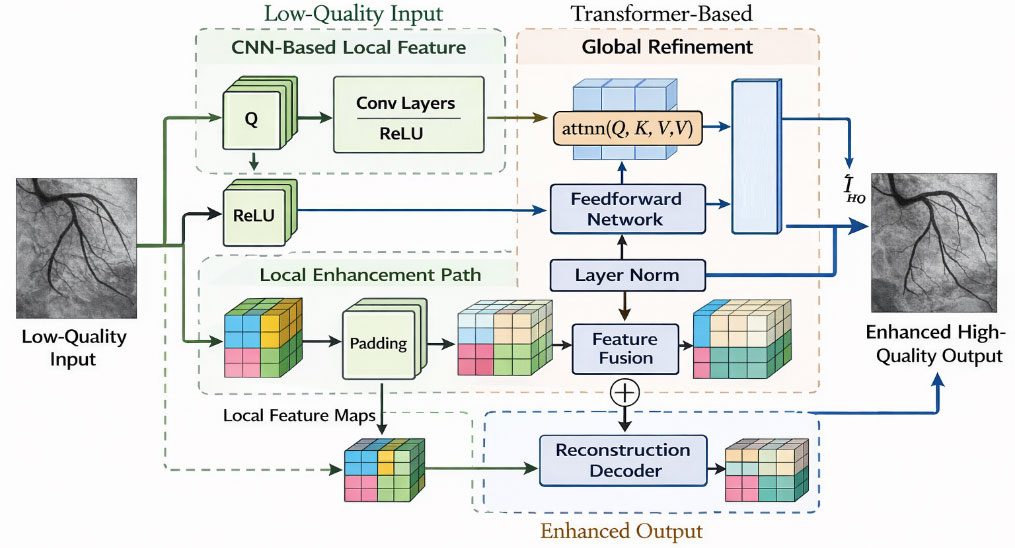
Coronary artery disease (CAD) remains a leading global cause of mortality, with X-ray coronary angiography serving as the clinical gold standard for evaluating coronary morphology and stenosis. However, angiographic images are often compromised by low contrast, noise, motion blur, and compression artifacts that obscure fine vascular structures and impede both diagnostic interpretation and automated analysis. To address these limitations, this study proposes a hybrid deep learning framework integrating convolutional neural networks (CNNs) with Transformer-based self-attention mechanisms for coronary angiography enhancement. The CNN component targets local feature extraction to suppress noise, enhance edges, and restore vessel details, while the Transformer module captures long-range spatial dependencies to preserve global anatomical continuity and structural coherence. The framework is trained in a supervised manner using paired high-quality and synthetically degraded images from the ARCADE dataset. Quantitative evaluation shows that the proposed hybrid model achieves a Peak Signal-to-Noise Ratio (PSNR) of 36.10 dB and Structural Similarity Index Measure (SSIM) of 0.9670, outperforming the CNN-only baseline (33.69 dB PSNR, 0.9594 SSIM) and conventional methods such as histogram equalization (28.4 dB, 0.87 SSIM) and CLAHE (29.6 dB, 0.90 SSIM). The hybrid approach yields a 2.41~dB PSNR improvement over the CNN baseline, indicating superior reconstruction fidelity and structural preservation. Qualitative assessment further confirms enhanced vessel clarity, contrast, and continuity of thin distal coronary branches. These findings demonstrate the effectiveness of global–local feature fusion for robust and clinically meaningful angiographic image enhancement.
Graphical Abstract
Keywords
Data Availability Statement
Funding
Conflicts of Interest
AI Use Statement
Ethical Approval and Consent to Participate
References
- Edpuganti, S., Shamim, A., Gangolli, V. H., Weerasekara, R. A. D. K. N., & Yellamilli, A. (2025). Artificial intelligence in cardiovascular imaging: Current landscape, clinical impact, and future directions. Discoveries, 13(2), e211.
[CrossRef] [Google Scholar] - Gurav, A., Revaiah, P. C., Tsai, T. Y., Miyashita, K., Tobe, A., Oshima, A., ... & Serruys, P. W. (2024). Coronary angiography: a review of the state of the art and the evolution of angiography in cardio therapeutics. Frontiers in cardiovascular medicine, 11, 1468888.
[CrossRef] [Google Scholar] - Asif, S., Wenhui, Y., ur-Rehman, S., ul-ain, Q., Amjad, K., Yueyang, Y., ... & Awais, M. (2025). Advancements and prospects of machine learning in medical diagnostics: unveiling the future of diagnostic precision. Archives of Computational Methods in Engineering, 32(2), 853-883.
[CrossRef] [Google Scholar] - Liao, Q. M., Hussain, W., Liao, Z. X., Hussain, S., Jiang, Z. L., Zhu, Y. H., ... & Wu, D. D. (2025). Computer-aided application in medicine and biomedicine. International Journal of Computational Intelligence Systems, 18(1), 221.
[CrossRef] [Google Scholar] - Benz, D. C., Benetos, G., Rampidis, G., Von Felten, E., Bakula, A., Sustar, A., ... & Buechel, R. R. (2020). Validation of deep-learning image reconstruction for coronary computed tomography angiography: impact on noise, image quality and diagnostic accuracy. Journal of cardiovascular computed tomography, 14(5), 444-451.
[CrossRef] [Google Scholar] - Hu, J., & Law, K. E. (2025). A Comprehensive Review of Compressed Image Restoration and Compression Artifact Reduction Techniques. IEEE Access, 13, 213824-213840.
[CrossRef] [Google Scholar] - Litjens, G., Kooi, T., Bejnordi, B. E., Setio, A. A. A., Ciompi, F., Ghafoorian, M., ... & Sánchez, C. I. (2017). A survey on deep learning in medical image analysis. Medical image analysis, 42, 60-88.
[CrossRef] [Google Scholar] - Kumar, R. R., & Priyadarshi, R. (2025). Denoising and segmentation in medical image analysis: A comprehensive review on machine learning and deep learning approaches. Multimedia Tools and Applications, 84(12), 10817-10875.
[CrossRef] [Google Scholar] - Shen, D., Wu, G., & Suk, H. I. (2017). Deep learning in medical image analysis. Annual Review of Biomedical Engineering, 19, 221-248.
[CrossRef] [Google Scholar] - Ali, A. M., Benjdira, B., Koubaa, A., El-Shafai, W., Khan, Z., & Boulila, W. (2023). Vision Transformers in Image Restoration: A Survey. Sensors, 23(5), 2385.
[CrossRef] [Google Scholar] - Zhang, C., Wang, J., Shi, Y., Yin, B., & Ling, N. (2025). A CNN-transformer hybrid network with selective fusion and dual attention for image super-resolution. Multimedia Systems, 31(2), 126.
[CrossRef] [Google Scholar] - Yang, H., Wang, Z., Liu, X., Li, C., Xin, J., & Wang, Z. (2023). Deep learning in medical image super resolution: a review. Applied Intelligence, 53(18), 20891-20916.
[CrossRef] [Google Scholar] - Zhao, B., Peng, J., Chen, C., Fan, Y., Zhang, K., & Zhang, Y. (2025). Diagnosis of coronary heart disease through deep learning-based segmentation and localization in computed tomography angiography. IEEE Access, 13, 10177-10193.
[CrossRef] [Google Scholar] - Shamshad, F., Khan, S., Zamir, S. W., Khan, M. H., Hayat, M., Khan, F. S., & Fu, H. (2023). Transformers in medical imaging: A survey. Medical image analysis, 88, 102802.
[CrossRef] [Google Scholar] - Majid Mohammed, I., & Ashidi Mat Isa, N. (2025). Contrast Limited Adaptive Local Histogram Equalization Method for Poor Contrast Image Enhancement. IEEE Access, 13, 62600-62632.
[CrossRef] [Google Scholar] - Frangi, A. F., Niessen, W. J., Vincken, K. L., & Viergever, M. A. (1998, October). Multiscale vessel enhancement filtering. In International conference on medical image computing and computer-assisted intervention (pp. 130-137). Berlin, Heidelberg: Springer Berlin Heidelberg.
[CrossRef] [Google Scholar] - Alkhodari, M., Alefishat, E., Jelinek, H. F., Kaabneh, A., & Liatsis, P. (2025). Enhancing CCTA image quality: a review of deep learning approaches for advanced artifact correction and denoising. The Artificial Intelligence Review, 58(10), 331.
[CrossRef] [Google Scholar] - Dong, C., Loy, C. C., He, K., & Tang, X. (2015). Image super-resolution using deep convolutional networks. IEEE transactions on pattern analysis and machine intelligence, 38(2), 295-307.
[CrossRef] [Google Scholar] - Gondara, L. (2016, December). Medical image denoising using convolutional denoising autoencoders. In 2016 IEEE 16th international conference on data mining workshops (ICDMW) (pp. 241-246). IEEE.
[CrossRef] [Google Scholar] - Zhang, K., Zuo, W., Chen, Y., Meng, D., & Zhang, L. (2017). Beyond a gaussian denoiser: Residual learning of deep cnn for image denoising. IEEE Transactions on Image Processing, 26(7), 3142–3155.
[CrossRef] [Google Scholar] - Tatsugami, F., Higaki, T., Nakamura, Y., Yu, Z., Zhou, J., Lu, Y., ... & Awai, K. (2019). Deep learning–based image restoration algorithm for coronary CT angiography. European radiology, 29(10), 5322-5329.
[CrossRef] [Google Scholar] - Dosovitskiy, A., Beyer, L., Kolesnikov, A., Weissenborn, D., Zhai, X., Unterthiner, T., ... & Houlsby, N. (2020). An image is worth 16x16 words: Transformers for image recognition at scale. arXiv preprint arXiv:2010.11929.
[CrossRef] [Google Scholar] - Liu, Z., Lin, Y., Cao, Y., Hu, H., Wei, Y., Zhang, Z., ... & Guo, B. (2021, October). Swin Transformer: Hierarchical Vision Transformer using Shifted Windows. In 2021 IEEE/CVF International Conference on Computer Vision (ICCV) (pp. 9992-10002). IEEE.
[CrossRef] [Google Scholar] - Zamir, S. W., Arora, A., Khan, S., Hayat, M., Khan, F. S., & Yang, M. H. (2022, June). Restormer: Efficient Transformer for High-Resolution Image Restoration. In 2022 IEEE/CVF Conference on Computer Vision and Pattern Recognition (CVPR) (pp. 5718-5729). IEEE.
[CrossRef] [Google Scholar] - Yu, Z., Lee, F., & Chen, Q. (2023). HCT-net: hybrid CNN-transformer model based on a neural architecture search network for medical image segmentation. Applied Intelligence, 53(17), 19990-20006.
[CrossRef] [Google Scholar] - Senthil Anandhi, A., & Jaiganesh, M. (2025). An enhanced image restoration using deep learning and transformer based contextual optimization algorithm. Scientific Reports, 15(1), 10324.
[CrossRef] [Google Scholar] - Molenaar, M. A., Selder, J. L., Nicolas, J., Claessen, B. E., Mehran, R., Bescós, J. O., ... & Chamuleau, S. A. (2022). Current state and future perspectives of artificial intelligence for automated coronary angiography imaging analysis in patients with ischemic heart disease. Current cardiology reports, 24(4), 365-376.
[CrossRef] [Google Scholar] - Chen, J., Lu, Y., Yu, Q., Luo, X., Adeli, E., Wang, Y., ... & Zhou, Y. (2021). Transunet: Transformers make strong encoders for medical image segmentation. arXiv preprint arXiv:2102.04306.
[CrossRef] [Google Scholar] - He, K., Zhang, X., Ren, S., & Sun, J. (2016, June). Deep Residual Learning for Image Recognition. In 2016 IEEE Conference on Computer Vision and Pattern Recognition (CVPR) (pp. 770-778). IEEE.
[Google Scholar] - Ronneberger, O., Fischer, P., & Brox, T. (2015, October). U-net: Convolutional networks for biomedical image segmentation. In International Conference on Medical image computing and computer-assisted intervention (pp. 234-241). Cham: Springer international publishing.
[CrossRef] [Google Scholar]
Cite This Article
TY  - JOUR
AU  - Khan, Romaan
AU  - Uddin, Islam
AU  - Khan, Salman
AU  - Allah, Abdul
PY  - 2026
DA  - 2026/08/11
TI  - Hybrid CNN–Transformer Framework for Structure-Preserving Enhancement of Coronary Angiography Images
JO  - ICCK Transactions on Applied Intelligence and Cybernetics
T2  - ICCK Transactions on Applied Intelligence and Cybernetics
JF  - ICCK Transactions on Applied Intelligence and Cybernetics
VL  - 1
IS  - 2
SP  - 96
EP  - 111
DO  - 10.62762/TAIC.2026.500998
UR  - https://www.icck.org/article/abs/TAIC.2026.500998
KW  - deep learning
KW  - coronary angiography
KW  - image enhancement
KW  - hybrid CNN–Transformer
KW  - structural preservation
KW  - convolutional neural networks
AB  - Coronary artery disease (CAD) remains a leading global cause of mortality, with X-ray coronary angiography serving as the clinical gold standard for evaluating coronary morphology and stenosis. However, angiographic images are often compromised by low contrast, noise, motion blur, and compression artifacts that obscure fine vascular structures and impede both diagnostic interpretation and automated analysis. To address these limitations, this study proposes a hybrid deep learning framework integrating convolutional neural networks (CNNs) with Transformer-based self-attention mechanisms for coronary angiography enhancement. The CNN component targets local feature extraction to suppress noise, enhance edges, and restore vessel details, while the Transformer module captures long-range spatial dependencies to preserve global anatomical continuity and structural coherence. The framework is trained in a supervised manner using paired high-quality and synthetically degraded images from the ARCADE dataset. Quantitative evaluation shows that the proposed hybrid model achieves a Peak Signal-to-Noise Ratio (PSNR) of 36.10 dB and Structural Similarity Index Measure (SSIM) of 0.9670, outperforming the CNN-only baseline (33.69 dB PSNR, 0.9594 SSIM) and conventional methods such as histogram equalization (28.4 dB, 0.87 SSIM) and CLAHE (29.6 dB, 0.90 SSIM). The hybrid approach yields a 2.41~dB PSNR improvement over the CNN baseline, indicating superior reconstruction fidelity and structural preservation. Qualitative assessment further confirms enhanced vessel clarity, contrast, and continuity of thin distal coronary branches. These findings demonstrate the effectiveness of global–local feature fusion for robust and clinically meaningful angiographic image enhancement.
SN  - 3143-0309
PB  - Institute of Central Computation and Knowledge
LA  - English
ER  -
@article{Khan2026Hybrid,
  author = {Romaan Khan and Islam Uddin and Salman Khan and Abdul Allah},
  title = {Hybrid CNN–Transformer Framework for Structure-Preserving Enhancement of Coronary Angiography Images},
  journal = {ICCK Transactions on Applied Intelligence and Cybernetics},
  year = {2026},
  volume = {1},
  number = {2},
  pages = {96-111},
  doi = {10.62762/TAIC.2026.500998},
  url = {https://www.icck.org/article/abs/TAIC.2026.500998},
  abstract = {Coronary artery disease (CAD) remains a leading global cause of mortality, with X-ray coronary angiography serving as the clinical gold standard for evaluating coronary morphology and stenosis. However, angiographic images are often compromised by low contrast, noise, motion blur, and compression artifacts that obscure fine vascular structures and impede both diagnostic interpretation and automated analysis. To address these limitations, this study proposes a hybrid deep learning framework integrating convolutional neural networks (CNNs) with Transformer-based self-attention mechanisms for coronary angiography enhancement. The CNN component targets local feature extraction to suppress noise, enhance edges, and restore vessel details, while the Transformer module captures long-range spatial dependencies to preserve global anatomical continuity and structural coherence. The framework is trained in a supervised manner using paired high-quality and synthetically degraded images from the ARCADE dataset. Quantitative evaluation shows that the proposed hybrid model achieves a Peak Signal-to-Noise Ratio (PSNR) of 36.10 dB and Structural Similarity Index Measure (SSIM) of 0.9670, outperforming the CNN-only baseline (33.69 dB PSNR, 0.9594 SSIM) and conventional methods such as histogram equalization (28.4 dB, 0.87 SSIM) and CLAHE (29.6 dB, 0.90 SSIM). The hybrid approach yields a 2.41~dB PSNR improvement over the CNN baseline, indicating superior reconstruction fidelity and structural preservation. Qualitative assessment further confirms enhanced vessel clarity, contrast, and continuity of thin distal coronary branches. These findings demonstrate the effectiveness of global–local feature fusion for robust and clinically meaningful angiographic image enhancement.},
  keywords = {deep learning, coronary angiography, image enhancement, hybrid CNN–Transformer, structural preservation, convolutional neural networks},
  issn = {3143-0309},
  publisher = {Institute of Central Computation and Knowledge}
}
Article Metrics
Publisher's Note
ICCK stays neutral with regard to jurisdictional claims in published maps and institutional affiliations.
Rights and Permissions
 Copyright © 2026 by the Author(s). Published by Institute of Central Computation and Knowledge. This article is an open access article distributed under the terms and conditions of the Creative Commons Attribution (CC BY) license (https://creativecommons.org/licenses/by/4.0/), which permits use, sharing, adaptation, distribution and reproduction in any medium or format, as long as you give appropriate credit to the original author(s) and the source, provide a link to the Creative Commons licence, and indicate if changes were made.


Portico
