

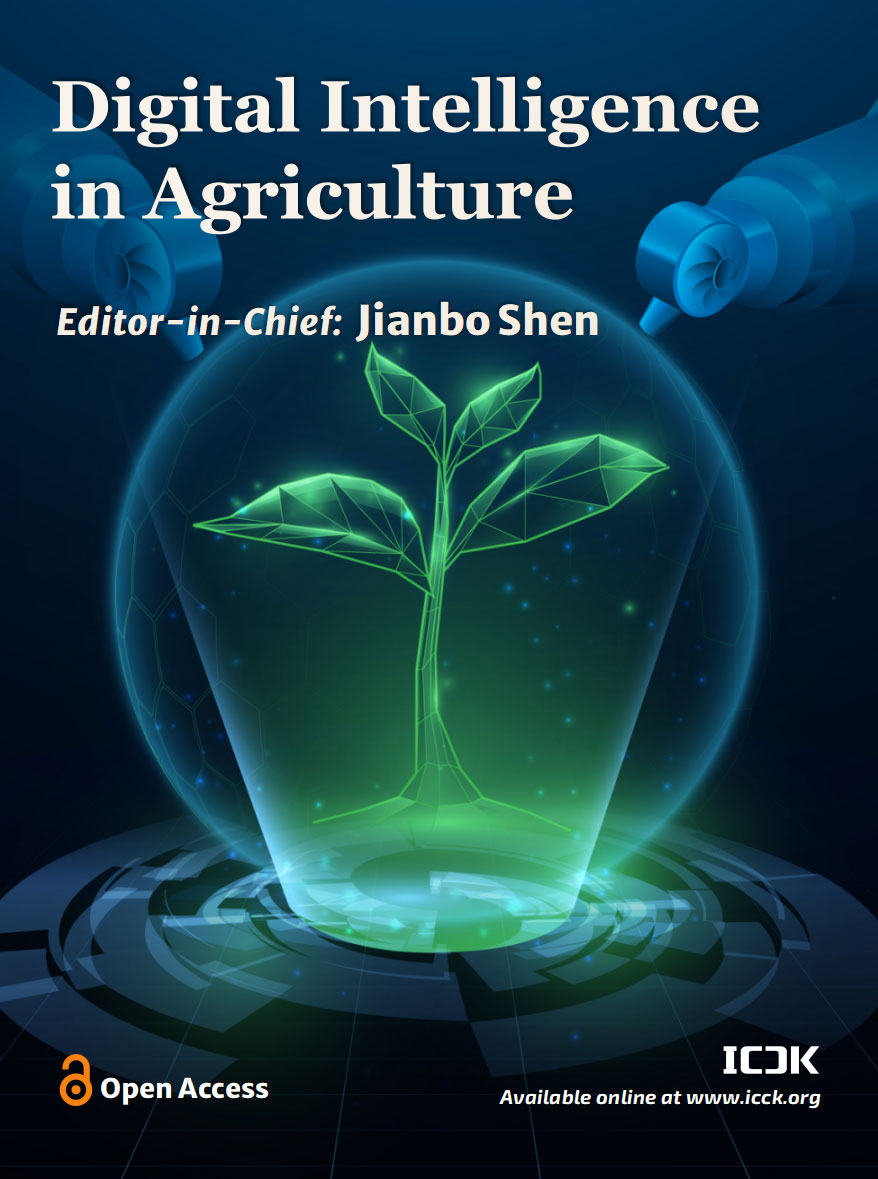
About the Journal
| Journal | Digital Intelligence in Agriculture |
|---|---|
| ISSN | 3069-3187 |
| Abbreviation | Digit. Intell. Agric. |
| CODEN | DIA |
| Publishing Model | Open Access |
| DOI Prefix | 10.62762/DIA |
| Official Website | https://www.icck.org/dia |
Aims & Scope
Aims
The Digital Intelligence in Agriculture (DIA) is a peer-reviewed open-access journal dedicated to advancing research and innovation at the intersection of digital technologies, artificial intelligence, and agricultural sciences. The journal aims to promote the development and application of intelligent digital solutions that support sustainable agricultural production, efficient resource management, and data-driven decision-making in modern farming systems. The journal provides an interdisciplinary platform for researchers, engineers, agronomists, data scientists, and industry practitioners to disseminate high-quality research addressing the digital transformation of agriculture.
Scope
The scope of the Journal includes, but is not limited to:
- Precision agriculture and smart farming systems
- Artificial intelligence and machine learning in agriculture
- Agricultural data science, big data analytics, and predictive modeling
- Internet of Things (IoT) and sensor networks for agricultural monitoring
- Remote sensing, UAVs, and satellite-based agricultural observation
- Agricultural robotics, automation, and autonomous machinery
- Computer vision and image analysis for crop and livestock monitoring
- Decision support systems and intelligent farm management platforms
- Digital twin technologies and modeling of agricultural systems
- Climate-smart agriculture and environmental monitoring technologies
- Smart irrigation, soil monitoring, and resource optimization
- Precision livestock farming and aquaculture monitoring
- Blockchain and digital platforms for agricultural supply chains
- Agricultural cyber-physical systems and edge/cloud computing
- Sustainable agriculture supported by digital technologies
Publication Frequency
Quarterly
Ownership
The journal is owned by Institute of Central Computation and Knowledge Inc.
Author Fees
For information regarding publication fees and waiver policies, please refer to Article Processing Charge (APC).
Archiving
All journals published by ICCK are archived in Portico, which provides permanent digital archiving for scholarly journals.
Copyright & Licensing
Articles published in DIA will be Open-Access articles distributed under the terms and conditions of the Creative Commons Attribution 4.0 International (CC BY). Under this license, author(s) retain ownership of the copyright for their article, but authors allow anyone to download, reuse, reprint, distribute, and/or copy articles published in DIA, so long as the original author(s) and source are cited.
Access Policy
All articles published in this journal are freely available to readers worldwide immediately upon publication. There are no subscription charges or pay-per-view fees. Readers may read, download, copy, distribute, print, search, or link to the full texts of the articles, or use them for any other lawful purpose, without asking prior permission from the publisher or the author.
Editorial Board
The Journal is guided by an Editorial Board consisting of recognized experts in the field. For the complete list of Editorial Board members, please refer to Editorial Board.
Peer Review
The journal adheres to rigorous peer review and undergoes single-blind peer review. For more details, please refer to Editorial Process and Peer Review Policy.
Editorial Process
All manuscripts submitted to DIA should adhere to the journal's Editorial Process.
Plagiarism
Plagiarism detection is performed at ICCK using the iThenticate- Crossref Similarity Checking tool. This web-based tool is employed in the editorial process to identify potential text plagiarism. It's important to note that while iThenticate can identify matching text, it cannot independently determine whether plagiarism has occurred. Manual examination of the matching text is still necessary, and judgment must be exercised to ascertain the presence or absence of plagiarism. The similarity report might be sent to the author for revision whenever needed.
Publication Ethics Statement
ICCK is responsible for implementing rigorous peer review and strict ethical policies and standards to ensure that high quality scientific work is added to the field of scholarly publishing. ICCK takes such publishing ethics issues very seriously, and our editors are trained to enforce COPE's Core Practices and Guidelines, with a zero-tolerance policy for plagiarism, data falsification, and other behaviours. To verify the originality of content submitted to our journals, we use iThenticate/Crossref Similarity Check to check submissions against previous publications.
Advertising
The journal does not accept any commercial product advertisements until policy changes otherwise.
Direct Marketing
Journal propagation has been done through the journal website and distribution of an introduction pamphlet. Invitations to submit a manuscript are usually targeted towards presenters at conferences, seminars, or workshops related to the journal's aims and scope.
Contact
Please visit Editorial Office for details about different queries.