
ICCK

Xiaoming Guo

School of Information and Communication Engineering, North University of China, Taiyuan 030051, China

Section 01

Academic Profile

Xiaoming Guo received the B.S. degree in Bachelor of Engineering from North University of China, Shanxi, China in 2019, where she is currently pursuing the M.S. and Ph.D. degrees in Information and Communication Engineering. Her research interests include image fusion and infrared information processing.

Section 02

Editorial Roles

This user currently does not serve as an editor for any ICCK journals.

Section 03

ICCK Publications

Open Access | Research Article | 17 April 2026
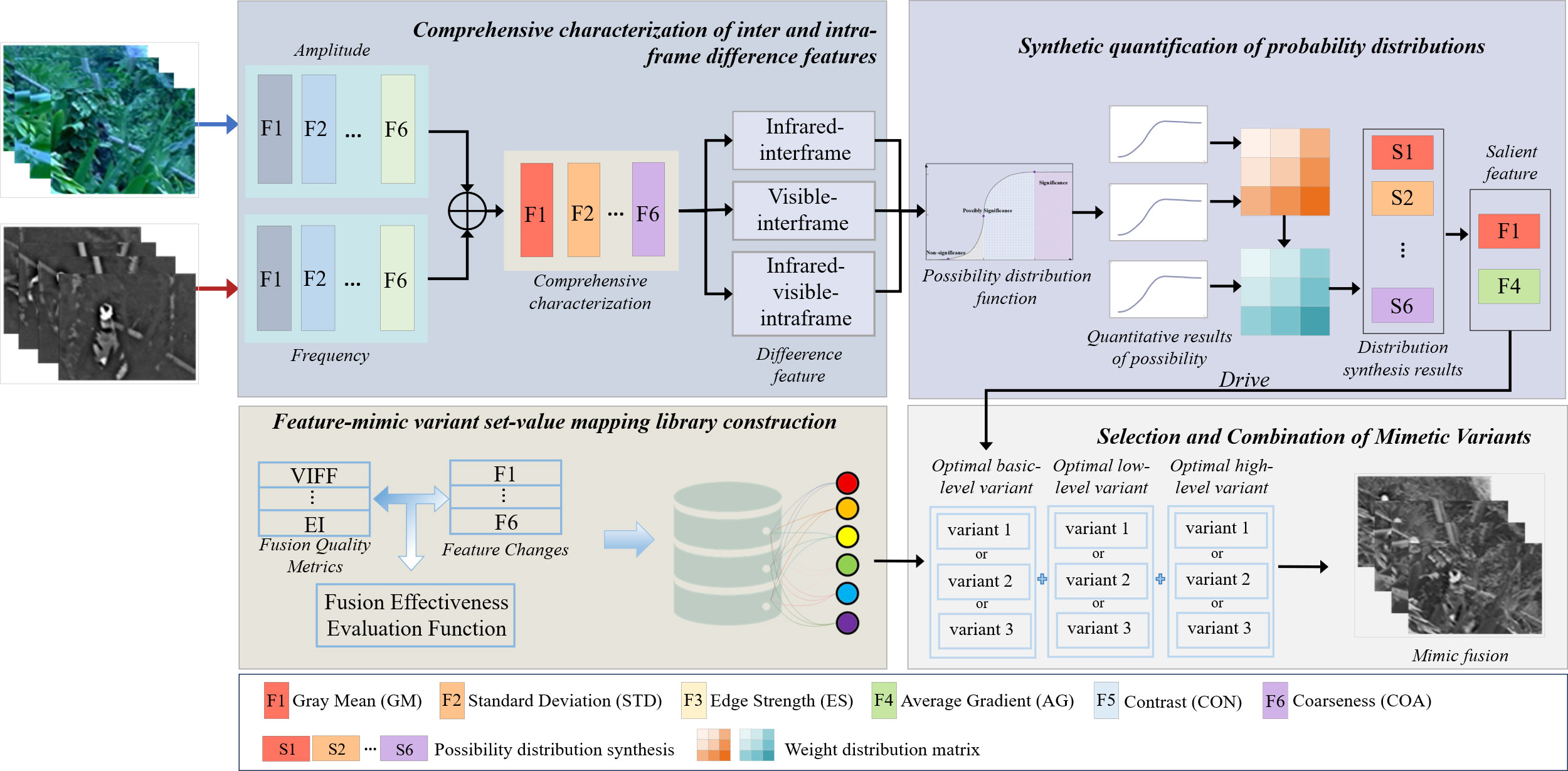
Salient Feature-Driven Bimodal Video Mimic Fusion Algorithm
Chinese Journal of Information Fusion | Volume 3, Issue 2: 74-92, 2026 | DOI: 10.62762/CJIF.2025.874404
Abstract
In complex dynamic environments, infrared and visible video sequences exhibit highly variable and unpredictable feature distributions. Existing fusion algorithms with fixed architectures cannot adaptively respond to these dynamic feature changes, resulting in blurred fusion outcomes and the loss of critical detail information. To address this limitation, we propose a salient feature-driven mimic fusion algorithm that continuously monitors feature variations and dynamically reconfigures the fusion architecture to maintain optimized fusion performance. First, we extract amplitude and frequency attributes from infrared and visible video features and perform weighted fusion to calculate single-m... More >

Graphical Abstract
Salient Feature-Driven Bimodal Video Mimic Fusion Algorithm
Author's Talk | Open Access | Research Article | Feature Paper | 28 May 2024 | Cited: Crossref logo  11 , Scopus 12
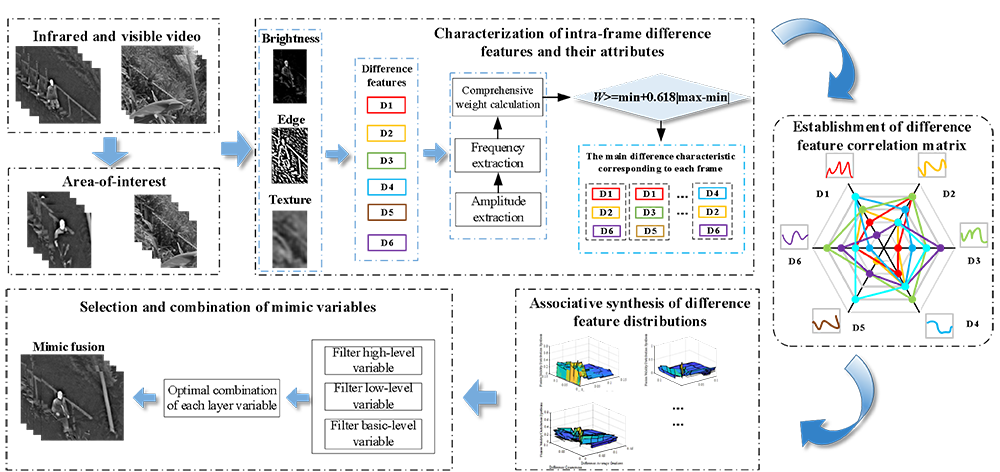
A Mimic Fusion Algorithm for Dual Channel Video Based on Possibility Distribution Synthesis Theory
Chinese Journal of Information Fusion | Volume 1, Issue 1: 33-49, 2024 | DOI: 10.62762/CJIF.2024.361886
Abstract
In response to the current practical fusion requirements for infrared and visible videos, which often involve collaborative fusion of difference feature information, and model cannot dynamically adjust the fusion strategy according to the difference between videos, resulting in poor fusion performance, a mimic fusion algorithm for infrared and visible videos based on the possibility distribution synthesis theory is proposed. Firstly, quantitatively describe the various difference features and their attributes of the region of interest in each frame of the dual channel video sequence, and select the main difference features corresponding to each frame. Secondly, the pearson correlation coeffi... More >

Graphical Abstract
Author's Talk
A Mimic Fusion Algorithm for Dual Channel Video Based on Possibility Distribution Synthesis Theory