


ICCK

Dhaya Ramakrishnan

School of Electrical & Communications Engineering, PNG University of Technology, Lae, Papua New Guinea

Section 01

Academic Profile

Dr. Dhaya R is having more than 19 years of academic, research and administrative experience in Asia, Middle East, and Oceania. Currently she is working as Senior Faculty of Computer Engineering, School of Electrical and Communications Engineering, PNG University of Technology (Public University & Engineers Australia Accredited), Lae, Papua New Guinea. He received his Post-Doctoral Fellowship from University of Louisiana, USA, and Ph.D Degree from Manonmaniam sundaranar University, India. She has published more than 20 books, 150 articles in international/national journals/conferences and 04 patents. She is the series editor of a number of book series and serves in various editorial capacities of several international journals. Her research interests focus on Cloud computing, Artificial Intelligence, Embedded Systems, Machine -deep learning, Wireless Sensor Networks and Network Security. She received young engineer award by Institution of Engineers (IEI), Kolkata, India.

Section 02

Editorial Roles

This user currently does not serve as an editor for any ICCK journals.

Section 03

ICCK Publications

Open Access | Review Article | 27 June 2025 | Cited: Crossref logo  4 , Scopus 4
Federated Learning for Artificial Intelligence in Embedded Systems
ICCK Transactions on Emerging Topics in Artificial Intelligence | Volume 2, Issue 2: 91-115, 2025 | DOI: 10.62762/TETAI.2025.440076
Abstract
Federated Learning (FL) has emerged as a principled paradigm for privacy-preserving decentralized machine learning, enabling model training across distributed embedded devices without centralizing sensitive data. This review examines FL as applied to resource-constrained embedded and edge AI systems, encompassing its architectural foundations, principal optimization algorithms, application domains, and security mechanisms. We analyze the interplay between FL's theoretical properties and the practical constraints imposed by heterogeneous embedded hardware, non-IID data distributions, bandwidth-limited IoT networks, and adversarial threat models. Application domains examined in depth include s... More >

Graphical Abstract
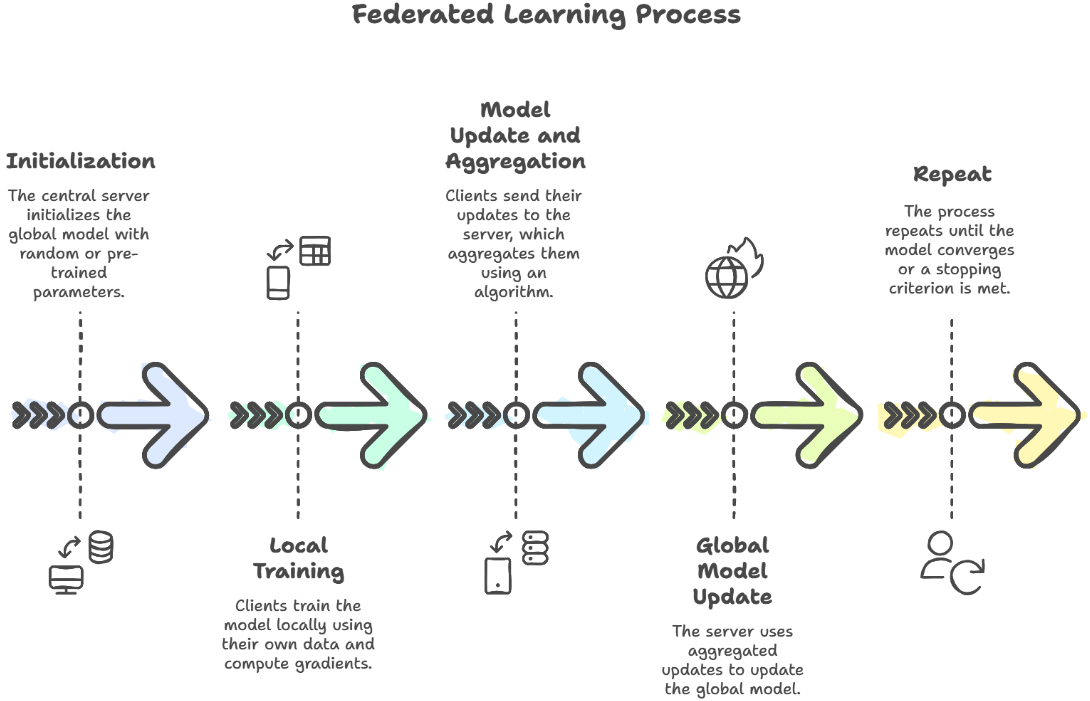
Federated Learning for Artificial Intelligence in Embedded Systems