Academic Profile

Academic Profile

No academic profile information available at the moment.

Editorial Roles

No Editorial Roles

This user currently does not serve as an editor for any ICCK journals.

ICCK Publications

Total Publications: 2
Free Access | Research Article | 08 November 2025
Comparative Study of Pentagonal and Hexagonal Fuzzy Membership Function Using Credibility Theory in Machine Learning Systems
ICCK Transactions on Machine Intelligence | Volume 1, Issue 3: 127-137, 2025 | DOI: 10.62762/TMI.2025.922612
Abstract
The paper carries out a comparative study that is based on the use of credibility theory to examine pentagonal and hexagonal fuzzy membership functions of machine learning systems. These fuzzy memberships can be used to manage the uncertainty and imprecision of a data driven-model which allows better decision-making in the case of vague or incomplete information. The credibility theory is used to determine quantitatively the reliability of the inferences obtained through each function. Both the membership functions are modelled, incorporated in machine learning framework and tested on randomly generated as well as application specific datasets. The results obtained indicate that the performa... More >

Graphical Abstract
Comparative Study of Pentagonal and Hexagonal Fuzzy Membership Function Using Credibility Theory in Machine Learning Systems
Free Access | Research Article | 02 June 2025 | Cited: 4 , Scopus 4
A Hybrid Machine Learning Fuzzy Non-linear Regression Approach for Neutrosophic Fuzzy Set
ICCK Transactions on Machine Intelligence | Volume 1, Issue 1: 42-51, 2025 | DOI: 10.62762/TMI.2025.561363
Abstract
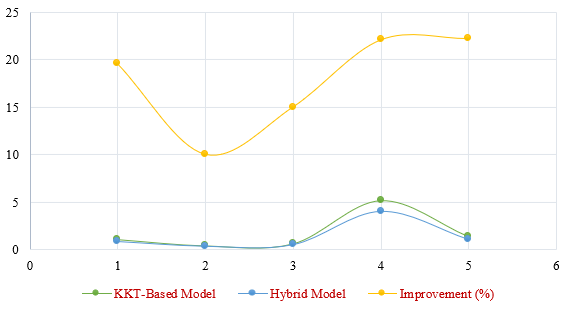
Neutrosophic sets play a significant role for handling indeterminacy. In this paper, we introduce a novel fuzzy non-linear regression model to find the minimum spread of neutrosophic fuzzy sets. Kuhn-Tucker's necessary conditions are employed to estimate the parameters for non-linear regression models, which can be applied to any data set. The resulting hybrid model possesses the ability to minimise the spread of uncertainty in a much better fashion than the existing non-linear regression contenders which rely on KKT- based model. The hybrid approach reduces the maximum spread by 22.09% and improves prediction accuracy, as shown by a 22.23% reduction in RMSE. The study’s findings highligh... More >

Graphical Abstract
A Hybrid Machine Learning Fuzzy Non-linear Regression Approach for Neutrosophic Fuzzy Set