Summary

Dr. Guillermo Félix, PhD, graduated with a bachelor’s degree in chemical engineering (2013) from the Technological Institute of Los Mochis, a master’s and PhD degree in advanced technology (2015 and 2019) from the National Polytechnic Institute (IPN) in Mexico. He was awarded the best postgraduate thesis (2019) from the IPN, the second-best technological solution developed by engineering in the energy category (2020) from the Mexican Academy of Engineering (AIM), and Level 1 in the National Researcher System (2021) by the Mexican government. He has also been a professor at the undergraduate level at the Technological Institute of Los Mochis (2019-2021). He is the author and co-author of several scientific papers and participated in various international congresses, furthermore, he has been a reviewer of international journals. Dr. Felix started his research career at the Mexican Petroleum Institute (2013) studying crude oil compatibility by performing mixtures of different types of crude oils (from light to heavy), the upgrade of heavy crude oil with slurry phase catalyst focused on developing novel kinetic models that represent the hydrocracking reactions with different types of catalyst, as well as to develop a thermodynamic model to predict the asphaltenes precipitation by regular solution models. Dr. Félix collaborated with the Korea Research Institute of Chemical Technology (KRICT) in 2018 working in the Hydrocracking of asphaltenes with liquid catalysts developing a kinetic model including the coke induction period. Currently, Dr. Felix is a researcher at Kazan Federal University, and his research is focused on the catalytic in-situ upgrading of unconventional hydrocarbons (heavy crude oil, oil shale, and bitumen) by different technologies (steam injection, hydrocracking, pyrolysis).

Edited Journals

ICCK Contributions


Open Access | Perspective | 07 December 2025
Integrating Supercritical Water and Catalysts: A Synergistic Approach for Heavy Oil Upgrading
Journal of Chemical Engineering and Renewable Fuels | Volume 2, Issue 1: 9-12, 2025 | DOI: 10.62762/JCERF.2025.734454
Abstract
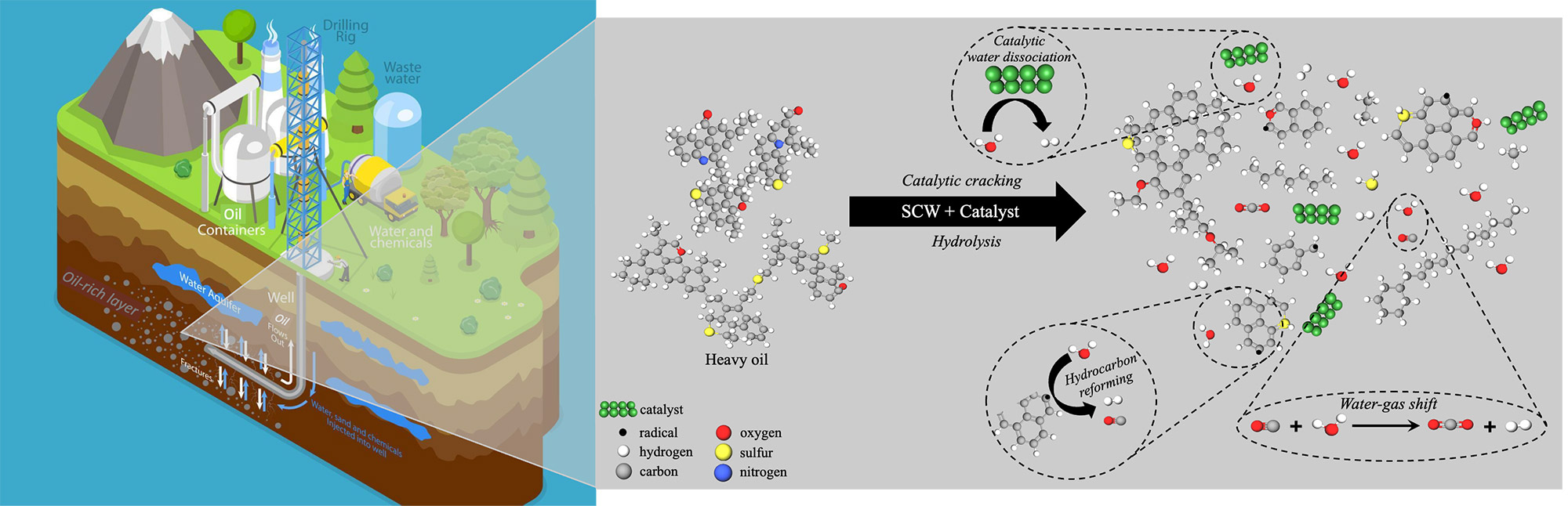
The depletion of conventional hydrocarbons has forced researchers to focus on unconventional petroleum, i.e., heavy crude oils. However, the typical methods to recover the former are not suitable for the latter. Therefore, new technologies, such as supercritical water (SCW) upgrading, commercial and novel catalytic compounds have been proposed individually and in combination to solve the difficulties in recovering these reserves. In this work, the advantages and disadvantages, mechanisms, reactions, and challenges when using SCW and catalysts for heavy oil upgrading are discussed, giving a perspective for new synergetic approaches. More >

Graphical Abstract
Integrating Supercritical Water and Catalysts: A Synergistic Approach for Heavy Oil Upgrading