


Academic Profile

Niamat Ullah graduated with distinction from the University of Malakand with a BS in computer science. His research focuses on developing and applying advanced algorithms to solve real-world problems. His research interests include Machine Learning, Deep Learning, Computer Vision and Visual Intelligence. He has a strong technical background in programming, data analysis, and AI model development.

Editorial Roles

No Editorial Roles

This user currently does not serve as an editor for any ICCK journals.

ICCK Publications

Total Publications: 2
Free Access | Research Article | 05 March 2025
Attention-Guided Wheat Disease Recognition Network through Multi-Scale Feature Optimization
ICCK Transactions on Sensing, Communication, and Control | Volume 2, Issue 1: 11-24, 2025 | DOI: 10.62762/TSCC.2025.435806
Abstract
Accurate and timely detection of wheat diseases remains crucial for sustainable agriculture, particularly in major wheat-producing regions. Wheat diseases pose a significant threat to global food security, need precise and timely detection to promote sustainable agriculture. Existing approaches consistently employ single-scale features with shallow-layered convolutional neural networks (CNNs). To bridge the research gaps, we introduce a novel Multi-Scale Wheat Disease Network (MSWDNet) with feature collaboration for wheat disease recognition supported by a comprehensive dataset collected from wheat fields. This study fills research gaps by introducing a novel technique to improve detection a... More >

Graphical Abstract
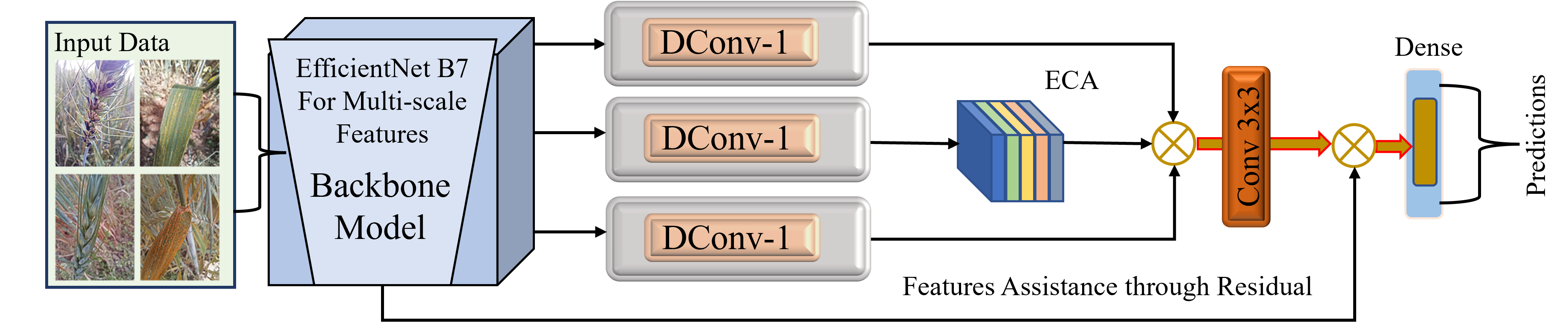
Attention-Guided Wheat Disease Recognition Network through Multi-Scale Feature Optimization
Free Access | Research Article | 20 September 2024 | Cited: 5 , Scopus 5
A Cyber-Physical System Based on On-Board Diagnosis (OBD-II) for Smart City
ICCK Transactions on Intelligent Systematics | Volume 1, Issue 2: 49-57, 2024 | DOI: 10.62762/TIS.2024.329126
Abstract
This paper proposes designing and structuring a Cyber-Physical System (CPS) with a specific focus on vehicles equipped with on-board diagnosis (OBD-II). The purpose of the CPS is to collect and assess data pertaining to the vehicle's Electronic Control Unit (ECU), such as engine RPM, speed, and other relevant parameters. The OBD-II scanner utilizes the obtained data on mass airflow (MAF) and vehicle speed to compute CO2 gas emissions and fuel consumption. The data is wirelessly communicated using a GSM module to a Semantic Web. The CPS also uses GPS tracking to ascertain the vehicle's whereabouts. A Semantic Web is utilized to construct a database management system that stores and manages se... More >

Graphical Abstract
A Cyber-Physical System Based on On-Board Diagnosis (OBD-II) for Smart City