
ICCK

Matheus dos Santos Farias

Universidade São Paulo - USP

Section 01

Academic Profile

No academic profile information available at the moment.

Section 02

Editorial Roles

This user currently does not serve as an editor for any ICCK journals.

Section 03

ICCK Publications

Open Access | Research Article | 16 October 2026
A Brain Uptake Constant for Mathematical Modeling of Cerebral Radiopharmaceutical Uptake: A Synthetic Computational Study
ICCK Journal of Applied Mathematics | Volume 2, Issue 4: 293-301, 2026 | DOI: 10.62762/JAM.2026.965290
Abstract
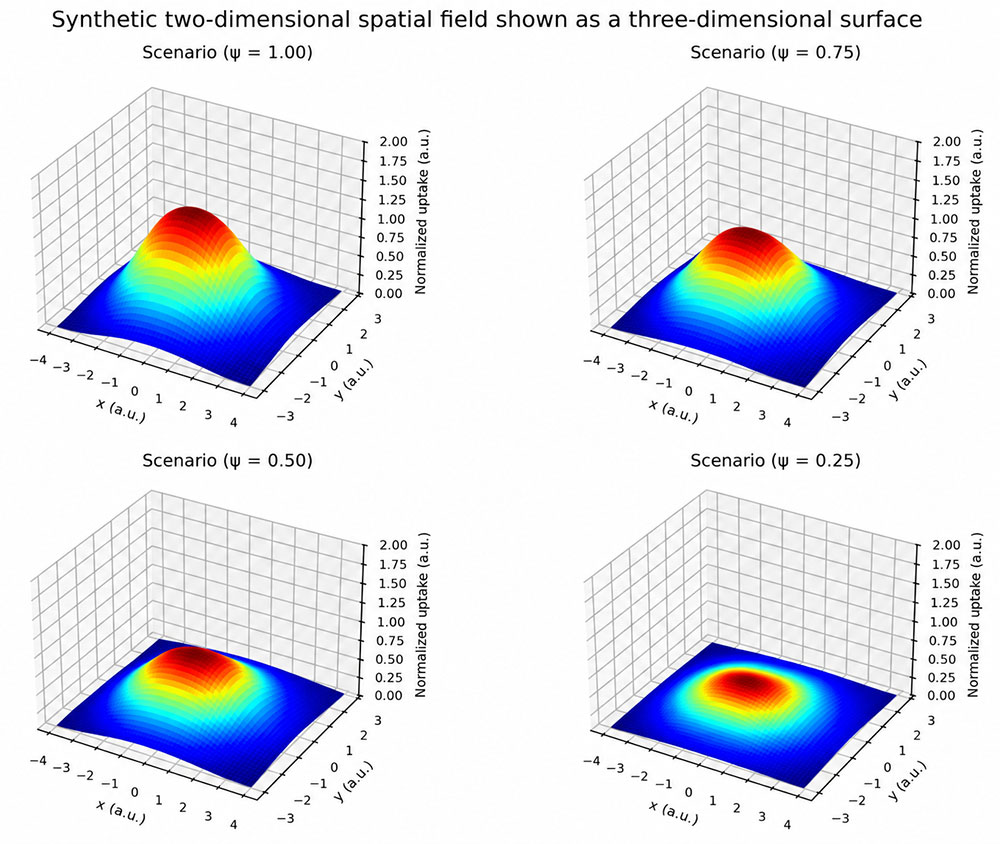
Compartmental and tracer-kinetic models are widely used to describe radiopharmaceutical uptake in brain PET and SPECT, but in simple analytical models the fraction of transferred activity that reaches the brain is seldom isolated as a parameter of its own. This study defines a dimensionless Brain Uptake Constant, $\psi$, as the uptake fraction in a two-stage first-order model of cerebral radiopharmaceutical activity and examines its behaviour in a purely synthetic setting. Activity in the systemic pool, $A(t)$, is lost at a first-order rate $k$; cerebral activity, $A_c(t)$, receives a source term $\psi k A(t)$ and is lost at an effective decay rate $\lambda$. The closed-form solution was eva... More >

Graphical Abstract
A Brain Uptake Constant for Mathematical Modeling of Cerebral Radiopharmaceutical Uptake: A Synthetic Computational Study
Open Access | Research Article | 16 October 2026
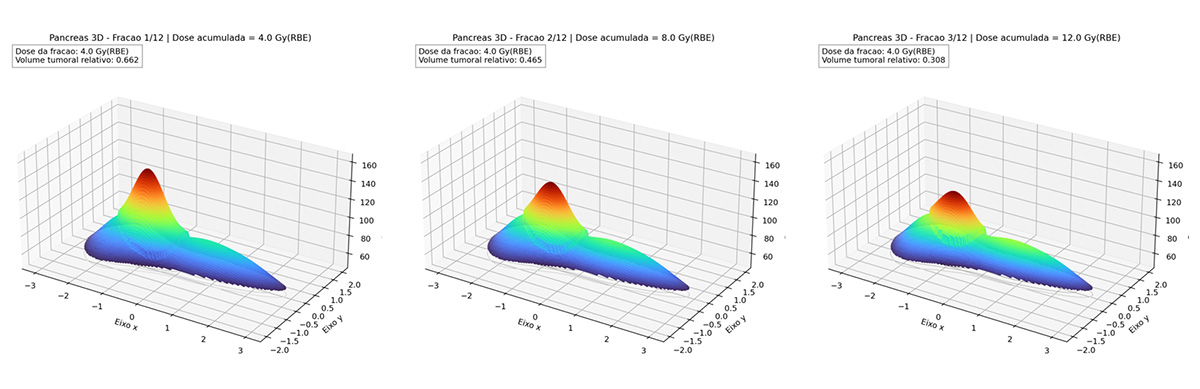
Carbon Ion Hadron Therapy: Analytical Formulation of Tumor Regression in Pancreatic Cancer by Computed Tomography
Journal of Numerical Simulations in Physics and Mathematics | Volume 3, Issue 1: 38-50, 2026 | DOI: 10.62762/JNSPM.2026.765432
Abstract
This study formulates a mathematical and computational model of tumor-cell-density regression in pancreatic cancer treated with carbon-ion hadron therapy. A reaction-diffusion equation with logistic proliferation and a local radiation-induced loss term is derived term by term, discretized with a two-dimensional finite-difference scheme and forward Euler time stepping, and implemented in Python. The treatment input follows a published carbon-ion schedule of 48~Gy(RBE) in 12 fractions of 4~Gy(RBE). The simulation produces sequential two- and three-dimensional maps of the modeled tumor-cell density as a function of accumulated dose; in the three-dimensional reconstruction the relative tumor vo... More >

Graphical Abstract
Carbon Ion Hadron Therapy: Analytical Formulation of Tumor Regression in Pancreatic Cancer by Computed Tomography
Open Access | Research Article | 07 October 2026
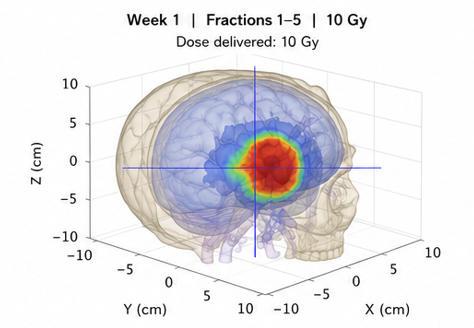
Mathematical Formulation and Computational Implementation of a Fisher-KPP Model for Glioblastoma Invasion under Fractionated Radiotherapy
ICCK Journal of Applied Mathematics | Volume 2, Issue 4: 283-292, 2026 | DOI: 10.62762/JAM.2026.576302
Abstract
Glioblastoma (GBM) is a highly infiltrative primary brain tumor, and reaction-diffusion models are widely used to describe how its cells spread and proliferate. We derive the classical Fisher-KPP equation from mass conservation, Fickian diffusion, and logistic growth, and extend it to fractionated radiotherapy through a linear-quadratic survival update applied to the tumor-density field at each fraction. The Fisher-KPP equation is solved by finite differences on a three-dimensional voxel grid with 0.5-mm spacing; Geant4 is used only for Monte Carlo photon transport and dose calculation. The schedule of 60~Gy in 30 fractions from the clinical case reported by Roda et al. is reproduced, and th... More >

Graphical Abstract
Mathematical Formulation and Computational Implementation of a Fisher-KPP Model for Glioblastoma Invasion under Fractionated Radiotherapy
Open Access | Research Article | 27 September 2026
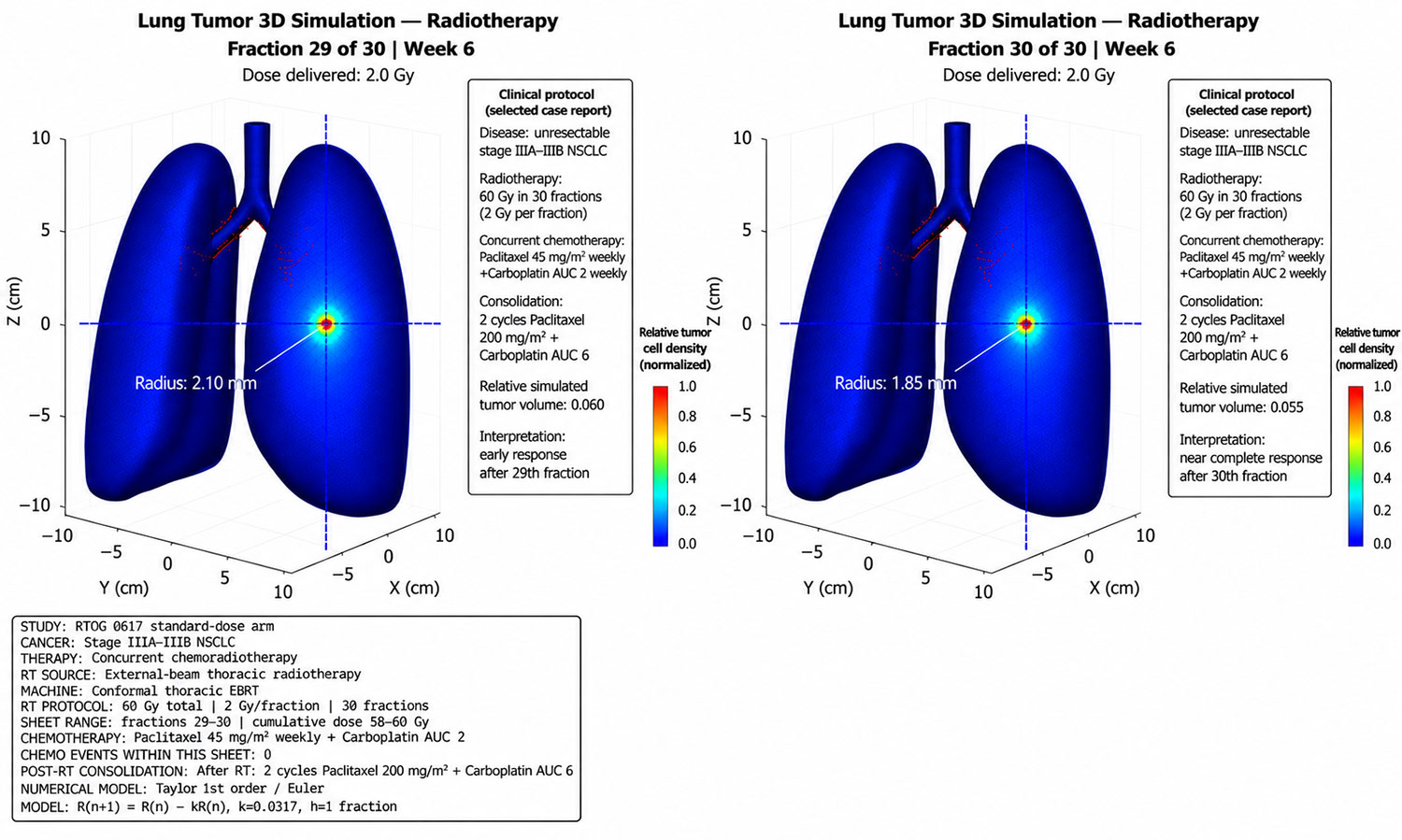
A Taylor-Series-Based Computational Framework for Simulating Lung Tumor Regression During Radiotherapy: Toward Model-Informed Decision Support in Precision Oncology
Biomedical Informatics and Smart Healthcare | Volume 2, Issue 3: 152-165, 2026 | DOI: 10.62762/BISH.2026.811248
Abstract
Mechanistic tumor-response models that are transparent and updatable with patient data are important for model-informed precision radiotherapy. This study presents a reproducible computational framework integrating an explicit mathematical derivation, numerical solver, clinical protocol-derived parameters, and three-dimensional visualization to simulate simplified lung tumor regression during radiotherapy for non-small cell lung cancer (NSCLC). A first-order Taylor approximation, equivalent to the forward Euler method, is derived from Taylor's formula with integral remainder, with local truncation error of order $h^2$. The resulting update rule is applied to a first-order regression model wi... More >

Graphical Abstract
A Taylor-Series-Based Computational Framework for Simulating Lung Tumor Regression During Radiotherapy: Toward Model-Informed Decision Support in Precision Oncology
Open Access | Research Article | 20 September 2026
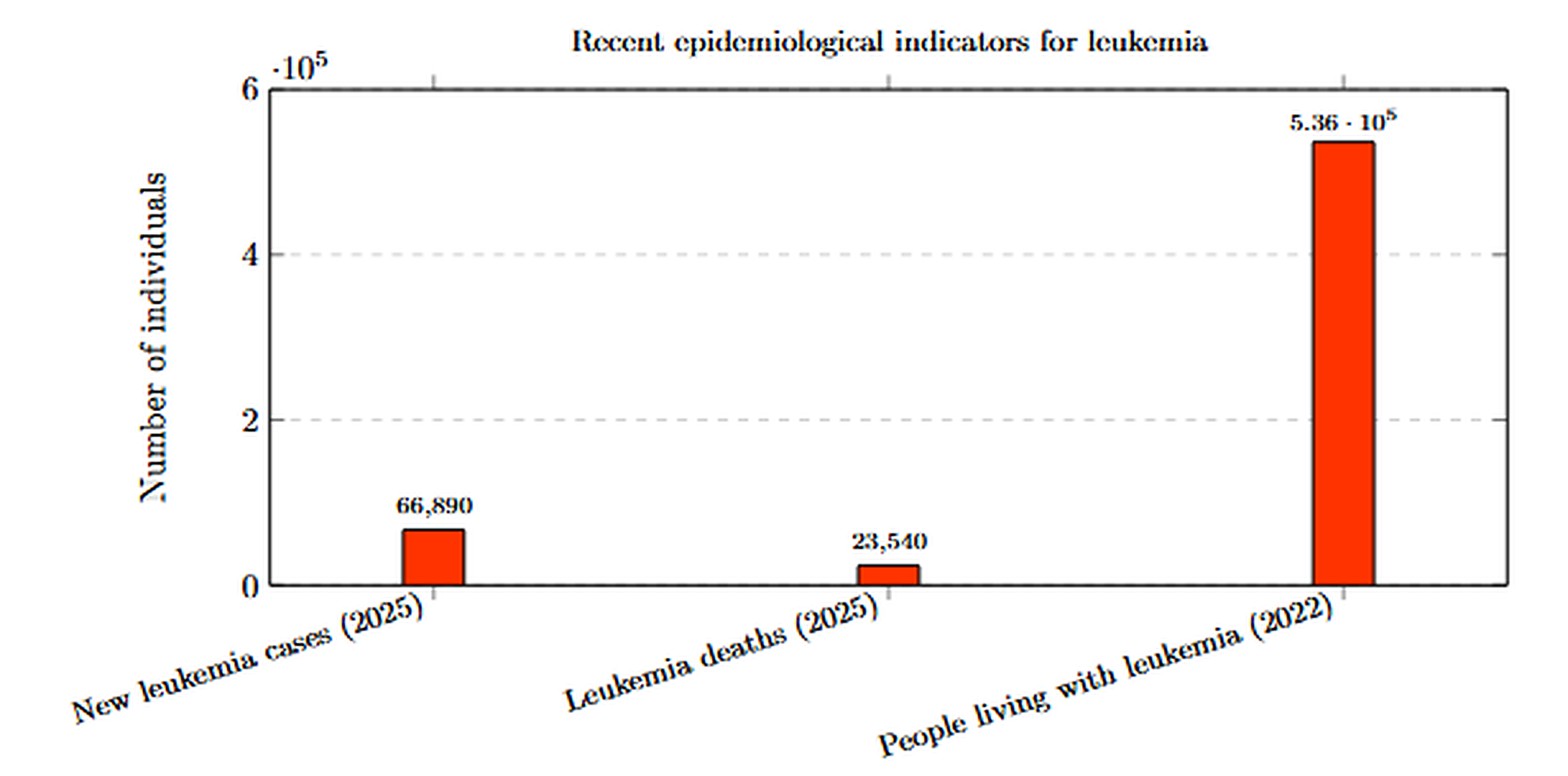
From the Formalism of the Delayed Mackey-Glass Equation and Its Application to Leukemia Growth
Journal of Numerical Simulations in Physics and Mathematics | Volume 2, Issue 2: 130-140, 2026 | DOI: 10.62762/JNSPM.2026.604346
Abstract
This study develops a mathematically explicit and computationally reproducible framework based on the delayed Mackey--Glass equation for leukemia-related population dynamics. The classical model is formulated from a population balance law, delayed maturation, and saturating nonlinear feedback, and is then extended by a stage-dependent treatment-control term. Parameters that are not identifiable from the available clinical information are taken from established mathematical and hematopoietic literature, while the treatment-control coefficients are constrained phenomenologically by the modeled burden states. A brief systematic literature search was used to characterize previous Mackey--Glass a... More >

Graphical Abstract
From the Formalism of the Delayed Mackey-Glass Equation and Its Application to Leukemia Growth
  • 1
  • 2