ICCK

Azad Rasul

Soran University

Section 01

Academic Profile

No academic profile information available at the moment.

Section 02

Editorial Roles

This user currently does not serve as an editor for any ICCK journals.

Section 03

ICCK Publications

Open Access | Research Article | 24 September 2026
EWLR - A New Method for Interpolating Elevation-Driven Variables: Annual Rainfall in Erbil Governorate
Journal of Geoscience and Earth Observation | Volume 1, Issue 2: 158-171, 2026 | DOI: 10.62762/JGEO.2026.171666
Abstract
Accurate spatial estimation of rainfall is critical for hydrological modeling, water resource management, and agricultural planning---particularly in mountainous and semi-arid regions with sparse monitoring networks. This study presents an Enhanced Elevation-Weighted Local Regression (EWLR) model to generate a high-resolution (30~m) annual rainfall surface for Erbil Governorate, northern Iraq. The EWLR model integrates distance weighting, elevation similarity weighting, and orographic enhancement within a locally weighted regression framework. Average annual rainfall, derived from rainy seasons spanning 1997--1998 to 2024--2025 across 19 meteorological stations, along with a 30~m resolution... More >

Graphical Abstract
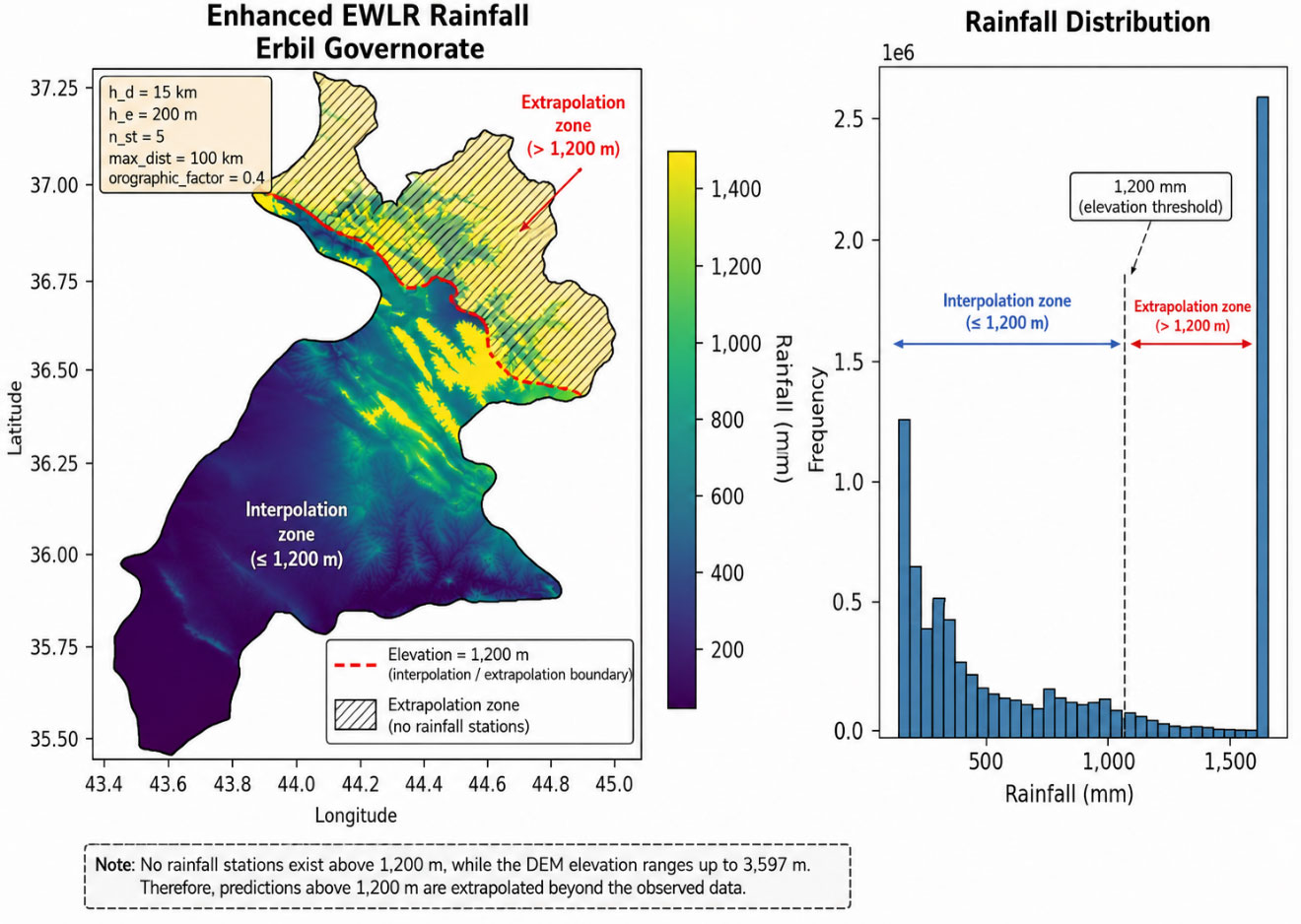
EWLR - A New Method for Interpolating Elevation-Driven Variables: Annual Rainfall in Erbil Governorate
Open Access | Review Article | 20 September 2026
Machine Learning and Deep Learning Approaches in Thermal Remote Sensing: A Systematic Review (2018–2026)
Journal of Geoscience and Earth Observation | Volume 1, Issue 2: 137-157, 2026 | DOI: 10.62762/JGEO.2026.270724
Abstract
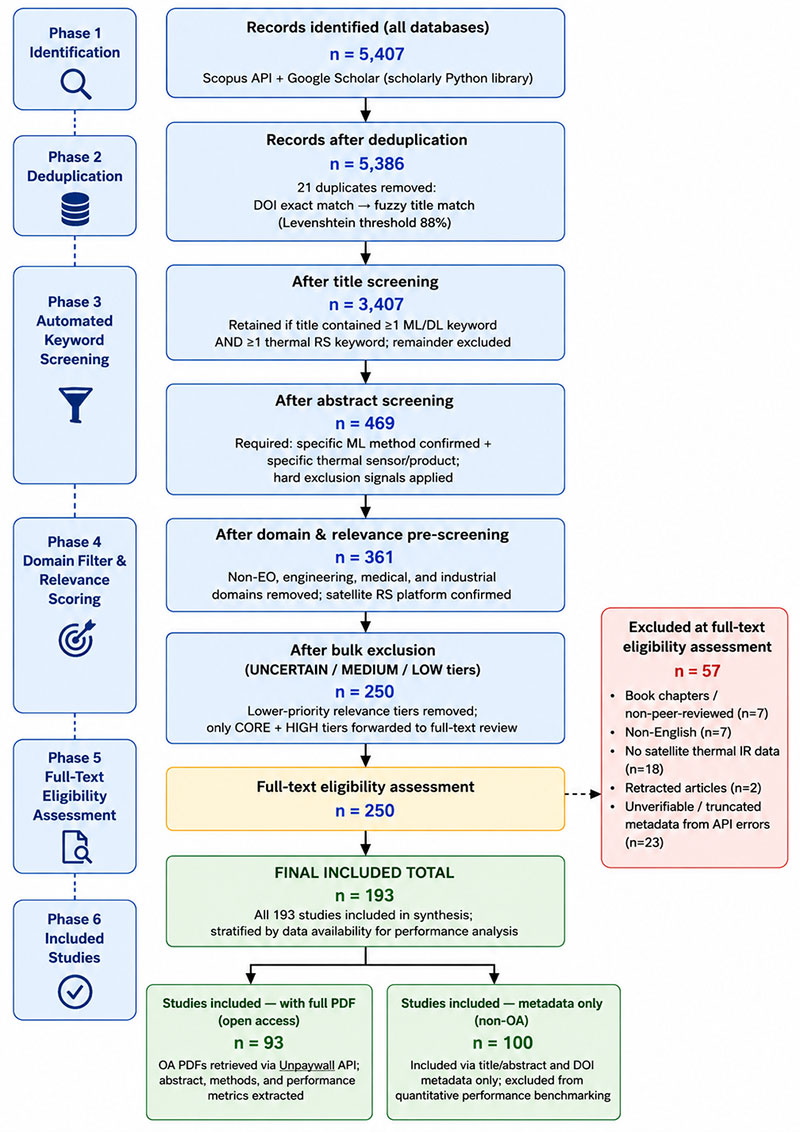
This systematic review, conducted in accordance with the PRISMA 2020 guidelines, maps the applications of machine learning (ML) and deep learning (DL) within thermal remote sensing (RS) from January 2018 to March 2026. Despite significant growth in this field driven by high-resolution satellite missions and open-source frameworks, no comprehensive PRISMA-compliant synthesis has previously focused exclusively on this domain during the post-2018 period. Through a structured search of Scopus and Google Scholar, we identified 193 peer-reviewed studies meeting inclusion criteria, of which 93 provided full-text access for in-depth methodological appraisal and 100 were analyzed at the metadata leve... More >

Graphical Abstract
Machine Learning and Deep Learning Approaches in Thermal Remote Sensing: A Systematic Review (2018–2026)
Open Access | Review Article | 20 September 2026
Machine Learning and Deep Learning in Agriculture: A PRISMA Systematic Review of Architectures, Applications, and Open Science Practices (2019–2026)
Digital Intelligence in Agriculture | Volume 2, Issue 3: 126-157, 2026 | DOI: 10.62762/DIA.2026.703096
Abstract
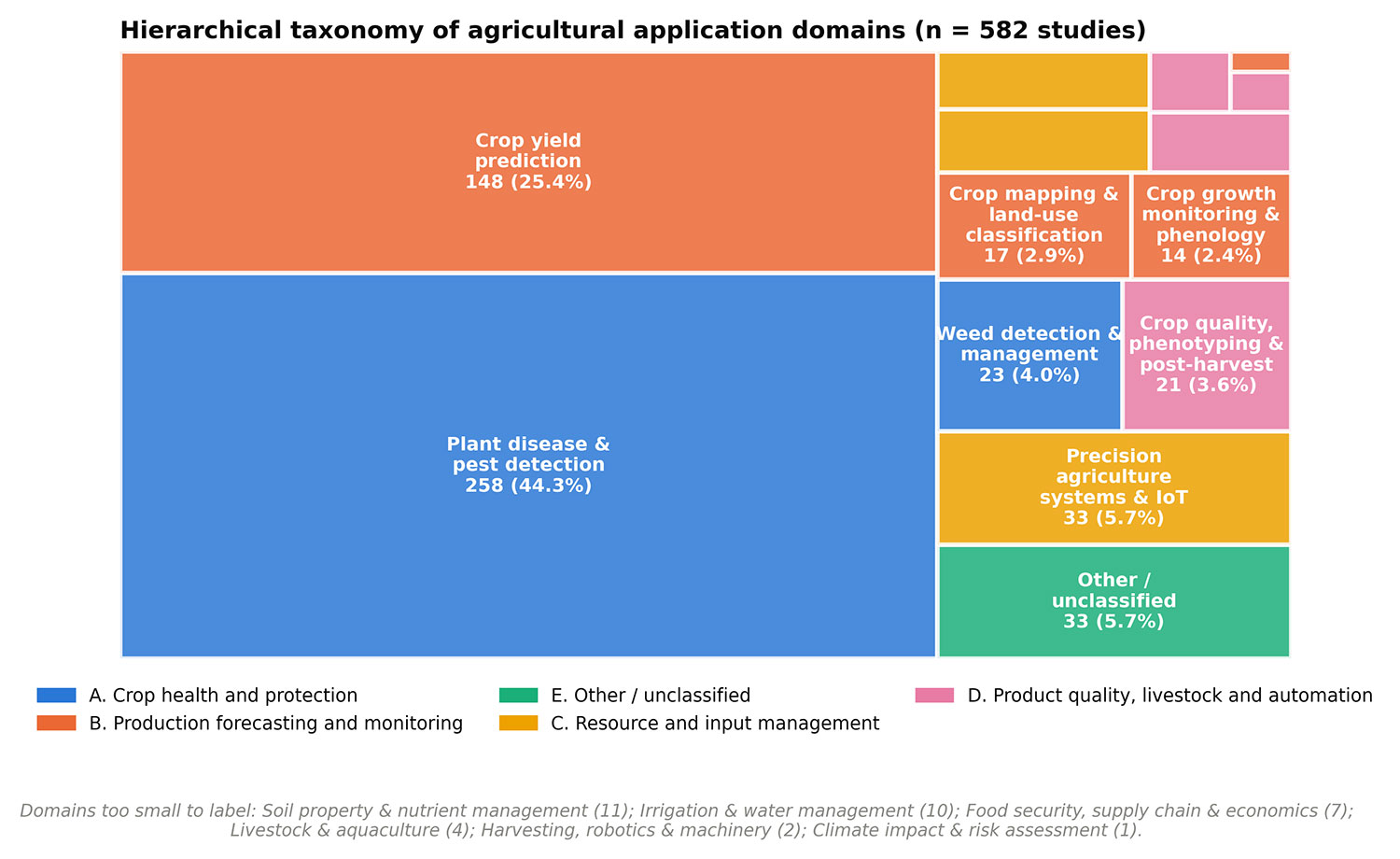
Agriculture faces growing pressures from food insecurity, climate change, and resource scarcity, increasing demand for scalable analytical tools. This PRISMA 2020-compliant systematic review synthesised 582 peer-reviewed studies on machine learning (ML) and deep learning (DL) in agriculture published between January 2019 and March 2026, with 430 retrieved full texts forming the analytic subsample. Publication volume increased from 6 papers in 2019 to 251 in 2025, corresponding to a compound annual growth of approximately 86%. Convolutional backbones remained dominant (57.2%), while Transformer-based models increased from 14.3% in 2022 to 41.2% in 2025. South and East Asia contributed 59.3% o... More >

Graphical Abstract
Machine Learning and Deep Learning in Agriculture: A PRISMA Systematic Review of Architectures, Applications, and Open Science Practices (2019–2026)
Open Access | Review Article | 12 June 2026
A Systematic Review of Methods Used to Monitor and Predict Agricultural, Hydrological, and Meteorological Droughts
Journal of Geoscience and Earth Observation | Volume 1, Issue 1: 69-84, 2026 | DOI: 10.62762/JGEO.2026.930918
Abstract
Droughts are among the most economically and ecologically destructive natural hazards, affecting more than half of the world's land surface annually and increasing in frequency and severity under anthropogenic climate change. Unlike episodic disasters such as earthquakes or hurricanes, droughts develop gradually and their full impacts may not be evident until months or years after peak conditions. This systematic review synthesises current knowledge of drought monitoring and prediction methods, encompassing approximately 27 drought indices—spanning meteorological, agricultural, hydrological, and remote sensing categories—and six major classes of prediction model: regression, time series,... More >