

ICCK

Fajun Guo

Lishui University

Section 01

Academic Profile

No academic profile information available at the moment.

Section 02

Editorial Roles

This user currently does not serve as an editor for any ICCK journals.

Section 03

ICCK Publications

Free Access | Review Article | 20 September 2026
Lightweight YOLO Object Detection Algorithms for Vision-Based Robotic Arms: A Review
ICCK Transactions on Intelligent Cyber-Physical Systems | Volume 1, Issue 3: 97-103, 2026 | DOI: 10.62762/TICPS.2026.107157
Abstract
To address the requirements of vision-based robotic manipulators for object detection accuracy, real-time performance, and lightweight deployment, this paper reviews lightweight You Only Look Once (YOLO) object detection techniques and their applications in robotic vision. First, the main techniques, including structural lightweighting, model compression, and edge deployment, are summarized. Representative algorithms for vision-based robotic manipulators are then categorized into three groups: backbone lightweighting, local structural optimization, and model compression, with their detection performance and lightweighting characteristics analyzed. On this basis, the limitations of existing m... More >

Graphical Abstract
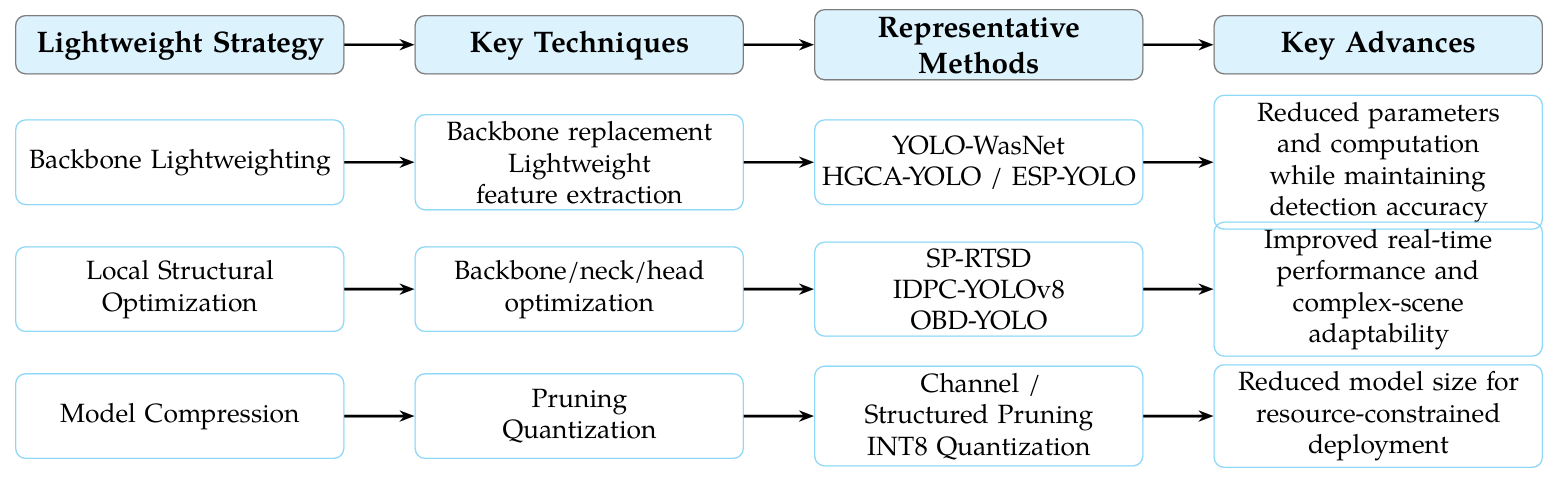
Lightweight YOLO Object Detection Algorithms for Vision-Based Robotic Arms: A Review
Free Access | Review Article | 07 June 2026
A Review on Embedded Arduino-Based Visual Robotic Arm Grasping and SLAM Navigation
ICCK Transactions on Intelligent Cyber-Physical Systems | Volume 1, Issue 2: 60-65, 2026 | DOI: 10.62762/TICPS.2026.578769
Abstract
With the development of desktop robotic arms towards low cost, lightweight and intelligence, the embedded Arduino vision-based robotic arm grasping technology has become a research hotspot. This paper reviews the current research status of the robotic arm vision grasping technology and embedded SLAM navigation with Arduino as the lower computer. Firstly, the embedded Arduino vision-based robotic arm grasping is introduced, and the system architecture, mainstream kinematic modeling methods, visual calibration, pose estimation, dynamic analysis and stability, and trajectory planning processes are sorted out in sequence. Then, the shortcomings of the system in terms of adaptability to complex e... More >