by


Aerospace Engineering Communications | Volume 1, Issue 2: 81-86, 2026 | DOI: 10.62762/AEC.2026.970989
Abstract
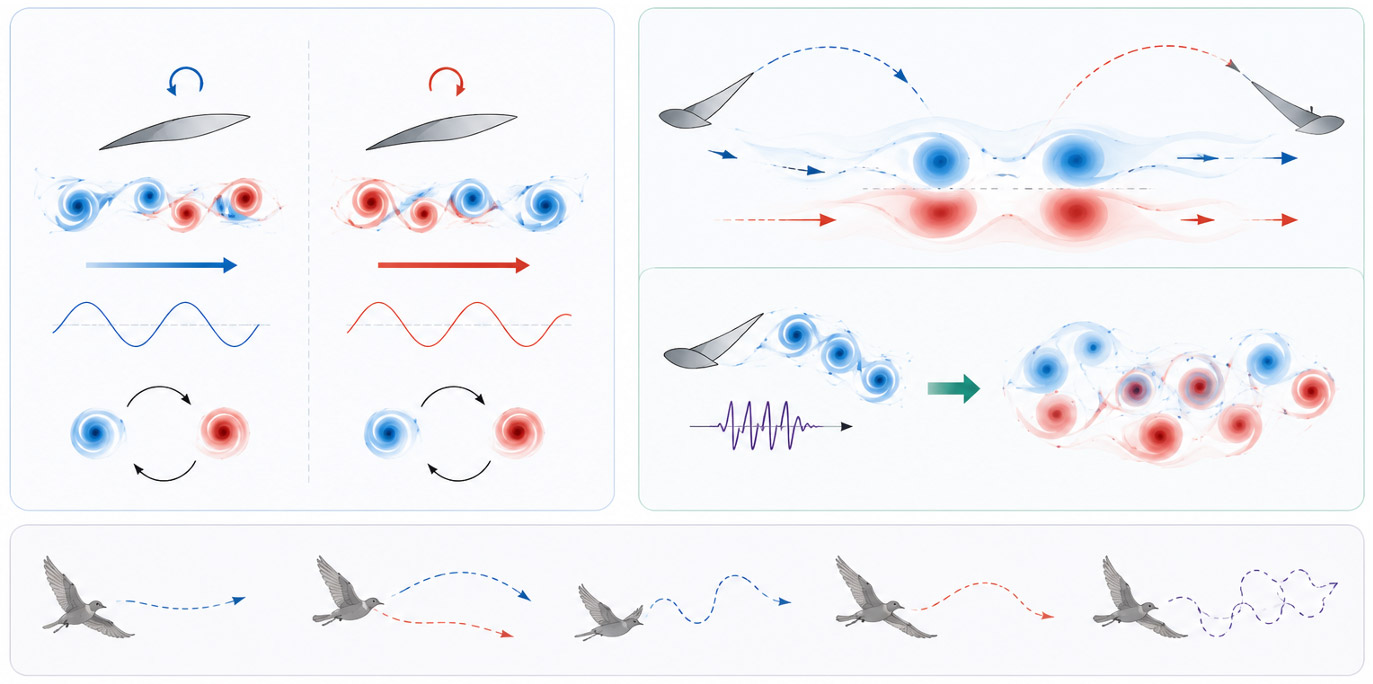
Flapping-wing flight has long inspired bio-inspired aerial robots because of its extraordinary aerodynamic efficiency and maneuverability. Although substantial progress has been achieved in understanding unsteady aerodynamic mechanisms, most existing frameworks remain centered on idealized periodic wing motions and cycle-averaged propulsion. Recent studies increasingly suggest that transient asymmetries and multi-frequency perturbations, traditionally regarded as disturbances, can actively reorganize vortex dynamics and enhance aerodynamic performance. These findings imply that biological flight may rely not solely on stable periodic propulsion, but on continuous adaptation to evolving flow... More >
Graphical Abstract