Journal of Reliable and Secure Computing | Volume 2, Issue 3: 194-211, 2026 | DOI: 10.62762/JRSC.2026.225854
Abstract
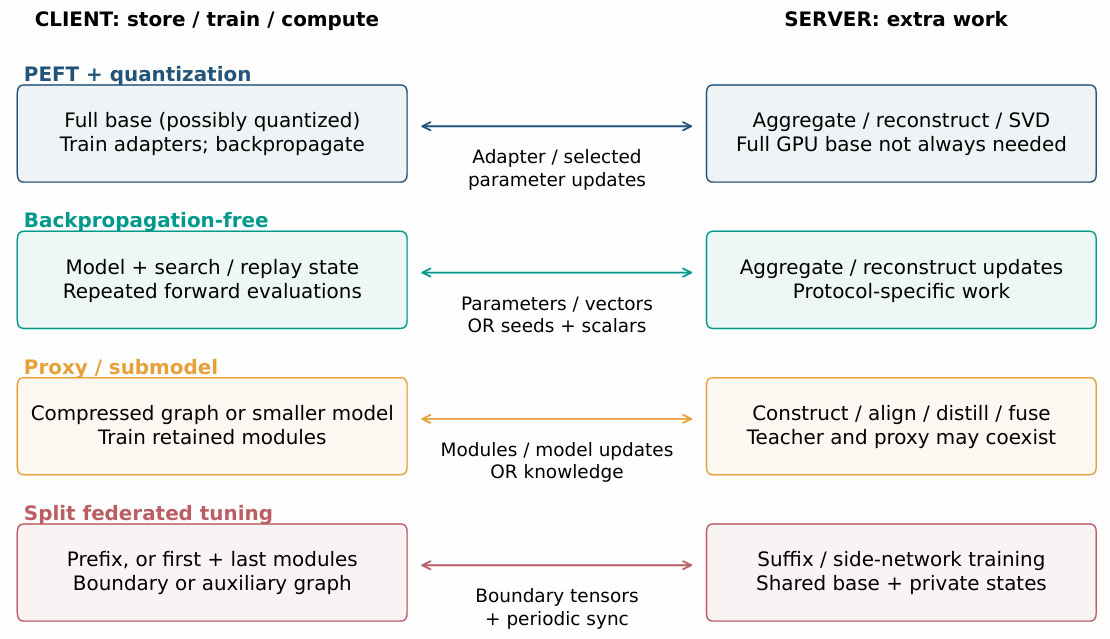
Federated fine-tuning adapts language models to distributed data and is widely adopted as a privacy-preserving alternative to centralized training, yet constrained clients must still store model weights and training states, execute updates, and communicate with a server. This review examines four composable routes---parameter-efficient and quantized adaptation, backpropagation-free adaptation, proxy or submodel adaptation, and split federated adaptation---through a common framework that traces the objects each endpoint retains, exchanges, and discloses. When a client retains the complete base, reducing adapter state leaves a base-storage floor; boundary communication depends on input dimensi... More >
Graphical Abstract