

A Study on the Relationship Between Parenting Styles, Subjective Well-Being, and Explanatory Styles Among College Students


Article Information
Abstract
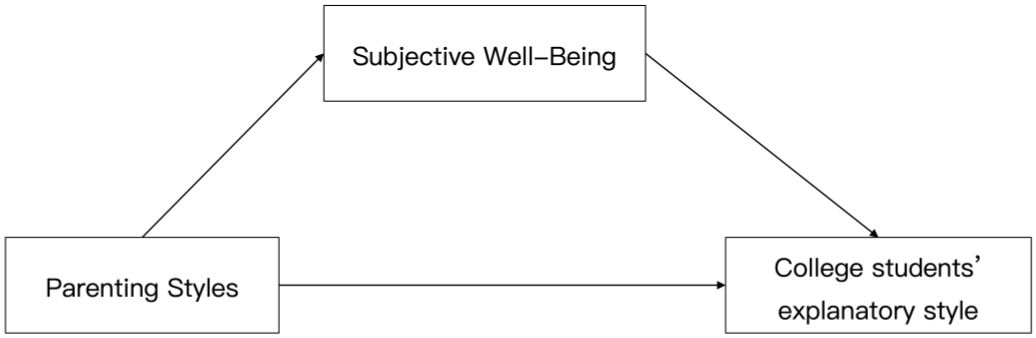
This study aims to explore the influence of parental parenting styles on college students' explanatory styles and to examine the mediating role of subjective well-being in this relationship. Using convenience sampling, 303 valid questionnaires were collected from undergraduate students. Data were analyzed using SPSS 27.0 Chinese Edition, employing independent samples t-tests, one-way ANOVA, simple effect analyses, correlation analyses, and regression analyses, while the mediating effect was tested using the product coefficient method with Bootstrap sampling via the PROCESS plugin. Results indicated that: (1) certain dimensions of parental parenting styles showed differences by gender and only-child status, with no significant grade differences; (2) only-child status and grade had distinct impacts on subjective well-being and explanatory styles, and certain dimensions of parenting styles were correlated with subjective well-being; and (3) parental parenting styles directly predicted college students' explanatory styles, with subjective well-being playing a partial mediating role. The study concludes that parenting styles influence students' explanatory styles—specifically, emotionally warm parenting positively affects explanatory styles, while rejecting and overprotective parenting negatively impact them. Significant positive correlations exist among parenting styles, subjective well-being, and explanatory styles. Furthermore, subjective well-being mediates the influence of parenting styles on explanatory styles: individuals experiencing rejecting parenting styles tend to report lower subjective well-being, which in turn leads to more negative explanatory styles.
Graphical Abstract
Keywords
Data Availability Statement
Funding
Conflicts of Interest
AI Use Statement
Ethical Approval and Consent to Participate
References
- Baldwin, D. R., McIntyre, A., & Hardaway, E. (2007). Perceived parenting styles on college students' optimism. College Student Journal, 41(3), 550--557. Available at: https://eric.ed.gov/?id=EJ777966
[Google Scholar] - Tiggemann, M., Winefield, H. R., Goldney, R. D., & Winefield, A. H. (1992). Attributional style and parental rearing as predictors of psychological distress. Personality and Individual Differences, 13(7), 835--841.
[CrossRef] [Google Scholar] - Maier, S. F., & Seligman, M. E. P. (1976). Learned helplessness: Theory and evidence. Journal of Experimental Psychology: General, 105(1), 3--46.
[CrossRef] [Google Scholar] - Stavrulaki, E., Li, M., & Gupta, J. (2021). Perceived parenting styles, academic achievement, and life satisfaction of college students: the mediating role of motivation orientation. European Journal of Psychology of Education, 36(3), 693--717.
[CrossRef] [Google Scholar] - Hu, J., Ji, T. S., & Feng, F. L. (2002). A correlational study between parental rearing patterns and general well-being of college students. Chinese Journal of Health Psychology, 10(1), 16--17.
[CrossRef] [Google Scholar] - Zhang, J., Miao, D., Sun, Y., Xiao, R., Ren, L., Xiao, W., & Peng, J. (2014). The impacts of attributional styles and dispositional optimism on subject well-being: A structural equation modelling analysis. Social Indicators Research, 119(2), 757--769.
[CrossRef] [Google Scholar] - Abramson, L. Y., Metalsky, G. I., & Alloy, L. B. (1989). Hopelessness depression: A theory-based subtype of depression. Psychological Review, 96(2), 358--372.
[CrossRef] [Google Scholar] - Seligman, M. E., & Schulman, P. (1986). Explanatory style as a predictor of productivity and quitting among life insurance sales agents. Journal of Personality and Social Psychology, 50(4), 832--838. https://psycnet.apa.org/doi/10.1037/0022-3514.50.4.832
[Google Scholar] - Li, X. G., Dong, S. H., & Wu, P. (2022). Revision of the Chinese version of the Attributional Style Questionnaire for college students. Chinese Journal of Clinical Psychology, 30(6), 1334--1338.
[CrossRef] [Google Scholar] - Diener, E. (1984). Subjective well-being. Psychological Bulletin, 95(3), 542-575.
[CrossRef] [Google Scholar] - Hu, Y., Zeng, Z., Peng, L., & Yang, Q. (2023). The effect of parenting styles on depressive symptoms among Chinese college students: The role of subjective well-being and Taq1A polymorphism. Current Psychology, 42(23), 19573--19583.
[CrossRef] [Google Scholar] - Cheng, H., & Furnham, A. (2001). Attributional style and personality as predictors of happiness and mental health. Journal of Happiness Studies, 2(3), 307--327.
[CrossRef] [Google Scholar] - Fazio, A. F. (1977). A concurrent validational study of the NCHS General Well-Being Schedule (Vital and Health Statistics, Series 2, No. 73; DHEW Publication No. (HRA) 78-1347). Hyattsville, MD: National Center for Health Statistics. Available at: https://stacks.cdc.gov/view/cdc/13079/cdc_13079_DS1.pdf
[Google Scholar] - Cheng, H., & Furnham, A. (2004). Perceived parental rearing style, self-esteem and self-criticism as predictors of happiness. Journal of Happiness Studies, 5(1), 1--21.
[CrossRef] [Google Scholar] - Beck, A. T. (1976). Cognitive therapy and the emotional disorders. New York: International Universities Press. https://archive.org/details/cognitivetherapy0000beck_e3y7
[Google Scholar] - Ryan, R. M., & Deci, E. L. (2000). Self-determination theory and the facilitation of intrinsic motivation, social development, and well-being. American Psychologist, 55(1), 68--78. https://psycnet.apa.org/doi/10.1037/0003-066X.55.1.68
[Google Scholar] - Bandura, A. (1986). Social foundations of thought and action: A social cognitive theory. Englewood Cliffs, NJ: Prentice-Hall. https://archive.org/details/socialfoundation0000band/page/n17/mode/2up
[Google Scholar]
Cite This Article
TY  - JOUR
AU  - Du, Xintian
AU  - Duan, Yani
PY  - 2026
DA  - 2026/08/15
TI  - A Study on the Relationship Between Parenting Styles, Subjective Well-Being, and Explanatory Styles Among College Students
JO  - Journal of Digital Intelligence in Education
T2  - Journal of Digital Intelligence in Education
JF  - Journal of Digital Intelligence in Education
VL  - 1
IS  - 1
SP  - 42
EP  - 57
DO  - 10.62762/JDIE.2025.159515
UR  - https://www.icck.org/article/abs/JDIE.2025.159515
KW  - parenting styles
KW  - subjective well-being
KW  - explanatory style
KW  - college students
AB  - This study aims to explore the influence of parental parenting styles on college students' explanatory styles and to examine the mediating role of subjective well-being in this relationship. Using convenience sampling, 303 valid questionnaires were collected from undergraduate students. Data were analyzed using SPSS 27.0 Chinese Edition, employing independent samples t-tests, one-way ANOVA, simple effect analyses, correlation analyses, and regression analyses, while the mediating effect was tested using the product coefficient method with Bootstrap sampling via the PROCESS plugin. Results indicated that: (1) certain dimensions of parental parenting styles showed differences by gender and only-child status, with no significant grade differences; (2) only-child status and grade had distinct impacts on subjective well-being and explanatory styles, and certain dimensions of parenting styles were correlated with subjective well-being; and (3) parental parenting styles directly predicted college students' explanatory styles, with subjective well-being playing a partial mediating role. The study concludes that parenting styles influence students' explanatory styles—specifically, emotionally warm parenting positively affects explanatory styles, while rejecting and overprotective parenting negatively impact them. Significant positive correlations exist among parenting styles, subjective well-being, and explanatory styles. Furthermore, subjective well-being mediates the influence of parenting styles on explanatory styles: individuals experiencing rejecting parenting styles tend to report lower subjective well-being, which in turn leads to more negative explanatory styles.
SN  - pending
PB  - Institute of Central Computation and Knowledge
LA  - English
ER  -
@article{Du2026A,
  author = {Xintian Du and Yani Duan},
  title = {A Study on the Relationship Between Parenting Styles, Subjective Well-Being, and Explanatory Styles Among College Students},
  journal = {Journal of Digital Intelligence in Education},
  year = {2026},
  volume = {1},
  number = {1},
  pages = {42-57},
  doi = {10.62762/JDIE.2025.159515},
  url = {https://www.icck.org/article/abs/JDIE.2025.159515},
  abstract = {This study aims to explore the influence of parental parenting styles on college students' explanatory styles and to examine the mediating role of subjective well-being in this relationship. Using convenience sampling, 303 valid questionnaires were collected from undergraduate students. Data were analyzed using SPSS 27.0 Chinese Edition, employing independent samples t-tests, one-way ANOVA, simple effect analyses, correlation analyses, and regression analyses, while the mediating effect was tested using the product coefficient method with Bootstrap sampling via the PROCESS plugin. Results indicated that: (1) certain dimensions of parental parenting styles showed differences by gender and only-child status, with no significant grade differences; (2) only-child status and grade had distinct impacts on subjective well-being and explanatory styles, and certain dimensions of parenting styles were correlated with subjective well-being; and (3) parental parenting styles directly predicted college students' explanatory styles, with subjective well-being playing a partial mediating role. The study concludes that parenting styles influence students' explanatory styles—specifically, emotionally warm parenting positively affects explanatory styles, while rejecting and overprotective parenting negatively impact them. Significant positive correlations exist among parenting styles, subjective well-being, and explanatory styles. Furthermore, subjective well-being mediates the influence of parenting styles on explanatory styles: individuals experiencing rejecting parenting styles tend to report lower subjective well-being, which in turn leads to more negative explanatory styles.},
  keywords = {parenting styles, subjective well-being, explanatory style, college students},
  issn = {pending},
  publisher = {Institute of Central Computation and Knowledge}
}
Article Metrics
Publisher's Note
ICCK stays neutral with regard to jurisdictional claims in published maps and institutional affiliations.
Rights and Permissions
 Copyright © 2026 by the Author(s). Published by Institute of Central Computation and Knowledge. This article is an open access article distributed under the terms and conditions of the Creative Commons Attribution (CC BY) license (https://creativecommons.org/licenses/by/4.0/), which permits use, sharing, adaptation, distribution and reproduction in any medium or format, as long as you give appropriate credit to the original author(s) and the source, provide a link to the Creative Commons licence, and indicate if changes were made.


Portico
